Reduced continuity index with proactive esophageal cooling compared to luminal temperature monitoring during radiofrequency ablation
Catherine Lazarus, Jacob Sherman, Natalie Putzel, Cameron Randolph, William Zagrodzky, Tiffany Sharkoski, Alex Ro, Jose Nazari, Westby Fisher, Erik Kulstad, Mark D. Metzl

TL;DR
Proactive esophageal cooling during heart ablation improves lesion continuity compared to temperature monitoring, possibly explaining better long-term outcomes.
Contribution
Demonstrates improved lesion contiguity with proactive cooling during ablation, offering a potential mechanism for better arrhythmia outcomes.
Findings
Proactive cooling resulted in a significantly lower continuity index (10.6) compared to temperature monitoring (37.0).
The left and right pulmonary veins showed reduced continuity indices with proactive cooling (5.6 and 4.9, respectively).
Abstract
Proactive esophageal cooling is Food and Drug Administration (FDA) cleared to reduce the likelihood of esophageal injury during radiofrequency ablation for treatment of atrial fibrillation (AF). Long-term follow-up data have also shown improved freedom from arrhythmia with proactive esophageal cooling compared with luminal esophageal temperature (LET) monitoring during pulmonary vein isolation (PVI). One hypothesized mechanism is improved lesion contiguity (as measured by the continuity index) with the use of cooling. We aimed to compare the continuity index of PVI cases using proactive esophageal cooling with those using LET monitoring. We calculated the continuity index for PVI cases at 2 different hospitals within the same health system, using a slightly modified continuity index to facilitate retrospective determination from review of recorded cases. The results were then compared…
Genes, proteins, chemicals, diseases, species, mutations and cell lines named across the full text — each resolved to its canonical identifier and authoritative record.
Click any figure to enlarge with its caption.
 Figure 1
 Figure 2
 Figure 3
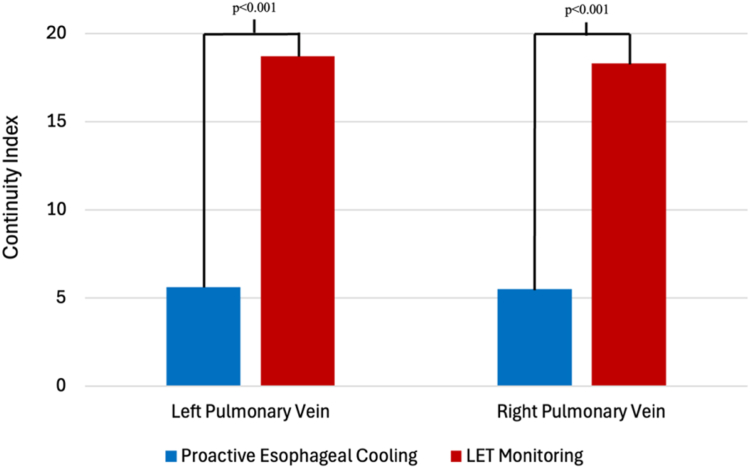 Figure 4
Peer Reviews
No public reviews on file for this paper yet. If you reviewed it on a platform where reviews are public (OpenReview, ICLR, NeurIPS, ICML), you can paste yours below so the community can read it here.
Videos
No videos yet. Explain this paper in a talk, walkthrough, or lecture? Add one.
Taxonomy
TopicsAtrial Fibrillation Management and Outcomes · Cardiac Arrhythmias and Treatments · Respiratory Support and Mechanisms