Latent class profile model with time-dependent covariates: a study on symptom patterning of patients for head and neck cancer
Jung Wun Lee, Hayley Dunnack Yackel

TL;DR
This paper introduces a new statistical model to identify symptom patterns in head and neck cancer patients, incorporating time-dependent factors.
Contribution
The novel contribution is extending the latent class profile model to include time-specific structures and time-dependent covariates.
Findings
The proposed model allows for simultaneous estimation of latent class parameters using the EM algorithm.
Numerical studies validate the model's effectiveness in capturing associations between symptom patterns and covariates.
Application to head and neck cancer data demonstrates the model's practical utility.
Abstract
The latent class profile model (LCPM) is a widely used technique for identifying distinct subgroups within a sample based on observations' longitudinal responses to categorical items. This paper proposes an expanded version of LCPM by embedding time-specific structures. Such development allows analysts to investigate associations between latent class memberships and time-dependent predictors at specific time points. We suggest a simultaneous estimation of latent class measurement parameters via the expectation-maximization (EM) algorithm, which yields valid point and interval estimators of associations between latent class memberships and covariates. We illustrate the validity of our estimation strategy via numerical studies. In addition, we demonstrate the novelty of the proposed model by analyzing the head and neck cancer data set.
Genes, proteins, chemicals, diseases, species, mutations and cell lines named across the full text — each resolved to its canonical identifier and authoritative record.
Click any figure to enlarge with its caption.
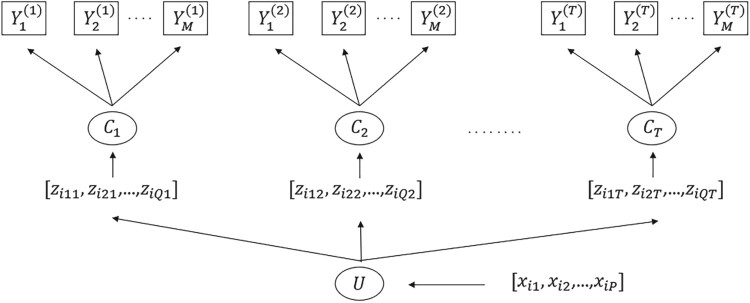 Figure 1
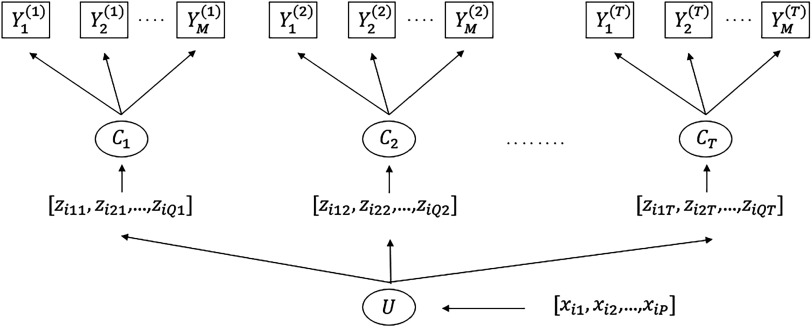 Figure 2
 Figure 3
 Figure 4
 Figure 5
 Figure 6
 Figure 7
 Figure 8
 Figure 9
 Figure 10
 Figure 11
 Figure 12
 Figure 13
 Figure 14
 Figure 15
 Figure 16
 Figure 17
 Figure 18
 Figure 19
 Figure 20
 Figure 21
 Figure 22
 Figure 23
 Figure 24
 Figure 25
 Figure 26
 Figure 27
 Figure 28
 Figure 29
 Figure 30
 Figure 31
 Figure 32
 Figure 33
 Figure 34
 Figure 35
 Figure 36
 Figure 37
 Figure 38
 Figure 39
 Figure 40
 Figure 41
 Figure 42
 Figure 43
 Figure 44
 Figure 45
 Figure 46
 Figure 47
 Figure 48
 Figure 49
 Figure 50
Peer Reviews
No public reviews on file for this paper yet. If you reviewed it on a platform where reviews are public (OpenReview, ICLR, NeurIPS, ICML), you can paste yours below so the community can read it here.
Videos
No videos yet. Explain this paper in a talk, walkthrough, or lecture? Add one.
Taxonomy
TopicsBayesian Methods and Mixture Models · Statistical Methods and Bayesian Inference · Statistical Methods and Inference