Hospitalization and Credit Scores Among Medicaid Beneficiaries in Louisiana
Brigham Walker, Gael Compta, Alexander Siebert, Andrew Anderson, Kevin Callison, Chima D. Ndumele, Jacob Wallace

TL;DR
This study examines how hospitalization affects the credit scores of Medicaid beneficiaries in Louisiana, considering factors like sex, race, and ethnicity.
Contribution
The study provides new insights into the relationship between hospitalization and credit scores among Medicaid beneficiaries in Louisiana.
Findings
Hospitalization was found to impact credit scores among Medicaid beneficiaries.
The effects of hospitalization on credit scores varied by sex, race, and ethnicity.
Abstract
This case-control study evaluates the impact of a hospitalization on credit scores for Medicaid beneficiaries in Louisiana stratified by sex, race, and ethnicity.
Genes, proteins, chemicals, diseases, species, mutations and cell lines named across the full text — each resolved to its canonical identifier and authoritative record.
Click any figure to enlarge with its caption.
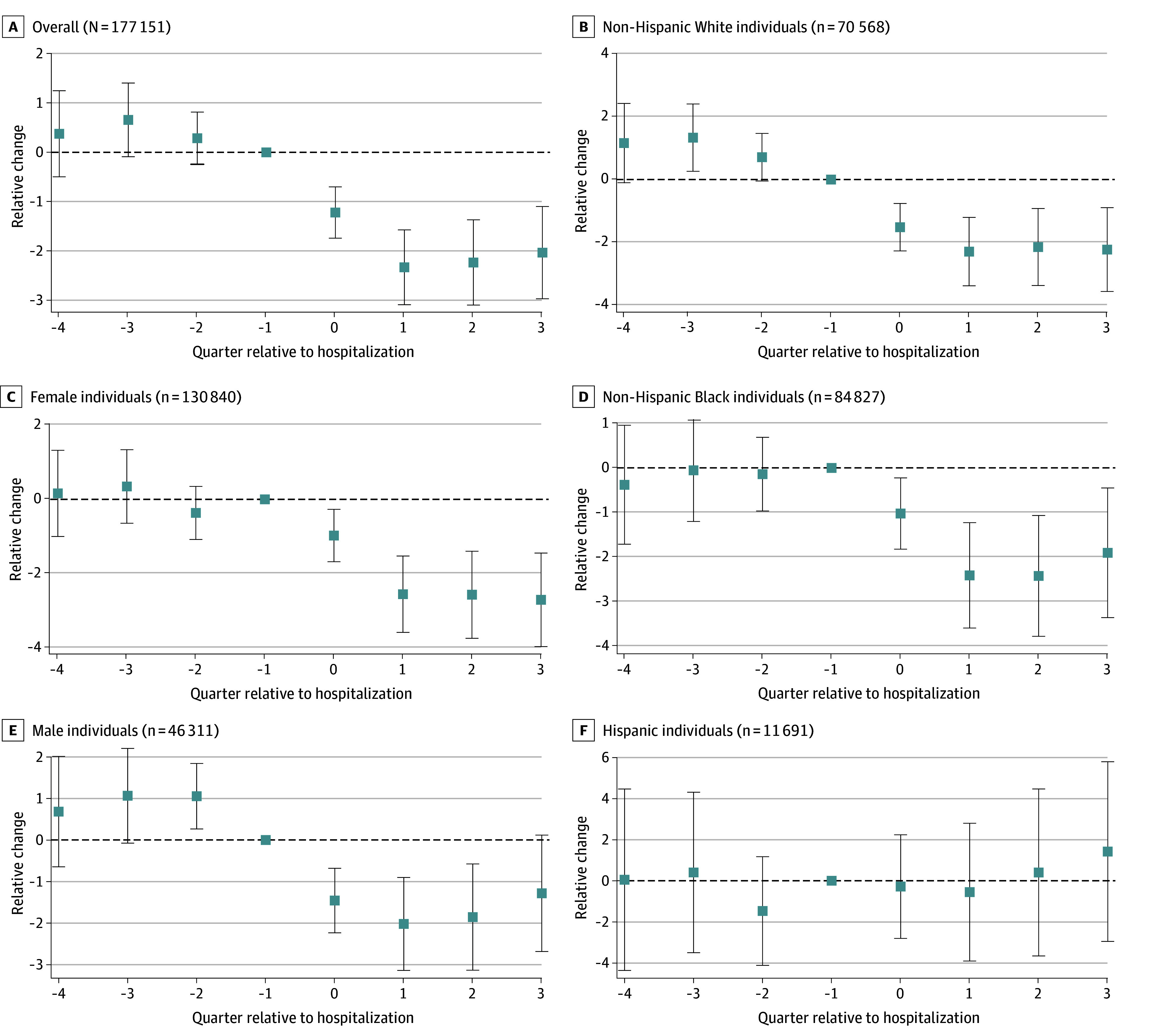 Figure 1
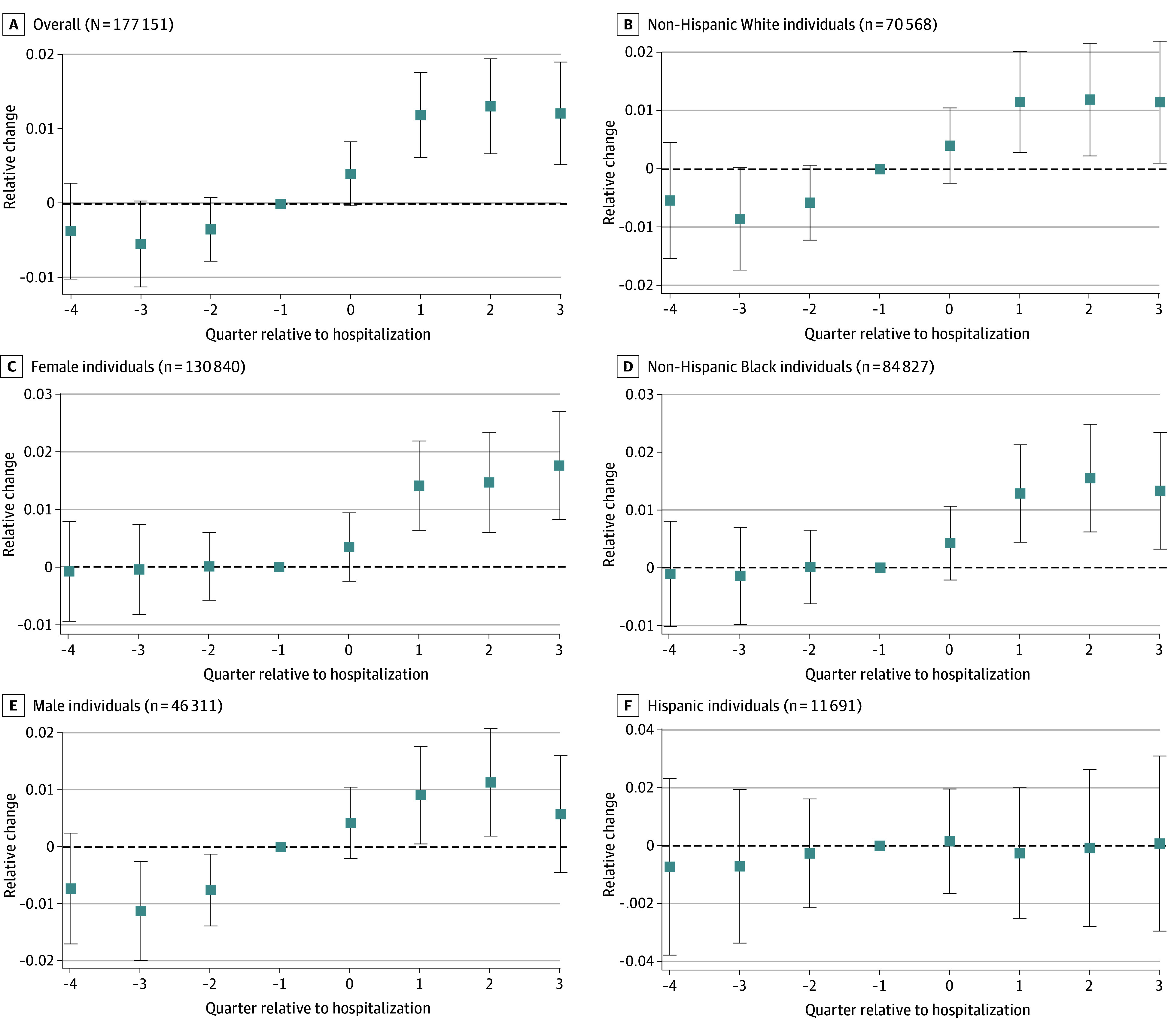 Figure 2
Peer Reviews
No public reviews on file for this paper yet. If you reviewed it on a platform where reviews are public (OpenReview, ICLR, NeurIPS, ICML), you can paste yours below so the community can read it here.
Videos
No videos yet. Explain this paper in a talk, walkthrough, or lecture? Add one.
Taxonomy
TopicsHealthcare Policy and Management · Primary Care and Health Outcomes · Global Health Care Issues
Introduction
Hospitalizations can impose financial hardships on families,^1,2^ contributing to lower credit scores^3^ and reducing access to credit.^1^ Non-Hispanic Black and Hispanic patients may struggle more with hospitalization costs due to lower wealth compared with non-Hispanic White patients.^4^
We evaluated the impact of a hospitalization on credit scores for Medicaid beneficiaries in Louisiana, examining effects by sex, race, and ethnicity. Louisiana is a setting well-suited for this research given that it is a Medicaid expansion state, has relatively high levels of personal debt (which inform credit scores), and has a relatively diverse population.
Methods
Health care claims data from the Louisiana Medicaid program were used to identify beneficiaries with any nonpregnancy-related hospitalization in 2018. This time period avoids potentially confounding effects due to the 2016 Medicaid expansion and the COVID-19 pandemic in 2020. The comparison group includes Medicaid beneficiaries who were not hospitalized or pregnant, to whom we randomly assigned a “pseudohospitalization” date in 2018 allowing for a contemporaneous comparison.
Beneficiaries in both groups were continuously enrolled for 12 months before and after their respective hospitalization month. The claims data were then linked to anonymized credit report data from one of the national consumer credit reporting bureaus. The key outcome variables were credit score (a continuous variable) and the probability of having a poor credit score (below 580). Data were aggregated to the year-quarter level. The Louisiana Department of Health and Tulane University institutional review boards approved this study and waived informed consent. This study followed the Strengthening the Reporting of Observational Studies in Epidemiology (STROBE) reporting guidelines.
Statistical Analysis
We used a difference-in-differences model where the estimates varied over time relative to the shock date. This allowed us to evaluate (1) whether the 2 groups trended similarly in the preperiod and (2) the potential timing of the hospitalization effects. Baseline observed characteristics between treatment and control groups were balanced using a maximum entropy reweighting scheme to align means and variances.^5,6^ Finally, to evaluate potential heterogeneous effects, we stratified analyses separately for Hispanic, non-Hispanic Black, and non-Hispanic White populations; and for male individuals and female individuals. The analysis took place between 2024 and 2025.
Results
Relative reductions in credit scores were apparent within the first quarter following hospitalization and were largely sustained for all groups (Figure 1A-E) except for Hispanic beneficiaries (Figure 1). These reductions leveled off in the second quarter following a hospitalization in which beneficiaries overall saw an average decrease of just over 2 points. Parallel trends generally held for all groups except non-Hispanic White and male beneficiaries (Figure 1).
Association of Hospitalization With Credit ScoreEach individual had 8 observations. Hospitalizations occurred in 2018. For perspective, approximately 2% had a myocardial infarction and approximately 1% had a stroke. Quarter 0 is the quarter in which the hospitalization occurred (and it occurred in the first month of that quarter). Credit score values are monthly average values within that quarter. The boxes indicate point estimates and the whiskers indicate the 95% CIs.
Similarly, all groups except for Hispanic beneficiaries saw increases in the probability of having poor credit, which peaked in the third quarter following a hospitalization at just over 1 percentage point (Figure 2A).
Association of Hospitalization With the Probability of Having Bad Credit (<580)Each individual had 8 observations. Hospitalizations occurred in 2018. For perspective, approximately 2% had a myocardial infarction and approximately 1% had a stroke. Quarter 0 is the quarter in which the hospitalization occurred (and it occurred in the first month of that quarter). The boxes indicate point estimates and the whiskers indicate the 95% CIs.
Discussion
These results suggest that, despite facing no cost-sharing, Medicaid beneficiaries who were hospitalized faced modest negative consequences to their credit scores and may require more financial support to cope with a hospitalization. The source of these credit effects requires more study, but could be due to disruptions in employment. Given that baseline credit scores were close to the threshold between poor and fair, these negative consequences translate to small—but potentially consequential—increases in the probability of having poor credit.
Although there are several limitations to this case-control study, such as the single-state setting that may not generalize nationally, instances of nonparallel pretrends for non-Hispanic White and male beneficiaries, a focus on Medicaid beneficiaries only, and possibly underestimated effects because the first period after hospitalization likely includes some days prior to hospitalization, the results consistently showed worsening credit measures across sex and heterogeneous effects between Hispanic and non-Hispanic groups following a hospitalization.
The reference list from the paper itself. Each links out to its DOI / PubMed record.
- 1Dobkin C, Finkelstein A, Kluender R, Notowidigdo MJ. The economic consequences of hospital admissions. Am Econ Rev. 2018;108(2):308-352. doi:10.1257/aer.2016103830091560 · doi ↗ · pubmed ↗
- 2Han X, Zhao J, Zheng Z, de Moor JS, Virgo KS, Yabroff KR. Medical financial hardship intensity and financial sacrifice associated with cancer in the United States. Cancer Epidemiol Biomarkers Prev. 2020;29(2):308-317. doi:10.1158/1055-9965.EPI-19-046031941708 PMC 7007367 · doi ↗ · pubmed ↗
- 3Hussaini SMQ, Gupta A, Dusetzina SB. Financial toxicity of cancer treatment. JAMA Oncol. 2022;8(5):788. doi:10.1001/jamaoncol.2021.798735266966 · doi ↗ · pubmed ↗
- 4Kent AH, Ricketts L. Wealth gaps between White, Black and Hispanic families in 2019. Federal Reserve Bank of St. Louis On the Economy Blog. Published March 1, 2021. Accessed January 2025. https://aspa.cbehs.com/applinks/Wealth%20Gaps%20between%20White,%20Black%20and%20Hispanic%20Families%20in%202019_%20St%20Louis%20Fed.pdf
- 5Hainmueller J, Xu Y. Ebalance: a Stata package for entropy balancing. J Stat Softw. 2013;54(7). doi:10.18637/jss.v 054.i 07 · doi ↗
- 6Hainmueller J. Entropy balancing for causal effects: A multivariate reweighting method to produce balanced samples in observational studies. Polit Anal. 2012;20(1):25-46. doi:10.1093/pan/mpr 025 · doi ↗