Protective role of pinocembrin in a rat model of intestinal ischemia-reperfusion injury
Osman Bardakçı, Hakim Çelik, İlyas Özardalı, Ali Uzunköy

TL;DR
Pinocembrin reduces intestinal damage in rats caused by ischemia-reperfusion injury by lowering oxidative stress and improving tissue health.
Contribution
This study demonstrates for the first time that pinocembrin protects against intestinal ischemia-reperfusion injury in a rat model.
Findings
Pinocembrin significantly reduced total oxidant status and oxidative stress index in both plasma and intestinal tissue.
Histopathological analysis showed reduced mucosal damage in the pinocembrin-treated group.
Pinocembrin preserved tissue architecture and alleviated oxidative stress in intestinal ischemia-reperfusion injury.
Abstract
To determine whether pinocembrin (PC) confers protective effects against experimentally induced intestinal ischemia-reperfusion (I/R) injury in rats. Thirty Wistar albino rats were randomly divided into three groups (n = 10 each): sham (underwent laparotomy only); I/R (superior mesenteric artery occlusion for 60 min followed by 60 min reperfusion); and I/R + PC (5 mg/kg PC intraperitoneally before ischemia and again prior to reperfusion). Total antioxidant capacity (TAC), total oxidant status (TOS), and oxidative stress index (OSI) were measured in both plasma and intestinal tissue. Histopathological evaluation was performed using hematoxylin and eosin staining and a modified Chiu scoring system. Although TAC values did not show significant intergroup differences (p > 0.05), TOS and OSI values were significantly lower in the I/R + PC group than in the I/R group (p < 0.05).…
Genes, proteins, chemicals, diseases, species, mutations and cell lines named across the full text — each resolved to its canonical identifier and authoritative record.
Click any figure to enlarge with its caption.
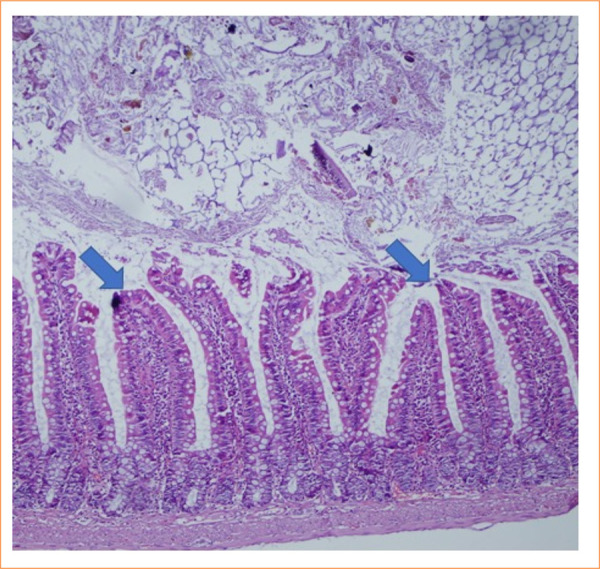 Figure 1
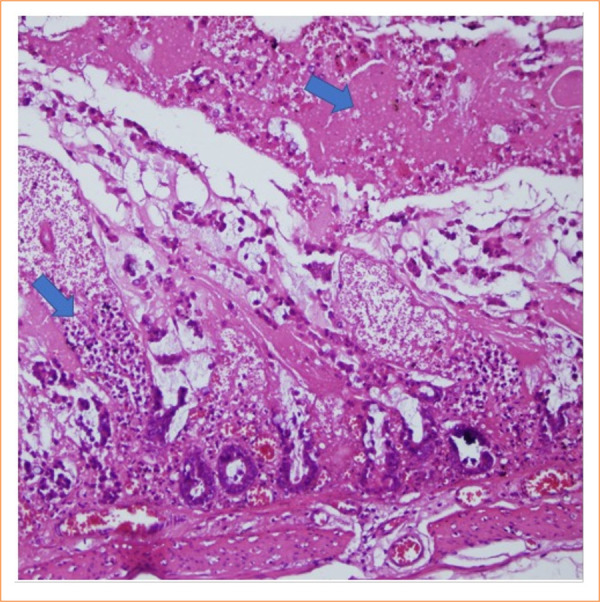 Figure 2
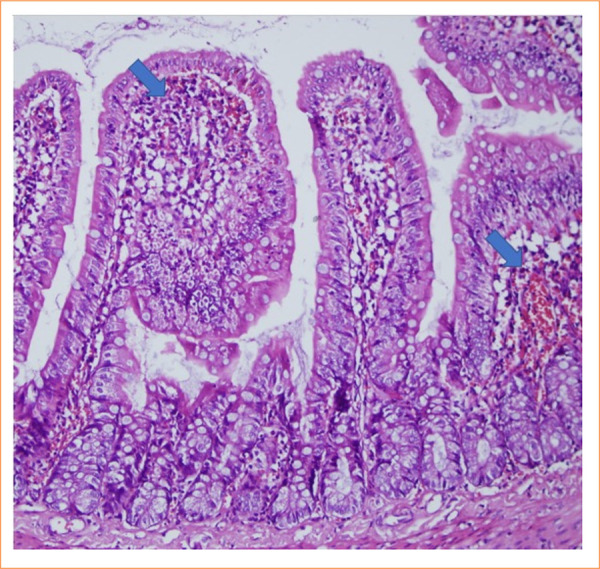 Figure 3
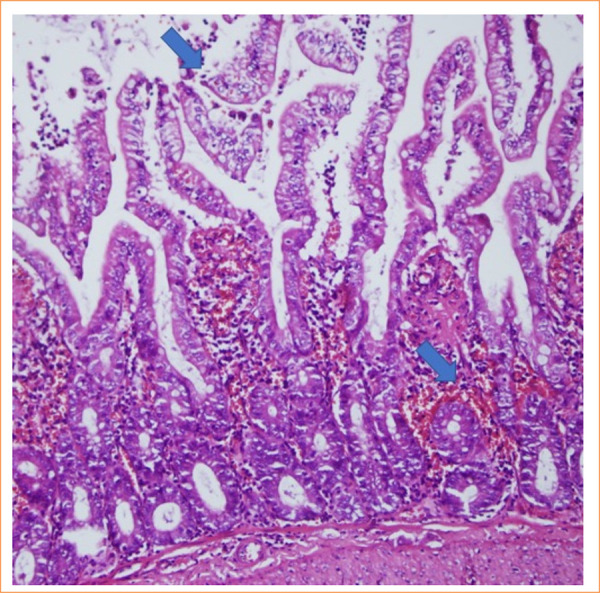 Figure 4
| Score | Histopathologic finding |
|---|---|
| 0 | Normal mucosal villi |
| 1 | Development of a subepithelial space, usually at the tip of the villus, with capillary congestion |
| 2 | Extension of the subepithelial space with the moderate lifting of the epithelial layer |
| 3 | Massive epithelial lifting down the sides of villi |
| 4 | Denuded villi with lamina propria, dilated capillaries exposed, increased cellularity of the lamina propria |
| 5 | Digestion and disintegration of the lamina propria, hemorrhage and ulceration |
| Sham | IR | IR + PC |
| |
|---|---|---|---|---|
| Serum TAC (mmol Trolox equivalent/L | 0.95 ± 0.17 | 0.93 ± 0.11 | 1.05 ± 0.25 | > 0.05 |
| Serum TOS (µmol H2O2 equivalent/L) | 46.9 ± 16.7 | 80.8 ± 13.5 | 62.5 ± 18.9 | < 0.05 |
| Serum OSI | 5 ± 1.7 | 8.8 ± 1.6 | 6.1 ± 2 | < 0.05 |
| Tissue TAC (mmol Trolox equivalent/L) | 0,15 ± 0,06 | 0.15 ± 0.05 | 0.17 ± 0.04 | > 0.05 |
| Tissue TOS (mmol Trolox equivalent/L) | 5.33 ± 1.35 | 10.03 ± 2 | 6.04 ± 2 | < 0.05 |
| Tissue OSI | 4.03 ± 2.06 | 6,99 ± 2.23 | 3.97 ± 2.77 | < 0.05 |
| Mean ± SD |
| |
|---|---|---|
| Sham | 0 ± 0.00 |
|
| IR group | 2,6 ± 1,56 | 0.009 |
| PC Group | 1 ± 1.05 | 0.15 |
Peer Reviews
No public reviews on file for this paper yet. If you reviewed it on a platform where reviews are public (OpenReview, ICLR, NeurIPS, ICML), you can paste yours below so the community can read it here.
Videos
No videos yet. Explain this paper in a talk, walkthrough, or lecture? Add one.
Taxonomy
TopicsCardiac Ischemia and Reperfusion · Anesthesia and Neurotoxicity Research · Heme Oxygenase-1 and Carbon Monoxide
Introduction
Intestinal ischemia-reperfusion (I/R) injury is a severe clinical problem encountered in conditions such as acute mesenteric ischemia, strangulated herni certain shock states and during intestinal transplantation1 ^,^ 2. During ischemia, depletion of adenosine triphosphate (ATP) and the accumulation of reactive oxygen species (ROS) precursors occur3 ^,^ 4. Upon reperfusion, the reintroduction of oxygen paradoxically exacerbates injury by increasing oxidative stress, eliciting strong inflammatory responses, and leading to cell death5. Consequently, I/R may disrupt the mucosal barrier, leading to bacterial (endotoxin) translocation and sepsis6 ^–^ 8.
Research on the pathophysiologic mechanisms of intestinal I/R and its resolution is mainly carried out in animal models. Pinocembrin (5,7-dihydroxyflavanone) (PC), a major flavonoid in propolis, possesses antioxidant, anti-inflammatory, antimicrobial, antiapoptotic, and vasorelaxant properties9 ^,^ 10. Many experimental studies have highlighted PC’s beneficial effects in various disease models, including colitis11 ^,^ 12 and cerebral ischemic injury13.
Despite growing interest, data on its direct role in preventing or mitigating intestinal I/R-induced injury remain limited. Nonetheless, several studies on ulcerative colitis and other inflammatory bowel disease models have demonstrated the potential of PC in preserving mucosal integrity, reducing cytokine production, and modulating gut microbiota14 ^,^ 15.
Given these findings, we hypothesized that PC might confer protection against the oxidative stress and inflammation inherent to intestinal I/R. The present study aimed to investigate whether PC administration attenuates morphological and biochemical markers of I/R-induced intestinal damage in rats.
Methods
Animals
The study was approved by the Harran University Animal Experiments Local Ethics Committee (approval no. 2010/05.07.00/270-40). Thirty male Wistar albino rats (180–240 g) were housed in temperature-controlled conditions (20–22°C), exposed to a 12-h light/dark cycle, and allowed free access to standard rat chow and water. Although the animals were routinely screened for common pathogens, they were not classified as fully specific pathogen-free (SPF).
Surgical procedures
Rats were randomized into three groups (n = 10 each):
Sham group: animals underwent midline laparotomy under sterile conditions, but no occlusion of the superior mesenteric artery (SMA) was performed;I/R group: after laparotomy, the SMA was clamped with a microvascular bulldog clamp for 60 min to induce ischemia. The clamp was then removed, allowing 60 min of reperfusion;I/R + PC group: identical I/R procedures were performed, and PC (5 mg/kg, intraperitoneally) was administered immediately prior to both ischemia and reperfusion.
All procedures were performed under ketamine (87 mg/kg, Ketalar, Pfizer, Turkey) and xylazine HCl (13 mg/kg) anesthesia. At the end of the reperfusion period, tissue samples from the small intestine were harvested for biochemical and histological analyses, and blood was collected by cardiac puncture for plasma assays.
No additional dose of anesthesia was required during the procedure. Intestinal tissues were placed in 10% formaldehyde solution and sent to the pathology laboratory. Paraffin sections were prepared, and 5-micron thick sections were obtained. After deparaffinization, these sections were stained with hematoxylin and eosin stain for histopathological examination. The blood samples obtained from the rats were sanrifuged, and the sera obtained were stored in the biochemistry laboratory at -80°C deep freezer for study. Tissue samples obtained from the same rats were also stored in -80°C deep freezer.
Biochemical analysis
Total antioxidant capacity and total oxidant level
Total antioxidant capacity (TAC) and total oxidant (TOS) levels were measured on a Beckman Coulter AU680 analyzer (Beckman Coulter, Miami, FL, United States of America) using commercial reagents (Rel Assay Diagnostic, Gaziantep, Turkey) based on new automated measurement methods developed by Erel16 ^,^ 17. TAC levels were expressed as mmol Trolox Eq/mg protein. TOS levels were expressed as μmol H2O2 Eq/mg protein16 ^,^ 17.
Oxidative stress index
When calculating the oxidative stress index (OSI) of the samples, TAC values are multiplied by 10, and units are equalized with TOS. TAC values were multiplied by 10 to match TOS units, and the oxidative stress index (OSI) was calculated as the ratio of TOS to TAC, expressed in arbitrary units (AU)17. Results were expressed in arbutrary units (AU).
Histopathological evaluation
Intestinal tissue samples fixed in 10% formalin were embedded in paraffin, sectioned at 5 µm, and stained with hematoxylin and eosin. All histopathological examinations were conducted by a blinded pathologist. The severity of ischemia-reperfusion injury was scored according to the Chiu system, which ranges from 0 (normal) to 5 (severe injury)18. Representative sections were photographed, and arrows/markers were used to highlight features such as epithelial lifting, hemorrhage, and edema (Table 1).
Statistical analysis
Data were analyzed using Statistical Package for the Social Sciences version 20 (IBM, Chicago, IL, United States of America). Normality was confirmed using the Shapiro-Wilk’s test. Parametric data were expressed as mean ± standard deviation (SD). Group comparisons were made using independent samples t-tests, and multiple comparisons (sham, I/R, I/R + PC) for histologic scores employed the Bonferroni post-hoc test. P < 0.05 was considered statistically significant.
Results
Blood and tissue samples were biochemically analyzed. The results were evaluated statistically. Firstly, sham and control groups were compared to evaluate whether ischemia–reperfusion injury (IRI) occurred or not. The PC treatment group and control group were then compared.
No statistically significant result was found between the sham group and the IR group and between the IR group and the IR + PC group in terms of TAC values in plasma and tissue (p > 0.05). In terms of TOS and OSI values, there was a statistically significant decrease between sham group and IR group and between IR group and IR + PC group (p < 0.05, p < 0.05) (Table 2).
The intestinal mucosa of rats in the sham group was observed to be pathologically normal (Fig. 1). In the control group, extensive lamina propria disintegration, ulceration, and hemorrhage were observed pathologically (Fig. 2). As shown by histological staging, ischemic damage was significantly reduced in the PC-treated groups. Pathological examination in the PC group showed capillary congestion, edema, and separation of the epithelial layer from the lamina propria in the villi (Figs. 3 and 4). Statistically significant difference was found between the sham group and the IR group (p < 0.001). A significant difference was found between the IR group and the PC group (p = 0.009), but no significant difference was found between the PC group and the sham group (p = 0.15). Histological staging results are presented in detail in Table 3.
Histological characteristics of normal ileal tissue were observed (score = 0) (hematoxylin and eosin 200x).
In the sample in the control group, disintegration, ulceration, and hemorrhage in the lamina propria were observed (score = 5) (hematoxylin and eosin 200x).
In the sample in the pinocembrin group, capillary congestion and edema were observed in the villi (score = 1) (hematoxylin and eosin 200x).
In the sample from the pinocembrin group, it was observed that the epithelial layer is separated from the lamina propria (score = 2) (hematoxylin and eosin 200x).
Discussion
In the present study, PC administration significantly reduced oxidative damage (TOS, OSI) and histological injury in a rat model of intestinal I/R. By contrast, TAC levels did not differ among the groups.
Intestinal I/R is the restoration of blood flow to the intestine following inadequate blood supply, which can occur in various clinical scenarios caused by diseases such as acute mesenteric embolism or thrombus, strangulated hernias, severe burns or traumatic or septic shock. Tissue hypoxia resulting from intestinal ischemia and disturbances in cellular energy metabolism due to nutrient deficiency can lead to a variety of pathophysiological mechanisms, including the formation of free oxygen radicals as a result of impaired mitochondrial function19 ^–^ 22. As a result of these changes, intracellular stress increases, resulting in cell death. After reperfusion is achieved, the ischemic area is re-circulated. This allows cells to regain access to oxygen and nutrients. However, this process can be also detrimental, as the reintroduction of blood to ischemic tissue during reperfusion can lead to reperfusion injury and eventually cell death23. Unfortunately, there is still no effective treatment for intestinal I/R injury, leading to a high mortality rate. According to statistics, 26% of patients do not live more than one year21.
PC has shown potent antioxidant properties through the induction of endogenous antioxidant capacity by various mechanisms24. In addition, it has anti-inflammatory activities shown in various disease models and different organs.
Studies with PC have shown that it inhibits the production of inflammatory cytokines, including tumor necrosis factor (TNF)-α, interleukin (IL)-1β and IL-6, and increases the level of anti-inflammatory IL-10 in activated macrophages25. In rats with ulcerative colitis, low doses of PC administered orally for one week decreased the expression of TNF-α, IL-1β, and IL-6 and increased the level of transforming growth factor (TGF)-β, which is essential for healing of the intestinal mucosa.
This study demonstrated a protective effect of PC against ulcerative colitis26. However, another study in rats using higher doses also demonstrated the therapeutic effect of PC and showed that its anti-inflammatory effects in ulcerative colitis are probably due to inhibition of the TLR4/NF-κB pathway15. PC also showed beneficial effects in neuroinflammation in different models13. In a rat ischemic stroke model, it inhibited the stimulation of microglia and astrocytes and decreased the expression of TNF-α, IL-1β, ıntercellular adhesion molecule (ICAM)-1, vascular cell adhesion molecule (VCAM)-1, inducible NO synthase (iNOS), and aquaporin-427. Although direct experimental data on PC’s impact in intestinal IR remain limited, its protective action in related gastrointestinal pathologies (e.g., colitis, sepsis-related gut injury) strongly supports our results.
In our study, we measured total oxidant and antioxidative capacities simultaneously to evaluate oxidative stress more accurately. We investigated both TAC and TOS using the measurement methods developed by Erel16 ^,^ 17. With OSI, we evaluated oxidative stress using both oxidative and antioxidative parameters. The determination of TAC is a very useful method in determining the protective capacity of the organism against free oxygen radicals. Similarly, TOS is used to determine the oxidative power of free radicals in the organism28. TOS measurement provides a sensitive measure of lipid peroxidation and oxidative stress. However, these markers have mostly been measured in serum. In our study, unlike other studies, we measured TAC, TOS, and OSI levels in both plasma and tissue. In our study, there was a decrease in TOS and OSI values at the tissue and level, possibly suggesting that PC chiefly mitigates oxidative burden rather than amplifying the global antioxidant capacity in this model. These data align with research indicating that PC exerts powerful anti-inflammatory and ROS-scavenging effects in various tissues11 ^,^ 12.
Several limitations warrant attention. First, only one dose (5 mg/kg) of PC and a single I/R interval (60 min ischemia + 60 min reperfusion) were used. Dose-response and time-course studies might clarify whether longer reperfusion intervals or higher doses would yield greater TAC changes. Second, while animals were maintained under standard laboratory conditions, they were not fully SPF, which may influence inflammatory responses. Nonetheless, the observed reductions in tissue TOS, OSI, and histopathological damage strongly indicate a protective effect of PC.
Future research should explore optimal dosing and timing regimens and investigate the molecular mechanisms underlying PC-mediated protection–specifically its potential modulation of intracellular signaling pathways such as TLR4/NF-κB or the Nrf2/HO-1 axis24. Clinical studies are also needed to validate the safety and efficacy of PC in human intestinal IR scenarios.
Conclusion
PC significantly attenuated intestinal I/IR in rats, as evidenced by reduced oxidative stress and milder histopathological damage. These findings highlight PC as a promising candidate for further research into intestinal I/R therapeutics. However, additional mechanistic studies and dose-optimization protocols are essential to fully elucidate the clinical potential of this natural flavonoid.
The reference list from the paper itself. Each links out to its DOI / PubMed record.
- 1Bala M Catena F Kashuk J De Simone Gomes CA Weber D Sartelli M Coccolini F Kluger Y Abu-Zidan FM Picetti E Ansaloni L Augustin G Biffl WL Ceresoli M Chiara O Chiarugi M Coimbra R Cui Y Damaskos D Di Saverio Galante JM Khokha V Kirkpatrick AW Inaba K Leppäniemi A Litvin A Peitzman AB Shelat VG Sugrue M Tolonen M Rizoli S Sall I Beka SG Di Carlo Ten Broek Mircea C Tebala G Pisano M van Goor Maier RV Jeekel H Civil I Hecker A Tan E Soreide K Lee MJ Wani I Bonavina L Malangoni MA Koike K Velmahos GC Fraga GP Fette A de’Angelis N Balogh ZJ Scalea TM Sganga · doi ↗ · pubmed ↗
- 2Carden DL Granger DN Pathophysiology of ischaemia–reperfusion injury Pathophysiology of ischaemia–reperfusion injury 2000190325526610.1002/(SICI)1096-9896(200002)190:3<255::AID-PATH 526>3.0.CO;2-610685060 · doi ↗ · pubmed ↗
- 3Vollmar B Menger MD Intestinal ischemia/reperfusion: microcirculatory pathology and functional consequences Langenbecks Arch Surg 2011396132910.1007/s 00423-010-0727-x 21088974 · doi ↗ · pubmed ↗
- 4Zhang M Liu Q Meng H Duan H Liu X Wu J Gao F Wang S Tan R Yuan J Ischemia-reperfusion injury: molecular mechanisms and therapeutic targets Signal Transduct Target Ther 202491121210.1038/s 41392-023-01688-x 38185705 PMC 10772178 · doi ↗ · pubmed ↗
- 5Eltzschig HK Eckle T Ischemia and reperfusion--from mechanism to translation Nat Med 2011171391140110.1038/nm.250722064429 PMC 3886192 · doi ↗ · pubmed ↗
- 6Bosi A Banfi D Bistoletti M Catizzone LM Chiaravalli AM Moretto P Moro E Karousou E Viola M Giron MC Crema F Rossetti C Binelli G Passi A Vigetti D Giaroni C Baj A Hyaluronan regulates neuronal and immune function in the rat small intestine and colonic microbiota after ischemic/reperfusion injury Cells 202211213370337010.3390/cells 1121337036359764 PMC 9657036 · doi ↗ · pubmed ↗
- 7Fan S Xu Y Li K Li B Diao Y Ellagic acid alleviates mice intestinal ischemia-reperfusion injury: a study based on transcriptomics combined with functional experiments Chem Biodivers 20221911 e 20220034510.1002/cbdv.20220034536214537 · doi ↗ · pubmed ↗
- 8Liao S Luo J Kadier T Ding K Chen R Meng Q Mitochondrial DNA release contributes to intestinal ischemia/reperfusion injury Front Pharmacol 20221385499485499410.3389/fphar.2022.85499435370747 PMC 8966724 · doi ↗ · pubmed ↗