Facial Papulopustular Eruption in an Adult: An Underreported Complication of Miliaria
Akshay Meena, Arun Somasundaram, Sivaranjini Ramassamy

Abstract
Genes, proteins, chemicals, diseases, species, mutations and cell lines named across the full text — each resolved to its canonical identifier and authoritative record.
Click any figure to enlarge with its caption.
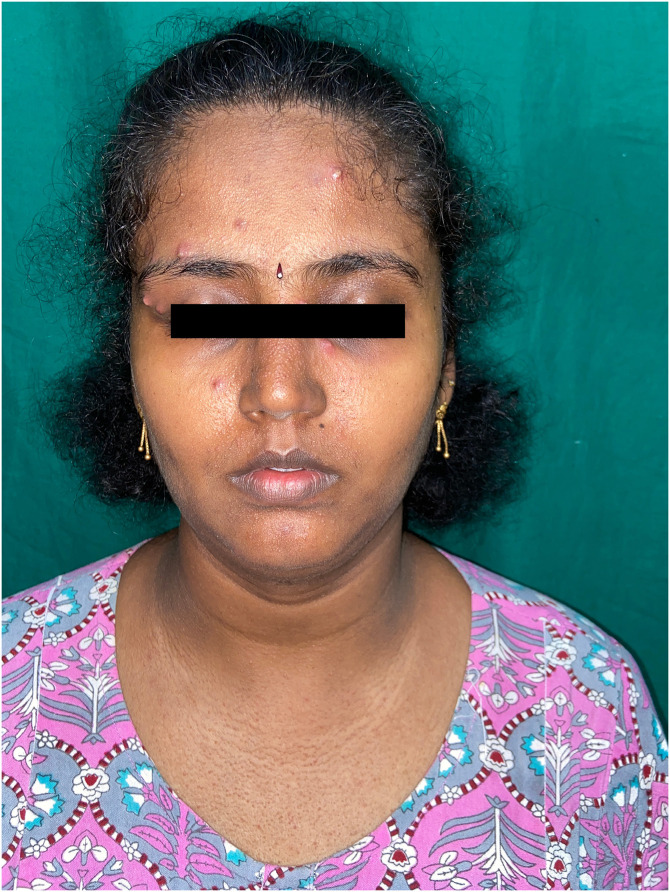 Figure 1
Peer Reviews
No public reviews on file for this paper yet. If you reviewed it on a platform where reviews are public (OpenReview, ICLR, NeurIPS, ICML), you can paste yours below so the community can read it here.
Videos
No videos yet. Explain this paper in a talk, walkthrough, or lecture? Add one.
Taxonomy
TopicsNonmelanoma Skin Cancer Studies · Cancer and Skin Lesions · Nail Diseases and Treatments
A 35-year-old woman presented with asymptomatic pus-filled lesions on her face for 5-days duration. On cutaneous examination, there were multiple discrete, minute, nontender, pinhead-sized pustules predominantly distributed on her forehead and periocular areas. Additionally, there were extensive pinpoint erythematous papules and superficially clear, thin-walled vesicles, 1–2 mm in diameter without surrounding inflammation, evenly distributed on her face and trunk (Figure 1). A swab culture from one of the pustules grew Staphylococcus aureus. Based on the clinical findings and laboratory results, a diagnosis of Periporitis staphylogenes with accompanying miliaria was made. The patient was treated with oral Cloxacillin for 5 days, and advised to keep her living environment cool. A follow-up exam after 7 days showed significant improvement in clinical symptoms.
Periporitis staphylogenes is an inflammation occuring around sweat ducts, caused by a superimposed Staphylococcus aureus infection. Although most commonly appearing in neonatal skin, Periporitis staphylogenes can occasionally affect adults.1 The lesions are typically discrete, minute, pinhead- to pea-sized papules and pustules, which can appear almost anywhere on the skin, but are commonly found on the scalp, forehead, neck, upper chest, shoulders, upper extremities, and back.2 The differential diagnoses include folliculitis, furuncles, demodex folliculitis, acne vulgaris, and papulopustular rosacea. Demodex folliculitis is characterized by itchy inflammatory papules and pustules on the face and neck, in immunosuppressed individuals with poor hygiene. A skin mount using potassium hydroxide or cyanoacrylate adhesive showing more than five mites per cm^2^, is a clue to the diagnosis. Acne vulgaris presents with asymptomatic polymorphic skin lesions, including: comedones, inflammatory papules, pustules, and nodules that sometimes leave scarring on the face, chest, and back in adolescents. The presence of comedones, folliculocentricity, and a lack of pruritus is more consistent with acne vulgaris than folliculitis. Papulopustular rosacea primarily affects adults and presents with pustules and erythematous papules on the central face with a background of photosensitivity and telangiectasias. Exacerbating factors, such as consumption of alcohol, spicy foods, and sun exposure may be present in patients with rosacea. Periporitis staphylogenes can be clinically distinguished from variants of miliaria such as miliaria pustulosa by characteristically deeper degree of furuncles/folliculitis with lack of tendency to form a central pus-point, local warmth, absence of significant tenderness, and lack of folliculocentricity. If left unnoticed, periporitis can evolve into sweat-gland abscesses. Bacterial cultures from the pustules or abscesses typically yield Staphylococcus aureus, confirming the diagnosis, as in our case. The preferred treatment of periporitis staphylogenes is combined antibiotic therapy and miliaria control measures. The presented case highlights this common, underreported complication of miliaria in tropical countries that can occur across all age groups.
The reference list from the paper itself. Each links out to its DOI / PubMed record.
- 1Lubowe II Perlman HH, 1954. Periporitis staphylogenes and other complications of miliaria in infants and children. AMA Arch Derm Syphilol 69: 543–553.13147561 10.1001/archderm.1954.01540170013002 · doi ↗ · pubmed ↗
- 2Maibach HI Kligman AM, 1960. Multiple sweat gland abscesses. JAMA 174: 140–142.14419980 10.1001/jama.1960.03030020028007 · doi ↗ · pubmed ↗