Genome Sequences of Microbacterium foliorum Phages BouleyBill and Carostasia, isolated in France
Christophe Regeard, Florence Constantinesco-Becker, Anne Lopes, Ana A Arteni, Malika Ouldali, Laura Pieri, Monique Auberdiac, Daniel Delaruelle, Kevin Tambosco, Hakima Abes, Clément Almeida-Monge, Félix Benard, Lucie Boucard, Elsa Chaouat, Juliette Charazac, Caroline Comte

TL;DR
This paper reports the genome sequences of two new bacteriophages found in France that infect a specific bacterial strain, expanding the known geographic range of these phage subclusters.
Contribution
The study expands the geographic distribution of phage subclusters EA4 and EA10 to Europe for the first time.
Findings
BouleyBill and Carostasia phages were isolated in France and infect Microbacterium foliorum strain NRRL B-24224.
The phages belong to subclusters EA4 and EA10, respectively, with genome sizes of 39,215-bp and 40,393-bp.
This is the first report of these subclusters being found in Europe.
Abstract
Bacteriophages BouleyBill and Carostasia, exhibiting siphovirus morphology, were isolated in France. Both infected Microbacterium foliorum strain NRRL B-24224. Their 39,215-bp and 40,393-bp genomes were assigned to subclusters EA4 and EA10, respectively, widening for the first time the known geographical distribution of these subclusters to Europe.
Genes, proteins, chemicals, diseases, species, mutations and cell lines named across the full text — each resolved to its canonical identifier and authoritative record.
Click any figure to enlarge with its caption.
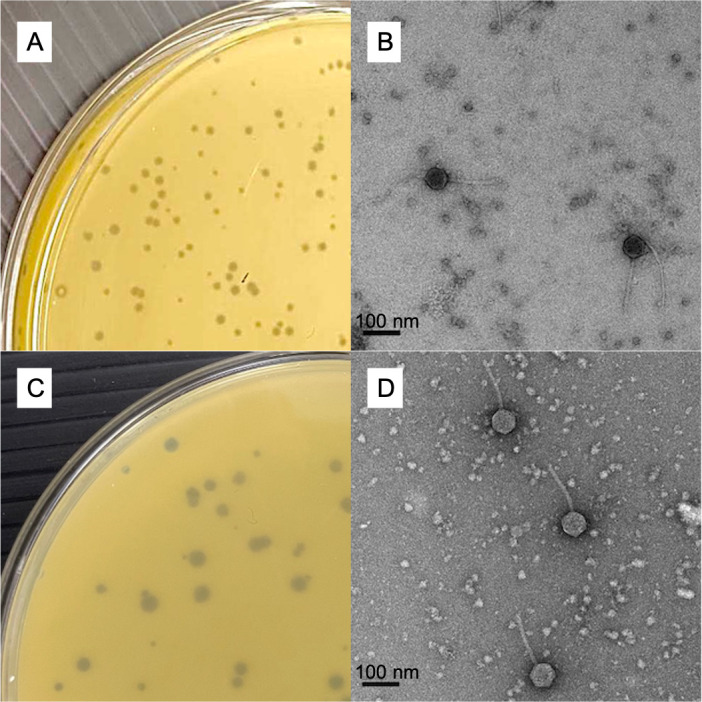 Figure 1
|
Phage name |
Sample collection site (GPS coordinates) |
Sample type |
Isolation method |
Approx. Shotgun coverage (fold) |
No. of 150-bp single-end reads |
Genome accession |
SRA accession |
Genome length (bp) |
Genome ends |
G + C content (%) |
No. of protein-coding genes |
No. of tRNAs |
Sub-cluster |
|
BouleyBill |
Dourdan, FR (48.533211 N, 2.007825 E) |
Garden compost |
Direct |
1,359 |
375,027 |
|
|
39,215 |
Circularly Permuted |
64.2 |
55 |
1 |
EA4 |
|
Carostasia |
Palaiseau, FR (48.713604 N, 2.248526 E) |
Sprigs of grass |
Direct |
1,673 |
476,899 |
|
|
40,393 |
Circularly Permuted |
63.8 |
63 |
0 |
EA10 |
Peer Reviews
No public reviews on file for this paper yet. If you reviewed it on a platform where reviews are public (OpenReview, ICLR, NeurIPS, ICML), you can paste yours below so the community can read it here.
Videos
No videos yet. Explain this paper in a talk, walkthrough, or lecture? Add one.
Taxonomy
TopicsFractal and DNA sequence analysis
Description
Bacteriophages are abundant and highly diverse viruses that infect bacteria. While approximately 600 different phages infecting the Gram-positive bacterium Microbacterium foliorum have been characterized, none have yet been isolated in Europe, leaving their geographic distribution and genetic diversity underexplored (Russell and Hatfull 2017; Jacobs-Sera et al. 2020; Milhaven et al. 2023)(see https://www.phagesdb.org, accessed on 1 December 2024).
Here, we report on the isolation of phages BouleyBill and Carostasia in France (Table 1). Compost or grass sprigs, respectively, were incubated for 1h in LB (5 g/L NaCl; 5 g/L yeast extract; 10 g/L tryptone), shaking at 30°C. Following centrifugation for 15 min at 4000xg, the supernatants were passed through a 0.22-µm filter and plated with top agar (LB 0.75% agar) supplemented with 1 mM CaCl2 and M . foliorum strain NRRL B-24224 (Russell et al. 2019). BouleyBill and Carostasia formed clear plaques with diameter ranges of 0.5-1 mm and 0.5-2 mm, respectively, after 24h at 30°C. They were further purified through two rounds of single plaque picking and plating (Fig. 1). Negative-staining transmission electron microscopy showed that both phages exhibit siphovirus morphology (Fig. 1). BouleyBill capsids were 55 (±3) nm in diameter and tails were 128 (±7) nm long (n = 13), while Carostasia capsids measured 60 (±1) nm and tails 134 (±5) nm (n = 24).
Phage DNA was extracted from high-titer lysates using the PCI/SDS protocol (https://phagesdb.org/media/workflow/protocols/pdfs/PCI_SDS_DNA_Extraction_2.2013.pdf). A library was prepared using the NEB Ultra II kit and sequenced using an Illumina Miseq instrument (v3 reagents). De novo assembly was performed with Newbler v2.9 as previously described (Russell 2018) and further checked with Consed v.29 (Gordon et al. 1998). The results are listed in Table 1. Based on gene content similarity of at least 35% to phages in the Actinobacteriophage database, phagesDB, both phages were assigned to cluster EA, but to different subclusters (Pope et al. 2017; Russell and Hatfull 2017), i.e. EA4 (containing 11 genomes with BouleyBill) and EA10 (6 genomes including Carostasia).
Gene prediction was performed using DNAmaster v5.23.6 (Pope and Jacobs-Sera 2018), which incorporates Glimmer v3.02 (Delcher et al. 2007) and Genmark v2.5p (Besemer and Borodovsky 2005). Auto-annotation was refined with Aragorn v1.2.41 (Laslett 2004), tRNAscan-SE v2.0 (Chan et al. 2021), Starterator v1.2 (http://phages.wustl.edu/starterator/), and Phamerator v579 (Cresawn et al. 2011). Start sites were selected based on gene length, minimal gaps or overlaps, RBS scores, and BlastP alignment, with Starterator used for further validation. Functional annotation was done with BlastP using NCBI nonredundant or actinobacteriophage databases (e values < 0.001) (Altschul et al. 1990; Russell and Hatfull 2017), and with HHpred (Soding et al. 2005) using databases PDB_mmCIF70_16_Aug, Pfam-A_v37, Uniprot-Swissprot-viral70_3_Nov_2021, and NCBI_Conserved_Domain(CD)_v3.19. Transmembrane domains were predicted using DeepTMHMM v1.0.24 (Hallgren et al. 2022). All software were used with default settings. BouleyBill and Carostasia contained 55 and 63 predicted protein-coding genes, with no putative functional prediction for 50% and 57% of identified genes, respectively.
As previously described for phages belonging to subcluster EA4 (Jacobs-Sera et al. 2020), phage BouleyBill carries a tRNA gene and its tail assembly chaperones are produced through a putative programmed translational -1 frameshift, features that were not identified in Carostasia. BouleyBill contains two genes downstream of the major capsid protein gene, while Carostasia has only one, which differs from the two in BouleyBill. Using Phamerator, a comparison of genomic regions 18,629–21,723 bp in BouleyBill (in particular genes 24, 28 and 29) and 18,678–21,406 bp in Carostasia (genes 23, 26 and 28) shows that the endolysin and two other genes are not conserved. From position 30,564 in BouleyBill and 30,625 in Carostasia to the genome ends, only six genes encode proteins that are homologous between the two phages. Taken together, this report constitutes the first description of Microbacterium foliorum phages discovered in Europe. The overall relatedness of BouleyBill and Carostasia with fifteen phages isolated in Northern America or the Caribbean suggests that phages from subclusters EA4 and EA10 have a wide geographical distribution.
Table 1. Isolation, sequencing and genome characteristics of phages BouleyBill and Carostasia
**: **
The reference list from the paper itself. Each links out to its DOI / PubMed record.
- 1Altschul SF Gish W Miller W Myers EW Lipman DJ 1990105 Basic local alignment search tool.J Mol Biol 21530022-283640341010.1016/S 0022-2836(05)80360-22231712 · doi ↗ · pubmed ↗
- 2Besemer J. Borodovsky M. 200571 Gene Mark: web software for gene finding in prokaryotes, eukaryotes and viruses Nucleic Acids Research 33Web Server 0305-1048 W 451W 45410.1093/nar/gki 48715980510 PMC 1160247 · doi ↗ · pubmed ↗
- 3Chan Patricia P Lin Brian Y Mak Allysia J Lowe Todd M 2021820 t RN Ascan-SE 2.0: improved detection and functional classification of transfer RNA genes Nucleic Acids Research 49160305-10489077909610.1093/nar/gkab 68834417604 PMC 8450103 · doi ↗ · pubmed ↗
- 4Cresawn Steven G Bogel Matt Day Nathan Jacobs-Sera Deborah Hendrix Roger W Hatfull Graham F 20111012 Phamerator: a bioinformatic tool for comparative bacteriophage genomics BMC Bioinformatics 1211471-210510.1186/1471-2105-12-395PMC 323361221991981 · doi ↗ · pubmed ↗
- 5Delcher Arthur L. Bratke Kirsten A. Powers Edwin C. Salzberg Steven L. 2007119 Identifying bacterial genes and endosymbiont DNA with Glimmer Bioinformatics 2361367-481167367910.1093/bioinformatics/btm 00917237039 PMC 2387122 · doi ↗ · pubmed ↗
- 6Gordon David Abajian Chris Green Phil 199831 Consed: A Graphical Tool for Sequence Finishing Genome Research 831088-905119520210.1101/gr.8.3.1959521923 · doi ↗ · pubmed ↗
- 7Hallgren Jeppe Tsirigos Konstantinos D. Pedersen Mads Damgaard Almagro Armenteros José Juan Marcatili Paolo Nielsen Henrik Krogh Anders Winther Ole 2022410 Deep TMHMM predicts alpha and beta transmembrane proteins using deep neural networks 10.1101/2022.04.08.487609 · doi ↗
- 8Jacobs-Sera Deborah Abad Lawrence A. Alvey Richard M. Anders Kirk R. Aull Haley G. Bhalla Suparna S. Blumer Lawrence S. Bollivar David W. Bonilla J. Alfred Butela Kristen A. Coomans Roy J. Cresawn Steven G. D'Elia Tom Diaz Arturo Divens Ashley M. Edgington Nicholas P. Frederick Gregory D. Gainey Maria D. Garlena Rebecca A. Grant Kenneth W. Gurney Susan M. R. Hendrickson Heather L. Hughes Lee E. Kenna Margaret A. Klyczek Karen K. Kotturi Hari Mavrich Travis N. Mc Kinney Angela L. Merkhofer Evan C. Moberg Parker Jordan Molloy Sa · doi ↗ · pubmed ↗