Is beauty beyond the eye of the butterfly?
Richard M. Merrill

TL;DR
A new study explores how Heliconius butterflies use color and genetics in making mating decisions.
Contribution
The study reveals genetic and neural mechanisms behind visual mating choices in Heliconius butterflies.
Findings
Bright colors in Heliconius butterflies are linked to mate choice through genetic factors.
Neural mechanisms influence how butterflies perceive and respond to color patterns.
The study provides insights into the evolution of visual mating behaviors.
Abstract
The bright colors observed across the animal world are often used during mate choice. An exciting new study in PLOS Biology suggests genetic and neural mechanisms contributing to the evolution of visual mating decisions in Heliconius butterflies. The diversity of bright colors observed across the animal world are often used during mate choice. This Primer explores a new study in PLOS Biology which reveals genetic and neural mechanisms contributing to the evolution of visual mating decisions in Heliconius butterflies
Genes, proteins, chemicals, diseases, species, mutations and cell lines named across the full text — each resolved to its canonical identifier and authoritative record.
Click any figure to enlarge with its caption.
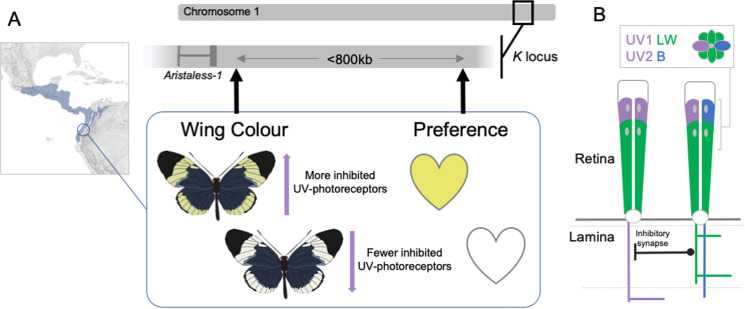 Figure 1
- —http://dx.doi.org/10.13039/501100000781European Research Council
Peer Reviews
No public reviews on file for this paper yet. If you reviewed it on a platform where reviews are public (OpenReview, ICLR, NeurIPS, ICML), you can paste yours below so the community can read it here.
Videos
No videos yet. Explain this paper in a talk, walkthrough, or lecture? Add one.
Taxonomy
TopicsPlant and animal studies · Neurobiology and Insect Physiology Research · Lepidoptera: Biology and Taxonomy
Animals often use color to inform their decisions. Although color discrimination is increasingly well-characterized at the molecular level [e.g. 1], we still know little about the genetic and neural changes underlying the evolution of how animals respond to visual cues. This is important because how selection shapes behavioral variation may depend on the mechanisms involved, including the relationship between reception and response. For example, while genetic changes influencing receptor sensitivity may avoid potentially deleterious modifications to downstream circuits, they might also alter perception of the broader environment on which multiple behaviors rely. This has been hypothesized to drive differences in mate choice [2], but in other situations it might equally act as a constraint. In an impressive marriage of evolutionary genomics and neurobiology, a recent PLoS Biology study by VanKuren and colleagues [3] begins to unravel the genetic and neural mechanisms underlying visual mate choice evolution in a tropical butterfly.
The bright wing patterns of Heliconius butterflies primarily function to warn birds that they are distasteful, but male Heliconius also use them to identify suitable mates. Closely related Heliconius species often display divergent wing patterns, and because males almost invariably prefer to court females that share their own colors, this can help maintain the integrity of taxonomic boundaries. Individuals of the same species tend to share the same pattern (at least within a single geographic location); however, some populations, including one of the H. cydno populations studied by VanKuren and colleagues, are polymorphic. Specifically, in western Ecuador, individual H. cydno alithea has either a white or yellow forewing patch. Previous work has revealed that these differences in warning coloration are coupled with corresponding mating preferences, so that yellow males preferentially court yellow females (white males appear to have no preference) [4].
Coupling of ecological and mating traits is often considered an efficient route towards speciation. This is because it allows divergent selection acting on the ecological trait to maintain variation in the mating trait, but determining the exact genetic mechanisms involved has often proved difficult (reviewed in [5]). Possible scenarios include pleiotropy, where the same allele influences variation in two seemingly unrelated phenotypes, as well as tight linkage, involving physically close but distinct loci on the same chromosome. Associations may also arise through population-level processes [6]. For example, because males with a preference for yellow are more likely to pair with yellow females, they will consequently also be more likely to sire offspring carrying both the yellow preference allele and the yellow color allele (even if the loci are on different chromosomes).
To address this, VanKuren and colleagues sequenced 113 H. cydno alithea males sampled from the polymorphic population in Ecuador, previously assayed for their relative preference for yellow or white females [4]. Genome-wide association (GWA) analyses subsequently revealed four regions in the genome associated with mating preference. Importantly the best supported locus was < 800 kb away—though still distinct—from the top hit for the white-yellow forewing color switch (within a region on chromosome 1 referred to as the ‘K locus’ and containing the color pattern gene aristaless-1 [7]) (Fig 1). This example of tight linkage broadly mirrors the situation observed between Heliconius species separated by a white-to-red forewing switch, where physically close but distinct genes, optix and regucalcin1, respectively, regulate wing color and the corresponding behavioral preference for either white or red females [8].
To ask how genetic variation might be translated into the white-yellow preference differences observed in H. cydno, VanKuren and colleagues recorded the response of individual photoreceptors to different wavelengths of light. This allowed them to specifically test whether variation in wing coloration (as a proxy for behavioral preference) correlates with differences in photoreceptor tuning, implying a direct link between reception and response. Although they found that photoreceptor sensitivity does indeed vary between Heliconius populations, and argue that this might aid visual discrimination in some contexts, the correlation between UV-photoreceptor spectral sensitivity and wing color did not hold in the polymorphic population from Ecuador. This suggests that variation in photoreceptor tuning is unlikely to be the primary cause of differences in mating preferences in this case. However, subsequent experiments revealed that some UV-sensitive photoreceptors in male Heliconius eyes receive inhibitory input from long-wavelength-sensitive photoreceptors, as has been observed in other insects. Remarkably, the proportion of inhibited UV photoreceptors is correlated with wing color, including within the key polymorphic population in Ecuador.
Previous studies in Papilio butterflies have shown that inhibitory synapses occur in the axons within the lamina, the upper layer of the optic lobe, the region of the insect brain responsible for initial visual processing [9]. Although VanKuren and colleagues have not yet explicitly linked the expression of specific genes to behavioral variation, they identify promising candidates, notably including some differentially expressed in the developing optic lobe. This will undoubtedly guide future work to visualize the expression of these genes in relation to the development of inhibitory synapses, and to experimentally test their effect on behavior. Regardless, the striking correlation between variation at the K locus and UV-photoreceptor inhibition, both within and between populations of H. cydno, already provides a new and compelling mechanistic hypothesis for the evolution of visual preferences.
Overall, results of this study suggest a model where variation in yellow-white Heliconius mating preferences depends on changes in downstream signal processing, rather than sensory reception. Of course, questions remain. For example, how are preferences for other types of color and pattern variation encoded in the sensory systems of Heliconius, and elsewhere? How often is the coupling of key traits of maintained through tight linkage, as opposed to other mechanisms such as pleiotropy, which is perhaps a more convincing hypothesis in other systems [e.g. 10]. And might the evolution of visual mate choice depend less often on changes in sensory reception than other modalities, such as olfaction (maybe due to the larger number and increased specificity of chemoreceptors on which selection can act)? Nevertheless, despite these and many other potential avenues for future research, this work by VanKuren and colleagues makes an important contribution to our expanding vision of behavioral evolution.
The reference list from the paper itself. Each links out to its DOI / PubMed record.
- 1Mc Culloch KJ, Macias-Muñoz A, Briscoe AD. Insect opsins and evo-devo: what have we learned in 25 years? Philos Trans R Soc Lond B Biol Sci. 2022;377:20210288. doi: 10.1098/rstb.2021.0288 36058243 PMC 9441233 · doi ↗ · pubmed ↗
- 2Seehausen O, Terai Y, Magalhaes IS, Carleton KL, Mrosso HDJ, Miyagi R, et al. Speciation through sensory drive in cichlid fish. Nature. 2008;455:620–6. doi: 10.1038/nature 07285 18833272 · doi ↗ · pubmed ↗
- 3Van Kuren NW, Buerkle NP, Lu W, Westerman EL, Im AK, Massardo D, Southcott LM, et al. Genetic, developmental, and neural changes underlying evolving butterfly mate. P Lo S Biol. 2025.10.1371/journal.pbio.3002989 PMC 1213615340067994 · doi ↗ · pubmed ↗
- 4Chamberlain NL, Hill RI, Kapan DD, Gilbert LE, Kronforst MR. Polymorphic butterfly reveals the missing link in ecological speciation. Science. 2009;326:847–50. doi: 10.1126/science.1179141 19892982 PMC 2875868 · doi ↗ · pubmed ↗
- 5Merrill RM, Arenas-Castro H, Feller AF, Harenčár J, Rossi M, Streisfeld MA, et al. Genetics and the evolution of prezygotic isolation. Cold Spring Harb Perspect Biol. 2024;16(2):a 041439. doi: 10.1101/cshperspect.a 041439 37848246 PMC 10835618 · doi ↗ · pubmed ↗
- 6Unbehend M, Kozak GM, Koutroumpa F, Coates BS, Dekker T, Groot AT, et al. bric à brac controls sex pheromone choice by male European corn borer moths. Nat Commun. 2021;12:2818. doi: 10.1038/s 41467-021-23026-x 33990556 PMC 8121916 · doi ↗ · pubmed ↗
- 7Westerman EL, Van Kuren NW, Massardo D, Tenger-Trolander A, Zhang W, Hill RI, et al. Aristaless controls butterfly wing color variation used in mimicry and mate choice. Curr Biol. 2018;28(21): 3469–74.e 4. doi: 10.1016/j.cub.2018.08.051 30415702 PMC 6234856 · doi ↗ · pubmed ↗
- 8Rossi M, Hausmann AE, Alcami P, Moest M, Roussou R, Van Belleghem SM, et al. Adaptive introgression of a visual preference gene. Science. 2024;383(6689):1368–73. doi: 10.1126/science.adj 9201 38513020 PMC 7616200 · doi ↗ · pubmed ↗