The complete chloroplast genome sequence of Syringa meyeri (Oleaceae)
Shaoying Cheng, Jingrui Li, Hongxia Cui, Yuanyuan Li, Zhonghua Liu

TL;DR
This paper reports the full chloroplast genome of Syringa meyeri, a type of lilac, offering insights into its genetic structure and evolutionary relationships.
Contribution
The study provides the first complete chloroplast genome sequence for Syringa meyeri and identifies its closest relative.
Findings
The chloroplast genome of S. meyeri is 160,459 bp long with a GC content of 37.9%.
Phylogenetic analysis shows S. meyeri is most closely related to S. pubescens subsp. microphylla.
The genome contains 141 annotated genes, including 96 protein-coding genes.
Abstract
Syringa meyeri C. K. Schneid. 1912 (Oleaceae) is a common dwarf ornamental lilac, native to Northeast China. In this study, the complete chloroplast genome of S. meyeri was assembled, exhibiting a typical quadripartite structure with a total length of 160,459 bp and a GC content of 37.9%. A total of 141 genes were annotated, including 96 protein-coding genes, 37 tRNA genes, and eight rRNA genes. Phylogenetic analysis of 19 cp genomes indicated that S. meyeri is most closely related to S. pubescens subsp. microphylla. These results provide essential genomic resources for future phylogenetic and evolutionary studies in Syringa.
Genes, proteins, chemicals, diseases, species, mutations and cell lines named across the full text — each resolved to its canonical identifier and authoritative record.
Click any figure to enlarge with its caption.
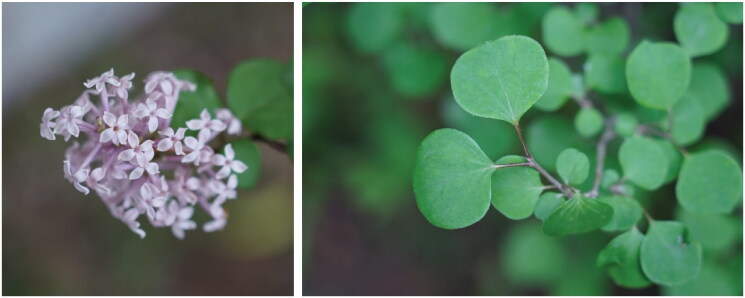 Figure 1
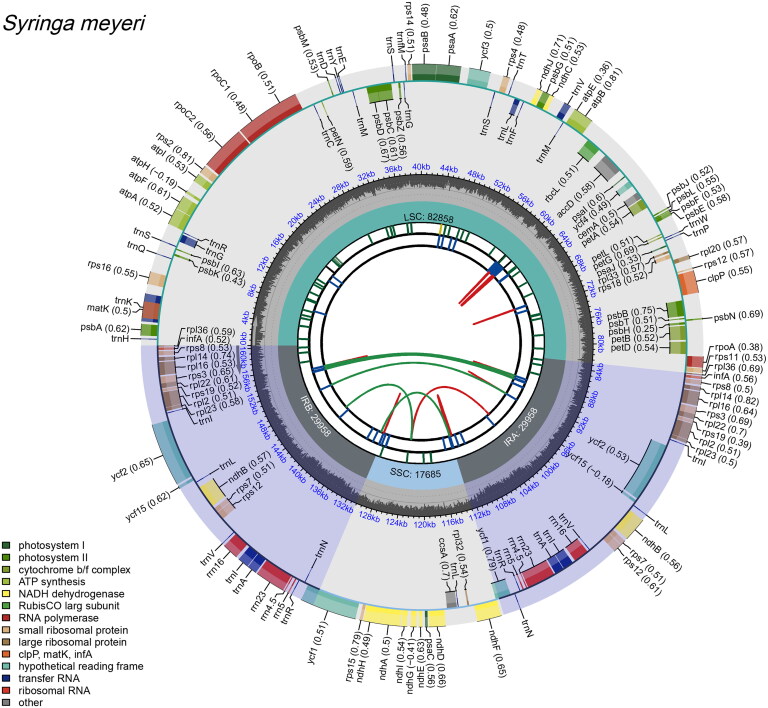 Figure 2
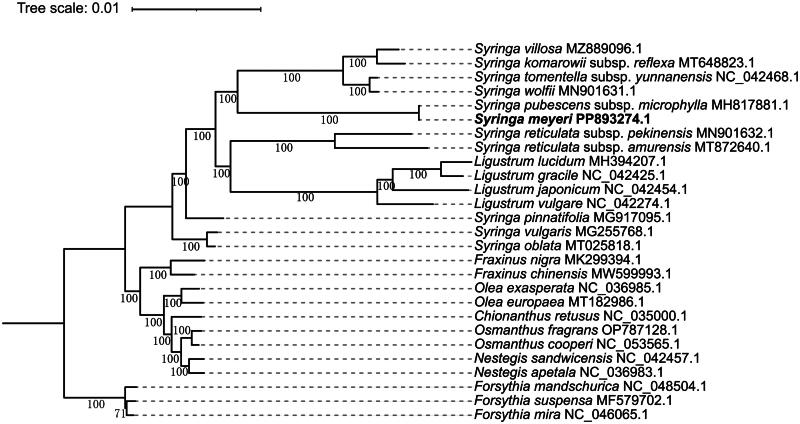 Figure 3
- —Major Science and Technology Projects in Hohhot
- —National Forestry and Grassland Administration Project
- —Beijing Municipal Forestry and Parks Bureau Project
- —Yulin District Forestry Bureau Project
Peer Reviews
No public reviews on file for this paper yet. If you reviewed it on a platform where reviews are public (OpenReview, ICLR, NeurIPS, ICML), you can paste yours below so the community can read it here.
Videos
No videos yet. Explain this paper in a talk, walkthrough, or lecture? Add one.
Taxonomy
TopicsGenomics and Phylogenetic Studies · Phytochemistry and Biological Activities · Ethnobotanical and Medicinal Plants Studies
Introduction
Lilacs (Syringa L., Oleaceae) have long been used in gardening, essential oil production, and for medicinal purposes in both Europe and East Asia (Wang et al. 2022). Taxonomically, Syringa comprises five groups: Series Syringa, Ser. Pinnatifoliae, Ser. Villosae, Ser. Pubescentes and Sect. Ligustrina. Ser. Pubescentes includes approximately one-third of all Syringa species (Chang and Qiu 1992), contributing to its considerable species diversity. The dwarf species Syringa meyeri C. K. Schneid. 1912 from Ser. Pubescentes, is native to Liaoning Province in Northeast China (Chang and Qiu 1992). Its compact size, coupled with its elegant flowers and pervasive fragrance, has made it a popular ornamental plant, widely cultivated in the northern regions of China (Gui et al. 2023). Despite its popularity, few studies on this species have been reported.
The chloroplast genome is a useful tool for phylogenetic analyses (Olofsson et al. 2019; Dupin et al. 2020). Approximately half of the cp genomes of Syringa have been sequenced (e.g. Olofsson et al. 2019; Zhang et al. 2019; Liu et al. 2020; Zhao et al. 2020; Yang et al. 2023). However, there remains a need to examine the chloroplast genome of this morphologically distinct dwarf species within the genus, although its sister species, the genome of S. pubescens subsp. microphylla from Ser. Pubescentes, has been sequenced (Van de Paer et al. 2018). In this study, we present the first complete assembly of the chloroplast genome of S. meyeri using next-generation sequencing technology, followed by a comprehensive analysis.
Materials and methods
meyeri (Figure 1) was cultivated at the Institute of Botany, Chinese Academy of Sciences (E 116°12’59′’, N 39°59’20′’). The voucher specimen was deposited at the herbarium of the Institute of Botany, Chinese Academy of Sciences (Li Zexin [email protected], accession number: 2763202). Total genomic DNA was extracted from fresh leaves using the CTAB method and sequenced on the Illumina × ten platform. The per-base coverage depth of the S. meyeri chloroplast genome was generated using SAMtools v1.17 (Danecek et al. 2021) and Bowtie 2 v2.5.4 (Langmead and Salzberg 2012). The chloroplast genome was assembled with the GetOrganelle v1.7.5 (Jin et al. 2020). The assembled genome was annotated with CPGAVAS2 (Shi et al. 2019), using the chloroplast genome of S. pubescens subsp. microphylla (GenBank number: MT872641.1) as the reference sequence, and visualized using CPGView (Liu et al. 2012). The tool was also used to generate cis-spliced and trans-spliced genes. To explore the phylogenetic relationships of S. meyeri, we selected 26 species from the Oleaceae family and used three species of Forsythia, namely Forsythia mandschurica (NC_048504.1), Forsythia suspensa (MF579702.1), and Forsythia mira (NC_046065.1), as outgroups to construct a phylogenetic tree. With the exception of S. meyeri, the cp genomes of the other species were downloaded from the GenBank database. The chloroplast genome of S. meyeri was aligned with those of the other 26 species using MAFFT with default parameters (Katoh and Standley 2013). We used IQ-TREE v1.6.12 (Nguyen et al. 2015) to construct a maximum likelihood (ML) tree, with the optimal evolutionary model identified as TVM+F + I + G4, based on the Bayesian Information Criterion (BIC).
Syringa meyeri from the institute of botany, chinese academy of sciences (E 116°12’59’’, N 39°59’20’’), features light purple corollas with elliptical lobes that are apically beaked, along with suborbicular leaves bearing two pairs of lateral veins converging at the leaf base. Photographs were taken by shaoying cheng.
Results
To assess the accuracy of the assembly, we evaluated the per-base coverage depth of the S. meyeri chloroplast genome. The coverage depth ranged from 22× to 2,612×, with a mean depth of 1,680×, confirming the reliability of the assembled genome (Figure S1).
The sequencing and assembly revealed that the length of the S.meyeri chloroplast genome is 122,586 bp, forming a circular structure with a typical quadripartite arrangement. This includes a pair of inverted repeats (IRs) of 29,958 bp separated by a large single-copy (LSC) region of 82,858 bp and a small single-copy (SSC) region of 17,685 bp (Figure 2). The GC content of the chloroplast genome is 37.9%. A total of 141 functional genes were annotated, including 96 protein-coding genes, 37 tRNA genes, and eight rRNA genes. Additionally, the following genes were found to contain introns: rps16, atpF, rpoC1, petB, petD, rpl16, rpl2, ndhB, ndhA, trnK-UUU, trnG-GCC, trnL-UAA, trnV-UAC, trnI-GAU, and trnA-UGC each contain one intron, while rps12, ycf3 and clpP each contain two introns (Figure S2). The rps12 gene is a trans-spliced gene, with distinct exons located at different genomic positions, connected through a complex splicing process to form the mature mRNA (Figure S3).
Annotated chloroplast genome map of Syringa meyeri. The first sequence track, radiating from the core, displays the forward and reverse repeats, which are indicated by green and red arcs. The second and third tracks show the tandem repeats and microsatellite sequences, each highlighted in distinct colors. The outermost track categorizes genes based on their functions, with the corresponding color scheme shown at the lower left corner.
The phylogenetic tree constructed using the complete chloroplast sequences from Syringa and other genera within the Oleaceae family reveals that Syringa meyeri and Syringa pubescens subsp. microphylla cluster together as sister taxa. This suggests a close phylogenetic relationship between the two species, with 100% support for this clade (Figure 3).
Maximum likelihood (ML) phylogenetic tree based on the protein-coding genes in the chloroplast genome of Syringa meyeri and 26 plastomes of the oleaceae family. The numbers above the branches represent the bootstrap values from 1000 rapid repetitions, and the legend indicates the scale of nucleotide substitutions. Forsythia species were used as outgroups in the phylogenetic tree. The sequences included in this tree were downloaded from the NCBI GenBank. Accession numbers are: Syringa vulgaris (MG255768.1) (unpublished), syringa oblata (MT025818.1) (Zhao et al. 2020), syringa pinnatifolia (MG917095.1) (Zhang et al. 2019), syringa reticulata subsp. pekinensis (MN901632.1) (Wang et al. 2020), syringa reticulata subsp. amurensis (MT872640.1) (unpublished), syringa wolfii (MN901631.1) (Liu et al. 2020), syringa villosa (MZ889096.1) (unpublished), syringa komarowii subsp. reflexa (MT648823.1) (unpublished), syringa pubescens subsp. microphylla (MH817881.1), syringa tomentella subsp. yunnanensis (NC_042468.1), ligustrum gracile (NC_042425.1), ligustrum japonicum (NC_042454.1), ligustrum vulgare (NC_042274.1), fraxinus nigra (MK299394.1), nestegis sandwicensis (NC_042457.1), forsythia mandschurica (NC_048504.1) (Olofsson et al. 2019), ligustrum lucidum (MH394207.1) (Wang et al. 2018), fraxinus chinensis (MW599993.1) (unpublished), olea exasperata (NC_036985.1) (unpublished), Olea europaea (MT182986.1) (Niu et al. 2020), osmanthus fragrans (OP787128.1) (unpublished), osmanthus cooperi (NC_053565.1) (Wang et al. 2019), nestegis apetala (NC_036983.1) (unpublished), chionanthus retusus (NC_035000.1) (He et al. 2017), forsythia suspensa (MF579702.1) (Wang et al. 2017), and forsythia mira (NC_046065.1) (Gao et al. 2019).
Discussion and conclusions
Phylogenetic trees constructed using complete plastid sequences of S. meyeri and other species of Syringa, along with other genera from the Oleaceae family, indicate that S. meyeri shares the closest relationship with S. pubescens subsp. microphylla, which is in agreement with the phylogenetic tree based on the nuclear genome (Wang et al. 2022). Ligustrum forms a monophyletic group nested within Syringa, identifying Syringa as a non-monophyletic genus. These findings are consistent with previous studies on the phylogenetic relationships within Oleaceae and Syringa (Dupin et al. 2020; Dupin et al. 2024; Li et al. 2002; Olofsson et al. 2019; Wang et al. 2025).
In this study, we present the first assembly and annotation of the chloroplast genome sequence of S. meyeri, which spans 160,459 bp in length, has a typical tetrameric structure, and is closely related to S. pubescens subsp. microphylla. This work lays the groundwork for future phylogenetic investigations of Syringa.
Supplementary Material
Supplementary Material Figure S3.tif
Supplementary Material Figure S2.tif
Supplementary Material Figure S1.tif
The reference list from the paper itself. Each links out to its DOI / PubMed record.
- 1Danecek P, Bonfield JK, Liddle J, Marshall J, Ohan V, Pollard MO, Whitwham A, Keane T, Mc Carthy SA, Davies RM, et al. 2021. Twelve years of SA Mtools and BC Ftools. Gigascience. 10(2):giab 008. doi:10.1093/gigascience/giab 008.33590861 PMC 7931819 · doi ↗ · pubmed ↗
- 2Dupin J, Hong-Wa C, Gaudeul M, Besnard G. 2024. Phylogenetics and biogeography of the olive family (Oleaceae). Ann Bot. 134(4):577–592. doi:10.1093/aob/mcae 100.38908009 PMC 11523611 · doi ↗ · pubmed ↗
- 3Dupin J, Raimondeau P, Hong-Wa C, Manzi S, Gaudeul M, Besnard G. 2020. Resolving the phylogeny of the olive family (Oleaceae): confronting information from organellar and nuclear genomes. Genes (Basel). 11(12):1508. doi:10.3390/genes 11121508.33339232 PMC 7767060 · doi ↗ · pubmed ↗
- 4Gao S, Bai JQ, Liu ML, Wang PF, Li N, Yang L, Wang XP, Li ZH. 2019. The complete chloroplast genome of Forsythia mira, an endemic medicinal shrub in China. Mitochondrial DNA B Resour. 5(1):57–58. doi:10.1080/23802359.2019.1693924.33366420 PMC 7720978 · doi ↗ · pubmed ↗
- 5Gui B, Fu X, Tan S. 2023. Syringa meyeri propagation and cultivation. China Flower & Garden. (05), :66–67. in Chinese).
- 6He Y, Liu L, Yang S, Dong M, Yuan W, Shang F. 2017. Characterization of the complete chloroplast genome of Chinese fringetree (Chionanthus retusus). Conservation Genet Resour. 9(3):431–434. doi:10.1007/s 12686-017-0704-6. · doi ↗
- 7Jin JJ, Yu WB, Yang JB, Song Y, de Pamphilis CW, Yi TS, Li DZ. 2020. Get Organelle: a fast and versatile toolkit for accurate de novo assembly of organelle genomes. Genome Biol. 21(1):241. doi:10.1186/s 13059-020-02154-5.32912315 PMC 7488116 · doi ↗ · pubmed ↗
- 8Katoh K, Standley DM. 2013. MAFFT multiple sequence alignment software version 7: improvements in performance and usability. Mol Biol Evol. 30(4):772–780. doi:10.1093/molbev/mst 010.23329690 PMC 3603318 · doi ↗ · pubmed ↗