Understanding personal preferences to promote exercise adherence in Parkinson’s disease
Caro I. Cools, Sonja A. Kotz, Bastiaan R. Bloem, Nienke M. de Vries, Annelien A. Duits

TL;DR
People with Parkinson's disease prefer exercises like walking and biking, which are not often studied, and matching preferences may improve adherence.
Contribution
Identifies a mismatch between preferred and studied exercises in Parkinson’s disease and highlights the importance of personal preferences for adherence.
Findings
Preferred exercises align with current practices but differ from those in prior studies.
Walking, biking, swimming, boxing, and tennis are top preferred but under-researched exercises.
Considering personal preferences may enhance long-term exercise adherence in Parkinson’s disease.
Abstract
•PwP’s preferred exercise types align with their currently practiced exercise types.•PwP’s preferred exercise types differ from exercise types used in prior studies.•Walking, biking, swimming, boxing, and tennis are preferred but have been relatively little studied.•Adherence to exercise is likely higher when considering personal preferences. PwP’s preferred exercise types align with their currently practiced exercise types. PwP’s preferred exercise types differ from exercise types used in prior studies. Walking, biking, swimming, boxing, and tennis are preferred but have been relatively little studied. Adherence to exercise is likely higher when considering personal preferences. Exercise is a recognized treatment for people with Parkinson’s Disease (PwP), but personal exercise preferences are rarely considered in exercise intervention studies. Yet these are critical for…
Genes, proteins, chemicals, diseases, species, mutations and cell lines named across the full text — each resolved to its canonical identifier and authoritative record.
Click any figure to enlarge with its caption.
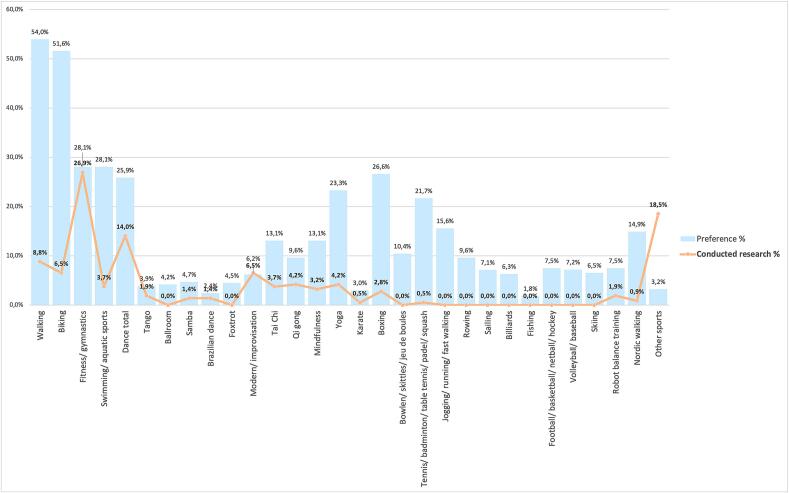 Figure 1
Peer Reviews
No public reviews on file for this paper yet. If you reviewed it on a platform where reviews are public (OpenReview, ICLR, NeurIPS, ICML), you can paste yours below so the community can read it here.
Videos
No videos yet. Explain this paper in a talk, walkthrough, or lecture? Add one.
Taxonomy
TopicsParkinson's Disease Mechanisms and Treatments · Cerebral Palsy and Movement Disorders
Introduction
1
Parkinson’s Disease (PD) is characterized by both motor and non-motor symptoms [1]. Exercising positively influences both. Maintaining physical activities may beneficially influence PD symptom progression [2], and exercising improves quality of life for people with PD (PwP) [3]. Moreover, one study suggested aerobic exercise to be associated with reduced global brain atrophy, enhanced functional connectivity in the brain, and improved cognitive control in PwP [4].
Despite potential benefits and guidelines about the type and degree of exercise to be performed [5], many PwP do not meet the recommended advice for physical activity [6]. One core factor stimulating exercise by PwP is motivation [7], which is associated with higher levels of premorbid motivation, greater self-compassion, and lower perceived disease severity [8]. Consequently, long-term exercise adherence might be stronger when exercise is linked to personal preferences in PwP [9].
Exercise intervention studies in PD often rely on a one-size-fits-all approach, and have not yet considered whether this approach aligns with exercise preferences in PwP. However, non-adherence to exercise might result from discrepancies between what PwP prefer and what intervention studies offer [10]. Although suggestions for personalized exercises were provided [11], little is currently known about how exercise preference might impact exercise adherence.
Therefore, exercise preferences in PwP in relation to practiced exercises were evaluated, and, second, these preferences were compared to exercise types investigated in prior exercise intervention studies. To answer the first objective, data were extracted from an online survey, and exercises PwP participated in (“practiced exercises”) were compared to those PwP actually preferred (“preferred exercises”). To answer the second objective, a brief literature review was performed. The observed exercise preferences of PwP were compared to exercise types in prior studies (“exercise types in prior studies”). Hypothesized was 1) no discrepancy between preferred and practiced exercises, and 2) a discrepancy between preferred and exercise types in prior studies.
Method
2
Preferences and practiced exercise types
2.1
Participants with a self-reported PD diagnosis were invited through multiple social channels to participate in an online survey. As one of many items in newsletters, it is unclear how many participants opened or read the newsletter, and proceeded to click on the survey invitation. Of those approached, 719 people responded. The online survey started with demographics, followed by questions about practiced and preferred exercises per exercise category. ‘Preferred’ refers to the willingness to participate in a specific exercise category, and participants could select an unlimited number of preferred exercise categories. The exercise categories were based on the LASA Physical Activity Questionnaire [12] and supplemented by interventions seen during the brief review. See Appendix A for the complete survey.
Based on the survey, both the percentages of practiced exercise types and preferences were calculated. As participants could select an unlimited number of preferred exercises, the number of preferred exercise categories could exceed 100 %.
Exercises types in prior studies
2.2
A brief review was conducted to identify exercise intervention studies for PwP published between January 2019 and June 2024. This timeframe was chosen to ensure an analysis of the most recent advancements in exercise intervention studies, mirroring the rise in such studies. The title and/ or abstract keyword methods of “Parkinson” AND “intervention” were used and 222 articles met the eligibility criteria. The remaining exercise interventions were divided into 30 different exercise types. Percentages were calculated per exercise type for the number of intervention studies performed. Next, the percentages of the exercise types in prior studies were compared with those of the preferred exercise types of PwP. A complete description of the methods section is provided in the supplementary material (see Supplementary Material).
Results
3
A total of 719 people responded; 54 participants were excluded from further analyses primarily because of missing data (see supplementary material). The final sample size was 665, including 92 incomplete surveys (completed more than the mandatory number of questions).
Participants in the final sample were on average 65.63 years (SD = 8.25, range: 38–88 years). 42.6 % were female, 57.1 % male, and 0.2 % identified as ‘other’ (and one missing value). Their mean self-reported health was 9.80 (SD = 3.86, min = 6, max = 25), with an average disease duration (time since diagnosis) of 6.66 years (SD = 5.06, range: 1–52 years). See supplementary material for additional information on assessments. The final sample consisted of exercising participants, with only 6.6 % of participants (n = 44) currently not exercising at all.
93.4 % of participants indicated to exercise regularly. Of these participants, 19.1 % participated in specific exercises for PD. Two weeks prior to the survey, the mean time of exercising or being physically active was 13.38 times (SD = 10.62, range: 0 – 85, e.g., like walking a dog multiple times a day or using a bicycle on a daily basis). The three most popular exercises were walking (including stepping and being on a treadmill), biking (including spinning, home trainers, and mountain bikes), and fitness/ gymnastics (including resistance training, cardio, workouts, body pump, and gymnastic exercises).
The remaining survey questions confirmed 37.1 % of participants exercising less after a PD diagnosis, 20 % maintaining the same level, and 42.9 % increasing exercising after diagnosis. Looking at differences pre- and post-diagnosis: biking decreased 19.2 %, swimming/ aquatic sports decreased 10.1 %, and the remaining categories decreased less than 10 %. Fitness/ gymnastics, however, increased by 9.7 %.
Practiced versus preferred preferences
3.1
The survey indicated that PwP participated mainly in walking, biking, and fitness/ gymnastics. Additionally, they also preferred swimming, dancing, and boxing. So, while PwP expressed preferences for some of the 30 different exercise categories in the survey, on average, they preferred the same top three exercises they had engaged in during the last two weeks before the survey (Table 1, column 2 and 3). Looking at preference levels for all exercise categories, only ‘walking’ and ‘fitness/ gymnastics’ scored lower in preference than the personal exercise engagement over the last two weeks.Table 1. An overview of participation frequency, participation levels, and preference for exercise next to conducted research (%).**Sports****Practiced exercises (incl. specially for PD) %****Preferred exercises %****Prior research %**Walking (including treadmill)77.054.08.8Biking (including spinning, exercising on a home trainer or mountain bike)44.951.66.5Fitness/ gymnastics (including resistance training, cardio, workouts, body pump, rope jumping, and milon circuit)37.328.126.9Swimming/ aquatic sports13.228.13.7Dance total5.725.914.0Tango1.13.91.9Ballroom0.64.20Samba0.34.71.4Brazilian dance02.41.4Foxtrot0.24.50Modern/Improvisation3.86.26.5Tai Chi1.813.13.7Qi gong3.59.64.2Mindfulness5.713.13.2Yoga13.623.34.2Karate03.00.5Boxing17.626.62.8Bowlen/ skittles/ jeu de boules0.910.40Tennis/ badminton/ table tennis/ padel/ squash11.621.70.5Jogging/ running/ fast walking10.715.60Rowing2.99.60Sailing0.27.10Billiards1.86.30Fishing0.81.80Football/ basketball/ netball/ hockey2.47.50Volleyball/ baseball1.47.20Skiing0.96.50Robot balance training07.51.9Nordic walking6.314.90.9Other sports6.5^a^3.2^b^18.5^b^None6.6^a, b^ See supplemented material for an overview of ‘other sports’.
Preferred versus exercise types in prior studies
3.2
Table 1 and Fig. 1 show distribution (in %) of exercise types in prior PD studies, and summarize the levels of participation and preferences for exercise types based on the online survey. PwP preferred walking, biking, fitness/ gymnastics, swimming, boxing, and dancing. However, the top 3 exercise types mostly used in prior research were fitness/ gymnastics, dancing, and walking. The table shows how 11 out of 30 exercise types were not included in any study since 2019.Fig. 1. Overview of preferred exercise types (blue bars) and the exercise types in prior research (orange line). (For interpretation of the references to colour in this figure legend, the reader is referred to the web version of this article.)
Further, most exercise types showed a remarkable difference regarding preferred exercises and exercise types explored in prior research. The 10 exercise types showing the largest differences between preferred by PwP and used in prior studies were walking, biking, swimming/ aquatic sports, dancing, tai chi, yoga, boxing, jogging, tennis, and Nordic walking. These findings confirmed a discrepancy between preferred exercises and exercise types used in prior intervention studies.
Discussion
4
The present study highlights the need to consider exercise preference of PwP, to better understand exercise adherence. The survey clearly showed that practiced exercises mostly matched preferred exercises. Further, PwP reported preferences for walking, biking, fitness/ gymnastics, swimming, boxing, and dancing, whereas prior exercise intervention studies primarily investigated fitness/ gymnastics, and dancing. Such a discrepancy between preferred exercises and those investigated in prior studies may have resulted from an increased emphasis on those exercises that can lead to positive intervention outcomes. This might increase the likelihood that these exercise types rather than those preferred by PwP are likely to be chosen in future studies on exercise intervention [13].
Using a one-size-fits-all approach seems more feasible than studying a range of preferred exercises. However, the present results highlight the diversity and individual exercise preferences of PwP, supporting the need for personalized exercise interventions [14]. Personalized intervention is more attractive for PwP and can enhance enjoyment, happiness, and improve long-term and successful exercise adherence [9]. Looking at drop-out rates and the lack of considering personal preferences might explain why PwP do not respond well to selected exercise interventions. This needs to be further addressed in designs of future exercise intervention studies. This can already be achieved by asking participants about their preferences and whether the intended exercise interventions include their preferences.
The implementation of exercise interventions can only be successful with prolonged exercise adherence. Some questions in the survey displayed changes in type and exercise frequency pre- and post-diagnosis. These give insight into how some PwP remain motivated to exercise, whereas others are not. Future studies on exercise interventions should therefore include exercise preferences to better understand motivation and exercise adherence, and to further clarify why some PwP do (not) benefit from specific exercise interventions.
So far, it remains unclear to what extent PD symptoms, the options to exercise, or their motivation prevent PwP from practicing their preferred exercise. The survey did not allow to differentiate preferences due to physical abilities or severity in disease symptoms. Further light needs to also be shed on whether motivation to exercise in daily life is different from motivation to participate in intervention studies. Participating in exercise interventions that do not align with preferred exercises could be less attractive and undermine exercise adherence.
While the present results provide clear evidence that preferred exercises should be considered when designing new exercise intervention studies, some limitations were noted, such as a selection bias. PwP were only approached via social media, which might indicate that only proactive PwP responded. For example, the high percentage (93.4 %) of responders that actively exercise might not generalize to all PwP. Further, the online survey was conducted in Dutch, thus cannot generalize to PwP who speak other languages. Future studies should consider including an English version of the survey to broaden its applicability and comparisons between, at least, English- and other language speaking countries.
The self-reported exercise data could have also been biased. Participants may have interpreted ‘exercising’ differently, including daily activities such as 'walking' or 'biking’. This may have conflated how accurately one reports exercise frequency. Additionally, participants might have over- or underestimated their exercise activity levels. Because an online survey was used, it was not possible to control how consistently participants reported their exercise behavior. Future studies should expand the current type of research by performing interviews to obtain a better understanding of how exercise adherence could benefit from an objective activity tracking method to enhance response accuracy.
Importantly, the number of studies on a specific exercise type cannot reflect the quality of its effectiveness. The reported results can only indicate how frequently specific exercise interventions were studied. This study aimed at highlighting discrepancies between preferred exercises by PwP and those typically selected in exercise intervention studies.
Finally, this survey study limited the included brief review of exercise intervention studies in a relatively short time window. This choice was motivated by the exponential increase in specific types of exercise intervention studies during this time and allowed for a direct and immediate comparison of preferred and actually studied intervention exercises in PwP.
To conclude, exercise preference seems to be a missing but strong determinant in how successfully PwP adhere to exercise interventions. This study showed that PwP's preferred exercises align well with the exercises they practice, but not necessarily in PwP with exercises in prior intervention studies. To consider motivation and increase exercise adherence in PwP, personal exercise preferences seem to be a necessary factor to be considered in future exercise intervention studies.
CRediT authorship contribution statement
Caro I. Cools: Writing – review & editing, Writing – original draft, Project administration, Methodology, Investigation, Formal analysis, Data curation, Conceptualization. Sonja A. Kotz: Writing – review & editing, Writing – original draft, Supervision, Conceptualization. Bastiaan R. Bloem: Writing – review & editing, Supervision. Nienke M. de Vries: Writing – review & editing, Supervision, Project administration, Methodology, Conceptualization. Annelien A. Duits: Writing – review & editing, Supervision, Conceptualization.
Declaration of competing interest
The authors declare that they have no known competing financial interests or personal relationships that could have appeared to influence the work reported in this paper.
The reference list from the paper itself. Each links out to its DOI / PubMed record.
- 1Bloem B.R.Okun M.S.Klein C.Parkinson's disease Lancet 3971029120212284230310.1016/S 0140-6736(21)00218-X 33848468 · doi ↗ · pubmed ↗
- 2Tsukita K.Sakamaki-Tsukita H.Takahashi R.Long-term effect of regular physical activity and exercise habits in patients with early Parkinson disease Neurology 9882022 e 859e 87110.1212/WNL.000000000001321835022304 PMC 8883509 · doi ↗ · pubmed ↗
- 3T.D. Ellis, C. Colón-Semenza, T.R. De Angelis, C.A. Thomas, M.H. Saint Hilaire, G.M. Earhart, L.E. Dibble, Evidence for early and regular physical therapy and exercise in Parkinson's disease, Seminars in Neurology, 41(2) (2021) 189-205. doi: 10.1055/s-0041-1725133.10.1055/s-0041-1725133 PMC 867892033742432 · doi ↗ · pubmed ↗
- 4Johansson M.E.Cameron I.G.Van der Kolk N.M.de Vries N.M.Klimars E.Toni I.Helmich R.C.Aerobic exercise alters brain function and structure in Parkinson's disease: a randomized controlled trial Ann. Neurol.912202220321610.1002/ana.2629134951063 PMC 9306840 · doi ↗ · pubmed ↗
- 5Corcos D.M.Lamotte G.Luthra N.S.Mc Kee K.E.Advice to people with parkinson's in my clinic: Exercise J. Parkinsons Dis 143202460961710.3233/JPD-23027738189710 PMC 11091645 · doi ↗ · pubmed ↗
- 6M. Benka Wallén, E. Franzén, H. Nero, M. Hagströmer, Levels and patterns of physical activity and sedentary behavior in elderly people with mild to moderate Parkinson disease, Physical therapy, 95(8) (2015) 1135-1141. doi: 10.1017/S 135561771600076 X.10.2522/ptj.2014037425655884 · doi ↗ · pubmed ↗
- 7Afshari M.Yang A.Bega D.Motivators and barriers to exercise in Parkinson’s disease J. Parkinsons Dis.74201770371110.3233/JPD-17117329103050 · doi ↗ · pubmed ↗
- 8Cools C.I.Kotz S.A.Bloem B.R.Duits A.A.N. M. De Vries Motivation Matters: Elucidating factors driving exercise in people with Parkinson’s disease Phys. Therapy J. (accepted for Publication)202510.1093/ptj/pzaf 048PMC 1213131840207869 · doi ↗ · pubmed ↗