Simulative learning in the room of horror – a method to enhance patient safety in undergraduate nursing education
Vivian Hauff, Laura Homann, Antje Tannen

TL;DR
A simulated learning method called the 'room of horror' helps nursing students learn about patient safety by identifying errors in a realistic setting.
Contribution
The study introduces the room of horror as an effective simulation method for enhancing patient safety awareness in nursing education.
Findings
Students identified 12 out of 13 safety-critical errors during the simulation.
All participants found the simulation educational and relevant to professional nursing practice.
The method enhanced risk awareness and situational awareness among students.
Abstract
High expectations are placed on healthcare systems concerning safety and health restoration. Simultaneously, healthcare involves risks and potential hazards that may lead to adverse events for patients and healthcare professionals alike. To raise awareness of these risks, it is essential to incorporate the topic of patient safety into healthcare education. The room of horror, a form of simulated learning, represents an effective teaching and learning approach for this purpose. At the end of their first semester, undergraduate nursing students participated in a room of horror exercise designed following the Swiss manual for interactive learning. The task involved identifying 13 errors relevant to patient safety within the room. Subsequently, the students provided written evaluations of this teaching format. Participants successfully identified twelve out of the thirteen safety-critical…
Genes, proteins, chemicals, diseases, species, mutations and cell lines named across the full text — each resolved to its canonical identifier and authoritative record.
Click any figure to enlarge with its caption.
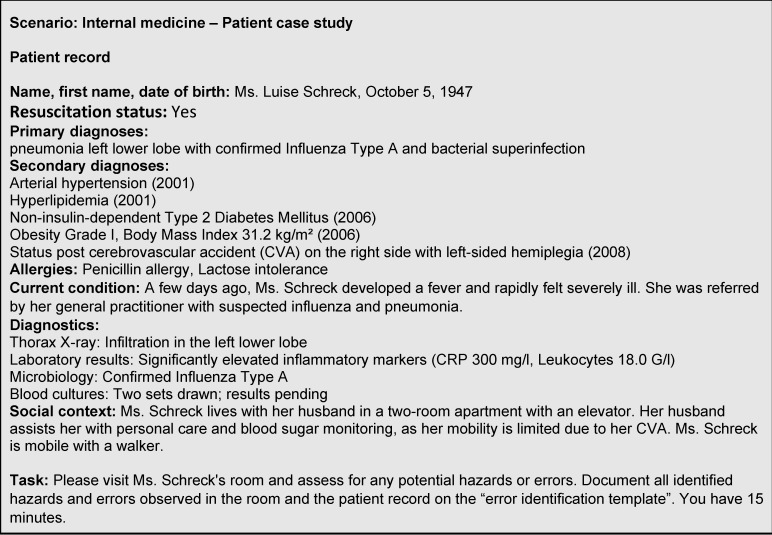 Figure 1
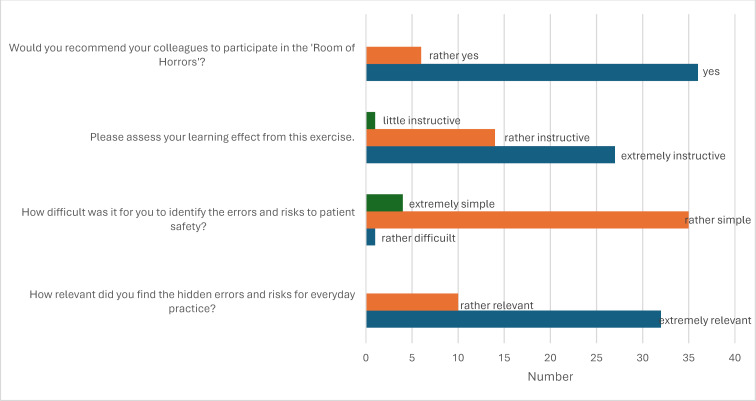 Figure 2
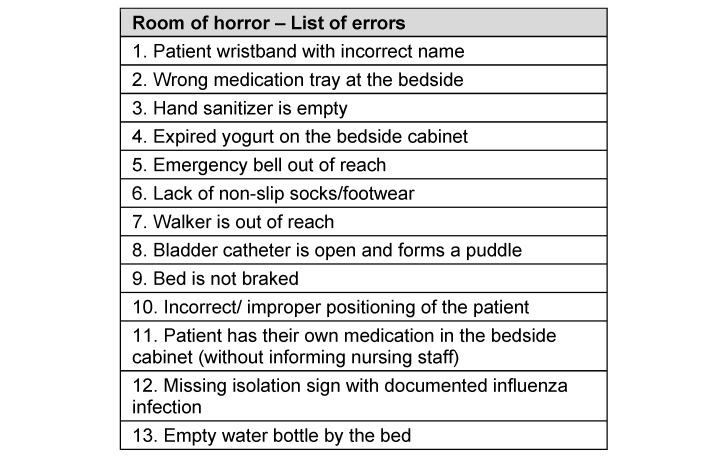 Figure 3
Peer Reviews
No public reviews on file for this paper yet. If you reviewed it on a platform where reviews are public (OpenReview, ICLR, NeurIPS, ICML), you can paste yours below so the community can read it here.
Videos
No videos yet. Explain this paper in a talk, walkthrough, or lecture? Add one.
Taxonomy
TopicsSimulation-Based Education in Healthcare · Patient Safety and Medication Errors
1. Introduction
Approximately ten percent of hospitalized patients worldwide experience adverse events during their stay, leading to harm [1]. Hospital care involves complex situations requiring extensive knowledge and skills from healthcare professionals [2]. Nurses play a critical role in patient safety, such as in early risk detection and safely executing nursing interventions [3], [4]. Addressing these challenges necessitates a fundamental engagement throughout nursing education, emphasizing both knowledge acquisition and the development of risk awareness [2], [3]. Simulative learning using the room of horror (RoH) is a suitable method to cultivate sensitivity to patient safety and train risk awareness among students [5], [6]. Positive effects of this teaching and learning method have been widely demonstrated, highlighting its role in developing safety-related skills [6]. This project aimed to evaluate the method and gain initial insights into its feasibility and acceptance among students.
2. Project description
Based on the WHO model curriculum [3], first-semester nursing students received comprehensive instruction on patient safety. Topics ranged from clarifying key terms and concepts, illustrating the roles of patients and nurses, to identifying risks associated with healthcare practices. At the end of the 12-week seminar series, students applied this knowledge by identifying errors in two identical simulated patient rooms equipped with a nursing simulation mannequin. No clinical placements had been conducted prior to this exercise. A total of N=42 students participated in the RoH over three consecutive days. The 90-minute simulation included theoretical preparation, pre-briefing, and debriefing. The pre-briefing involved a 20-minute case presentation (see figure 1 (Fig. 1)) and explanation of the RoH process. During the allotted time (15 minutes), two small groups of five to six students each simultaneously searched for errors. No differentiated role assignments were made. The rooms contained 13 safety-relevant errors based on the Swiss Patient Safety Foundation’s Manual [7] (see table 1 (Tab. 1)). Students documented identified errors on a recording sheet. Afterward, a joint analysis of the simulation was conducted, followed by a debriefing to discuss emotions and experiences. Participants then provided feedback via a brief paper-pencil survey using a four-point Likert scale. Quantitative data were descriptively analyzed (SPSS 29), while qualitative free-text responses were summarized.
3. Results
Teams identified more errors in the simulation rooms than originally placed. However, a differentiated detection rate was not recorded. Errors such as incorrect patient positioning, an open urinary catheter, and empty hand sanitizer were recognized by all participants. Missing isolation precautions for documented influenza infection were overlooked by nearly all groups. Evaluation forms indicated that all students found the simulation relevant and educational for professional practice and would recommend participation to peers (see figure 2 (Fig. 2)). Open-ended questions asked about significant experiences, suggestions, and ideas for future RoH designs. Students emphasized the high relevance of the format for professional practice and its effectiveness in raising awareness of risks in patient care. They also highlighted the importance of a constructive error culture as a learning opportunity. Additionally, students suggested incorporating RoH exercises throughout their studies to simulate increasingly complex situations. Realistic room design and smaller group sizes of fewer than four participants were recommended to optimize the RoH experience. Overall, students found the simulation engaging and enjoyable.
4. Discussion
This RoH implementation suggests it is an effective and feasible teaching and learning method for raising awareness of patient safety [7]. It should be noted that successful implementation relies on personnel, logistical, and structural resources, which could present potential barriers requiring preemptive resolution. These findings align with other studies on simulative learning using the RoH [6]. Similar positive sentiments and high detection rates were reported in this project [6], [8]. Given that apparent errors like improper positioning or open urinary catheters were frequently identified, future exercises could focus on less obvious errors, such as documentation discrepancies. This pilot project’s evaluation is limited due to the small number of participants. Generalizations are not possible without replication in other studies and populations and testing the method in varied settings. Nonetheless, even within this relatively small cohort, positive effects such as perceived learning success and enhanced risk awareness were evident.
5. Conclusion
Simulative learning in a RoH is a low-threshold and educational method for promoting patient safety awareness in professional practice. Implementation is feasible for both basic and continuing education for nursing professionals. Elements such as realistic room design and optimal group sizes are critical for effectively training critical thinking and situational awareness. A repetitive format aligned with evolving qualifications and potential interprofessional orientation for real-world relevance would be desirable for future RoH designs.
Authors’ ORCIDs
- Vivian Hauff: [0009-0000-1754-1952]
- Antje Tannen: [0000-0003-0970-1818]
Competing interests
The authors declare that they have no competing interests.
The reference list from the paper itself. Each links out to its DOI / PubMed record.
- 1Panagioti M Khan K Keers RN Abuzour A Phipps D Kontopantelis E Bower P Campbell S Haneef R Avery AJ Ashcroft DM Prevalence, severity, and nature of preventable patient harm across medical care settings: systematic review and meta-analysis BMJ 2019366 I 418510.1136/bmj.l 4185 PMC 693964831315828 · doi ↗ · pubmed ↗
- 2Zimmermann C Fridrich A Schwappach DL Training situational awareness for patient safety in a room of horrors: an evaluation of a low-fidelity simulation method J Patient Saf 2021178 e 1026 e 103310.1097/PTS.000000000000080633395018 PMC 8612898 · doi ↗ · pubmed ↗
- 3Charité – Universitätsmedizin Berlin Mustercurriculum Patientensicherheit der Weltgesundheitsorganisation – Multiprofessionelle Ausgabe 2018 Berlin Charité – Universitätsmedizin Berlin Available from: https://igpw.charite.de/fileadmin/user_upload/microsites/m_cc 01/igpw/Forschung/PAMM/WHO_Mustercurriculum_Patientensicherheit_DEUTSCH_2018.pdf
- 4Vaismoradi M Tella S Logan PA Khakurel J Vizcaya-Moreno F Nurses' Adherence to Patient Safety Principles: A Systematic Review Int J Environ Res Public Health 2020176202810.3390/ijerph 1706202832204403 PMC 7142993 · doi ↗ · pubmed ↗
- 5Karner S Warnecke F Simulatives Lernen im Room of Horrors : Praxisbuch mit Fallbeispielen für die generalistische Pflegeausbildung 20231. ed.Stuttgart Verlag W. Kohlhammer 10.17433/978-3-17-042852-2 · doi ↗
- 6Lee S Repsha C Seo WJ Lee SH Dahinten VS Room of horrors simulation in healthcare education: A systematic review Nurse Educ Today 202312610582410.1016/j.nedt.2023.10582437121075 · doi ↗ · pubmed ↗
- 7Zimmermann C Schwappach D Interaktives Lernen Im Room of Horrors. Manual für Spitäler 2019 Zürich Stiftung für Patientensicherheit Schweiz Available from: https://patientensicherheit.ch/wp/wp-content/uploads/2023/03/Room_of_Horrors_Manual_Spit_ler_D_V 2.pdf
- 8Löber N Garske C Rohe J Room of horrors – ein low-fidelity Simulationstraining für patientensicherheitsrelevante Gefährdungspotentiale im Klinikalltag Room of horrors: A low-fidelity simulation practice for patient safety-relevant hazards of hospitalization Z Evid Fortbild Qual Gesundhwes 2020153-15410411010.1016/j.zefq.2020.05.01032712178 · doi ↗ · pubmed ↗