Minimum requirements for scientific training in medical studies
Julia Eckel, Elena Sperk, Wilko Thiele, Katrin Schüttpelz-Brauns

TL;DR
The paper suggests a clear approach to set minimum scientific training standards for medical students, focusing on the scientific method.
Contribution
A new approach to define and present clear learning objectives for scientific training in medical studies.
Findings
A systematic scientific method instruction is a fundamental prerequisite for university studies.
The proposed approach provides a foundation for acquiring scientific knowledge and evidence-based medical practice.
Abstract
We propose a new approach to deriving minimum standards for scientific training in medical studies. This approach allows specific learning objectives to be clearly defined and presented, in an easily comprehensible manner. We contend that a fundamental prerequisite for university studies is the instruction in the systematic scientific method that can be described through the scientific cycle. This instruction provides the foundation for the acquisition of scientific knowledge and evidence-based practice in medicine.
Genes, proteins, chemicals, diseases, species, mutations and cell lines named across the full text — each resolved to its canonical identifier and authoritative record.
Click any figure to enlarge with its caption.
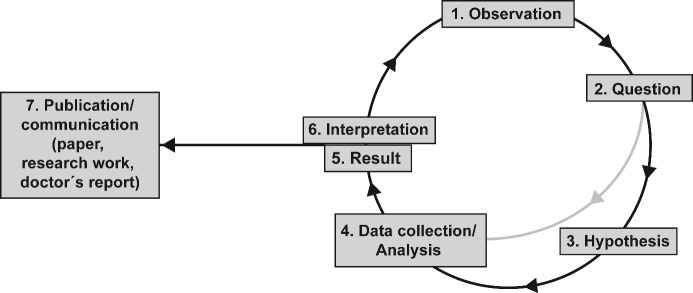 Figure 1
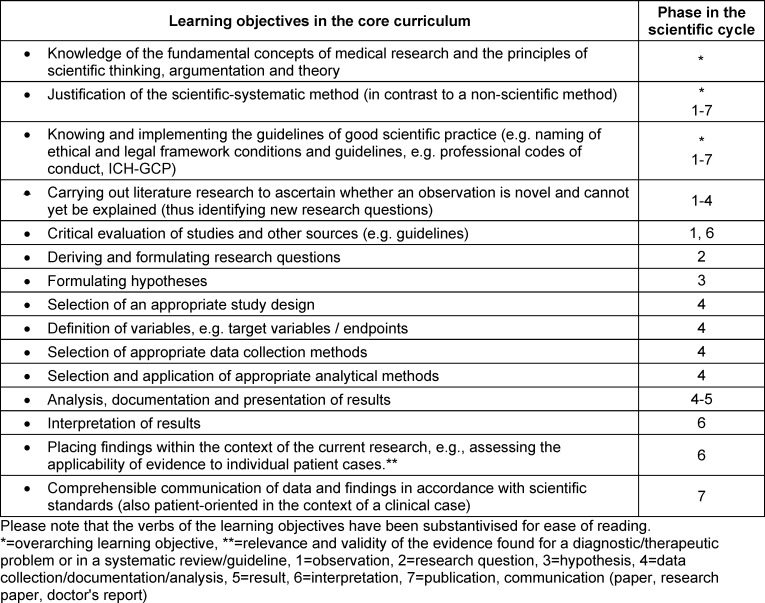 Figure 2
Peer Reviews
No public reviews on file for this paper yet. If you reviewed it on a platform where reviews are public (OpenReview, ICLR, NeurIPS, ICML), you can paste yours below so the community can read it here.
Videos
No videos yet. Explain this paper in a talk, walkthrough, or lecture? Add one.
Taxonomy
TopicsHealth and Medical Research Impacts · Advances in Oncology and Radiotherapy · Innovations in Medical Education
Introduction
A sound scientific understanding is a prerequisite for evidence-based action in medicine [23], and the application of scientific findings in everyday clinical practice has a positive influence on quality in patient care [23], [24]. Physicians must therefore read scientific publications and critically evaluate the extent to which the findings presented in them, or derivable from them, have implications for their clinical practice. In reality, however, practicing physicians frequently report that they lack the skills to evaluate clinical studies or other scientific publications with regard to their quality and validity [28].
This proficiency gap is already apparent during their studies, where medical students do not feel adequately prepared to conduct research independently [7], [27]. Moreover, the content taught during their studies should also prepare medical students for a doctorate, which is actually intended to demonstrate their ability to conduct scientific research. Without fostering a fundamental understanding of science during training, there is a risk of a shortage of future researchers in medical science [9], [20]. This problem has already been recognised, and for years, there have been calls from various directions to improve scientific education in medical studies, not only due to the rapid growth of knowledge and technological advancements [1], [3], [4], [5], [6], [23], [21], [25], [33]. The Association of the Scientific Medical Societies in Germany (2008) [25], the German Research Foundation (2010) [6], the German Council of Science and Humanities (2014) [33], and the Association of Medical Faculties (2016) [22] have long acknowledged the necessity for the enhanced acquisition of fundamental scientific competencies throughout the course of medical studies. In addition, universities, in their role as research institutions and educational institutions for scientific skills, fear a “deprofessionalization” of medical training and the loss of the scientific basis (“de-academisation”) [25]. This is evidenced by the divergence in the content and focus of the scientific curricula of different medical faculties in Germany. While two-thirds of the innovative and reform-based degree programmes integrate a compulsory module on scientific work, this is only the case for around a quarter of the traditional degree programmes [2].
The German National Competency-Based Learning Objective Catalog (NKLM) [14], including the chapter on medical-scientific skills (VIII.1.), is currently being revised to reduce learning objectives and redundancies. Since the medical curricula are currently overloaded with subject-specific knowledge and learning objectives, there is critical opposition to a curriculum reform. Accordingly, discussions are ongoing at the faculties regarding how scientific thinking and research can be integrated into medical programs, raising the question of the minimum requirements for scientific rigor in medical education. At the same time, the faculties face the challenge and responsibility of sufficiently realising the scientific education within the medical curriculum as part of a university education. With this commentary, we aim to stimulate further discussion on the minimum standards for scientific education in medical studies.
Scientific-systematic method
Scientific competence is defined as “the ability to identify problems, generate hypotheses, search for and evaluate evidence, draw conclusions, and communicate and critically evaluate scientific thinking and its results” [33] (for further information, please refer to [8] and [19]).
Scientific competence is therefore the ability to apply the scientific method that can be described with the help of the scientific cycle (see figure 1 (Fig. 1)).
The scientific method has its origins in the work of Hippocrates of Kos (460-370 BC) and encompasses abductive, retroductive, deductive and inductive reasoning and argumentation [19]. Although the specific starting points and the emphasis on individual steps of the scientific cycle may vary across different disciplines [8], the method is generic, meaning it is the same in all areas of medical research and across disciplines (see attachment 1 ).
In their everyday clinical practice, medical doctors must also adopt a scientific and systematic method, which involves developing questions, generating hypotheses, collecting data and deriving, documenting and communicating evidence-based working strategies. The critical analysis of a paper in everyday clinical practice, or in the context of research, also requires checking whether scientific standards have been adhered to in the individual steps of the scientific cycle and whether the statements in the paper are valid.
Derivation of the minimum requirement for scientific training
The minimum scientific training requirement for medical students can be clearly derived from the scientific cycle as the overarching structure. It is defined as the ability to independently conduct scientific and systematic inquiry, utilising the individual steps outlined in figure 1 (Fig. 1). This ability serves to prepare for and implement a doctorate, enabling the independent conduct of studies aimed at generating knowledge in various research areas (with their respective discipline-specific research methods) and the development of guidelines and subsequent targeted application of evidence-based medicine according to the current state of scientific knowledge. Table 1 (Tab. 1) shows the thus derived science-oriented learning objectives for a future core curriculum of medical faculties, depending on the competencies required for the scientific-systematic method.
It is essential that the learning objectives are operationalised in the curriculum at both the individual level (e.g. literature research) and within a contextual framework (as part of the scientific-systematic method). In order to assess scientific competence at the final examination stage, students should be required to complete a scientific paper independently, under the guidance of a supervisor. The necessity for independent performance in scientific work has been discussed at length and justified in terms of learning theory. It is also pertinent to cite the ongoing debate surrounding research-based teaching (see references [12], [15], [16]), Holzkamp’s (1995) subject-science method to learning (see [17]), and the fundamental concepts of research-based learning as outlined by Huber (2009) (see [18]). Furthermore, it is of great significance to establish a connection between scientific discoveries, and their impact on clinical practice. This can for example be achieved by examining the applicability of current scientific evidence to patient cases.
Conclusion
It is imperative that scientific skills be taught at medical faculties in Germany, as they form the foundation for scientific inquiry and medical care, with consideration of the current state of scientific knowledge. In this context, the facilitation of the aforementioned systematic scientific method, from which the science-oriented learning objectives formulated for the core curriculum can be derived, represents a fundamental prerequisite for a university-level education.
Authors’ ORCIDs
- Elena Sperk: [0000-0002-8771-8124]
- Wilko Thiele: [0000-0002-8978-4192]
- Katrin Schüttpelz-Brauns: [0000-0001-9004-0724]
Competing interests
The authors declare that they have no competing interests.
Supplementary Material
Illustrative examples of the application of scientific-systematic procedures in the context of preclinical, clinical, and health services research, as well as in the context of a clinical case
The reference list from the paper itself. Each links out to its DOI / PubMed record.
- 1Arbeitsgemeinschaft der Wissenschaftlichen Medizinischen Fachgesellschaften e.V. (AWMF)Stellungnahme zur Wissenschaftlichkeit des Medizinstudiums 2014 Düsseldorf AWMF Available from: https://www.awmf.org/fileadmin/user_upload/dateien/stellungnahmen/2014/1.pdf
- 2Bauer J Schendzielorz J Oess S Mantke R Ausmaß und Integration von Wissenschaftsmodulen in das Medizinstudium an den staatlichen Fakultäten und den privaten staatlich anerkannten Fakultäten in Deutschland: eine Querschnittsstudie Depth and integration of science modules in medical studies at recognized public and private faculties in Germany: A cross-sectional study Z Evid Fortbild Qual Gesundhwes 2022174909610.1016/j.zefq.2022.08.00636137933 · doi ↗ · pubmed ↗
- 3Bundesärztekammer Wissenschaftlichkeit als konstitutionelles Element des Arztberufes 2020 Berlin Bundesärztekammer Available from: https://www.bundesaerztekammer.de/fileadmin/user_upload/downloads/pdf-Ordner/WB/Stellungnahme_Wissenschaftlichkeit.pdf
- 4Bundesvertretung der Medizinstudierenden in Deutschland e.V. (bvmd)Konzeptpapier zur Zukunft und Weiterentwicklung des Medizinstudiums 2014 Berlinbvmd Available from: https://www.bvmd.de/wp-content/uploads/2021/04/2014-06-01_aktuell_Grundsatzetscheidung_Zukunft_und_Weiterentwicklung_des_Medizinstudiums_zuletzt_gea%CC%88ndert_am_30.06.2018.pdf
- 5Densen P Challenges and opportunities facing medical education Trans Am Clin Climatol Assoc 2011122485821686208 PMC 3116346 · pubmed ↗
- 6Deutsche Forschungsgemeinschaft, Senatskommission Empfehlungen der Senatskommission für Klinische Forschung. Strukturierung der wissenschaftlichen Ausbildung für Medizinerinnen und Mediziner 2010 Bonn Deutsche Forschungsgemeinschaft Available from: https://www.dfg.de/resource/blob/169680/df 604c 619d 6c 03218789 faa 0d 18acc 70/medizinausbildung-senat-klinische-forschung-data.pdf
- 7Epstein N Huber J Gartmeier M Berberat PO Reimer M Fischer MR Investigation on the acquisition of scientific competences during medical studies and the medical doctoral thesis GMS J Med Educ 2018352 Doc 2010.3205/zma 00116729963610 PMC 6022582 · doi ↗ · pubmed ↗
- 8Fischer F Kollar I Ufer S Sodian B Hussmann H Pekrun R Neuhaus B Dorner B Pankofer S Fischer M Strijbos JW Henne M Eberle J Scientific reasoning and argumentation: advancing an interdisciplinary research agenda in education Frontline Learn Res 201423284510.14786/flr.v 2i 3.96 · doi ↗