Reference genome of the kidnapper ant, Polyergus mexicanus
Elizabeth I Cash, Merly Escalona, Philip S Ward, Ruta Sahasrabudhe, Courtney Miller, Erin Toffelmier, Colin Fairbairn, William Seligmann, H Bradley Shaffer, Neil D Tsutsui

TL;DR
This paper presents a high-quality genome assembly for the kidnapper ant Polyergus mexicanus, which is important for understanding its unique social parasitism behavior and genetic diversity.
Contribution
The paper provides a high-quality genome assembly and the genome of its Wolbachia endosymbiont, enabling future studies on conservation and population genetics.
Findings
The genome assembly of P. mexicanus has a BUSCO completeness of 95.4%.
The Wolbachia endosymbiont genome is a single circular contig of 1.23 Mb.
P. mexicanus exhibits substantial genetic polymorphism linked to different Formica host species.
Abstract
Polyergus kidnapper ants are widely distributed, but relatively uncommon, throughout the Holarctic, spanning an elevational range from sea level to over 3,000 m. These species are well known for their obligate social parasitism with various Formica ant species, which they kidnap in dramatic, highly coordinated raids. Kidnapped Formica larvae and pupae become integrated into the Polyergus colony where they develop into adults and perform nearly all of the necessary colony tasks for the benefit of their captors. In California, Polyergus mexicanus is the most widely distributed Polyergus, but recent evidence has identified substantial genetic polymorphism within this species, including genetically divergent lineages associated with the use of different Formica host species. Given its unique behavior and genetic diversity, P. mexicanus plays a critical role in maintaining ecosystem balance…
Genes, proteins, chemicals, diseases, species, mutations and cell lines named across the full text — each resolved to its canonical identifier and authoritative record.
Click any figure to enlarge with its caption.
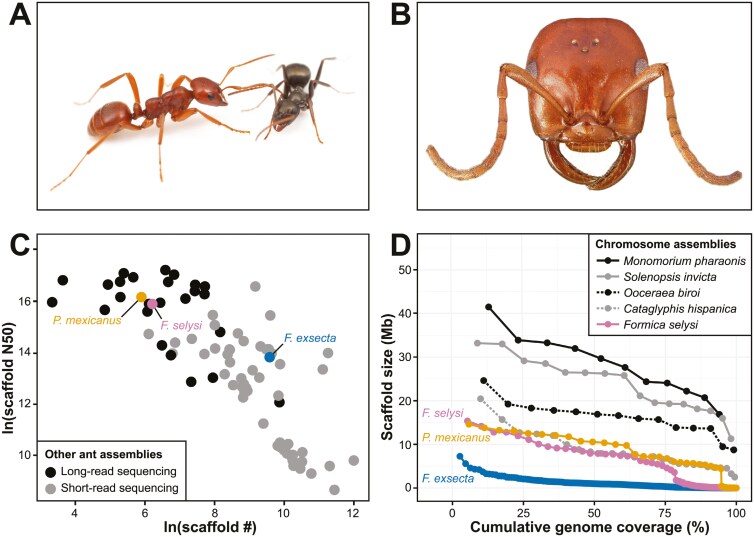 Fig. 1
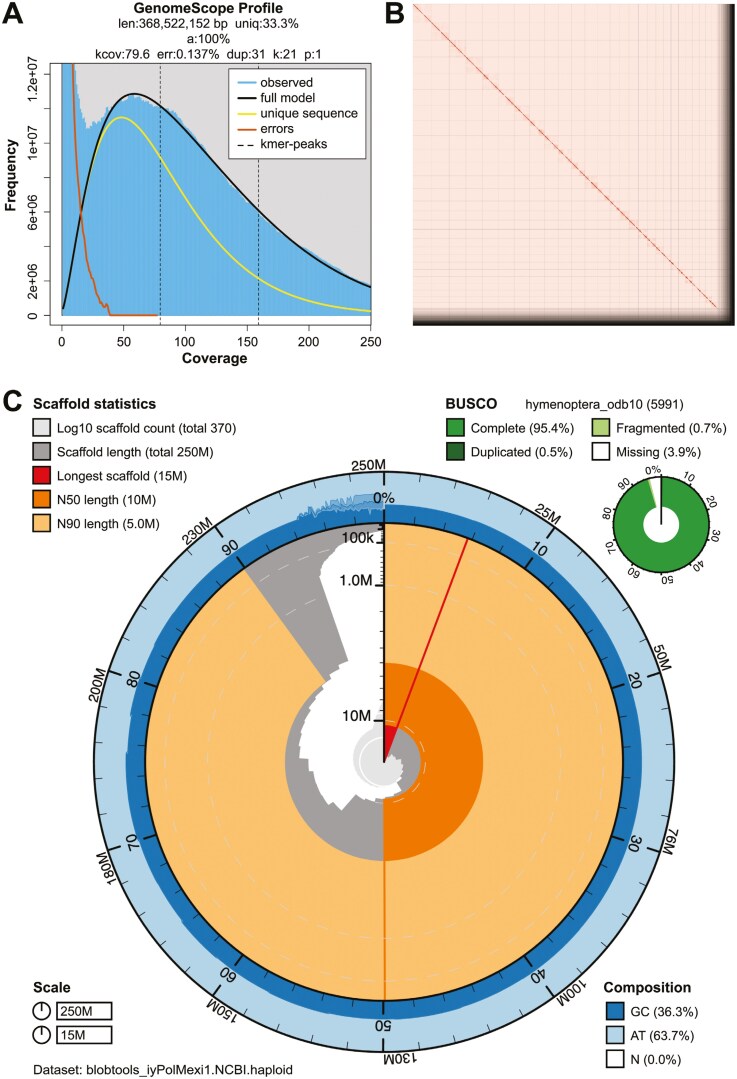 Fig. 2
| Assembly | Software and any non-default options | Version |
|---|---|---|
| Filtering PacBio HiFi adapters | HiFiAdapterFilt | Commit 64d1c7b |
| K-mer counting | Meryl ( | 1 |
| Estimation of genome size and heterozygosity | GenomeScope | 2 |
| De novo assembly (contiging) | HiFiasm (--n-hap 1 -l0) | 0.16.1-r375 |
| Scaffolding | ||
| Omni-C data alignment | Arima Genomics Mapping Pipeline | Commit 2e74ea4 |
| Omni-C Scaffolding | SALSA (-DNASE, -i 20, -p yes) | 2 |
| Gap closing | YAGCloser (-mins 2 -f 20 -mcc 2 -prt 0.25 -eft 0.2 -pld 0.2) | Commit 0e34c3b |
| Omni-C Contact map generation | ||
| Short-read alignment | BWA-MEM (-5SP) | 0.7.17-r1188 |
| SAM/BAM processing | samtools | 1.11 |
| SAM/BAM filtering | pairtools | 0.3.0 |
| Pairs indexing | pairix | 0.3.7 |
| Matrix generation | cooler | 0.8.10 |
| Matrix balancing | hicExplorer (hicCorrectmatrix correct --filterThreshold -2 4) | 3.6 |
| Contact map visualization | HiGlass | 2.1.11 |
| PretextMap | 0.1.4 | |
| PretextView | 0.1.5 | |
| PretextSnapshot | 0.0.3 | |
| Manual curation tools | Rapid curation pipeline (Wellcome Trust Sanger Institute, Genome Reference Informatics Team) | Commit 4ddca450 |
| Genome quality assessment | ||
| Basic assembly metrics | QUAST (--est-ref-size) | 5.0.2 |
| Assembly completeness | BUSCO (-m geno, -l hymenoptera) | 5.0.0 |
| Merqury | 2020-01-29 | |
| Contamination screening | ||
| Local alignment tool | BLAST+ (-db nt, -outfmt “6 qseqid staxids bitscore std,” -max_target_seqs 1, -max_hsps 1, -evalue 1e-25) | 2.10 |
| General contamination screening | BlobToolKit (PacBIo HiFi Coverage, NCBI Taxa ID = 262038, BUSCODB = Hymenoptera) | 2.3.3 |
| Mitochondrial assembly | ||
| Mitochondrial genome assembly | MitoHiFi (-r, -p 80, -o 1 -a animal) | 2.2 |
|
| ||
| Sequence alignment | lastz (--nogapped,--notransition, –step = 20) | 1.04.15 |
| Alignment visualization | LAJ ( | 2005-12-14 |
| Local alignment tool | BLAST+ (-db nt, -outfmt “6 qseqid staxids bitscore std,” -max_target_seqs 1, -max_hsps 1, -evalue 1e-25) | 2.1 |
| Completeness assessment | CheckM (taxon sets: genus | 1.2.2 |
| Genome annotation | bakta ( | 1.9.1| DB: 5.0.0 |
| Bio projects and vouchers | ||||||
|---|---|---|---|---|---|---|
| CCGP NCBI BioProject | PRJNA720569 | |||||
| Genera NCBI BioProject | PRJNA765828 | |||||
| Species NCBI BioProject | PRJNA808362 | |||||
| NCBI BioSample | SAMN35821861, SAMN35821862 | |||||
| Specimen identification | NDT 795.1, NDT 795.3 | |||||
| NCBI Genome accessions | ||||||
| Assembly accession | GCA_030449975.1 | |||||
| Genome sequences | ||||||
| Genome sequence | ||||||
| PacBio HiFi reads | Run | 1 PACBIO_SMRT (Sequel II) run: 3.3 M spots, 29.5 G bases, 14Gb | ||||
| Accession | SRX21253684 | |||||
| Omni-C Illumina reads | Run | 2 ILLUMINA (Illumina NovaSeq 6000) runs: 103 M spots, 31.1 G bases, 10.2 Gb | ||||
| Accession | SRX21253685, SRX21253686 | |||||
| Genome Assembly Quality Metrics | ||||||
| Assembly identifier (Quality code | iyPolMexi1(5.6.P5.Q55.C95) | |||||
| HiFi Read coverage | 101.03× | |||||
| Number of contigs | 1,151 | |||||
| Contig N50 (bp) | 481,250 | |||||
| Contig NG50 | 399,645 | |||||
| Longest Contigs | 3,834,916 | |||||
| Number of scaffolds | 364 | |||||
| Scaffold N50 | 10,364,369 | |||||
| Scaffold NG50 | 9,764,453 | |||||
| Largest scaffold | 14,608,128 | |||||
| Size of final assembly (bp) | 252,309,906 | |||||
| Phased block NG50 | 419,568 | |||||
| Gaps per Gbp (#Gaps) | 3121(788) | |||||
| Indel QV (Frame shift) | 43.65515337 | |||||
| Base pair QV | 55.3601 | |||||
| k-mer completeness | 96.154 | |||||
| BUSCO completeness |
|
|
|
|
| |
| 95.40% | 94.90% | 0.50% | 0.70% | 3.90% | ||
| Organelles (partial mitochondrial sequence) | Size (bp) | 15,803 | ||||
| Accession | ||||||
| Endosymbionts ( | Size (bp) | 1,225,351 | ||||
| Completeness | 98.55% | |||||
| Accession | ||||||
- —California Conservation Genomics Project
- —United States Department of Agriculture Hatch Projects
Peer Reviews
No public reviews on file for this paper yet. If you reviewed it on a platform where reviews are public (OpenReview, ICLR, NeurIPS, ICML), you can paste yours below so the community can read it here.
Videos
No videos yet. Explain this paper in a talk, walkthrough, or lecture? Add one.
Taxonomy
TopicsInsect and Arachnid Ecology and Behavior · Insect symbiosis and bacterial influences · Plant and animal studies
Introduction
Polyergus kidnapper ants are obligate social parasites that are widespread, but relatively uncommon, in the northern hemisphere. In California, two nominal taxa are currently recognized, Polyergus mexicanus and Polyergus vinosus, and they parasitize several different species of ants from the closely related genus, Formica, by capturing larvae and pupae in dramatic, well-organized raids on Formica colonies (Trager 2013). The captured Formica mature into adult workers within the Polyergus colony, imprint on the colony odors in their new home, and begin to perform normal worker behaviors for the benefit of their Polyergus captors. As a result, foraging, nest excavation, brood care, and other essential tasks in Polyergus colonies are performed by their Formica captives (Topoff et al. 1989; Trager 2013). In California, P. mexicanus can parasitize at least eight out of an estimated 40 nominal Formica species present in the state, but each Polyergus colony usually specializes in using only one of these potential host species (Wheeler 1915; Ward 2005; Torres et al. 2018, Fig. 1A and B). Recent genetic studies, based on mitochondrial DNA and microsatellite markers, have shown that substantial cryptic diversity exists within P. mexicanus, where new host-associated races of P. mexicanus appear to be diverging into incipient species as they adapt to exploiting different Formica hosts (Torres et al. 2018). As greater clarity on this cryptic, co-evolutionary diversity unfolds, genomic resources including reference genomes and associated statewide population genomic sampling as part of the California Conservation Genomics Projects (CCGP; Shaffer et al. 2022) will help identify genetically unique populations, cryptic species, and geographic regions of high conservation value (Fiedler et al. 2022).
Kidnapper ant, Polyergus mexicanus, and genome assembly comparisons. A) Representative worker of P. mexicanus (left) with a parasitized host Formica worker (right) (image credit: Elizabeth I. Cash). B) Close-up of a P. mexicanus worker head showing distinctive sickle-shaped mandibles specialized for carrying raided larvae and pupae from host ant colonies (image credit: April Nobile, specimen: CASENT0005397, from: https://www.antweb.org). C) Scatterplot of genome metrics for 83 ant genomes representing 61 species with scaffold-level assemblies accessed via NCBI Datasets (see Supplementary Table S1 for full details). Three focal species, P. mexicanus (this study, long-read sequencing), Formica selysi (Brelsford et al. 2020, long-read sequencing), and F. exsecta (Dhaygude et al. 2019, short-read sequencing), are highlighted to compare scaffold assemblies of these closely related taxa with 80 other ant genome assemblies (shaded according to sequencing method, i.e. long- versus short-read lengths). D) Lineplot of genome metrics comparing six ant species with P. mexicanus. The size of each chromosome or scaffold (Mb) is displayed on the y axis and color formatted by species. The cumulative genome coverage (%) is represented on the x axis by the sum of the preceding chromosome or scaffold size(s) up to a given point. Chromosome-level assemblies for five ant species (Cataglyphis hispanica, F. selysi, Monomorium pharaonis, Ooceraea biroi, and Solenopsis invicta) are compared to focal ant species with scaffold-level assemblies (P. mexicanus and F. exsecta) showing the similarity between assembled scaffold sizes of P. mexicanus (this study) and chromosome sizes of a closely related species, F. selysi (see Supplementary Table S2).
Several features of P. mexicanus make it an important conservation target. First, the highly specialized life history of P. mexicanus translates into relative rarity, as this social parasite relies on thriving populations of its host Formica species to persist. In addition, the range of P. mexicanus extends to extremely high elevation sites throughout the Sierra Nevada and other mountain ranges in western United States, which are among the habitats likely to be affected by increasing global temperatures, changing patterns of precipitation, and increased frequency and intensity of wildfires. Finally, the extensive population differentiation and cryptic species diversity in this complex suggests that incipient species with highly restricted geographic ranges are likely to exist, and maybe imperiled by changing land use practices, habitat fragmentation, and global climate change. In this context, the CCGP is particularly interested in understanding and mitigating these risks through genetically informed conservation strategies (Shaffer et al. 2022).
We report here a de novo reference genome assembly for P. mexicanus, which serves as an important tool for analyzing population genomic datasets including divergence patterns within P. mexicanus. The reference genome also enables studies of the potential impacts of climate change on P. mexicanus at its range limits and offers insights into the evolution of their unique behaviors. Specifically, the genome allows researchers to investigate genetic adaptations related to thermal tolerance and stress responses (Franks and Hoffman 2012), as well as the genetic basis of parasitic behaviors due to loss of worker-associated genes, the gain of parasite-associated genes, and/or the reconfiguration of genes associated with social behavior (Cini et al. 2015; Smith et al. 2015), providing a comprehensive tool for understanding both ecological impacts and evolutionary mechanisms. Existing genomic resources for Polyergus include lower coverage double digest restriction-site associated DNA (ddRAD) sequences from a P. mexicanus male collected at Donner Pass in the Sierra Nevada and from a P. vinosus female collected from Santa Cruz Island, California (Brelsford et al. 2020). Additionally, genomic resources for closely related Formica species include a chromosome-level whole genome assembly of F. selysi (Brelsford et al. 2020) and a scaffold-level whole genome assembly of F. exsecta (Dhaygude et al. 2019). We highlight comparisons between P. mexicanus (this study) and the whole genome sequences of these two Formica species as well as the whole genome sequences of other ant species currently available in the NCBI genome database (Fig. 1C and D).
Methods
Biological materials
A large P. mexicanus colony fragment was collected from a fallen log approximately 2.8 km east of La Porte, California (39.69222, −120.95389) on 02 August 2020 by N. D. Tsutsui (collection number NDT 795). A single male alate (NDT 795.1) was used for HiFi SMRTbell library construction and sequencing and three adults (diploid female) workers (NDT 795.3) were used for Omni-C library construction and sequencing. Additionally, morphological analysis identified the host species of this colony as Formica accreta (determined by P. S. Ward, collection number NDT 795.H1). Voucher specimens from this colony were assigned unique specimen codes CASENT0885504 (P. mexicanus) and CASENT0885505 (host F. accreta), and have been deposited in the Bohart Museum of Entomology, University of California, Davis.
High molecular weight genomic DNA isolation
A flash-frozen adult male ant was homogenized in 500 µL of homogenization buffer (10 mM Tris-HCL-pH 8.0 and 25 mM EDTA) using TissueRuptor II (Qiagen, Germany; Cat # 9002755). Lysis buffer (500 µL, 10 mM Tris, 25 mM EDTA, 200 mM NaCl, and 1% SDS) and proteinase K (500 µL, 100 µg/mL) were added to the homogenate, and it was incubated overnight at room temperature. Lysate was treated with RNAse A (20 µg/mL) at 37 °C for 30 min and was cleaned with equal volumes of phenol/chloroform using phase-lock gels (Quantabio Cat # 2302830). The DNA was precipitated by adding 0.4× volume of 5 M ammonium acetate and 3× volume of ice-cold ethanol. The DNA pellet was washed twice with 70% ethanol and resuspended in an elution buffer (10 mM Tris, pH 8.0). DNA was further cleaned with 1× KAPA Pure SPRI beads. Total DNA yield was 30 ng as measured by the Qubit 2.0 Fluorometer (Thermo Fisher Scientific, Waltham, MA). Integrity of the HMW gDNA was verified on a Femto pulse system (Agilent Technologies, Santa Clara, CA), with 52% of DNA in fragments larger than 50 kb in length.
Nucleic acid library preparation
The HiFi SMRTbell library was constructed using the SMRTbell gDNA Sample Amplification Kit (Pacific Biosciences—PacBio, Menlo Park, CA; Cat. #101-980-000) and the SMRTbell Express Template Prep Kit 2.0 (PacBio; Cat. #100-938-900) according to the manufacturer’s instructions. HMW gDNA was sheared to around 10 kb using the Diagenode Megaruptor 3 system (Diagenode, Belgium; Cat. #B06010003). The sheared gDNA was incubated at 37 °C for 15 min to remove single-strand overhangs, followed by DNA damage repair at 37 °C for 30 min, end repair and A-tailing at 20 °C for 30 min and 65 °C for 30 min, and ligation of overhang adapters at 20 °C for 60 min. To prepare for library amplification by PCR, the library was purified with ProNex beads (Promega, Madison, WI; Cat. # NG2002) for two PCR amplification conditions at 15 cycles each then another ProNex beads purification. Purified amplified DNA from both reactions were pooled in equal mass quantities for another round of enzymatic steps that included DNA repair, end repair/A-tailing, overhang adapter ligation, and purification with ProNex Beads. The PippinHT system (Sage Science, Beverly, MA; Cat # HPE7510) was used for SMRTbell library size selection to remove fragments <6 kb. The 10 kb average HiFi SMRTbell library was sequenced at UC Davis DNA Technologies Core (Davis, CA) using one 8 M Single-molecule Real Time (SMRT) cell, Sequel II sequencing chemistry 2.0, and 30-h movies each on a PacBio Sequel II sequencer.
Omni-C preparation
The Omni-C library was prepared using the Dovetail Omni-C Kit (Dovetail Genomics, Scotts Valley, CA) according to the manufacturer’s protocol with slight modifications. First, specimen tissue (whole individuals, three adult workers, NDT 795.3) was thoroughly ground with a mortar and pestle while cooled with liquid nitrogen. Subsequently, chromatin was fixed in place in the nucleus. The suspended chromatin solution was then passed through 100 µm and 40 µm cell strainers to remove large debris. Fixed chromatin was digested under various conditions of DNase I until a suitable fragment length distribution of DNA molecules was obtained. Chromatin ends were repaired and ligated to a biotinylated bridge adapter followed by proximity ligation of adapter-containing ends. After proximity ligation, crosslinks were reversed and the DNA was purified from proteins. Purified DNA was treated to remove biotin that was not internal to ligated fragments. An NGS library was generated using an NEB Ultra II DNA Library Prep kit (NEB, Ipswich, MA) with an Illumina-compatible y-adaptor. Biotin-containing fragments were then captured using streptavidin beads. The post-capture product was split into two replicates before PCR enrichment to preserve library complexity with each replicate receiving unique dual indices. The library was sequenced at Vincent J. Coates Genomics Sequencing Lab (Berkeley, CA) on an Illumina NovaSeq 6000 platform (Illumina, San Diego, CA) to generate approximately 100 million 2 × 150 bp read pairs per GB of genome length.
DNA sequencing and genome assembly
Nuclear genome assembly
We assembled the P. mexicanus genome following the CCGP assembly pipeline for haploid species, as outlined in Table 1, which lists the tools and non-default parameters used in the assembly. The pipeline uses both the PacBio HiFi reads and Omni-C data to produce highly contiguous genome assemblies. First, we removed the remnant adapter sequences from the PacBio HiFi dataset using HiFiAdapterFilt (Sim et al. 2022) and generated an initial haploid assembly using HiFiasm (Cheng et al. 2022) based on the filtered PacBio HiFi reads. During the initial assembly, we specified no purging and the ploidy corresponding to the sequenced haploid male. From the generated output, we kept the file corresponding to the primary assembly file. We then aligned the Omni-C data to the assembly following the Arima Genomics Mapping Pipeline (https://github.com/ArimaGenomics/mapping_pipeline) and then scaffolded it with SALSA (Ghurye et al. 2017, 2019).
The assembly was manually curated by generating and analyzing the corresponding Omni-C contact maps and breaking scaffolds when misassemblies were identified. In general, to generate the contact maps, we aligned the Omni-C data with BWA-MEM (Li 2013), identified ligation junctions, and generated Omni-C pairs using pairtools (Open2C et al. 2024). We generated multi-resolution Omni-C matrices with cooler (Abdennur and Mirny 2020) and balanced them with hicExplorer (Ramírez et al. 2018). We used HiGlass (Kerpedjiev et al. 2018) and the PretextSuite (https://github.com/wtsi-hpag/PretextView; https://github.com/wtsi-hpag/PretextMap; https://github.com/wtsi-hpag/PretextSnapshot) to visualize the contact maps where we identified misassemblies and misjoins. Some remaining gaps (joins generated during scaffolding and/or curation) were closed using the PacBio HiFi reads and YAGCloser (https://github.com/merlyescalona/yagcloser). Finally, we checked for contamination using the BlobToolKit Framework (Challis et al. 2020).
Genome quality assessment
We generated k-mer counts from the PacBio HiFi reads using meryl (https://github.com/marbl/meryl). The k-mer counts were then used in GenomeScope 2.0 (Ranallo-Benavidez et al. 2020) to estimate genome features including genome size, heterozygosity, and repeat content. To obtain general contiguity metrics, we ran QUAST (Gurevich et al. 2013). To evaluate genome quality and functional completeness, we used Benchmarking Universal Single-Copy Orthologs (BUSCO) (Manni et al. 2021) with the Hymenoptera ortholog database (hymenoptera_odb10) which contains 5,991 genes. Base level accuracy (QV) and k-mer completeness were assessed using the previously generated meryl database and merqury (Rhie et al. 2020). We further estimated genome assembly accuracy via BUSCO gene set frameshift analysis using the pipeline described in Korlach et al. (2017). Given that the specimen used for the assembly is haploid, measurements of the size of the phased blocks are based on the size of the final contigs. We follow the quality metric nomenclature established by Rhie et al. (2021), with the genome quality code x.y.P.Q.C, where, x = log10[contig NG50]; y = log10[scaffold NG50]; P = log10 [phased block NG50]; Q = Phred base accuracy QV (quality value); C = % genome represented by the first “n” scaffolds, assuming a karyotype of n = 27, which is the number of chromosomes for other species in the genus (Imai 1966).
Mitochondrial genome assembly
We assembled the P. mexicanus mitochondrial genome from the PacBio HiFi reads using the reference-guided pipeline MitoHiFi (Allio et al. 2020; Uliano-Silva et al. 2023). The mitochondrial sequence of Formica sinae (NCBI: NC_060873.1) was used as the starting sequence. After completion of the nuclear genome, we searched for matches of the resulting mitochondrial assembly sequence in the nuclear genome assembly using BLAST+ (Camacho et al. 2009) and filtered out contigs and scaffolds from the nuclear genome with a sequence identity >99% and size smaller than the mitochondrial assembly sequence. No other manual curation was performed on the mitochondrial genome.
Endosymbiont genome assembly
We used the genome of Wolbachia endosymbiont of Cardiocondyla obscurior (NCBI: GCA_902713645.1; WoCaobscurior_wCobs-JP2010-OypB_1) as a guide to find the Wolbachia endosymbiont genome present in our initial P. mexicanus assembly. We aligned the contigs removed from the nuclear genome in the contamination process to the assembly ID reference using BLAST+. We visually inspected the circularity of the endosymbiont contig using lastz (Harris 2007) and LAJ (Wilson et al. 2001). Finally, we used bakta (Schwengers et al. 2021) to generate a draft genome annotation of the bacterial genome and we used CheckM (Parks et al. 2015) to assess completeness of the genome.
Genome assembly comparisons
We compared basic scaffold-level genome assembly metrics for 61 ant species currently available in the NCBI genome database (Supplementary Table S1). Scaffold number versus scaffold N50 (ln transformed) were plotted using ggplot2 in R (Wickham 2016) to visualize differences in contiguity between ant genome assemblies (Fig. 1C). Additionally, scaffold and chromosome sizes (Mb) were plotted relative to genome coverage (%) for four ant species with chromosome-level assemblies (Cataglyphis hispanica, Monomorium pharaonis, Ooceraea biroi, and Solenopsis invicta) along with two Formica species, F. exsecta (Dhaygude et al. 2019) and F. selysi (Brelsford et al. 2020), and the kidnapper ant, P. mexicanus (this study), to compare mapping results among genome assemblies (Fig. 1D, Supplementary Table S2).
Results
Sequencing data
The Omni-C and PacBio HiFi sequencing libraries generated 102.99 million read pairs and 3.25 million reads, respectively. The latter yielded 101.03-fold coverage (N50 read length 9,167 bp; minimum read length 123 bp; mean read length 9,181 bp; maximum read length of 33,305 bp) based on the GenomeScope 2.0 genome size estimation of 368.52 Mb. We estimated a 0.137% sequencing error based on PacBio HiFi reads, and the k-mer spectrum shows a unimodal distribution with a single major peak at ~80 (Fig. 2A).
Visual overview of Polyergus mexicanus genome assembly metrics. A) K-mer spectra output generated from PacBio HiFi data without adapters using GenomeScope 2.0. The observed unimodal pattern corresponds to a haploid genome. B) Omni-C contact map for the scaffold-level genome assembly generated with PretextSnapshot. The Omni-C contact map translates proximity of genomic regions in 3D space to contiguous linear organization. Each cell in the contact map corresponds to sequencing data supporting the linkage (or join) between two such regions. Scaffolds are separated by black lines, with higher density corresponding to higher levels of fragmentation. C) BlobToolKit Snail plot showing a graphical representation of the quality metrics presented in Table 2 for the P. mexicanus assembly (iyPolMexi1) and BUSCO assessment results based on the Hymenoptera set of orthologous genes (n = 5,991). The plot circle represents the full size of the assembly. From the inside to the outside, the central plot covers length-related metrics. The red line represents the size of the longest scaffold; all other scaffolds are arranged in size-order moving clockwise around the plot and drawn in gray starting from the outside of the central plot. Dark and light orange arcs show the scaffold N50 and scaffold N90 values, respectively. The central light gray spiral shows the cumulative scaffold count with a white line at each order of magnitude. White regions in this area reflect the proportion of Ns in the assembly. The dark versus light blue area around it shows mean, maximum, and minimum GC versus AT content at 0.1% intervals.
Nuclear and mitochondrial genome assembly
The size of the final P. mexicanus assembly (iyPolMexi1) was similar but not equal to the estimated value from GenomeScope 2.0 (Fig. 2A), as has been observed in other taxa (see Pflug et al. 2020 for an example). The genome coverage was 101.03× and the assembly consists of 364 scaffolds spanning 252.31 Mb, with contig N50 of 0.48 Mb, scaffold N50 of 10.36 Mb, largest contig of 3.83 Mb, and largest scaffold of 14.60 Mb. The estimated BUSCO completeness score of the iyPolMexi1 assembly corresponds to 95.4% using the Hymenoptera gene set, with a per base quality (QV) of 55.36, a k-mer completeness of 96.15%, and a frameshift indel QV of 43.65.
During manual curation, we made 461 joins and 34 breaks. In the gap-closing step, we were able to close a total of three gaps. We filtered out 91 contigs corresponding to bacterial contamination from Fructilactobacillus (2,579,852 bp), Oecophyllibacter (2,314,524 bp), Wolbachia (1,603,876 bp), and an undefined Acetobacteraceae bacterium (2,078,418 bp), as well as two contigs corresponding to viral contamination from Iridovirus Liz-CrIV (192,140 bp, Supplementary Table S3). No further contigs were removed. The Omni-C contact map of the scaffold assembly shows that the genome was highly contiguous (Fig. 2B). A graphical representation of the genome assembly is shown in Fig. 2C, and detailed assembly statistics are reported in Table 2. We have deposited the genome assembly in GenBank (see Table 2 and Data Availability for details).
We assembled a partial mitochondrial genome for P. mexicanus with MitoHiFi. The mitochondrial sequence has a size of 15,803 bp, with a nucleotide composition biased toward A + T content (A = 40.02%, T = 41.38%, G = 12.90%, C = 5.69%), and consists of 11 unique transfer RNAs and 17 protein-coding genes. Given its smaller, potentially incomplete, size (i.e. 90.7% of the bp length compared with Formica sinae), the partial mitochondrial assembly is included with the nuclear genome assembly as a separate scaffold (Table 2).
Endosymbiont genome assembly
The final Wolbachia endosymbiont of the P. mexicanus genome (icPolMex1_wolbachia, GenBank accession CP158586) was a single, circular, gapless contig with a final size of 1,225,351 bp (Supplementary Fig. S1), which was similar to the reference used as a guide (Wolbachia endosymbiont of C. obscurior, GCA_902713645.1; genome size = 1,299,373 bp, Supplementary Table S4). CheckM analysis of genome completeness at the genus level (Wolbachia) and the family level (Anaplasmataceae) were 98.55% and 99.06%, respectively, and the contamination and strain heterogeneity values were 0.00% for both taxonomic-level comparisons. The base composition of the final assembly was A = 32.38%, T = 32.28%, G = 17.77%, C = 17.57%. Bakta annotation of the Wolbachia genome identified 1,161 coding sequences, 34 transfer RNAs, 1 transfer-messenger RNA, 3 ribosomal RNAs, 18 non-coding RNAs, 1 non-coding RNA cis-regulatory region, and 1 origin of replication (oriC) feature.
Assembly comparisons
Genome metrics indicate that the kidnapper ant assembly was highly contiguous (364 scaffolds, scaffold N50 of 10.36 Mb), with a scaffold number and scaffold N50 comparable to other available ant genomes generated with long-read sequencing methods (Fig. 1C, Supplementary Table S1). Although chromosome assignments were not determined for P. mexicanus, 27 out of the 364 total scaffolds in the genome assembly approach sizes >4 Mb (mean ± SD = 8.84 ± 3.26 Mb), make up >94% of the genome assembly, and are comparable to the average chromosome sizes of genome assemblies from five representative ant species including the closely related species F. selysi (mean ± SD = 8.41 ± 3.05 Mb, Fig. 1D, Supplementary Table S2).
Discussion
The development of this reference genome for P. mexicanus fills an important gap for a genus that has a rich history of behavioral ecological research, but relatively few genomic resources. As obligate social parasites, Polyergus species exhibit a syndrome of unusual mating, colony-founding, and host-kidnapping behaviors (Trager 2013; Sapp et al. 2020). At the same time, these species have lost the ability to perform most typical worker ant behaviors, including foraging, nest excavation, and brood care (Topoff 1990). Persistence of P. mexicanus populations relies on robust populations of their host Formica, and recent studies in California have shown that P. mexicanus forms specialized, genetically divergent, host-associated lineages (Torres et al. 2018). In addition to their direct impacts on host Formica species, Polyergus are also influenced by host-competition with other socially parasitic Formica species and play important roles in maintaining ecosystem balance through these interactions (Mori et al. 2001). Currently, there are no known genomic underpinnings linked to the specific suite of parasitic behaviors exhibited by Polyergus kidnapper ants. The reference genome presented here provides a critical starting point for future studies into the genetic basis of this behavioral co-evolution.
Our P. mexicanus reference genome assembly is highly accurate, with excellent coverage (>100×) and BUSCO completeness (>95%). Compared to other ant genome assemblies, it is also highly contiguous with scaffold and scaffold N50 values similar to that of the chromosome-level genome assembly of the closely related F. selysi as well as other ant species sequenced with long-read methods (Fig. 1C, Supplementary Table S1). The 27 largest P. mexicanus scaffolds comprise 94.6% of the genome assembly, matching the predicted chromosome number of n = 27 for P. mexicanus based on the reported karyotypes of the related species Polyergus samurai (Imai 1966). Furthermore, these 27 scaffolds are similar to the assembled chromosome sizes of F. selysi and four other representative ant species (Fig. 1D, Supplementary Table S2). Taken together, these results indicate that our P. mexicanus genome is essentially a chromosome-level assembly, with less than 6% fragmented into smaller scaffolds.
The assembled size of this genome (252.31 Mb) is very close to genome size estimates by flow cytometry of P. mexicanus from Sagehen Creek, California (six individuals; mean = 262.9 Mb ± 1.3 SE) and Polyergus breviceps from near Barfoot Peak, Arizona (three individuals; mean = 264.1 Mb ± 2.7 SE, N. D. Tsutsui and J. S. Johnston, unpublished data). Although other Polyergus reference genomes have not been published, comparison to genomes of the relatively closely related Formica suggests that Polyergus may have reduced genome sizes. Our P. mexicanus assembly is moderately smaller than the assemblies for F. exsecta (277.7 Mb, Dhaygude et al. 2019) and F. selysi (290 Mb, Brelsford et al. 2020), and much smaller than the flow cytometry estimate for F. pallidefulva (385.1 Mb, Tsutsui et al. 2008). Our P. mexicanus mitochondrial genome assembly (15,803 bp) is also smaller than the mitochondrial genome assembly of F. selysi (16,752 bp, Brelsford et al. 2020), although it is currently unclear if the small size might be due to incomplete assembly or reduced genome size for this species. Despite this, the inclusion of the partial mitochondrial genome assembly is valuable for future studies of mitochondrial evolution in this genus. Development of additional genomic resources will reveal if reduced genome size is a general pattern across Polyergus and, if so, may indicate that the parasitic life history of Polyergus has led directly to genomic reductions.
We also assembled the Wolbachia bacterial endosymbiont of P. mexicanus whose size and completeness are similar to assemblies of Wolbachia endosymbionts reported for other ant species available on NCBI’s Genome database (Supplementary Table S4). Wolbachia endosymbionts play a significant role in insect biology, influencing aspects of reproduction, behavior, and immunity (Werren et al. 2008), and in ants Wolbachia have been shown to influence sex ratios, colony development, and nutrient metabolism (Pontieri et al. 2017; Cheng et al. 2019; Singh and Linksvayer 2020). Understanding the genomic mechanisms underlying Wolbachia–ant interactions can provide insights into ant evolution and the effects of Wolbachia on ant biodiversity. Furthermore, uncovering the diversity and distribution of Wolbachia strains in ants contributes to our broader understanding of microbial symbiosis and its impact on ecological communities.
Overall, the reference genome of the P. mexicanus kidnapper ant will be a crucially important resource for future studies of topics including speciation and the evolution of reproductive isolation, host/parasite co-evolution, behavioral ecology, and chemical ecology. In addition, this reference genome sequence will improve our understanding of conservation issues related to California Polyergus, which likely include geographically restricted California endemic species of this vulnerable group of ants (IUCN 2023). These studies will clarify the taxonomy of the species in this genus, contribute to larger goals of the CCGP (Shaffer et al. 2022), and fill an important phylogenetic gap in our genomic understanding of California biodiversity (Toffelmier et al. 2022).
Supplementary material
Supplementary material is available at Journal of Heredity online.
esae047_suppl_Supplementary_Table_S1
esae047_suppl_Supplementary_Table_S2
esae047_suppl_Supplementary_Table_S3
esae047_suppl_Supplementary_Figure_S1
esae047_suppl_Supplementary_Table_S4
The reference list from the paper itself. Each links out to its DOI / PubMed record.
- 1Abdennur N , Mirny LA. Cooler: scalable storage for Hi-C data and other genomically labeled arrays. Bioinformatics. 2020:36:311–316. doi: https://doi.org/10.1093/bioinformatics/btz 54031290943 PMC 8205516 · doi ↗ · pubmed ↗
- 2Allio R , Schomaker-Bastos A, Romiguier J, Prosdocimi F, Nabholz B, Delsuc F. Mito Finder: efficient automated large-scale extraction of mitogenomic data in target enrichment phylogenomics. Mol Ecol Resour. 2020:20:892–905. doi: https://doi.org/10.1111/1755-0998.1316032243090 PMC 7497042 · doi ↗ · pubmed ↗
- 3Brelsford A , Purcell J, Avril A, Van PT, Zhang J, Brütsch T, Chapuisat M. An ancient and eroded social supergene is widespread across Formica ants. Curr Biol. 2020:30:304–311.31902719 10.1016/j.cub.2019.11.032 · doi ↗ · pubmed ↗
- 4Camacho C , Coulouris G, Avagyan V, Ma N, Papadopoulos J, Bealer K, Madden TL. BLAST+: architecture and applications. BMC Bioinf. 2009:10:421.10.1186/1471-2105-10-421PMC 280385720003500 · doi ↗ · pubmed ↗
- 5Challis R , Richards E, Rajan J, Cochrane G, Blaxter M. . Blob Tool Kit—interactive quality assessment of genome assemblies. G 3 Genes|Genomes|Genetics. 2020:10:1361–1374. doi: https://doi.org/10.1534/g 3.119.40090832071071 PMC 7144090 · doi ↗ · pubmed ↗
- 6Cheng D , Chen S, Huang Y, Pierce NE, Riegler M, Yang F, Xu Y. Symbiotic microbiota may reflect host adaptation by resident to invasive ant species. P Lo S Pathog. 2019:15:e 1007942. doi: https://doi.org/10.1371/journal.ppat.100794231323076 PMC 6668852 · doi ↗ · pubmed ↗
- 7Cheng H , Jarvis ED, Fedrigo O, Koepfli K-P, Urban L, Gemmell NJ, Li H. Haplotype-resolved assembly of diploid individuals without parental data. Nat Biotechnol. 2022:40:1332–1335. doi: https://doi.org/10.1038/s 41587-022-01261-x 35332338 PMC 9464699 · doi ↗ · pubmed ↗
- 8Cini A , Patalano S, Segonds-Pichon A, Busby GB, Cervo R, Sumner S. Social parasitism and the molecular basis of phenotypic evolution. Front Genet. 2015:6:120930. doi: https://doi.org/10.3389/fgene.2015.00032 PMC 433235625741361 · doi ↗ · pubmed ↗