
TL;DR
Scientists engineered tobacco plants to create microcompartments that improve photosynthesis, potentially boosting crop productivity and addressing climate challenges.
Contribution
The study demonstrates the use of synthetic biology to create functional Rubisco condensates in chloroplasts, enhancing photosynthetic efficiency.
Findings
Fusing GFP to Rubisco forms functional condensates in chloroplasts of tobacco plants.
These condensates maintain CO2-fixing activity and support plant growth.
The approach offers a new strategy for improving photosynthesis and crop productivity.
Abstract
Front cover image: Fusing green fluorescent protein (GFP) to Rubisco results in formation of functional Rubisco condensates within the chloroplasts of engineered tobacco plants, creating dynamic, liquid‐like microcompartments that maintain CO2‐fixing activity and plant grow. The study paves the way for employing synthetic biology to enhance photosynthetic efficiency and crop productivity to address climate challenges. Cover illustration refers to the article published in this issue (Chen et al., pp. 2140–2149).
Genes, proteins, chemicals, diseases, species, mutations and cell lines named across the full text — each resolved to its canonical identifier and authoritative record.
Click any figure to enlarge with its caption.
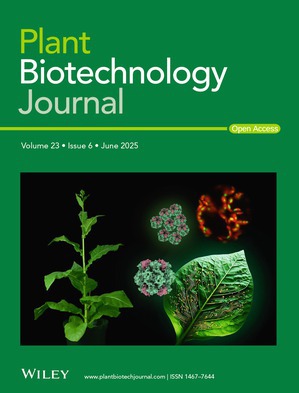 Figure 1
Peer Reviews
No public reviews on file for this paper yet. If you reviewed it on a platform where reviews are public (OpenReview, ICLR, NeurIPS, ICML), you can paste yours below so the community can read it here.
Videos
No videos yet. Explain this paper in a talk, walkthrough, or lecture? Add one.
Taxonomy
TopicsPhotosynthetic Processes and Mechanisms · Plant nutrient uptake and metabolism · Plant-Microbe Interactions and Immunity