A multicenter prospective study evaluating use of EmboCube™ Embolization Gelatin alone or in combination with other embolic agents to control bleeding
Olivier Pellerin, Julien Frandon, Glen Schlaphoff, Ross Copping, Carole Déan, Warren Clements

TL;DR
This study shows that EmboCube embolization gelatin is safe and effective for stopping bleeding, either alone or with other agents.
Contribution
The study provides real-world evidence of EmboCube's safety and effectiveness in controlling bleeding across multiple hospitals.
Findings
EmboCube achieved 100% technical success and 99% clinical success in stopping bleeding.
No unanticipated serious adverse events were linked to EmboCube use.
Only 4.4% of patients experienced adverse events within 28 days of treatment.
Abstract
Embolization is a vital endovascular procedure that can be used to quickly achieve hemostasis in patients experiencing uncontrolled bleeding. This study was conducted to describe real-world outcomes following embolization with a pre-cut absorbable gelatin sponge to control bleeding. This prospective study was conducted across five hospitals in Australia and France. Inclusion criteria included adults ≥ 18 years who required embolization with EmboCube™ Embolization Gelatin for bleeding. Primary performance and safety endpoints were the proportion of patients that achieved clinical success (i.e., cessation of bleeding post-embolization, the absence of rebleeding at the treated site requiring reintervention within 24 h), and the absence of unanticipated serious adverse device effects within 24 h of the initial embolization, respectively. Secondary endpoints included technical success and…
Genes, proteins, chemicals, diseases, species, mutations and cell lines named across the full text — each resolved to its canonical identifier and authoritative record.
Click any figure to enlarge with its caption.
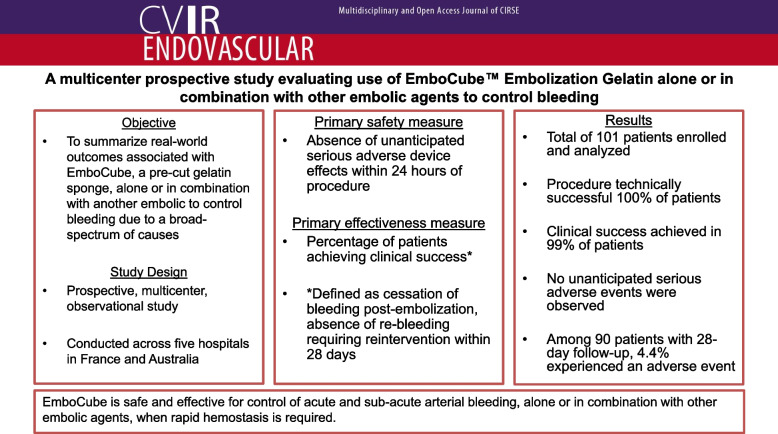 Figure 1
- —http://dx.doi.org/10.13039/100019484Merit Medical Systems
Peer Reviews
No public reviews on file for this paper yet. If you reviewed it on a platform where reviews are public (OpenReview, ICLR, NeurIPS, ICML), you can paste yours below so the community can read it here.
Videos
No videos yet. Explain this paper in a talk, walkthrough, or lecture? Add one.
Taxonomy
TopicsCase Reports on Hematomas · Abdominal vascular conditions and treatments · Hemostasis and retained surgical items
Introduction
Bleeding can result from trauma- (e.g., pelvic, visceral) and non-trauma-related (e.g., spontaneous, gynecologic, iatrogenic) causes [1, 2]. The inability to control bleeding is a leading cause of preventable death [3]. Hemorrhage control is critical to lowering mortality [4]. Embolization is an expedient nonsurgical intervention often used to achieve hemostasis in diseased or ruptured vasculature [5–7]. Several types of temporary (e.g., absorbable gelatin sponge) and permanent (e.g., coils, calibrated microspheres, liquid agents such as N-Butyl-Cyanoacrylate or NBCA) embolics are available for the occlusion of blood vessels [5, 8–13]. The type of embolic, or combination of embolic agents, to control bleeding is determined based on several factors such as vessel size, location, flow dynamics, extent of hemorrhage, pre-existing coagulopathy, and physician preference [14, 15].
Of the available products, gelatin-based embolics have been used as an intravascular embolic agent for over 50 years [5, 16]. Since its first reported use in 1945 [17], several studies have reported successful use of gelatin-based embolics for cessation of trauma-related bleeding [9, 18] and to stop bleeding in areas such as the gastrointestinal tract, spleen, uterus/pelvis, and kidney [19–32]. In general, gelatin-based embolics (i.e., gelatin sponge) are considered a safe and effective agent to control bleeding. According to the Eastern Association for the Surgery of Trauma (EAST) guidelines, gelatin sponges are particularly recommended in locations where rapid but temporary occlusion may be desired, commonly following pelvic trauma when used non-selectively [33]. Although the clinical utility of gelatin-based embolics has been recognized by different treatment guidelines, there is no universal standard regarding which embolic, or combination of agents, to use [34, 35]. As a result, treatment practices can vary across indications.
In 2022, the gelatin-based embolic, EmboCube™ Embolization Gelatin, received the Conformité Européenne (CE) Mark in Europe. A beneficial aspect of EmboCube is its availability in the form of pre-cut cubes. Prior to the emergence of EmboCube, clinicians manually cut gelatin sheets, which was a potentially time-consuming task resulting in non-uniform particles. Evidence indicates that EmboCube is associated with high rates of technical and clinical success [36, 37]. However, there is an on-going need for data confirming its benefit to patients. This study describes clinical outcomes following use of EmboCube in real-world practice to control bleeding due to a broad spectrum of causes among patients in Australia and France.
Methods
Study design
This was a prospective study conducted across five centers, two in France, three in Australia. To be eligible for inclusion in the study, consecutive patients were required to be ≥ 18 years of age, require embolization for bleeding that could be performed in accordance with the device’s Instructions for Use, and provide written and informed consent. The full list of country-specific inclusion and exclusion criteria are provided in Table 1. The eligibility criteria were broad as a key objective of this study was to capture real-world use of EmboCube Embolization Gelatin (Merit Medical Systems, Inc., South Jordan, Utah, USA), including the wide spectrum of bleeding indications, treated vessels, and patient profiles. Table 1. Country-specific inclusion and exclusion criteriaFranceAustraliaInclusion criteria1. Age ≥ 18 years2. Patient requires embolization and is suitable for treatment with EmboCube in accordance with the device’s Instructions for Use for the treatment of bleeding3. Patient provides written informed consent to study data collection4. Patient has Social Security1. Age ≥ 18 years2. Target vessel(s) require treatment are ≤ 5 mm3. Patient requires embolization and is suitable for treatment with EmboCube in accordance with the device’s Instructions for Use for the treatment of bleeding4. Patient provides written informed consent to study data collectionExclusion criteria1. Patient has bleeding site in the neck, head, or brain2. Patient has co-morbidity with survival prognosis of less than 30 days, in the opinion of the treating physician3. In the investigator’s opinion, participation in the study may not be in the patient’s best interest4. Patient is pregnant woman, under guardianship or curatorship, under judicial protection, and/or does not write or speak French1. Vascular anatomy precludes correct catheter placement2. Feeding arteries are too small to accept selected EmboCube Embolization Gelatin3. Patient has bleeding site in the neck, head, or brain4. Presence or suspicion of vasospasm5. High-flow arteriovenous shunts with a diameter greater than the selected EmboCube Embolization Gelatin6. Use in the pulmonary vasculature7. Use in pre-operative portal vein embolization8. Patient has severe atherosclerosis9. Patient has known allergy to gelatin of porcine origin10. Patient has co-morbidity with survival prognosis of less than 30 days, in the opinion of the treating physician11. In the investigator’s opinion, participation in the study may not be in the patient’s best interest
This study was conducted in compliance with the Declaration of Helsinki, Good Clinical Practice, and independent ethics committees and local and national regulatory requirements. The study is reported according to the STROBE guidelines.
Device
EmboCube is a sterile ready-to-use device that consists of biocompatible, hydrophilic, and dry pre-cut cubes of resorbable 100% porcine gelatin packaged in a 10-mL syringe with a standard luer lock tip. All available sizes (2.5 mm and 5.0 mm) and weight configurations (25 mg, 50 mg, 100 mg) of EmboCube were available for use in this study.
Procedure
All procedures were performed in accordance with the standard operating protocols at each participating center and the device’s Instructions for Use. EmboCube sizes were selected after the diameter of the vessel(s) responsible for bleeding was measured. Following hydration of EmboCube within the 10 mL syringe using a 1:1 mixture of 0.9% saline and iodinated contrast (Omnipaque 300/350, GE Healthcare, Chicago, Illinois, USA), under fluoroscopic imaging, the embolic was injected into the delivery microcatheter positioned at the target vessel requiring occlusion. EmboCube was administered according to flow and hemorrhage dynamics, after waiting for a short period of time, typically 1- to 2-min intervals (determined by the treating physician), flow was observed before check angiography was performed to confirm vessel occlusion. All procedures were performed by certified interventional radiologists (OP, JF, GS, RC, WC) with > 20 years of experience in arterial embolization.
Study measures and outcomes
The primary effectiveness endpoint was clinical success, defined as cessation of bleeding post-embolization and the absence of rebleeding at the treated site requiring reintervention (i.e., repeat embolization or additional surgery) within 24 h following the index procedure. The primary safety endpoint was the absence of unanticipated serious adverse device effects within 24 h following the index procedure.
Secondary endpoints included the following: (1) the incidence of adverse events (serious and device and/or procedure-related) to 24 h post procedure; (2) the incidence of adverse events (serious and device- and/or procedure-related) between 24 h and 28 days post procedure; (3) technical success, defined as successful occlusion of the target area determined by the physician based on post-embolization angiography; and (4) the incidence of device observations relating to EmboCube.
An independent physician adjudicator was responsible for systematically reviewing and adjudicating all serious adverse events related to the device and procedure, including deaths, as well as any adverse event potentially related to the device and procedure. The independent physician adjudicator was experienced in interventional peripheral vascular procedures to occlude blood flow and control bleeding and was entirely independent of the study sponsor and all participating centers.
Analysis
Study measures and outcomes were summarized using descriptive statistics. Mean, standard deviation, and median were used to summarize continuous data; categorical data were reported using percentages. As this study was purely descriptive, no hypothesis testing was conducted.
Results
Patient demographics
A total of 101 patients were enrolled and treated, 51 were from France and 50 were from Australia. Over the 28-day study period, a total of 4 patients were lost to follow up and 7 patients died. Table 2 summarizes patient demographics and medical history. Approximately half of all patients were male (53.5%). The three most prevalent comorbidities reported in patients’ medical history were hypertension (40.6%), active malignancy (28.7%), and history of bleeding (24.8%). Fifty-three patients (52.5%) were on an anticoagulant/antiplatelet medication at the time of hemorrhage. The most common anticoagulant/antiplatelet medications were enoxaparin (24.8%) and aspirin (17.8%). Table 2. Patient demographics, medical history, and baseline medicationsPatient DemographicsPatients (N = 101)Age (years), mean ± SD (N)57.1 ± 20.37 (101)Males, n/N (%)54/101 (53.5)Race, n/N (%) African American/Black2/101 (2.0) Asian6/101 (5.9) Caucasian/White40/101 (39.6) Pacific Islander5/101 (5.0) Not reported/Refuse to disclose25/101 (24.8)Ethnicity, n/N (%) Hispanic or Latino4/101 (4.0) Not Hispanic or Latino72/101 (71.3) Not Reported/Refuse to disclose25/101 (24.7) Weight (kg), mean ± SD (N)75.3 ± 16.50 (92) Body mass index, mean ± SD (N)26.5 ± 5.22 (91)Medical History, n/N (%) History of bleeding25/101 (24.8) History of alcohol abuse10/101 (9.9) History of active malignancy29/101 (28.7) History of Bleeding disorders^1^10/101 (9.9) Anemia6/10 (60.0) Aplastic anemia1/10 (10.0) Disseminated intravascular coagulation1/10 (10.0) Sickle cell anemia1/10 (10.0) Von Willebrand disease1/10 (10.0) Hemorrhagic shock1/10 (10.0) History of cerebrovascular disease13/101 (12.9) History of diabetes (Type 2)18/101 (17.8) History of cirrhosis of the liver8/101 (7.9) History of hepatic (liver) failure8/101 (7.9) History of gastrointestinal bleeding9/101 (8.9) History of hypertension41/101 (40.6) History of prior pregnancy complications9/47 (19.1) History of renal insufficiency/failure9/101 (8.9)* Baseline Anticoagulant, Antiplatelet Medication, n/N (%)*Antiplatelets Aspirin18/101 (17.8) Prasugrel (Effient)1/101 (1.0) Clopidogrel (Plavix)1/101 (1.0)Anticoagulants Apixaban (Eliquis)10/101 (9.9) Dabigatran (Pradaxa)1/101 (1.0) Enoxaparin (Lovenox)25/101 (24.8) Heparin10/101 (9.9) Rivaroxaban (Xarelto)3/101 (2.9) Warfarin (Coumadin)2/101 (2.0) Idarucizumab1/101 (1.0)^1^Patients can have more than one type of bleeding disorder
Procedural characteristics
Table 3 summarizes procedural characteristics. The most common indication for embolization was trauma (32.7%). The mean procedure time was 66.9 min (± 43.74) and the mean time to hemostasis following embolization was 3.4 min (± 3.96). The main vessel used for access was the femoral artery (85.1%). Table 3. Procedure CharacteristicsCharacteristicPatients (N = 101)Indication for Index Procedure, n/N (%) Trauma33/101 (32.7) Postpartum hemorrhage13/101 (12.9) Hypervascular tumors23/101 (22.8) Gastrointestinal system disorders7/101 (6.9) Angiodysplasia1/7 (14.3) Inflammation of the gastrointestinal tract1/7 (14.3) Other gastrointestinal complication^1^5/7 (71.4) Other Cause of Bleeding25/101 (24.8) Soft tissue hematoma11/34 (32.4) Post-operative bleeding14/34 (41.2)Procedure Details Procedure Time (minutes), mean ± SD (N)66.9 ± 43.74 (101) Total fluoroscopy time (minutes), mean ± SD (N)22.6 ± 17.85 (100) Total amount of contrast (mL), mean ± SD (N)134.1 ± 92.73 (97) Time to hemostasis post-EmboCube embolization (minutes), mean ± SD (N)3.4 ± 3.96 (100)Procedure Access Location, n/N (%) Femoral artery86/101 (85.1) Radial artery13/101 (12.9) Other^2^2/101 (2.0)Patients’ treated vessels, n/N (%)^3^ Hepatic artery15/112 (13.4) Internal iliac artery branch30/112 (26.8) Other abdominal artery branch6/112 (5.4) Parietal artery24/112 (21.4) Renal artery8/112 (7.1) Splenic artery3/112 (2.7) Superior mesenteric artery4/112 (3.6) Uterine artery22/112 (19.6)* Maximum Reference Vessel Diameter (mm), mean* ± *SD (N)*3.3 ± 1.43 (84)1 Cecal bleed on apixaban (n = 1), duodenal ulcer (n = 1), gastric ulcer (n = 2), ulcer (n = 1)2 Left ulnar artery (n = 1), humeral artery (n = 1)3 Patients could have more than one treated vessel
The mean total volume of prepared EmboCube administered was 13.8 mL (± 17.55). A total of 171 devices were used in this study; the median number of devices was 1.0 per patient. The most commonly used sizes were 5.0 mm, 50 mg (55.6%, 95/171) and 2.5 mm, 50 mg (28.1%, 48/171).
Sixty-six patients (65.3%) were treated with EmboCube only. Thirty-five patients (34.7%) were treated with additional embolic agents. Table 4 summarizes the specific embolic agents used. Table 4. Embolic devices used during the studyEmbolic AgentsPatients (N = 101)Patients treated with EmboCube only66/101 (65.3%)Patients treated with EmboCube and other embolics^1^35/101 (34.7%)Coils^2,3^33/35 (94.3%)Non-coil permanent agent Liquid agents Onyx2/35 (5.7%) Squid-182/35 (5.7%) Non-coil permanent agents Permanent embolics1/35 (2.9%) Embosphere®3/35 (8.6%) Other unspecified non-coil embolic6/35 (17.1%)Resorbable agent Other gelatin embolic1/35 (2.9%)1 Patients could be treated with different embolic agents2 One patient was treated with both coils and onyx3 One patient had both coils and Embosphere®
Technical success was achieved for all treated patients. No evidence of unintended embolization was observed during the index procedure.
Effectiveness and safety outcomes
Clinical success was achieved in 100 of 101 treated patients (99%). No difference in clinical success was observed among patients treated with EmboCube only compared to EmboCube in combination with another embolic agent.
One patient required a re-intervention within the 24-h period following the index procedure to treat bleeding that occurred within the vessels treated as well as several other vessels that subsequently required embolization. For this patient, the indication for the index procedure was a biopsy tract-related bleed in the right lumbar L3 artery with prophylactic embolization of the adjacent lumbar arteries (L1, L2, L4). Although the treated area was successfully occluded in this patient, due to evidence of deterioration on the same day of the procedure, a repeat angiogram was performed, and embolization of the same vessels was deemed necessary using coils and NBCA. The adverse event reported for this patient was attributed to therapeutic anticoagulant usage which could not be ceased. No patient experienced an unanticipated serious adverse event related to EmboCube within 24 h of the procedure.
Among the 90 patients that completed the 28-day follow up, 4 patients (4.4%) experienced a serious adverse event between 24 h and 28 days following the procedure. These four adverse events are summarized in Table 5. Table 5. Summary of adjudicated serious adverse events due to EmboCube or the embolization procedureAdverse eventDays to onset of eventSite-reported outcomeHematoma ≥ 5 cm at puncture site, with or without surgical repair2Resolved with sequelaeHematoma of the left kidney6Resolved/RecoveredIschemic Colitis5Resolved/RecoveredPeritonitis2Ongoing
A total of 7 patients died during the study. None of the deaths were related to EmboCube, or the embolization procedure. Causes of death were cancer (n = 1) 16 days post procedure, cirrhosis (n = 1) 23 days post procedure, multi-organ failure (n = 1) 6 days post procedure, and progressive deterioration of liver function (n = 1) 11 days post procedure. Two patients died due to unspecified sequelae of blood loss, one 11 days after the index procedure and another 23 days post procedure.
Discussion
This study describes clinical outcomes following use of a pre-cut absorbable gelatin sponge to control bleeding in patients treated at hospitals in Australia and France. Over one third of the patients included in this study underwent embolization due to trauma (32.7%). The high rates of technical success (100%) and clinical success (99%) suggest that the pre-cut gelatin sponge used can effectively contribute to the delivery of life-saving care to critically unwell patients across a variety of indications alone, or in combination with other agents. Among the patients who died during the study period, none of the deaths were device- or procedure-related. As there were no unanticipated serious adverse events associated with the embolic used, and the rate of all-cause serious adverse events were low (4.4%), its safety profile is considered tolerable, especially within the context of the urgent care required.
The favorable performance and safety profiles of EmboCube reported in this study align with results from prior studies that have documented the clinical utility of gelatin-based embolics for a variety of bleeding indications [25–31, 38]. For example, a study published in 2021 describing clinical outcomes in 23 patients treated with Gelfoam® in combination with coils for hemorrhoidal bleeding reported a technical success rate of 100% [38]. In that study, clinical success, defined as a sustained ≥ 2-point improvement in the French bleeding severity score for ≥ 6 months with no complications, was achieved in 20 of the 23 patients (87%) [38]. A study published in 2024 that retrospectively analyzed 50 patients with pelvic arterial bleeding who were treated with Gelfoam between January 2020 and May 2021 reported a technical success rate of 100% and no complications [31]. In that study, the all-cause mortality rate was 10%, however none of the deaths were related to the device or the procedure.
Currently, there is no universal standard regarding which embolic agent is preferred for different bleeding indications; the choice of embolic agent(s) remains the discretion of the treating physician. Any embolic agent should be suited to the individual anatomy, flow dynamics, and urgency of a patient’s situation. A benefit of the EmboCube product is its pre-cut delivery in a sterile syringe, which allows rapid rehydration and administration, a particular advantage for patients actively bleeding. This is a tangible and time-saving solution compared to the need for the operator to manually cut and load traditional gelatin sponge into solution, which is commonly available in a sheet format designed for topical use. This is an important advantage as the standardization of EmboCube allows uniform pledgets to be injected each time leading to more predictable outcomes. In addition, the EmboCube platform is faster to prepare than many other embolic agents including NBCA, squid, onyx, and detachable coils.
In this study, physicians were allowed to treat patients with more than one embolic agent, based on their clinical judgement. As a result, this study provides valuable insight regarding real-world patient outcomes from care under different physicians from different practices. An important strength of this study is that it expands the current body of literature by providing evidence to suggest that there is no detrimental impact of periprocedural use of other embolic agents with a resorbable gelatin embolic. An additional strength of the present study is that it contained a larger sample of patients with diverse indications and different vessels requiring intervention, relative to prior studies focused on outcomes in smaller cohorts of patients with a single indication for the embolization procedure.
A key aspect of the literature to date is not the novel and minimal invasive nature of a gelatin-based agent in embolization procedures, but rather its ability to provide clinicians an essential and potentially life-saving resource for patients with urgent need [31]. This is of particular importance in Australia where endovascular use of the gelatin-based embolic Gelfoam is not currently approved for commercial use. Based on the high rates of technical and clinical success, as well as the low incidence of adverse events reported in this study, we anticipate that this study will assist healthcare stakeholders, including regulatory bodies, recognize the ability of a pre-cut gelatin-based embolic, alone or in combination with other agents, to meet the needs of urgent care for patients with bleeding.
This study was designed to capture clinical outcomes in real-world practice; all participating sites were requested to enroll consecutive patients to minimize selection bias. Nevertheless, this study was subject to certain limitations. As a purely descriptive uncontrolled cohort study, no hypothesis testing was conducted. Additionally, the time to hemostasis was not standardized across centers. While this study describes clinical outcomes of patients treated with EmboCube, 35 patients (34.7%) were treated with an additional embolic(s), although there was not a significant difference in clinical success. It is unclear whether use of additional embolics represented failure of EmboCube or standard practice patterns at each hospital. Use of a pre-cut gelatin-based embolic to control bleeding may necessitate use of additional embolics based on physician judgement of the vessel(s) to be treated. Despite these limitations, the present study does provide useful information regarding the safety and performance of EmboCube across different indications and vessels requiring intervention to control bleeding in France and Australia. The high rates of technical and clinical success, with few incidences of adverse events, give credence to the safety and effectiveness of the device used in this study, and may encourage its use more broadly for patients who require life-saving care to control bleeding, irrespective of whether other embolic agents were used previously, periprocedurally, or after EmboCube as part of standard practice.
Conclusions
Findings from this real-world study regarding the use of EmboCube, a pre-cut absorbable gelatin sponge, to treat bleeding in patients from France and Australia demonstrated that this embolic is associated with few adverse events and high rates of clinical and technical success, alone or in combination with other agents. As there is no consensus regarding which embolic agent should be used to control bleeding, findings from this study suggest that as a cost-effective, time-proven gelatin sponge, EmboCube should be considered as part of the embolization armamentarium wherever or whenever embolization procedures are required.
The reference list from the paper itself. Each links out to its DOI / PubMed record.