SNAP Work Requirements Reversal and Program Enrollment
Hannah Factor, Jacob Wallace, Matthew Lavallee, Anthony Lollo, Chima D. Ndumele

TL;DR
This study examines how changes in SNAP work requirements affect enrollment in the program.
Contribution
The study provides new evidence on how policy changes to SNAP work requirements impact program participation.
Findings
Implementation of SNAP work requirements was associated with a decline in enrollment.
Reversal of these requirements led to an increase in SNAP enrollment.
Abstract
This cohort study assesses the association of implementation and reversal of Supplemental Nutritional Assistance Program (SNAP) work requirements with SNAP enrollment.
Genes, proteins, chemicals, diseases, species, mutations and cell lines named across the full text — each resolved to its canonical identifier and authoritative record.
Click any figure to enlarge with its caption.
 Figure
| Characteristic | Targeted able-bodied adults without dependent, No. (%) | Untargeted parents and caregivers, No. (%) | ||||
|---|---|---|---|---|---|---|
| Work requirements eliminated (n = 8490) | Work requirements remained (n = 10 682) | Exempt towns (n = 19 172) | Work requirements eliminated (n = 9626) | Work requirements remained (n = 12 146) | Exempt towns (n = 21 772) | |
| Age group,y | ||||||
| 25-29 | 2914 (34.3) | 3779 (35.4) | 6693 (34.9) | 1611 (16.7) | 1672 (13.8) | 3283 (15.1) |
| 30-39 | 2840 (33.5) | 3642 (34.1) | 6482 (33.8) | 4296 (44.6) | 5170 (42.6) | 9466 (43.5) |
| 40-49 | 2736 (32.2) | 3261 (30.5) | 5997 (31.3) | 3719 (38.6) | 5304 (43.7) | 9023 (41.4) |
| Race and ethnicity | ||||||
| Hispanic | 534 (6.3) | 1424 (13.3) | 1958 (10.2) | 1129 (11.7) | 3307 (27.2) | 4436 (20.4) |
| Non-Hispanic Black | 308 (3.6) | 1052 (9.8) | 1360 (7.1) | 397 (4.1) | 1237 (10.2) | 1634 (7.5) |
| Non-Hispanic White | 7458 (87.8) | 7802 (73.0) | 15 260 (79.6) | 7671 (79.7) | 6741 (55.5) | 14 412 (66.2) |
| Other | 190 (2.2) | 404 (3.8) | 594 (3.1) | 429 (4.5) | 861 (7.1) | 1290 (5.9) |
| Sex | ||||||
| Female | 3312 (39.0) | 4164 (39.0) | 7476 (39.0) | 7016 (72.9) | 8944 (73.6) | 15 960 (73.3) |
| Male | 5178 (61.0) | 6518 (61.0) | 11 696 (61.0) | 2610 (27.1) | 3202 (26.4) | 5812 (26.7) |
| Resident in rural town | 845 (10.0) | 1587 (14.9) | 2432 (12.7) | 871 (9.0) | 1539 (12.7) | 2410 (11.1) |
| Enrolled in SNAP in before work requirements | 2848 (33.5) | 3046 (28.5) | 5894 (30.7) | 4247 (44.1) | 4671 (38.5) | 8918 (41.0) |
| Unhoused | 289 (3.4) | 452 (4.2) | 1049 (5.5) | 14 (0.1) | 31 (0.3) | 79 (0.4) |
| ≥1 Chronic condition | 3462 (40.8) | 3916 (36.7) | 7545 (39.4) | 4120 (42.8) | 4855 (40.0) | 9813 (45.1) |
Peer Reviews
No public reviews on file for this paper yet. If you reviewed it on a platform where reviews are public (OpenReview, ICLR, NeurIPS, ICML), you can paste yours below so the community can read it here.
Videos
No videos yet. Explain this paper in a talk, walkthrough, or lecture? Add one.
Taxonomy
TopicsFood Security and Health in Diverse Populations · Geriatric Care and Nursing Homes · Child Nutrition and Feeding Issues
Introduction
The US social safety net is an array of government programs designed to combat poverty by providing access to basic needs. In response to concerns that the availability of safety net benefits discourages people from working, the federal government and some states plan to expand work requirements for programs including the Supplemental Nutritional Assistance Program (SNAP) and Medicaid.^1^ These policies require able-bodied recipients to work or participate in a qualifying workforce program to maintain coverage. Prior research found that SNAP work requirements reduced short-term program participation and introduced additional administrative burdens, particularly for clinically and socially vulnerable households, but the lasting effects of this policy remain less understood.^2^
Given the potentially detrimental effects of work requirements, many policy observers have called for them to be repealed or narrowed.^3^ While such action may insulate against negative effects for new enrollees, it is unclear whether removing work requirements increases SNAP participation in the short term since households that lose coverage would need to be aware of the policy change and reapply.^4,5^ Understanding whether the effects of work requirements are reversible provides critical information to lawmakers weighing the long-term consequences of these policies. This cohort study examined a natural experiment wherein Connecticut imposed and then reversed SNAP work requirements for some residents but not others. We compared the enrollment gains from removing work requirements with the initial disenrollments when they were imposed.
Methods
The primary data source was linked administrative data on Medicaid or SNAP enrollees in Connecticut between 2015 and 2018. Using US Department of Agriculture waiver data, we identified 87 towns with work requirements starting in January 2016; 41 eliminated work requirements in January 2017 (eFigure in Supplement 1). The full experiment is described elsewhere.^2^ This study was approved by the Yale University institutional review board and followed the STROBE reporting guideline. Informed consent was waived because the study used administrative data with no direct participant contact.
We estimated a triple-difference model that compared changes over time in SNAP enrollment for able-bodied adults without dependents in work requirement towns compared with exempt towns and with unaffected parents and caretakers. We estimated our triple-difference model separately in towns where work requirements were eliminated in January 2017 vs those where they were retained using an event study at the person-month level. To improve the comparability of groups, we matched individuals on characteristics in the Table.^6^ SEs were clustered at the town level, and statistical significance was assessed at *P < *.05. Analyses were performed from September 2023 to January 2025 using R, version 4.3.3.
Results
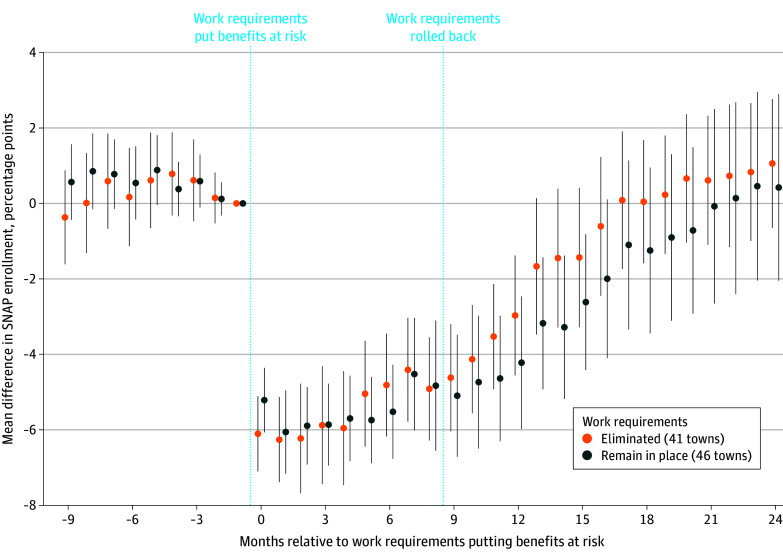
The study included 81 888 enrollees as of March 2016, the month before SNAP work requirements put benefits at risk. Work requirements were associated with a mean reduction in enrollment of 5.4 (95% CI, 4.6-6.3) percentage points over the 9 months following implementation. Reversal of the policy was not associated with a change in enrollment (mean difference, 1.2 [95% CI, −0.1 to 2.6] percentage points) over the subsequent 9 months in towns where work requirements were reversed (Figure).
Triple-Difference Event Study of Supplemental Nutrition Assistance Program (SNAP) Enrollment Before and After the Work Requirements Policy Among Treated Able-Bodied Adults Without Dependents vs Untreated Parents and Caregivers in Affected vs Exempted TownsTime was measured relative to the month prior to work requirements putting SNAP benefits at risk in March 2016. SEs were clustered at the town level based on enrollee's town in that month. The policy was reversed starting in January of 2017. Error bars indicate 95% CIs.
Discussion
While work requirements in SNAP were associated with immediate coverage losses, removing work requirements was not associated with a change in enrollment. The enrollment patterns were similar in towns with and without a policy reversal. One potential explanation is that households automatically lost coverage when work requirements were imposed via procedural terminations but needed to be aware of a policy that eliminated work requirements and required a manual process of reapplying.
A limitation is there was possibility of spillover effects of work requirements for individuals in exempt towns, but prior research^2^ suggests this is unlikely. Consistent with findings in Medicaid,^5^ we found that coverage losses from work requirements largely dissipated 9 months after reversal. Our results suggest this was not driven by the targeted group reenrolling but by secular declines in the nontargeted comparison cohorts. Our study highlights that work requirement implementation may have lasting effects that are difficult to reverse.
The reference list from the paper itself. Each links out to its DOI / PubMed record.
- 1SNAP work requirements. Food and Nutrition Service, US Department of Agriculture. Accessed January 8, 2024. https://www.fns.usda.gov/snap/work-requirements
- 2Ndumele CD, Factor H, Lavallee M, Lollo A Jr, Wallace J. Supplemental Nutrition Assistance Program work requirements and safety-net program participation. JAMA Intern Med. 2025;185(1):92-100. doi:10.1001/jamainternmed.2024.593239495527 PMC 11536301 · doi ↗ · pubmed ↗
- 3Amiri F. Many Democratic lawmakers frustrated by debt deal’s work requirements for food aid. PBS News. June 3, 2023. Accessed January 12, 2025. https://www.pbs.org/newshour/politics/many-democratic-lawmakers-frustrated-by-debt-deals-work-requirements-for-food-aid
- 4Supplemental Nutrition Assistance Program (SNAP) able-bodied adults without dependents. (ABAWD) Policy Guide. Food and Nutrition Service, US Department of Agriculture; 2023:18. Accessed January 14, 2025. https://fns-prod.azureedge.us/sites/default/files/resource-files/SNAP-ABAWD-Policy-Guide-September-2023.pdf
- 5Sommers BD, Chen L, Blendon RJ, Orav EJ, Epstein AM. Medicaid work requirements in Arkansas: two-year impacts on coverage, employment, and affordability of care. Health Aff (Millwood). 2020;39(9):1522-1530. doi:10.1377/hlthaff.2020.0053832897784 PMC 7497731 · doi ↗ · pubmed ↗
- 6CT rural towns. Connecticut State Office of Rural Health. Accessed December 20, 2023. https://www.ruralhealthct.org/towns.htm