The cadherin domains and the kinesin-binding intracellular domain of CASY-1/calsyntenin function in a redundant manner for learning
Hayao Ohno, Yuzuha Komachiya, Yuichi Iino

TL;DR
The study shows that two parts of the CASY-1 protein work together to support learning in C. elegans, even if each part alone is not essential.
Contribution
The paper reveals functional redundancy in CASY-1 domains for learning, providing new insights into its transport mechanism.
Findings
The cadherin domains and kinesin-binding domain of CASY-1 are individually dispensable for learning.
Simultaneous loss of both domains abolishes CASY-1 function, indicating functional redundancy.
CASY-1 supports robust transport through multiple protein interactions.
Abstract
Taste avoidance learning in Caenorhabditis elegans is regulated by the calsyntenin/alcadein homolog CASY-1 , which transports the insulin receptor DAF-2c to the synaptic region. This transport involves binding of the CASY-1 intracellular domain to the kinesin-1 (KIF5) complex. However, a previous study showed that the intracellular domain of CASY-1 is dispensable for learning. To investigate how CASY-1 functions, we performed functional domain mapping of CASY-1 . Both the cadherin domains of CASY-1 and its binding to kinesin-1 are individually dispensable, while simultaneous loss of both abolished the CASY-1 function, suggesting that CASY-1 enables robust intracellular transport through physical interactions with multiple proteins.
Genes, proteins, chemicals, diseases, species, mutations and cell lines named across the full text — each resolved to its canonical identifier and authoritative record.
Click any figure to enlarge with its caption.
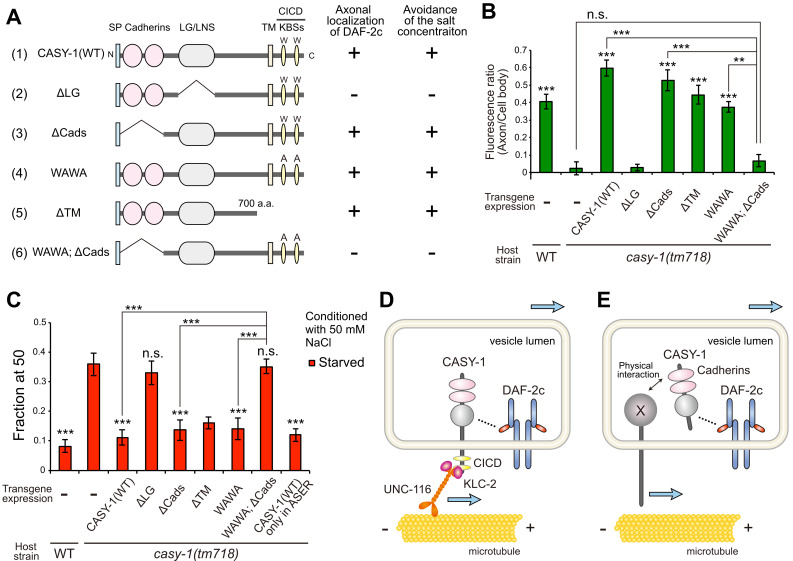 Figure 1
|
JN1505 |
|
|
JN1527 |
|
|
JN1528 |
|
|
JN1529 |
|
|
JN1530 |
|
|
JN1531 |
|
|
JN1532 |
|
|
JN1533 |
|
|
JN1538 |
|
|
JN1560 |
|
|
JN1561 |
|
|
JN1562 |
|
|
JN1563 |
|
|
JN1564 |
|
|
JN1565 |
|
Peer Reviews
No public reviews on file for this paper yet. If you reviewed it on a platform where reviews are public (OpenReview, ICLR, NeurIPS, ICML), you can paste yours below so the community can read it here.
Videos
No videos yet. Explain this paper in a talk, walkthrough, or lecture? Add one.
Taxonomy
TopicsWnt/β-catenin signaling in development and cancer · Hippo pathway signaling and YAP/TAZ · Axon Guidance and Neuronal Signaling
Description
The nematode * Caenorhabditis elegans * can memorize external salt concentrations and modify the preference for them according to past experiences; they are attracted to the past salt concentration where they had been fed, whereas they avoid it if they were starved (Kunitomo et al., 2013; Ohno et al., 2014). We found that the avoidance of the salt concentrations associated with starvation was impaired in mutants of * casy-1 * (Ikeda et al., 2008; Ohno et al., 2014). CASY-1 is the sole * C. elegans * ortholog of calsyntenins/alcadeins, a family of transmembrane proteins highly expressed in neurons. CASY-1 has the extracellular cadherin and LG/LNS domains and the intracellular kinesin-1 binding segments (KBSs) (Ikeda et al., 2008, Fig. 1A ). It has been suggested that CASY-1 functions in intracellular trafficking and cell adhesion through physical interactions with BAM-2 /neurexin-related (Kim & Emmons, 2017), UNC-104 /kinesin-3 (KIF1) (Thapliyal et al., 2018), and KLC-2 /kinesin-1 (KIF5) light chain (Ohno et al., 2014).
In a previous study (Ohno et al., 2014), we reported that CASY-1 induces starvation-associated learning by acting as an adaptor linking the insulin receptor isoform DAF-2c and the kinesin-1 complex to transport DAF-2c to the synaptic region, based on the following results: (1) CASY-1 physically interacts with KLC-2 and DAF-2c, (2) mutation or knockdown of * unc-116 * /kinesin-1 heavy chain or * klc-2 * inhibits the synaptic DAF-2c localization, and (3) MAPK-dependent KLC-2 S452 phosphorylation prevents physical interaction between CASY-1 and KLC-2 and this phosphorylation also prevents the synaptic DAF-2c localization. However, another study (Ikeda et al., 2008) found that the expression of the extracellular domain of CASY-1 , which lacks intracellular KBSs, is sufficient to restore the learning defects of * casy-1 * mutants.
To understand how CASY-1 regulates the DAF-2c transport and learning, we examined the functions of mutated variants of CASY-1 ( Fig. 1A ) by transgenic rescue experiments, in which the constructs were expressed under the * casy-1 * promoter in the * casy-1 ( tm718 ) * deletion mutant strain. Consistent with the previous study (Ikeda et al., 2008), deletion of the central LG/LNS domain (ΔLG) abolished the functionality of CASY-1 , whereas that of the cadherin domains (ΔCads) did not, in both the regulation of DAF-2c localization and the starvation-associated learning ( Fig. 1A (2)(3), Fig. 1B, and Fig. 1C ). Interestingly, replacement of the tryptophans of both kinesin-binding motifs in KBSs by alanines (WAWA), which completely disrupts the binding of the intracellular domain of CASY-1 with KLC-2 (Ohno et al., 2014), did not affect the functions of CASY-1 ( Fig. 1A (4), Fig. 1B, and Fig. 1C ). Even the extracellular domain alone (ΔTM), which is assumed to be released from the cell surface, was functional ( Fig. 1A (5), Fig. 1B, and Fig. 1C ). By contrast, the construct that harbors both the replacement of the tryptophans by alanines and the deletion of cadherin domains (WAWA; ΔCads) failed to rescue the * casy-1 * mutant phenotypes ( Fig. 1A (6), Fig. 1B, and Fig. 1C ), suggesting that the cadherin domains and the kinesin binding intracellular domain function in a redundant fashion. These results may be explained by assuming that CASY-1 mediates the transport of DAF-2c via two interactions, the interaction of the intracellular domain with kinesin-1 ( Fig. 1D ) and the interaction of the extracellular cadherin domains with an unknown axonal protein(s), which is itself transported probably by interaction with motor proteins ( Fig. 1E ). Since the point mutations in kinesin-1 binding motifs of CASY-1 abolished the functions of the cadherin domains-deleted construct ( Fig. 1A (6)) and the expression of a gain-of-function form of KLC-2 increased the axonal DAF-2c localization in a CASY-1-dependent fashion (Ohno et al., 2014), the association of CASY-1 with kinesin-1 appears to have a significant contribution to the axonal transport of DAF-2c.
Methods
Salt concentration preference assay was performed as described (Ohno et al., 2014). Young adult worms were exposed to 50 mM NaCl without food for 4 h followed by a behavioral test in which five to nine worms were transferred to an agar assay plate (56 mm [w] x 38 mm [d] plastic dish poured with 4 mL of 2% agar, 5 mM potassium phosphate [pH 6.0], 1 mM CaCl 2 , 1 mM MgSO 4 ) with a gradient of NaCl, covering a concentration range of approximately 20 mM to 80 mM. Worms that moved to the ~50 mM (the central half area of an assay plate) area were classified as “50”.
Axonal localization of DAF-2c::venus was evaluated as described (Ohno et al., 2014). Fluorescence was observed with a Leica HCX PL APO 63×/1.30 objective on a Leica TCS-SP5 confocal microscope. Images were analyzed with the software attached to the confocal microscope (LAS AF ver 2.2).
Statistic analyses were performed with a statistic package (Prism v.5, GraphPad software).
Reagents
**: **
The reference list from the paper itself. Each links out to its DOI / PubMed record.
- 1Ikeda Daisuke D. Duan Yukan Matsuki Masahiro Kunitomo Hirofumi Hutter Harald Hedgecock Edward M. Iino Yuichi 200841 CASY-1, an ortholog of calsyntenins/alcadeins, is essential for learning in Caenorhabditis elegans Proceedings of the National Academy of Sciences 105130027-84245260526510.1073/pnas.0711894105 PMC 227822018381821 · doi ↗ · pubmed ↗
- 2Kim Byunghyuk Emmons Scott W 2017913 Multiple conserved cell adhesion protein interactions mediate neural wiring of a sensory circuit in C. eleganse Life 62050-084X 10.7554/elife.29257 PMC 561995028901288 · doi ↗ · pubmed ↗
- 3Kunitomo Hirofumi Sato Hirofumi Iwata Ryo Satoh Yohsuke Ohno Hayao Yamada Koji Iino Yuichi 2013726 Concentration memory-dependent synaptic plasticity of a taste circuit regulates salt concentration chemotaxis in Caenorhabditis elegans Nature Communications 412041-172310.1038/ncomms 321023887678 · doi ↗ · pubmed ↗
- 4Ohno Hayao Kato Shinya Naito Yasuki Kunitomo Hirofumi Tomioka Masahiro Iino Yuichi 2014718 Role of synaptic phosphatidylinositol 3-kinase in a behavioral learning response in C. elegans Science 34561940036-807531331710.1126/science.125070925035490 · doi ↗ · pubmed ↗
- 5Thapliyal Shruti Vasudevan Amruta Dong Yongming Bai Jihong Koushika Sandhya P. Babu Kavita 2018312 The C-terminal of CASY-1/Calsyntenin regulates GAB Aergic synaptic transmission at the Caenorhabditis elegans neuromuscular junction PLOS Genetics 1431553-7404 e 1007263 e 100726310.1371/journal.pgen.100726329529030 PMC 5864096 · doi ↗ · pubmed ↗