Primulalongipes subsp. bayburtensis Sefali, Yapar & Demir (Primulaceae): A new taxon from north-eastern Anatolia, Türkiye

Abstract
Genes, proteins, chemicals, diseases, species, mutations and cell lines named across the full text — each resolved to its canonical identifier and authoritative record.
Click any figure to enlarge with its caption.
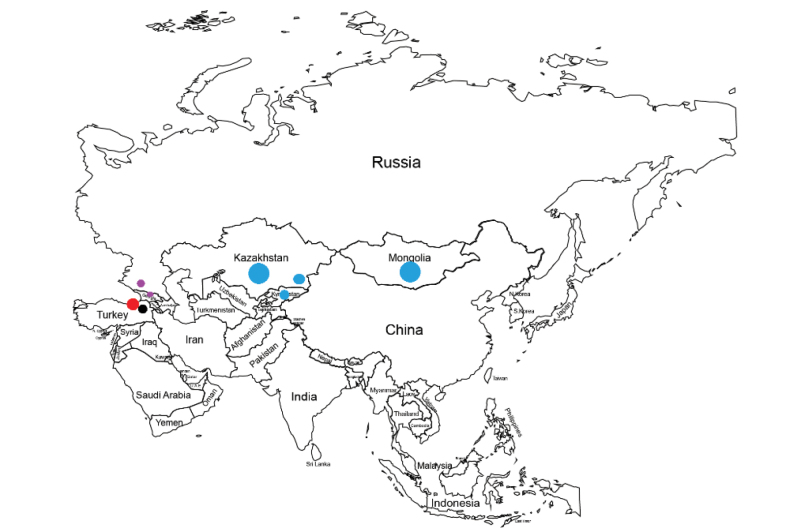 Figure 1
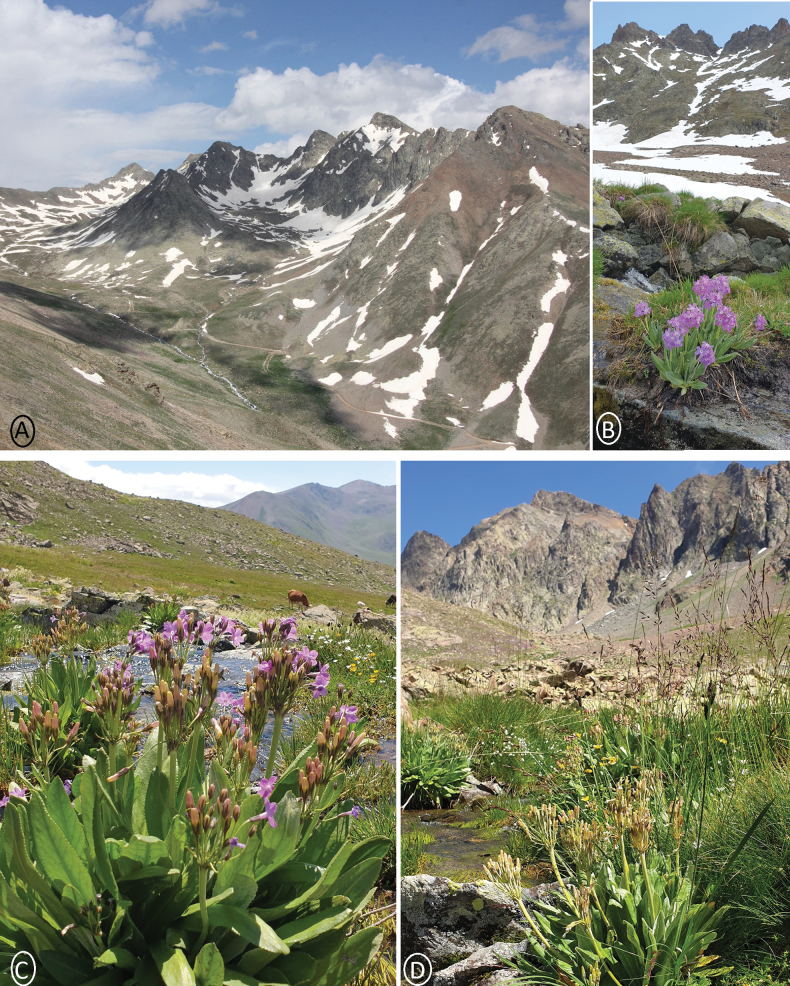 Figure 2
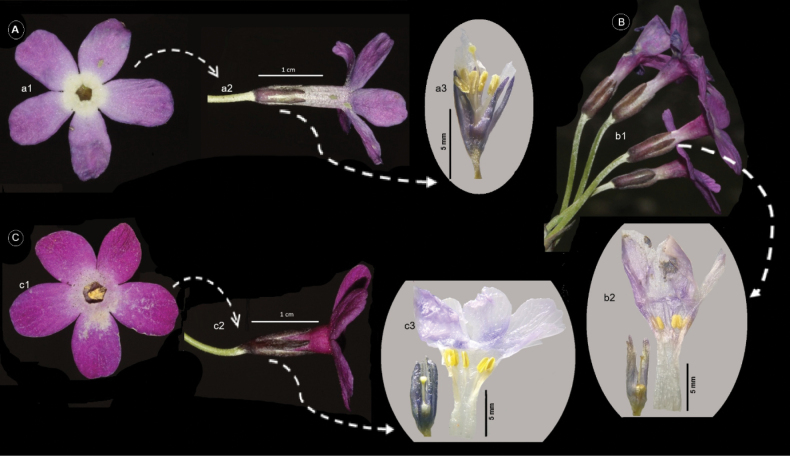 Figure 3
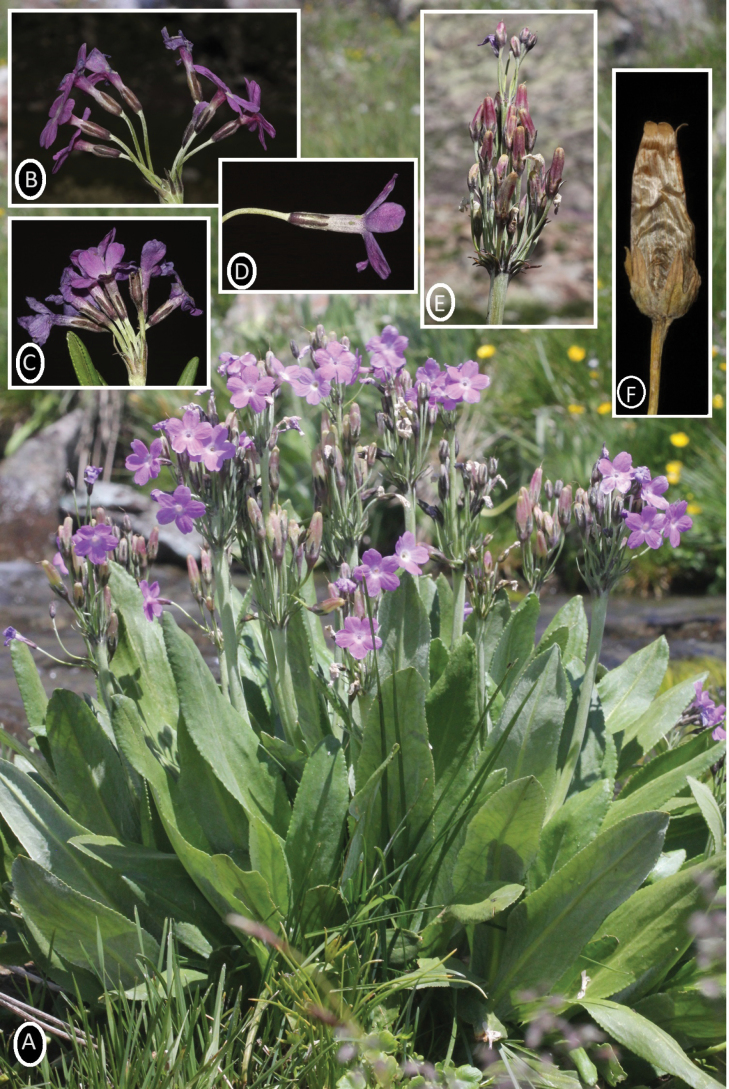 Figure 4
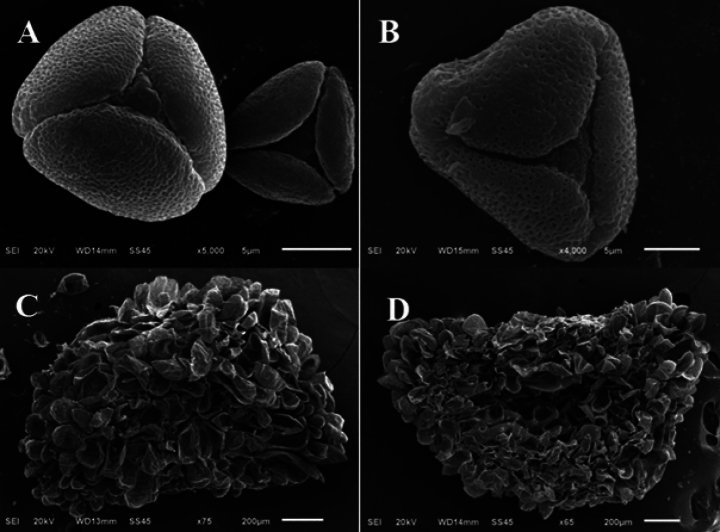 Figure 5
| Characters |
|
|
|
|---|---|---|---|
| Bracts | numerous, linear lanceolate, generally filiform. | several, narrow-triangular. | narrowly lanceolate. |
| Calyx | tubular, 5–7 mm, divided to 3/5. | campanulate, 6–12 mm, divided to 3/5. | tubular, 6–11 mm, divided to ½. |
| Calyx teeth | 3.5–4.5 mm, lobes linear to lanceolate. | ca. 9 mm, lobes linear to lanceolate. | 3–5.5 mm, lobes lanceolate. |
| Corolla | corolla tube ca. 14 mm, lobes 6–10 mm, ± broadly oblong, entire, magenta. | corolla tube 6–12 mm, lobes 6–9 mm, ± broadly oblong, emarginate or not, lavender-blue to reddish mauve. | corolla tube 8–15 mm, lobes 7–14 mm, oblong, margin entire, violet to purple. |
| Calyx/Corolla tube length | 0.5 | 0.7 | 0.4 |
| Thrum flowers: | stamens equalling or above apex of calyx; 1–1.5 mm, style ca. 4 mm. | stamens bearing apex of calyx or above; style ca. 3–3.5 mm. | stamens slightly above apex of calyx; style ca. 2 mm. |
| Capsule | cylindrical, 2–4.5× as long as calyx. | oblong, 1–2× as long as calyx. | oblong, 1–2× as long as calyx. |
Peer Reviews
No public reviews on file for this paper yet. If you reviewed it on a platform where reviews are public (OpenReview, ICLR, NeurIPS, ICML), you can paste yours below so the community can read it here.
Videos
No videos yet. Explain this paper in a talk, walkthrough, or lecture? Add one.
Taxonomy
TopicsPlant Ecology and Taxonomy Studies · Plant and Fungal Species Descriptions · Botany, Ecology, and Taxonomy Studies
Introduction
The genus Primula L. (1753:142) is found in temperate parts of the Northern Hemisphere, extending from East Asia and Europe to the subarctic zone. Based on morphological features, the ca. 500 species in the genus have been divided into 37 sections (Richards 2003; Smith and Fletcher 1942). With about 300 species spread throughout 24 sections, the Himalayan-Hengduan Mountains in particular, located in south-western China, are a hotspot for Primula diversity (Hu 1994; Hu and Kelso 1996).
Since the majority of Primula species produce lovely, eye-catching flowers, several species that are very ornamental and can be easily cultivated and multiplied are popular ornamental plants. As pot and garden plants, P.malacoides, P.obconica and P.×polyantha, for instance, are currently considered key floricultural crops (Kato et al. 2018). These attractive flowering plants of Primula have attracted the attention of not only gardeners, but also researchers. Primula flowers have been popular for 150 years (Wu et. al. 2023) since Darwin made his pioneering work on flower polymorphism in Primula (Darwin 1877). The genus species are mostly (92%) distyles (Wang et al. 2021) that, usually, consist of two flower morphs (i.e. long-styled or short-styled) that differ reciprocally in stigma and anther height in a tubular flower (Barrett 2019).
Primulasect.Crystallophlomis (also referred to as Nivalid primulas) are often long, erect (about 40 cm), with a basal rosette of lanceolate, somewhat fleshy leaves and typically have white or pale yellow farinose below. The section has the potential to develop multiple flower whorls and pink, purple, white, cream or generally magenta flowers. Due to its usual location, its buds are covered by snow for a considerable amount of time. Primulanivalis Pallas, which is found in central Asia and southern Siberia, is the section’s type species. It has a robust habit, broad, lanceolate leaves with serrate margins, a tall, farinose scape up to 40 cm high and distyles flowers (Kelso 1987). P.sect.Crystallophlomis has four subsections: subsection Agleniana, subsection Calliantha, subsection Crystallophlomis and subsection Maximowiczii (Rankin 2012). Subsection Crystallophlomis has rotational symmetrical flowers, ca. 2.5 cm resting buds, farinose, green or white petioles, corolla lobes not reflexed and broad, and capsules dehiscing with valves (Rankin 2012).
Türkiye has 12 taxa of Primula belonging to eight species that were recognised by Lamond (1978). In the last decade, a hybrid, Primula×uzungolensis, was identified in north-eastern Türkiye (Terzioğlu et al. 2012) in the Soğanlı and Kaçkar Mountains at Trabzon, Gümüşhane, Rize, Artvin Province. The north-eastern part of Türkiye contains the richest species of the Primula and Androsace taxa. Primula is represented by 12 taxa and Androsace is represented by 8 taxa. (Lamond 1978; Terzioğlu et al. 2012; Sefalı 2021; Sefalı and Yapar 2022).
Our field study was undertaken in Bayburt Province within the north-eastern area of Türkiye. This Province belongs to the Soğanlı Mountains (Kırklar Mountain) chain. As a result of the field work carried out three times in June and July 2024, the new taxon was found in the south valley of Kırklar Mountain (Fig. 1). The authors noticed an interesting Nivalid Primula that resembled Primulalongipes Freyn & Sint. (1896: 141), but this had a distinct long corolla tube, longer capsule and linear bracts. As a result, it was decided that this plant could be a new taxon and was named as Primulalongipessubsp.bayburtensis.
Distribution map for Primulalongipessubsp.bayburtensis (red circle), P.longipessubsp.longipes (black circle), P.nivalissubsp.turkestanica (blue circle) and P.crassifolia (purple circle).
Material and methods
The new taxon, Primulalongipessubsp.bayburtensis, was compared with herbarium specimens at EGE, ISTE, BIN, VANF, KNYA, ANK and AIBU. Additionally, some digital herbarium materials were examined (E, K, BR, WU herbaria and G) (acronyms according to Thiers (2025)). In addition, the relevant literature was reviewed (Fedorov 1952; Lamond 1978; Kelso 1987; Hu 1994; Hu and Kelso 1996; Richards 2002; Gültepe et al. 2010; Terzioğlu et al. 2012; Rankin 2012; Kato et al. 2018). Using a stereo-binocular microscope equipped with millimetric rules, extensive morphological measurements were carried out on the new taxon material and compared with its closely related species, Primulalongipes. Since the new taxon was found in only one valley, 20 individuals were included in the study.
A seed micrograph was taken with a scanning electron microscope (SEM). Seed properties were interpreted according to Morozowska et al. (2011). Palynological investigations were conducted with both light and scanning electron microscope (SEM). Pollen slides were prepared using the Wodehouse technique (1935) for light microscope studies. The averages and standard deviations of the measurements were calculated by light microscope. Measurements were taken for at least 25 pollen grains. The pollen terminology follows Faegri and Iversen (1975) and Punt et al. (2007).
Results and discussion
Taxonomic treatment
Primula
longipes Freyn & Sint. subsp. bayburtensis
Taxon classificationPlantaeEricalesPrimulaceae
Sefali, Yapar & Demir subsp. nov.
C5BA900F-E0BB-5DC4-BA07-4E106D598FA2
urn:lsid:ipni.org:names:77362178-1
Diagnosis.
Primulalongipessubsp.bayburtensis differs from P.longipessubsp.longipes in its longer corolla tube and thurm flowers unwidening corolla throat. While Primulalongipessubsp.bayburtensis’s corolla tube ca. 14 mm and calyx/corolla tube length ratio is 0.5, P.longipessubsp.longipes’s corolla tube ca. 12 mm and calyx/corolla tube length ratio is 0.7 (Fig. 3).
Type.
Türkiye. Bayburt • Kırklar Mountain, southern valley, river side, stony and wet places, 2950 m elev., 15 June 2024, A. Sefali, Y. Yapar & İ. Demir 1052 (holotype: VANF!; isotypes: BIN!).
Etymology.
Primulalongipessubsp.bayburtensis is named after the geographical province. This epithet is bayburtensis (in Turkish, Bayburt), refering to Bayburt Province, north-eastern Türkiye. The Turkish name for this taxon was chosen as “Bayburt çulhası” (Menemen et al. 2016).
Description.
Sturdy perennial, 15–50 cm, basal bud scales long stocks formed by overlapping petioles. Roots thickish and fibrous. Stem shortly puberulent, farinose. Leaves rosette, petiole broadly winged, 6–8 × ca. 1 cm. Leaf lamina elliptic-lanceolate 6–22 × 1.5–3 cm and near petiole shortly puberulent, farinose, base gradually thinning. Leaf margin irregularly blunt denticulate and apex bluntly acute. Scapes 10–38 cm, elongated to 45 cm in fruit. Inflorescence, 4–30-flowered (sometimes 2-whorled) at umbels. Bracts linear lanceolate, generally filiform, 2–13 mm. Flowers heterostylous. Pedicel 8–12 mm, elongated to 2–5.5 cm in fruit. Calyx tubular, 5–7 mm, divided to 3/5. Calyx teeth, 3.5–4.5 mm, lobes linear to lanceolate. Corolla tube ca. 14 mm, lobes 6–10 mm, ± broadly oblong, entire, magenta. Pin flowers, stamens 4–5 mm above base of corolla tube, style longer than calyx. Thrum flowers, stamens equalling or above (1–1.5 mm) apex of calyx, style ca. 4 mm. Capsule cylindrical, 2–4.5× as long as calyx. Seed elliptic to deltoid, yellowish, 2 × 1.5 mm (Fig. 4).
Phenology.
Flowering from June to July; fruiting in August.
Seed and pollen morphology.
(Fig. 5) Seed grains of P.longipessubsp.bayburtensis are eliptic to deltoid, yellowish, 2 × 1.5 mm, tuberculate, P.longipessubsp.longipes is elliptic, brownish, 2 × 1.5 mm, tuberculate. Pollen grains of P.longipessubsp.bayburtensis are prolate-spheroidal (P/E = 1.04 μm), polar axis (P) 19.17 μm (max. 20.98 μm, min. 17.73 μm), equatorial axis (E) 18.19 μm (max. 19.44 μm, min. 16.75 μm), radially symmetrical, isopolar, triparasyncolpate. Shape in polar view triangular. Exine 0.91 μm (max. 1.15 μm, min. 0.65 μm), intine 0.45 μm (max. 0.55 μm, min. 0.33 μm). Ornamentation of exine microreticulate. Additionally, pollen grains of P.longipessubsp.longipes are prolate-spheroidal (P/E = 1.07 μm). Polar axis 20.22 μm (max. 21.54 μm, min. 18.79 μm), equatorial axis 18.75 μm (max. 20.14 μm, min. 17.14 μm) radially symmetrical, isopolar, triparasyncolpate. Shape in polar view triangular. Exine 0.96 μm (max. 1.25 μm, min. 0.72 μm), intine 0.51 μm (max. 0.58 μm, min. 0.41 μm). Ornamentation of exine microreticulate.
Distribution and ecology.
(Fig. 2) The new taxon is a local endemic restricted to the south valley of Kırklar Mountain in Bayburt Province, North-eastern Türkiye. It is an Euxine element (Figs 1, 2). The habitat of the Primulalongipessubsp.bayburtensis is stream banks and it grows in open alpine areas. The new subspecies grows in the near vicinity of Drabanemorosa L., Cardamineraphanifolia Pourr., Primulaalgida Adams, P.auriculata Lam., P.elatiorsubsp.amoena (M.Bieb.) Greuter & Burdet, Pedicularisnordmanniana Bunge, Ericaspiculifolia Salisb., Scillaalinihatiana Aslan & Yıldırım, Silenelazica Boiss. (it is found near stony places), Erodiumhendrikii Alpınar, Pinguiculabalcanica Casper, Heracleumpastinacifolium K.Koch, Saxifragaexarata Vill., Minuartiaaizoides (Boiss.) Bornm. and Poa sp.
Kırklar Mountain: A southern valley of Kırklar Mountain B habitat of Primulalongipessubsp.bayburtensis (early period) C late period of new taxon D fruiting time of new taxon.
Morphologically related taxon in terms of flower, corolla tube and calyx ratio. A Pin flower of Primulalongipessubsp.bayburtensisB thrum flowers of P.longipessubsp.bayburtensisC thrum flowers of P.longipessubsp.longipes.
Primulalongipessubsp.bayburtensis: A Habitus B, C inflorescence D flower (calyx and corolla tube) E fruits and bracts F fruit.
SEM pollen (thurm flowers) and seed grain photographs: A–CPrimulalongipessubsp.bayburtensisB–DP.longipessubsp.longipes.
Taxonomic relationships.
Primulasect.Crystallophlomis members are generally distributed in highly mountainous places. The new taxon belongs to the Primulasect.Crystallophlomis and subsection Crystallophlomis (Rankin 2012). Primulalongipessubsp.bayburtensis is closely related to P.longipessubsp.longipes, P.nivalisPall.subsp.turkestanica (Haage & Schmidt) Kovt. and P.crassifolia Lehm. as they all belong to the same section (section Crystallophlomis). According to Lamond (1978), in Turkish Flora, P.longipes is one of the most beautiful of the Nivalid Primulas and a western vicarial of the Caucasian white-flowered P.bayernii, which is a synonym of P.crassifolia now, and also P.nivalisPallasvar.farinosa Schrenk, that is a synonym of P.nivalissubsp.turkestanica, related to P.longipes (Lamond 1978). The new taxon differs from P.longipessubsp.longipes by its corolla tube and calyx length ratio and thurm flower characters (Table 1). Differing from other taxa, P.nivalis. Subs.turkestanica growing in Kazakhstan, Kirgizstan, Mongolia and Xinjiang, its bracts shape, calyx divided ratio and corolla tube and calyx length of ratio etc. P.crassifolia, spread across North Caucasus and Transcaucasus, is similar to the new taxon, but its white-flowered habit is distinctive.
It is not surprising to find a new taxon from the province in northeast Türkiye as this area has a rich diversity of Androsace and Primula species (Lamond 1978; Terzioğlu et. al. 2012; Sefalı 2021; Sefalı and Yapar 2022). P.longipessubsp.bayburtensis is found in Bayburt, Kırklar Mountain, north-eastern Türkiye. The new taxon’s spread is restricted to the southern valley of Kırklar Mountain. This valley is exposed to the Black Sea climate, the air currents from the south and fed by the Çoruh River. Probably, this climate differentiation challenged the new taxon for some adaptation. This environmental factor may be the reason for the new taxon’s changes in the flower futures (calix divided ratio, thurm flowers, corolla tube and calyx length of ratio).
Examined specimens.
Primulalongipessubsp.longipes – Türkiye • Gümüşhane, in saxosis tracti Karagolldagh circa lacum Bojuk-goll, 2500 m elev., 31 vii 1894, Sintenis 7307 (E00024014!, L2650049, G, K000732926, BR/BR0000005297337, WU0069730) • Erzurum, Erzurum Province (bordering Rize Province), İspir District (bordering İkizdere District), Kaçkar Dağları (Kaçkar Mountains), about 1.7 km S of Ovit Dağı Geçidi (Ovit-Pass, 2640 m elev.). 40.611027°N, 40.78309°E, C. Gilli (WU11602); Giresun, Karagöl Dağı, 2600 m elev., 10 June 2021, A. Sefalı 690 (VANF 165225) • Rize, Upper Kavrun Valley, Kaçkar Mountains, with Rhododendroncaucasicum populations, grazing ground, 2600 m elev., 21 June 2024, A. Sefalı 107? (BIN). P.nivalissubsp.turkestanica – Kyrgyzstan • Talas Oblast, North West of Otmök Pass, 3554 m elev., 12 July 2008, J. Osborne 518 (K000493578). Primulacrassifolia – Georgia • (E00024012). Primulalongipessubsp.bayburtensis – Türkiye • Bayburt; Kırklar Mountain, southern valley, river side, stony and wet places, 2950 m elev., 15 June 2024, A. Sefalı 1052 (holotype: VANF!; isotypes: BIN!).
Supplementary Material
XML Treatment for Primula longipes Freyn & Sint. subsp. bayburtensis
The reference list from the paper itself. Each links out to its DOI / PubMed record.
- 1Barrett SC (2019) ‘A most complex marriage arrangement’: recent advances on heterostyly and unresolved questions.New Phytologist 224(3): 1051–1067. 10.1111/nph.1602631631362 · doi ↗ · pubmed ↗
- 2Darwin C (1877) The Different Forms of Flowers on Plants of the Same Species. John Murray, London UK. 10.5962/bhl.title.46988 · doi ↗
- 3Faegri K Iversen J (1975) Textbook of pollen analysis.
- 4Fedorov AA (1952) Semeistva pervocvetnye— Primulaceae Vent.Flora SSSR [Flora of the USSR]18: 108–292.
- 5Gültepe M Uzuner U Coşkunçelebi K Beldüz AO Terzioğlu S (2010) Internal transcribed spacer (ITS) polymorphism in the wild Primula (Primulaceae) taxa of Türkiye.Turkish Journal of Botany 34(3): 147–157. 10.3906/bot-0905-23 · doi ↗
- 6Hu CM (1994) On the geographical distribution of the Primulaceae.Journal of Tropical and Subtropical Botany 4: 1–14.
- 7Hu CM Kelso S (1996) Primulaceae. In: Wu CY Raven PH (Eds) Flora of China Volume 15.Science Press, Beijing, and Missouri Botanical Garden Press, St. Louis, 99–185.
- 8Kato J Inari-Ikeda M Hayashi M Amano J Ohashi H Mii M (2018) Primula. Ornamental Crops, 627–647. 10.1007/978-3-319-90698-0_24 · doi ↗