The Central American millipede family Rhachodesmidae in Costa Rica, with the description of a new species of Aceratophallus Carl, 1902 (Diplopoda, Polydesmida)

Abstract
Genes, proteins, chemicals, diseases, species, mutations and cell lines named across the full text — each resolved to its canonical identifier and authoritative record.
Click any figure to enlarge with its caption.
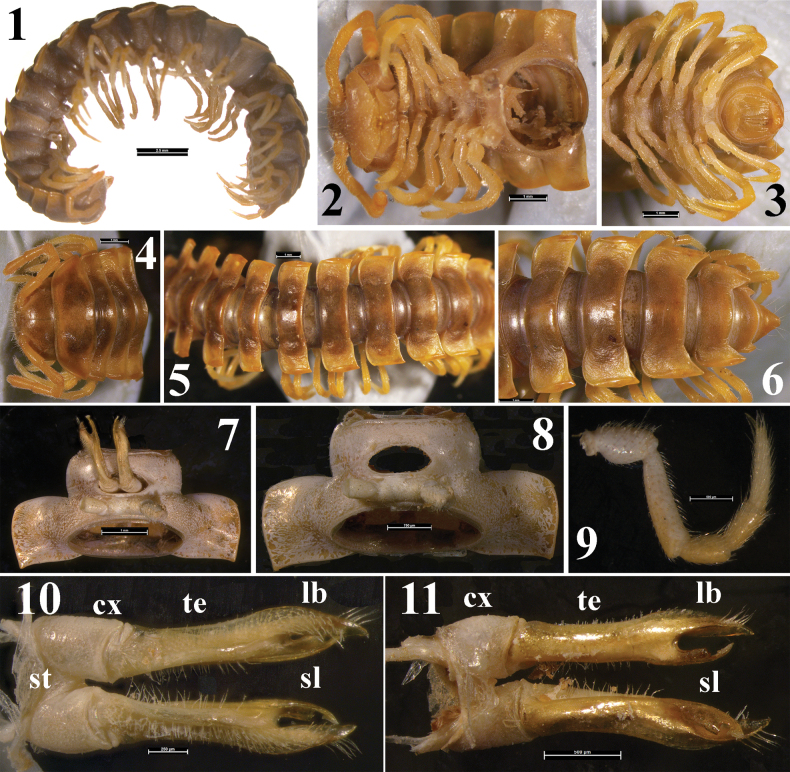 Figures 1–11
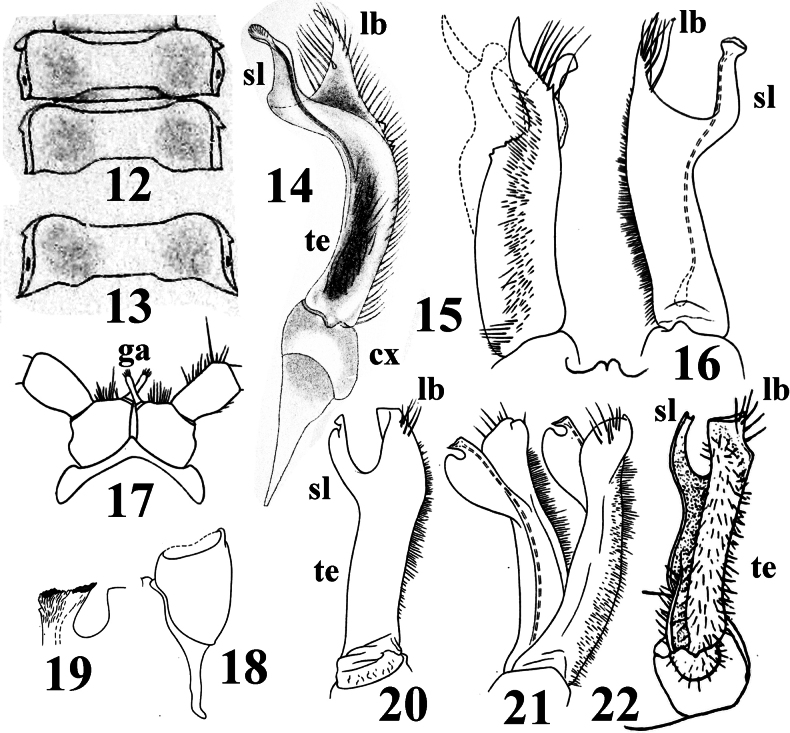 Figures 12–22
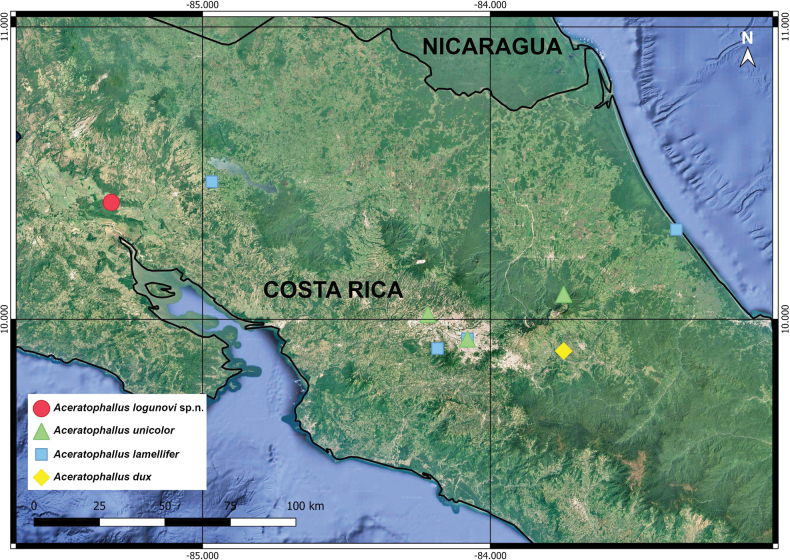 Figure 23
| 1(2) | Gonopodal telopodites ( |
|
| 2(1) | Gonopodal telopodites ( |
|
| 3(4) | All paraterga below dorsum. Caudal corners/tips of paraterga slightly, but increasingly curved and directed laterad (Figs |
|
| 4(3) | Paraterga mostly upturned, with tips above dorsum. Caudal corners/tips of paraterga not curved laterad. Gonopodal telopodites ( |
|
| 5(6) | A dark, interrupted, axial line on metaterga present. Hypoproct regularly rounded caudally. Solenomere ( |
|
| 6(5) | A vague light axial stripe at most. Hypoproct subtriangular, narrowly rounded caudally. Solenomere ( |
|
Peer Reviews
No public reviews on file for this paper yet. If you reviewed it on a platform where reviews are public (OpenReview, ICLR, NeurIPS, ICML), you can paste yours below so the community can read it here.
Videos
No videos yet. Explain this paper in a talk, walkthrough, or lecture? Add one.
Taxonomy
TopicsPlant and animal studies · Insect and Arachnid Ecology and Behavior · Lepidoptera: Biology and Taxonomy
Introduction
The millipede family Rhachodesmidae Carl, 1903 is endemic to Central America. Presently, it encompasses c. 63 species in 18 genera that range from Mexico in the north to Costa Rica in the south (Hoffman 1999; Hoffman et al. 2002; Enghoff et al. 2015). The genus Aceratophallus Carl, 1902 is among the largest in terms of species diversity, and its 12 currently accepted species range from Yucatán Peninsula in Mexico to Costa Rica (Hoffman 1999). According to Hoffman’s (1999) catalogue, which is still relevant and obviously requires no reiteration, only three species have so far been accepted as populating Costa Rica. The southernmost range periphery for both the family and the genus is as follows:
Aceratophallusdux Chamberlin, 1914, from Juan Viñas, Prov. Cartago, Costa Rica (Chamberlin 1914, 1922); Aceratophalluslamellifer Brölemann, 1905, from San José (Brölemann 1905), recorded also from Parismina, Chitaria, and Tilarán, Costa Rica (Chamberlin 1922, 1933; Hoffman 1999); Aceratophallusunicolor Carl, 1902, from San José, Costa Rica (Carl 1902), recorded also from El Gallito, Prov. Heredia or Alajuela, Costa Rica (Chamberlin 1922, 1933; Hoffman 1999).
The present note was prompted by the discovery of another new species of Aceratophallus, the first to be recorded in Costa Rica’s Guanacaste Province. An illustrated key is also provided to distinguish all four congeners that are known to occur in the country.
Material and methods
The holotype of the new species treated below was collected in 2023 by Dmitry V. Logunov, Keeper of Arachnida and Myriapoda at the Zoological Institute of the Russian Academy of Sciences, St. Petersburg (ZISP), Russia. Colour photographs were taken at the Paleontological Institute, Russian Academy of Sciences (PIN), Moscow, using a Flexacam C1 camera mounted on a Leica M165С stereo microscope with built-in LasX software. Final image processing was performed with Adobe Photoshop CC. The distribution map was composed using QGIS ver. 3.32.1-Lima. Abbreviations used to denote particular structures of the gonopods are explained both in the text and figure captions.
Taxonomy
Class Diplopoda de Blainville in Gervais, 1844
Order Polydesmida Latreille, 1802/03
Family Rhachodesmidae Carl, 1903
Aceratophallus
Taxon classificationAnimaliaPolydesmidaRhachodesmidae
Genus
Carl, 1902
3CC80904-C18A-5BD1-BC5B-41594E5FC2B2
Type species.
A.unicolor Carl, 1902, by original designation.
Diagnosis.
Differs from other genera of the family primarily in the gonopodal telopodites (te) being densely setose all along their length, with its base being devoid of a clearly outlined spermal cavity/fossa (Fig. 14). With long and slender gonapophyses (ga) placed distomesally on male coxae 2 (Fig. 17). Slender, dorsoventrally flattened and only slightly diverging gonopods (Figs 1, 10, 11, 14–16, 20–22) directed cephalad and located inside a very simple, relatively small and transversely ovoid aperture (Figs 7, 8). Gonopods set centrally on a small triangular sternum (st) (Fig. 10). Each gonopod featuring a short cylindrical coxite (cx) (Figs 10, 11, 14, 18) and a longer, distally bipartite telopodite divided into a mesal solenomere (sl) and a lateral branch (lb) (Carl 1903). Like in all Rhachodesmidae, they are devoid of a cannula.
Composition.
Thirteen species, including the new one treated below.
Incorporation of the new congener described below into a key is straightforward, as all three Aceratophallus species from Costa Rica have long been keyed, albeit based solely on gonopodal characters (Attems 1940). The new key provided in the present contribution considers some somatic traits as well. Moreover, the distributions of all four Rhachodesmidae (= Aceratophallus) in Costa Rica have been mapped (Fig. 23).
Aceratophallus
logunovi
sp. nov.
Taxon classificationAnimaliaPolydesmidaRhachodesmidae
D188472B-DD86-5D5F-9270-BA7FE3D1C53C
https://zoobank.org/4275A9F1-7667-4AC0-8702-FA354B98DDAB
Material examined.
Holotype • male (in alcohol, ZISP MYR_DIP_0000189), Costa Rica, Guanacaste Province, entrance to Palo Verde National Park, tropical rainforest, 10°24'N, 85°19'W, 30.VI.2023, D. Logunov leg.
Name.
Honours Dmitry V. Logunov, the collector.
Diagnosis.
Differs from congeners primarily by the gonopodal telopodite being nearly straight, only slightly bent dorsad in basal 2/3 and erect in distal 1/3. With both solenomere (sl) and lateral (lb) branches pointed, held subparallel and closely attached to each other. The sl with a small lateral bulge clearly removed from the apex (see also key below).
Description.
Length 28 mm, width of midbody pro- and metazona 2.7 and 5.0 mm, respectively. General coloration in alcohol light brown with most of head, collum and following metaterga between paraterga faintly infuscate and brown; antennae, venter, legs, paraterga, central parts of collum and following metaterga and gonopods slightly lighter orange-yellow to yellow; legs and gonopods very faintly infuscate distad; calluses/peritremata on paraterga bright orange. Tegument generally smooth and shining; head and metazona, including sides, finely microgranulate; prozona shagreened and even more finely microgranulate. Sides of metazona below paraterga light greyish, a little more strongly granulate than prozona; strictures smooth; caudal halves of metaterga and, especially, bases of paraterga clearly and irregularly striolate (Figs 1–6).
Head very finely microgranulate all over; epicranial suture long, thin and fine, starting between antennae; clypeolabral region densely setose, vertex nearly bare; interantennal isthmus c. 1.5 times as wide as diameter of antennal socket (Figs 2, 4). Antennae only very slightly clavate, in situ extending past ring 4 dorsally (Figs 1, 4) (male). In length, antennomeres 2 = 6 > 3 > 4 = 5 > 1 > 7. Genae squarish.
In width, head < collum < ring 2 = 3 < 4 < 5–15, thereafter gradually tapering towards telson (Figs 4–6). Paraterga very well-developed (Figs 1–8) (male), always lying below level of a moderately convex dorsum, mostly set at about upper 1/4 midbody height, largely only poorly declined to subhorizontal. Collum sublanceolate, almost pointed at each end; both anterior and posterior margins straight medially; both anterolateral and lateral margins very broadly and regularly rounded and narrowly rimmed; paraterga poorly concave caudally (Fig. 4). Following paraterga with rimmed and faintly rounded to subrectangular anterior shoulders, each shoulder carrying a small denticle at anterolateral corner. Paratergal sides faintly rounded, fully taken up by lanceolate and narrow calluses/peritremata, these being always delimited by distinct sulci both dorsally and ventrally, clearly thicker and wider on poriferous rings than on poreless ones. Paratergal caudal corners first narrowly rounded and subrectangular, but starting with ring 3 increasingly acute, especially sharp and drawn past rear tergal margin on rings 13–18, but smaller, robust and sharp teeth on ring 19. Metatergal caudal margins narrowly rimmed, regularly and first faintly, but then increasingly concave (Figs 1, 4–6). Neither an axial line nor transverse metatergal sulci. Strictures between pro- and metazona faint and smooth. Limbus hyaline, thin, fine and microspiculate/microdenticulate. Pore formula normal (5, 7, 9, 10, 12, 13, 15–19). Ozopores dorsolateral, located near half to caudal 1/3 of poriferous paraterga inside oblong grooves. Pleurosternal carinae very small and rounded ridges visible only on rings 2–4. Spiracles inconspicuous. Epiproct as usual, rather long, finger-shaped, straight, subtruncate at tip, subapical setigerous knobs very faint (Figs 1, 3, 6). Hypoproct roundly subtriangular, with 1+1 indistinct rounded knobs removed from caudal margin (Fig. 3).
Aceratophalluslogunovi sp. nov., male holotype (ZISP MYR_DIP_0000189): 1 habitus, lateral view 2, 4 anterior part of body (head and rings 1–6), ventral and anterodorsal views, respectively 3, 6 posterior part of body, ventral and dorsal views, respectively 5 middle part of body, dorsal view 7, 8 body ring 7 with both gonopods in situ (7) and with both gonopods removed (8) 9 leg 9, lateral view 10, 11 both gonopods, ventral and dorsal views, respectively. Abbreviations: cx coxite. lb lateral branch, sl solenomere, st sternite, te telopodite. Photographs courtesy R.A. Rakitov.
Aceratophallusunicolor Carl, 1902, ♂ syntype (12–16), Aceratophalluslamellifer Brölemann, 1905, ♂ syntype (17–21), and Aceratophallusdux Chamberlin, 1914, ♂ holotype (22): 12 two midbody rings, dorsal view 13 metatergum 17, dorsal view 14 left gonopod devoid of a cannula and with an elongated excavation instead of a basal fossa, mesal view 15, 16 right gonopod, ventral and lateral views, respectively 17 coxae and prefemora 2, caudal view 18 coxite of left gonopod, ventral view 19 tip of solenomere with a minute apical brush, mesal view 20 left gonopod, lateral view 21 both gonopods, dorsolateral view 22 left gonopod, ventral view. Abbreviations: cx coxite. ga gonapophyses, lb lateral branch, sl solenomere, te telopodite. 12–14, after Carl (1902); 15–21, after Brölemann (1905); and 22, after Chamberlin (1914).
Legs long and slender, c. 1.7–1.8 times as long as midbody height (male) (Fig. 1), densely setose. In length, femur > tarsus > prefemur = postfemur = tibia > coxa. Tarsal claw small, simple and nearly straight (Figs 1–3, 9). Prefemora not bulged laterally (Fig. 9). Coxa 2 with a rather long, straight, coniform and apically fimbriate gonapophysis (male) (Fig. 2). Sterna densely setose, devoid of evident modifications. Tarsal brushes present only on a few anterior legs (Figs 2, 3).
Gonopodal aperture lanceolate, taking up entire central 1/3 prozonum 7, margins simple and not elevated (Figs 7, 8). Gonopods (Figs 7, 10, 11) in situ directed cephalad, typical of the genus, both only slightly diverging and located on a small triangular sternum (st). Coxites (cx) short, cylindrical and bare, c. 0.25 times as long as telopodites (te), each totally devoid of a cannula. Telopodites (te) slender, clearly flattened dorsoventrally, only slightly broadened distally, in situ basal 2/3 faintly and regularly curved dorsally, but distal 1/3 erect, only dorsal surfaces of te bare, all other sides densely setose throughout. Seminal groove starting inside a vague and oblong fossa near te base, but its course remaining clearly on mesal side. Distal third of each te branching into a somewhat shorter mesal solenomere (sl) and a longer lateral branch (lb). The sl carrying a minute apical brush and a small lateral bulge at its base, while lb an evident apical brush of longer setae before a sharp apex (Figs 10, 11). Both sl and lb pointed, held subparallel and closely attached to each other.
Distribution of Rhachodesmidae (= Aceratophallus) in Costa Rica.
Key to Aceratophallus species in Costa Rica
**: **
Supplementary Material
XML Treatment for Aceratophallus
XML Treatment for Aceratophallus logunovi
The reference list from the paper itself. Each links out to its DOI / PubMed record.
- 1Attems C (1940) Myriapoda 3. Polydesmoidea III. Fam. Polydesmidae, Vanhoeffeniidae, Cryptodesmidae, Oniscodesmidae, Sphaerotrichopidae, Peridontodesmidae, Rhachidesmidae, Macellolophidae, Pandirodesmidae.Das Tierreich 70: 1–577. 10.1515/9783111609645 · doi ↗
- 2Brölemann HW (1905) Myriapodes de Costa-Rica recueillis par M. le Professeur P. Biolley. I Ie Mémoire.Annales de la Société Entomologique de France 74: 337–380. 10.1080/21686351.1905.12279346 · doi ↗
- 3Carl J (1902) Exotische Polydesmiden.Revue suisse de Zoologie 10: 565–679. 10.5962/bhl.part.13794 · doi ↗
- 4Carl J (1903) Revision amerikanischer Polydesmiden.Revue suisse de Zoologie 11: 543–562. 10.5962/bhl.part.82519 · doi ↗
- 5Chamberlin RV (1914) On a collection of myriapods from Costa Rica.Transactions of the American Entomological Society 40: 185–194. https://archive.org/details/jstor-25076920
- 6Chamberlin RV (1922) The millipeds of Central America.Proceedings of the United States National Museum 60(8): 1–75. 10.5479/si.00963801.60-2403.1 · doi ↗
- 7Chamberlin RV (1933) On a collection of centipeds and millipeds from Costa Rica.The Pan-Pacific Entomologist 9(1): 11–24. https://archive.org/details/biostor-225547
- 8Enghoff H Golovatch SI Short M Stoev PE Wesener T (2015) Diplopoda — taxonomic overview. In: Minelli A (Ed.) Treatise on Zoology — Anatomy, Taxonomy, Biology.The Myriapoda. Volume 2. Brill, Leiden & Boston, 363–453. 10.1163/9789004188273_017 · doi ↗