Baylisascaris procyonis Roundworm in Common Raccoon (Procyon lotor), Mexico
Ana Luisa Gómez-Sánchez, Carlos Daniel Pinacho-Pinacho, Juan José Barrios-Gutierrez, Ismael Guzmán-Valdivieso, Alberto Gonzalez-Romero, Tania Fonseca-Leal, Andrés M. López-Pérez

TL;DR
A study found a roundworm in raccoons in Mexico that can infect humans, highlighting the need for increased awareness and surveillance.
Contribution
The first report of Baylisascaris procyonis in raccoons from Mexico.
Findings
Baylisascaris procyonis was identified in a common raccoon in Mexico.
Raccoon expansion into human areas may increase human infection risk.
Surveillance and awareness of baylisascariasis are needed in Mexico.
Abstract
We found the zoonotic nematode, Baylisascaris procyonis, in a common raccoon (Procyon lotor) in Mexico. Expansion of raccoons into human-dominated regions might increase the risk of B. procyonis infections in humans. Increased surveillance and healthcare provider awareness of baylisascariasis in Mexico will be needed to prevent those infections in humans.
Genes, proteins, chemicals, diseases, species, mutations and cell lines named across the full text — each resolved to its canonical identifier and authoritative record.
Click any figure to enlarge with its caption.
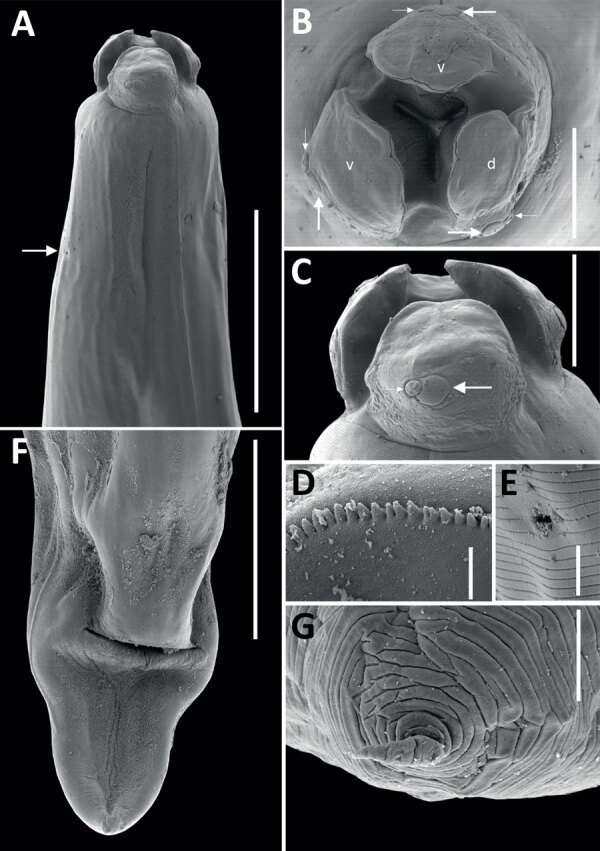 Figure 1
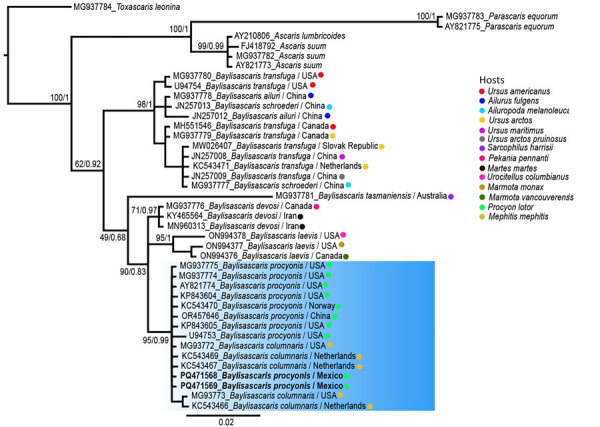 Figure 2
Peer Reviews
No public reviews on file for this paper yet. If you reviewed it on a platform where reviews are public (OpenReview, ICLR, NeurIPS, ICML), you can paste yours below so the community can read it here.
Videos
No videos yet. Explain this paper in a talk, walkthrough, or lecture? Add one.
Taxonomy
TopicsParasitic Infections and Diagnostics · Zoonotic diseases and public health · Dermatological diseases and infestations
Baylisascaris procyonis, also known as the raccoon roundworm, is a zoonotic ascarid nematode that parasitizes the small intestine of its definitive host, the common raccoon (Procyon lotor). B. procyonis worms are commonly found in the United States and Canada (1). The B. procyonis life cycle involves direct transmission via the fecal–oral route between raccoons, but raccoons can also acquire the parasite indirectly by ingesting infected paratenic (transport) hosts (1,2). In the definitive host, the parasite life cycle occurs in the small intestine, where larvae hatch from infective eggs and develop into adults; male and female adult worms then mate and eggs are oviposited. However, larvae do not develop to adult stages in humans and other paratenic hosts. Instead, once the larvae hatch, they rapidly penetrate the intestinal mucosa and migrate through blood to the liver, lungs, or other tissues, causing visceral, ocular, or neural larval migrans, which can result in fatal disease or neurologic disease with severe outcomes (1,2). Exposure risk is highest for young children, who are more likely to accidentally ingest animal feces (1,3).
B. procyonis roundworms are considered a rare cause of human disease; ≈40 cases have been reported worldwide (3). However, human infection is increasingly recognized as an emerging public health concern in North America and in some countries in Europe and Asia, where raccoons have been introduced (1,2).
In January 2024, we captured a juvenile (<1 year of age), male raccoon in a patch of cloud forest in Veracruz, Mexico (latitude 19°30'47''N, longitude 96°56'33''W) that showed clinical signs consistent with distemper virus infection. Because of illness severity, we euthanized the raccoon and subsequently performed a necropsy. We conducted all handling procedures according to the Universidad Veracruzana Institutional Animal Care and Use Committee protocol (no. 003/2024-UV-IACUC) and the collection permit issued by the Mexico Secretary of Environment (permit no. SPARN/DGVS/06330/23). During necropsy, we collected 4 roundworms from the small intestine. We preserved 2 worms in 96% ethanol for molecular testing and fixed the other 2 worms in 4% formalin for morphologic identification. We did not detect eggs in the feces by using sedimentation or flotation tests.
All 4 roundworms were initially identified as Baylisascaris sp. by using a Leica DM750 light microscope (Leica, https://www.leica-microsystems.com) (4). To better characterize morphology, we processed 1 female specimen for scanning electron microscopy using standard methods, including washing, rinsing, and dehydrating steps, followed by a critical point drying step and mounting on aluminum stubs with a carbon adhesive before sputter coating with gold in a Quorum Q150RS instrument (Quorum Technologies, https://www.quorumtech.com). We produced scanning electron micrographs of the female specimen (Figure 1). We deposited 1 male B. procyonis roundworm specimen into the Colección Nacional de Helmintos del Instituto de Biología at the Universidad Nacional Autonoma de Mexico in México City (accession no. CNHE 8585).
We extracted genomic DNA from 2 worms by using DNAzol (Molecular Research Center, https://www.mrcgene.com) (5). To confirm morphologic identification of Baylisascaris sp., we amplified partial segments of the domains D2–D3 of the 28S rDNA gene (785 bp) by using 502 and 536 primers and conditions, as previously described (6). Macrogen Inc. (https://dna.macrogen.com) purified and sequenced the PCR samples. We assembled contigs and resolved base-calling differences by using Geneious version 8.1.8 (https://www.geneious.com). We generated consensus sequences and compared them with sequences in GenBank. Using MEGA11 (7), we aligned sequences by using the ClustalW algorithm and constructed phylogenetic trees by using the maximum-likelihood method. Phylogenetic analysis of the 28S rRNA sequences showed 100% identity with B. procyonis worms collected from raccoons in the United States (GenBank accession no. KP843605), China (accession no. OR457646) and Norway (accession no. KC543470) (Figure 2). We submitted sequences from this study to GenBank (accession nos. PQ471568 and PQ471569).
Finding B. procyonis roundworms in a raccoon in Mexico extends the geographic distribution of this zoonotic nematode in the Americas, which has been described throughout Canada and the United States and, in 1 report, from Costa Rica (1,8). Despite the relatively low number of human cases reported worldwide and previous absence of B. procyonis worms in Mexico, the ecoepidemiology of B. procyonis roundworms suggests that the number of infection cases are underestimated. Infection prevalence is high in raccoons across their known distribution range; infected animals can carry several adult worms, which can excrete millions of eggs into the environment (1). A high infection prevalence likely also applies to Mexico because raccoons are distributed throughout all the states within the country, and they have increasingly become synanthropic, living close to human settlements, where they are also occasionally kept as pets (9,10). In addition, domestic dogs could also play a key role in the epidemiology of B. procyonis roundworms, and other zoonotic ascarids such as Toxocara canis, which raises the risk for human exposure and infection (1,2). Our findings highlight the importance of increasing epidemiologic surveillance and healthcare provider awareness of baylisascariasis in Mexico to effectively prevent infections, particularly in areas where humans (especially children) and dogs might come into contact with raccoons or B. procyonis eggs in the environment.
The reference list from the paper itself. Each links out to its DOI / PubMed record.
- 1US Geological Survey, National Wildlife Health Center. Baylisascaris larva migrans. Circular 1412. 2016 [cited 2024 Apr 25]. https://pubs.usgs.gov/circ/1412/cir 1412.pdf
- 2Bauer C. Baylisascariosis—infections of animals and humans with ‘unusual’ roundworms. Vet Parasitol. 2013;193:404–12. 10.1016/j.vetpar.2012.12.03623339846 · doi ↗ · pubmed ↗
- 3Lipton BA, Oltean HN, Capron RB, Hamlet A, Montgomery SP, Chancey RJ, et al. Baylisascaris procyonis roundworm infection in child with autism spectrum disorder, Washington, USA, 2022. Emerg Infect Dis. 2023;29:1232–5. 10.3201/eid 2906.23029037209678 PMC 10202880 · doi ↗ · pubmed ↗
- 4Gu XH, Chen HX, Hu JJ, Li L. Morphology and ASAP analysis of the important zoonotic nematode parasite Baylisascaris procyonis (Stefahski and Zarnowski, 1951), with molecular phylogenetic relationships of Baylisascaris species (Nematoda: Ascaridida). Parasitology. 2024;151:200–12.38087962 10.1017/S 0031182023001312 PMC 10941036 · doi ↗ · pubmed ↗
- 5Pinacho-Pinacho CD, Calixto-Rojas M, García-Vásquez A, Guzmán-Valdivieso I, Barrios-Gutiérrez JJ, Rubio-Godoy M. Species delimitation of Gyrodactylus (Monogenea: Gyrodactylidae) infecting the southernmost cyprinids (Actinopterygii: Cyprinidae) in the New World. Parasitol Res. 2021;120:831–48. 10.1007/s 00436-020-06987-833409628 · doi ↗ · pubmed ↗
- 6García-Varela M, Nadler SA. Phylogenetic relationships of Palaeacanthocephala (Acanthocephala) inferred from SSU and LSU r DNA gene sequences. J Parasitol. 2005;91:1401–9. 10.1645/GE-523R.116539024 · doi ↗ · pubmed ↗
- 7Tamura K, Stecher G, Kumar S. MEGA 11: molecular evolutionary genetics analysis version 11. Mol Biol Evol. 2021;38:3022–7. 10.1093/molbev/msab 12033892491 PMC 8233496 · doi ↗ · pubmed ↗
- 8Baldi M, Alvarado G, Smith S, Santoro M, Bolaños N, Jiménez C, et al. Baylisascaris procyonis parasites in raccoons, Costa Rica, 2014. Emerg Infect Dis. 2016;22:1502–3. 10.3201/eid 2208.15162727433741 PMC 4982188 · doi ↗ · pubmed ↗