Ring of resistance: Circular RNA Os-CircANK sequesters miR398b to counter rice blast resistance
Pei Qin Ng

Abstract
Genes, proteins, chemicals, diseases, species, mutations and cell lines named across the full text — each resolved to its canonical identifier and authoritative record.
Click any figure to enlarge with its caption.
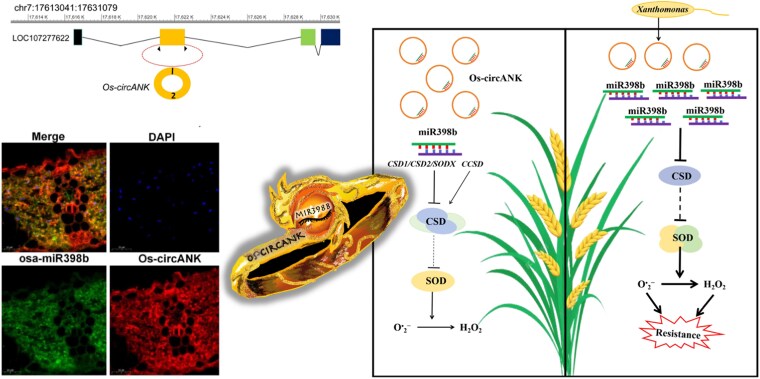 Figure 1
Peer Reviews
No public reviews on file for this paper yet. If you reviewed it on a platform where reviews are public (OpenReview, ICLR, NeurIPS, ICML), you can paste yours below so the community can read it here.
Videos
No videos yet. Explain this paper in a talk, walkthrough, or lecture? Add one.
Taxonomy
TopicsInsect Resistance and Genetics · Circular RNAs in diseases · Vector-Borne Animal Diseases
Circular RNAs are noncoding, single-stranded RNA molecules in which the downstream splice-donor site is covalently linked to the upstream donor site (Kristensen et al. 2019). In humans, circular RNA plays essential roles in cancer progression and serves as a biomarker in disease diagnostics (Xia et al. 2017; Chu et al. 2022). In plants, circular RNAs are abundant and show different characteristics than their animal counterparts, including different biogenesis processes (Zhang et al. 2020). In rice, circular RNAs originate from young parental genes, suggesting that these noncoding RNAs emerged relatively recently in plant evolution (Zhang et al. 2020; Chu et al. 2022). However, the function of these plant circular RNAs remains underexplored in the context of plant disease resistance.
In contrast, the role of RNA silencing via small RNAs (ranging from 21 to 26 nt) in plant immunity is well-established (Baulcombe 2004; Li et al. 2022). MicroRNAs, for example, mediate key plant processes, including development and stress regulation, with microRNA 398b (miR398b) being a regulator of stress and disease response (Li et al. 2022). Recent work by Xiaohui Liu and colleagues (Liu et al. 2025) shows that the circular RNA Os-CircANK lowers the ability of rice plants to combat the incoming infection via “sponging” miR398b. Their work unravels a novel regulation mechanism for counteracting disease resistance in rice.
To investigate the putative role of circular RNAs in disease resistance, Liu and colleagues identified Os-circANK, a circular RNA found to be downregulated in blight-infected rice. Next, the team generated Os-circANK knockdown (Os-circANK_KD_) and overexpressing (Os-circANK_OE_) plants and compared these with the wild-type rice plants. Infection assays with Xanthomonas oryzae pv. oryzae (Xoo), the main causal agent of blight disease in rice, showed that Os-circANK overexpressing plants (Os-circANK_OE_) displayed a more severe disease phenotype compared to wild-type or knockdown plants. Using a combination of computational predictions, dual luciferase assay, and RNA immunoprecipitations, miR398b was identified and validated as the target of Os-circANK. Fluorescent in-situ hybridization showed coexpression of miRNA398b and Os-circANK in the cytosol, supporting the role of Os-circANK as a competing endogenous RNA. These findings suggest that the depletion of miR398b is due to miRNA398b binding to Os-circANK, which prevents miR398b from binding to its target transcripts.
miRNA398b was found to be highly enriched in Os-circANK_OE_ and reduced in Os-circANK_KD_. plants. To investigate the interaction between Os-circANK and miR398b in more detail, Liu and colleagues further quantified the transcript levels of miR893b target genes, many of which regulate the production of reactive oxygen species. In Os-circANK_OE_ rice plants, these transcripts are no longer suppressed by miRNA398b, thereby impeding reactive oxygen species generation and leading to decreased resistance to Xoo infection (Figure). miR398b-overexpressing rice plants showed stronger disease resistance, with Os-circANK_KD_ lines showing similar effects. Interestingly, quantitative real-time PCR revealed that miR398b was highly expressed in Xoo-infected rice, while the transcript levels of its target genes were downregulated, further consolidating Os-circANK as the negative regulator of rice blight disease resistance.
In summary, the work of Liu et al. (2025) not only sheds light on the direct interaction of a circular RNA with a miRNA and its role in plant disease resistance but also presents a technique for studying circular RNAs. This work expands our knowledge of circular RNAs in plants and opens the door to their use as a tool to improve crop disease resistance.
Recent related articles in The Plant Cell
Attallah et al. (2025) review the roles of long and small ncRNAs in plant biology, highlighting their application as powerful tools in agricultural biotechnology.
The reference list from the paper itself. Each links out to its DOI / PubMed record.
- 1Attallah C, Conti G, Zuljan F, Zavallo D, Ariel F. Noncoding RN As as tools for advancing translational biology in plants. Plant Cell. 2025:koaf 054. 10.1093/plcell/koaf 05440090356 PMC 12079378 · doi ↗ · pubmed ↗
- 2Baulcombe D . RNA silencing in plants. Nature. 2004:431(7006):356–363. 10.1038/nature 0287415372043 · doi ↗ · pubmed ↗
- 3Chu Q, Ding Y, Xu X, Ye C-Y, Zhu Q-H, Guo L, Fan L. Recent origination of circular RN As in plants. New Phytol. 2022:233(1):515–525. 10.1111/nph.1779834643280 · doi ↗ · pubmed ↗
- 4Kristensen LS, Andersen MS, Stagsted LVW, Ebbesen KK, Hansen TB, Kjems J. The biogenesis, biology and characterization of circular RN As. Nat Rev Genet. 2019:20(11):675–691. 10.1038/s 41576-019-0158-731395983 · doi ↗ · pubmed ↗
- 5Li J, Song Q, Zuo Z-F, Liu L. Microrna 398: a master regulator of plant development and stress responses. Int J Mol Sci. 2022:23(18):10803. 10.3390/ijms 23181080336142715 PMC 9502370 · doi ↗ · pubmed ↗
- 6Liu X, Wang P, Wang S, Liao W, Ouyang M, Lin S, Lin R, Sarris PF, Michalopoulou V, Feng X, et al The circular RNA circ ANK suppresses rice resistance to bacterial blight by inhibiting micro RNA 398b-mediated defense. Plant Cell. 2025:37(4):koaf 082. 10.1093/plcell/koaf 08240261967 PMC 12013817 · doi ↗ · pubmed ↗
- 7Xia S, Feng J, Lei L, Hu J, Xia L, Wang J, Xiang Y, Liu L, Zhong S, Han L, et al Comprehensive characterization of tissue-specific circular RN As in the human and mouse genomes. Brief Bioinformatics. 2017:18(6):984–992. 10.1093/bib/bbw 08127543790 · doi ↗ · pubmed ↗
- 8Zhang P, Li S, Chen M. Characterization and function of circular rnas in plants. Front Mol Biosci. 2020:7:91. 10.3389/fmolb.2020.0009132509801 PMC 7248317 · doi ↗ · pubmed ↗