Appropriate Use of Proton Pump Inhibitors in General Out Patient Department of a Tertiary Care Center of Kathmandu Valley: An Observational Study
Jeetendra Bhandari, Narendra Bhandari

TL;DR
This study examines how often proton pump inhibitors are appropriately prescribed in a general outpatient clinic in Nepal.
Contribution
The study provides insights into PPI prescription practices in a Nepalese tertiary care center.
Findings
PPIs were appropriately prescribed in 57.74% of cases.
Pantoprazol was the most commonly prescribed PPI (74.62%).
Over 40% of PPI prescriptions lacked clear medical justification.
Abstract
Proton Pump Inhibitors (PPIs) are widely used medications that suppress gastric acid secretion worldwide. However, they have been linked to an increased risk of chronic kidney disease, hypomagnesemia, and bacterial infections, including C. difficile and acid hypersecretion. This study aimed to identify the appropriateness of PPI prescriptions in general clinics. An observational cross-section study was conducted in General out patient department of a tertiary care center of Nepal. Purposive sampling was done. The study included 355 clinical notes from the clinic's out patient department with at least one proton pumb inhibitor prescription. Data was collected, and the proportion of different parameters was calculated. Appropriate use of proton pumb inhibitor was 255 (57.74%). Among the total study population, 186 (51.22%) were male. The appropriate use of proton pump inhibitor use by…
Genes, proteins, chemicals, diseases, species, mutations and cell lines named across the full text — each resolved to its canonical identifier and authoritative record.
Click any figure to enlarge with its caption.
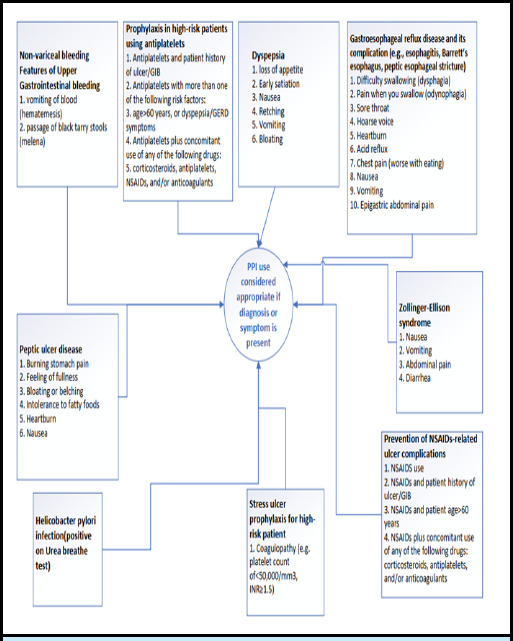 Figure 1
|
Age Group |
Appropriate Use n(%) |
Not appropriate Use n(%) |
|---|---|---|
|
15-20 |
- |
3(100) |
|
20-30 |
36(50) |
36(50) |
|
30-40 |
66(57.89) |
48(42.11) |
|
40-50 |
37(50) |
37(50) |
|
50-60 |
27(61.36) |
17(38.64) |
|
More than 60 |
39(81.25) |
9(10.75) |
|
Levels of Doctor |
Appropriate Use n(%) |
Not appropriate Use n(%) |
|---|---|---|
|
Medical Officers |
43(55.84) |
34(44.16) |
|
Resident |
79(55.63) |
63(44.37) |
|
Faculty |
83(61.02) |
53(38.98) |
|
Reasons for the use of Proton pump inhibitors |
n (%) |
|---|---|
|
Dyspepsia |
6 (2.92) |
|
Features of Upper Gastrointestinal bleeding |
18 (8.78) |
|
Gastroesophageal reflux disease and its complication |
30 (14.63) |
|
Helicobacter pylori infection (positive Urease breathe test) |
18 (8.78) |
|
NSAIDs and patient history of ulcer complication |
6 (2.92) |
|
Peptic ulcer Disease |
58 (28.29) |
|
Prevention of NSAIDS-related ulcer complication |
68 (33.68) |
|
PPI Name |
Once Daily (n%) |
Twice Total (n%) |
Daily (n%) |
|---|---|---|---|
|
Pantoprazole |
212 (75.85) |
53 (20) |
265 (74.62) |
|
Esomeprazole |
37 (88.10) |
5 (11.90) |
42 (11.83) |
|
Rabeprazole |
22 (100) |
- |
22 (6.21) |
|
Omeprazole |
8 (30.77) |
18 (69.23) |
26 (7.32) |
Peer Reviews
No public reviews on file for this paper yet. If you reviewed it on a platform where reviews are public (OpenReview, ICLR, NeurIPS, ICML), you can paste yours below so the community can read it here.
Videos
No videos yet. Explain this paper in a talk, walkthrough, or lecture? Add one.
Taxonomy
TopicsGastroesophageal reflux and treatments · Helicobacter pylori-related gastroenterology studies · Gastrointestinal Bleeding Diagnosis and Treatment
INTRODUCTION
Appropriateness and suitability of healthcare have been discussed since the 1990s.^1^ Antibiotics are the most commonly inappropriately used medicine worldwide, followed by proton pump inhibitors (PPI) which has been in frequent use since 1989 AD.^23^
Studies have shown that PPI has a risk of atherosclerosis, chronic kidney disease, etc, if used longer.^4-6^ Over 110 million PPI prescriptions are filled yearly in the United States.^7^ A study from Austraila suggests that PPI utilization increased by 1318% in one decade.^8^ Similarly, a study from China showed that 50% of PPIs were prescribed appropriately while a study from India showed that only 13.8% of children were prescribed PPIs appropriately.^10,11^
Therefore, this study is designed to determine the appropriate use of PPIs by doctors working in general practice clinic.
METHODS
This is an observational cross-section study conducted at the General Practice Clinic of the Department of General Practice and Emergency Medicine, Patan Academy of Health Sciences, which is a tertiary care teaching hospital located in Lalitpur, Nepal. The study was conducted between November 2021 and May 2024 AD after obtaining ethical approval from the Institutional Review Committee (Reference number: PMG2203041596).
A purposive sampling method was used, and the maximum sample size calculated was 355. The sample size was calculated as follows.
The sample size was calculated considering 30.7% inappropriate use of PPI taken from a similar study. With a 5% margin of error and 10% non-response rate, the estimated sample size was 355. A purposive sampling was done.^12^
All clinical notes from out patient department (OPD) with at least one PPI prescription were included in the study. Patients who were under the age of fourteen years, clinical notes without symptoms and diagnosis, illegible handwriting and patients already on PPIs before the visit were excluded from the study.
Indications for appropriate PPI prescription in this study were identified following standard guidelines and previous review articles (Table 1).
The principal investigator and a trained colleague collected data weekly at the OPD using photography. which were securely stored, and data was gathered from medical notes using a structured proforma. Consent was obtained form all participants above age of 18 years and assent with participants below 18 years.
Data was entered in EPI-INFO and analyzed in Easy R. Continuous variables were tested for normality. Categorical variables like age, sex, PPI use, etc., were presented as numbers and percentages.
The working definition13-15 of appropriate use of PPI.
RESULTS
The study included 355 patients out of which 186 (51.55%) were male and 114 (32.11%) were in the age group of 40-50 years (Table 1).
The appropriate use of proton pump inhibitor was observed in 255 (57.54%) clinical notes. Clinician of more than 60 years has 39 (81.25%) clinical note where PPIs were prescribed appropriately (Table 1).
There were 138 (75.49%) male and 67 (38.95%) female using PPIs appropriately. Amongst the doctors, 83 (61.02%) of faculties used PPIs appropriately (Table 2).
In 258 (73%) clinical notes, diagnosis was included and 63 (33.68%) used to prevent Non-steroidal antiinflammatory drug-related ulcer complications, while 58 (28.29%) were used for peptic ulcer disease (Table 3).
Pantoprazole was used by 265 (74.62%) individuals., (Table 4).
DISCUSSION
The overall appropriateness of using PPI among the patients visiting the general clinic of the center was 205(57.74%). Different studies have shown different rates of the appropriateness of using PPI. Some studies done in the hospital setting have an appropriateness of use range between 19%-73%, with a mean of appropriate use of 43%.^17-22^ Some of the studies performed in the primary care setting showed the appropriateness of using PPI between 37% and 64%, with a mean of 50%.^12, 23^
A study performed in the community teaching hospital in New Haven County, Connecticut, United States, showed the appropriate use of acid-lowering agents (they used both PPI and H2 blockers as study variables) to be only 35% ( among 226 patients used in the study).^19^ Studies performed in Italy in L. Sacco Hospital, a teaching hospital located in north-west Milan, showed the inappropriate use of acid suppression medication to be 44%(out of 799 patients studied, which used PPI and H2 blockers).^20^ A study that was performed among pulmonary patients in Sweden at Sahlgrenska University Hospital, which is a metropolitan teaching hospital, showed the appropriateness of the use of acid suppression agents to be only 19%(out of 301 patients enrolled; they also used both PPI and H2 blocker as acid suppression agent during the study).^21^ Studies performed in William Beaumont Hospital, Michigan, USA showed appropriateness of the use of acid suppressant(both PPI and H2 blocker) to be 40%(out of 324 patients).^24^
A study performed in Ireland in Midland Regional Hospital at Tullamore, which was a single-day survey of the charts of 157 patients of the hospital, showed the appropriateness of use of PPI to be 67%(out of 48 patients who were prescribed with any one of the PPI).^22^ Studies performed in China, PPI prescriptions for nonhospitalized patients in Beijing, Chengdu, Guangzhou, and Hangzhou, China, over 40 days in 2016 showed the inappropriate use of PPI between 32.6% to 56.8%.^25^ Studies performed in the same center where this study was performed among the admitted patients in surgery and medical ward showed the inappropriate use of intravenous PPI to be as high as 92.3%.^26^
Proton Pump inhibitors are the most used drug worldwide since 1989 AD after the discovery of Omeprazole.^3^ Data have shown that the proportion of PPI users has increased from 0.2% in 1990 to 15.0% in 2014 in the UK. ^27^ Moreover, there are emerging potential adverse effects or risks induced by PPI abuse or in conjunction with other drugs.^4-6, 8^ Why do doctors over-prescribe acid suppression therapy on general medical floors? Practitioners not knowing the correct indications for in-patient anti-secretory therapy may be the leading cause of the misuse of acid suppression.^16^
This study showed that the highest proportion of appropriate use of PPI was in the age group over 60 years. A study on the global burden and demographic profiles of peptic ulcer disease showed that the prevalence of Peptic ulcer disease is higher in the age group above 70 years.^28^ Risk of peptic ulcer complication is 10-fold higher than those over the age of 60 years compared to younger age groups.^16^ The common age group for orthopedics-related degenerative disorders,^29^ cardiovascular-related disorders, is high among the elderly age group.^16^ There is the use of NSAIDs, anticoagulants, antiplatelet therapy, and corticosteroid therapy is high among this age group.^16^ So, there are clearer indications of the use of PPI among these age groups, such as those over 60 years. This can be the reason for the appropriate use of PPI in age groups over 60 years compared to other age groups. In contrary to this, there is also inappropriate use of PPI among the young population, but in comparison to the elderly, it seems to be less.
This study shows that the appropriateness of using PPI is more in males, 75.40% (138 of 183 total males in the study) than in females, 38.95% (67 out of 172 female participants). A study on the global burden and demographic profile of peptic ulcer disease showed that the age and standardized prevalence rate of Peptic ulcer disease is higher among males than females.^28^ But on the contrary, the same study showed higher PUD among females than in males on both spectrums of age spectrums (more than 70 and less than 24 years of age).
This study shows that the most appropriate use of PPI was made by faculties, which was 83(61.02%). A study from the United States suggests that internists there were aware of the 5-6 adverse effects of PPI and said to change the prescribing habit of PPI.^30^
CONCLUSIONS
This study suggests there was an appropriate use of PPI more than 50 percent of the time, but still, there is a high number of patients who have been prescribed the proton pump inhibitor without a clear indication. This study was done among patients coming to the general clinic.
The reference list from the paper itself. Each links out to its DOI / PubMed record.
- 1Buetow SA Sibbald B Cantrill JA Halliwell S Appropriateness In Health Care: Application To Prescribing.Soc Sci Med.1997 Jul 4522617110.1016/S 0277-9536(96)00342-59225413 · doi ↗ · pubmed ↗
- 2Casula M Ardoino I Franchi C Appropriateness Of The Prescription And Use Of Medicines: An Old Concept But More Relevant Than Ever.Int J Environ Res Public Health.2023 Feb 2203270010.3390/ijerph 2003270036768066 PMC 9915431 · doi ↗ · pubmed ↗
- 3Shi S Klotz U Proton Pump Inhibitors: An Update Of Their Clinical Use And Pharmacokinetics.Eur J Clin Pharmacol.2008 Oct 64109355110.1007/s 00228-008-0538-y 18679668 · doi ↗ · pubmed ↗
- 4Lazarus B Chen Y Wilson FP Sang Y Chang AR Coresh J et al Proton Pump Inhibitor Use And The Risk Of Chronic Kidney Disease.JAMA Intern Med.2016 Feb 17622384610.1001/jamainternmed.2015.719326752337 PMC 4772730 · doi ↗ · pubmed ↗
- 5Cheungpasitporn W Thongprayoon C Kittanamongkolchai W Srivali N Edmonds PJ Ungprasert P et al Proton Pump Inhibitors Linked To Hypomagnesemia: A Systematic Review And Meta-Analysis Of Observational Studies.Ren Fail.2015 Aug 37712374110.3109/0886022 X.2015.105780026108134 · doi ↗ · pubmed ↗
- 6Kwok CS Arthur AK Anibueze CI Singh S Cavallazzi R Loke YK Risk Of Clostridium Difficile Infection With Acid Suppressing Drugs And Antibiotics: Meta-Analysis.Am J Gastroenterol.2012 Jul 107710119 Epub 2012 Apr 24. Erratum In: Am J Gastroenterol. 2014 Jan;109(1):14410.1038/ajg.2012.10822525304 · doi ↗ · pubmed ↗
- 7Mishuk AU Chen L Gaillard P Westrick S Hansen RA Qian J National Trends In Prescription Proton Pump Inhibitor Use And Expenditure In The United States In 2002-2017.J Am Pharm Assoc (2003)2020 Oct 22S 1544-31912030476-310.1016/j.japh.2020.09.01534756356 · doi ↗ · pubmed ↗
- 8Hollingworth S Duncan EL Martin JH Marked Increase In Proton Pump Inhibitors Use In Australia.Pharmacoepidemiol Drug Saf.2010 Oct 191010192410.1002/pds.196920623646 · doi ↗ · pubmed ↗