Erythema Ab Igne Associated With Prolonged Direct Skin Contact With a Space Heater: A Case Report
Viniya Patidar, Mary Ann Kirkconnell Hall, Bonnie Cruser

TL;DR
A woman developed a heat-related skin condition from prolonged use of a space heater, which was successfully addressed by stopping the heat exposure.
Contribution
This case report highlights erythema ab igne caused by a space heater, emphasizing the importance of recognizing non-occupational heat sources.
Findings
Erythema ab igne was diagnosed in a woman due to prolonged direct skin contact with a space heater.
The condition was resolved by discontinuing heat exposure and counseling the patient.
Prolonged heat exposure can lead to permanent pigmentation or skin cancer if untreated.
Abstract
Erythema ab igne is a rare condition manifesting in a reticulated, hyperpigmented rash that develops from chronic exposure to direct heat or infrared radiation. Diagnosis is clinical, with biopsy only required when malignancy is suspected. Historically, individuals repeatedly exposed to direct heat, such as bakers and metalworkers, were at increased risk, but since the development of central heating, incidence has significantly decreased in developed countries. However, it is important to recognize that erythema ab igne may occur with prolonged chronic exposure to normally functioning heated items such as car seats and, in our case, a space heater. The mainstay of treatment is the removal of heat exposure; delays in diagnosis and ongoing heat exposure can result in permanent pigmentation or progression to malignant transformation, leading to Merkel cell carcinoma, basal cell carcinoma,…
Genes, proteins, chemicals, diseases, species, mutations and cell lines named across the full text — each resolved to its canonical identifier and authoritative record.
Click any figure to enlarge with its caption.
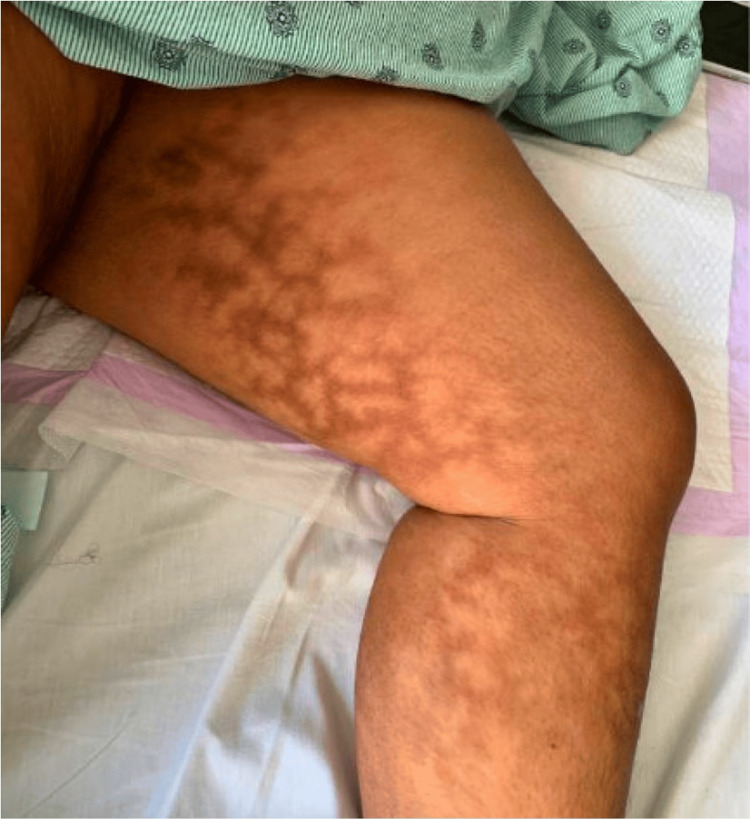 Figure 1
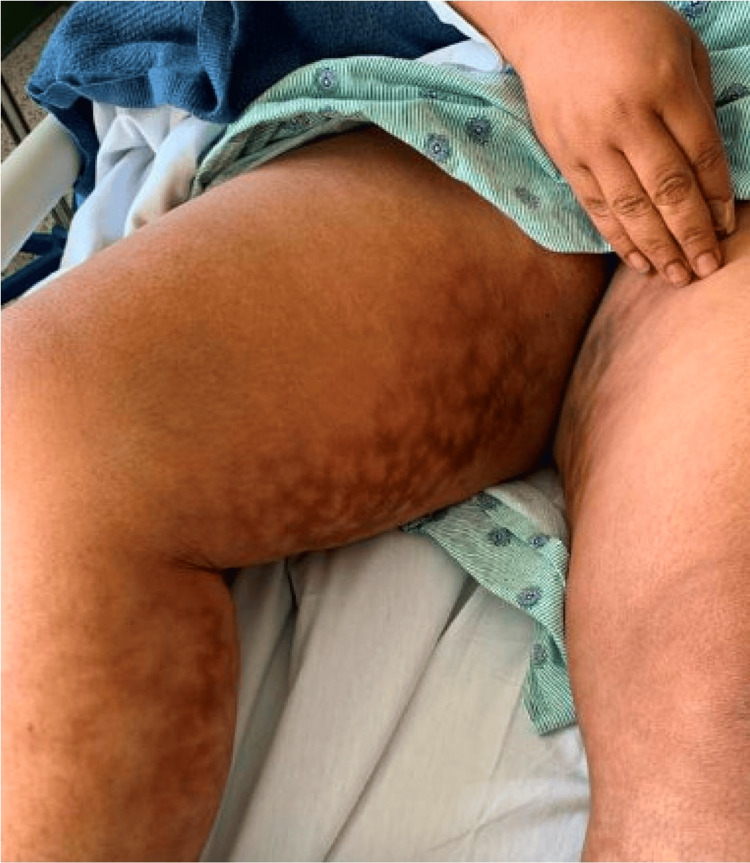 Figure 2
| Assay | Value | Reference range |
| Hemoglobin | 6.8 g/dL | 12.1-15.1 g/dL |
| Iron | 32 mcg/dL | 60-160 mcg/dL |
| Ferritin | 3 ng/mL | 10-150 ng/mL |
| Total iron-binding capacity | 437 mcg/dL | 240-450 mcg/dL |
| Transferrin saturation | 7% | 15%-50% |
| Haptoglobin | 204 mg/dL | 83-267 mg/dL |
| Lactate dehydrogenase | 228 units/L | 80-225 units/L |
| Estimated sedimentation rate | 85 mm/hour | 0-20 mm/hour |
| C-reactive protein | 6.2 mg/dL |
Normal: <0.3 mg/dL, normal or minor elevation: 0.3-1.0 mg/dL, moderate elevation: 1.0-10.0 mg/dL, marked elevation: >10.0 mg/dL, severe elevation: >50.0 mg/dL [ |
| HIV | Negative | N/A |
| Acute viral hepatitis A, B, C | Negative | N/A |
| Requires workup for autoimmune/hypercoagulable state? | Temperature association | Other notes | |
| Erythema ab igne | No | Heat | - |
| Livedo reticularis | Yes, associated with lupus, cryoglobulinemia, and Raynaud phenomenon | Cold | - |
| Livedo racemosa | Yes | - | - |
| Cutis marmorata | No | Cold | Common in infants |
| Poikiloderma of Civatte | No | Heat | Associated with UV exposure |
| COVID-associated rash | No | - | - |
| Drug-induced reticulate hyperpigmentation | No | - | - |
Peer Reviews
No public reviews on file for this paper yet. If you reviewed it on a platform where reviews are public (OpenReview, ICLR, NeurIPS, ICML), you can paste yours below so the community can read it here.
Videos
No videos yet. Explain this paper in a talk, walkthrough, or lecture? Add one.
Taxonomy
TopicsDermatological and COVID-19 studies · Genital Health and Disease · Streptococcal Infections and Treatments
Introduction
In the original Latin, erythema ab igne literally means "redness from fire." Erythema ab igne is a rarely reported condition where a reticulated, hyperpigmented rash is caused by chronic exposure to either direct heat or infrared radiation [1]. It closely resembles livedo reticularis, which is associated with underlying systemic illness and requires additional workup and treatment. It can also mimic other dermatologic conditions, further complicating the diagnosis.
"Retiform" and "reticular" are synonyms that mean "net-like." The differential diagnosis for a reticular rash includes other medical conditions such as livedo reticularis, cutis marmorata, livedo racemosa, poikiloderma of Civatte, or COVID-associated rash [2]. Erythema ab igne is usually asymptomatic; however, some patients report itching or burning involving the rash site [3]. It can initially start off as an erythematous patch and eventually can progress to involve skin pigment changes and fibrosis in advanced, chronic cases. The diagnosis is largely clinical, not requiring a skin biopsy other than in cases where malignancy is suspected [1-3].
In premodern times, erythema ab igne was most frequently observed in individuals repeatedly exposed to direct heat, often occupationally, such as bakers and metalworkers, or by proximity to sources of heating such as open fires. Its incidence has significantly decreased in developed countries since the introduction of central heating and subsequent reduction in skin exposure to direct heat sources. There are still rare cases reported in individuals exposed to space heaters, laptop computers on bare skin, heated car seats, heating pads, and heated water bottles [2,4-6]. Most seat heaters have an upper limit of 43°C; however, malfunctioning seats can sometimes reach even higher levels, nearing around 48.9°C, and can cause second-degree burns, particularly in patients with impaired mobility and sensation. It is also important to recognize that erythema ab igne may occur with prolonged chronic exposure to normally functioning heated elements [5].
The primary approach to treatment is removing exposure to heat; delays in diagnosis and continued heat exposure may result in permanent pigmentation or progression to malignant transformation, leading to Merkel cell carcinoma, basal cell carcinoma, and squamous cell carcinoma [1,3].
In this report, we describe the case of a woman who presented with complaints of cramping pain in her legs, accompanied by discoloration and a lacy rash, particularly on the inner aspects of both upper thighs and down her calves. Subsequent investigation revealed that she had exposed her skin to a space heater placed between her legs for multiple hours each day for the previous several months, and she was diagnosed with erythema ab igne.
Case presentation
Patient information
A 37-year-old woman with no known past medical history presented with several weeks' history of worsening crampy pain in her legs; she reported taking nonsteroidal anti-inflammatory drugs for pain with little relief. She had also noticed discoloration and a lacy rash, particularly around her calves and moving upward toward her inner legs. She reported feeling cold in her legs, further contributing to her discomfort, along with increased fatigue, lightheadedness, and dyspnea on exertion during this time.
Clinical findings
On presentation, her vitals were a temperature of 36.4°C, heart rate of 101, blood pressure of 125/77 mmHg, and oxygen saturation of 100% on room air. She denied any signs of bleeding and reported normal menstrual cycles. Results of an extended anemia panel suggested iron deficiency anemia (Table 1). In the context of her symptoms, anemia raised our clinical suspicion of an underlying autoimmune condition, and we ordered haptoglobin, lactate dehydrogenase, estimated sedimentation rate (ESR), C-reactive protein (CRP), HIV, and hepatitis studies (Table 1). All were within (or very near) normal values, with the exception of ESR and CRP, which were mildly elevated (Table 1).
On examination, she had extensive mottling of skin with hyperpigmented changes involving her bilateral lower extremities, notably her calves and the inner aspects and back of her thighs (Figure 1 and Figure 2).
Erythema ab igne on the left inner thigh and calf
Erythema ab igne on the right inner thigh and calf
Diagnostic assessment
Due to her low hemoglobin level, the patient was admitted and transfused one unit of packed red blood cells and hemoglobin with an appropriate response.
For the lower extremity rash, we were concerned about livedo reticularis and consulted dermatology. Dermatology determined that her severe iron deficiency anemia was causing restless leg syndrome and pain. Upon further history obtained by dermatology, the patient revealed that due to her legs feeling cold and cramping, she had been placing a space heater between her legs with direct exposure of her skin for several hours a day, every day, for several months.
Due to this history of routine, prolonged, direct heat to the inner thighs and a clinical finding of fixed, brown retiform patches and thin plaques isolated to the area, the diagnosis was thought to be consistent with erythema ab igne, and it was determined that no additional autoimmune workup was needed.
Therapeutic intervention
The treatment recommended by dermatology was to avoid ongoing heat exposure. The patient was counseled extensively on the importance of stopping the use of space heaters for prolonged periods of time near her legs.
Follow-up and outcomes
The patient was discharged in stable condition but did not return to the clinic thereafter; hence, resolution of the rash was not visualized.
Discussion
This case highlights the importance of clinical awareness and consideration of erythema ab igne. The differential diagnosis for a reticulated rash is limited. A history of heat exposure is sufficient to make a clinical diagnosis, thus avoiding the time and expense of further workup of more sinister causes, such as livedo reticularis, ruled out in our case by dermatology's definitive diagnosis, that can be associated with autoimmune illnesses.
Early detection and removal of the offending heat source(s) is important to prevent progression to permanent hyperpigmentation or carcinoma [6]. Erythema ab igne is twice as frequently diagnosed in women as in men and is more likely to occur involving the lower extremities; it can occur at any age but is most common between the ages of 40 and 70 years [7]. It is generally asymptomatic but can be associated with burning or itching [8].
Erythema ab igne is caused by thermal damage from heat sources not hot enough to cause burns, such as heated car seats, space heaters, or laptops [3,4]. Although the pathophysiology is not definitively known, it is thought that damage to superficial blood vessels results in hemosiderin deposition [7]. Erythema ab igne is not typically associated with the formation of bullae; however, there has been a reported case of bullous erythema ab igne, and it is thus important to include it in the differential diagnosis of bullous disorders [2].
As noted in the Introduction, the differential diagnosis for reticular rash includes erythema ab igne as well as livedo reticularis, livedo racemosa, cutis marmorata, poikiloderma of Civatte, COVID-associated rash, or drug-induced reticulate hyperpigmentation (Table 2). Livedo reticularis and cutis marmorata are typically worsened by cold, in contrast to erythema ab igne, which is worsened by heat [2]. Unlike livedo reticularis and livedo racemosa, erythema ab igne does not require laboratory evaluation for an underlying vasculitis or hypercoagulable state [2].
Erythema ab igne is a clinical diagnosis. Biopsy is typically not required to make a diagnosis of erythema ab igne [9,10] but should be done if there are papular or nodular lesions within the rash concerning for malignant transformation [1,10]. In our case, although our patient had mildly elevated ESR and CRP, dermatology was confident in the clinical diagnosis of erythema ab igne. We believe that the diagnosis was correct, supported by the fact that the patient did not present again for treatment in our health system.
Early diagnosis and removal of the offending heat source(s) is important, as, rarely, erythema ab igne has been reported to progress to squamous cell carcinoma, cutaneous marginal zone lymphoma, poorly differentiated carcinoma, and Merkel cell carcinoma [1,3,9,10]. The mainstay of treatment of erythema ab igne is removal of the heat source, which may reverse the skin changes of hyperpigmentation [1,3,9,11]. Consideration of the underlying causes of chronic pain, thus prompting the use of heat sources, is prudent. In some cases, if removal of the heat source does not fully or only minimally improve the rash, topical steroids, hydroquinone, 5-fluorouracil, or tretinoin may aid in reducing the discoloration [12].
Conclusions
A reticular rash is easily recognizable on examination and has a limited differential diagnosis. In cases of erythema ab igne, a good history of heat exposure can yield the correct diagnosis without the need for biopsy. The most important diagnosis to rule out is livedo reticularis, which can be a sign of a systemic medium-vessel vasculitis. Removal of the offending heat source is important, as in rare cases, erythema ab igne can evolve to permanent skin discoloration or carcinoma.
The reference list from the paper itself. Each links out to its DOI / PubMed record.
- 1Erythema Ab Igne Kettelhut EA Traylor J Sathe NC Treasure Island, FL Stat Pearls Publishing 2025 https://www.ncbi.nlm.nih.gov/books/NBK 538250/30855838 · pubmed ↗
- 2Space heater-induced bullous erythema ab igne Cutis Redding KS Watts AN Lee J Kennedy KR Shimek CM Skinner RB 0101002017 https://www.mdedge.com/cutis/article/262637/contact-dermatitis/erythema-ab-igne-clinical-review 28961297 · pubmed ↗
- 3Erythema ab igne: a clinical review Cutis Harview CL Krenitsky A 08111202310.12788/cutis.077137289686 · doi ↗ · pubmed ↗
- 4Erythema ab igne from heating pad use: a report of three clinical cases and a differential diagnosis Cureus Aria AB Chen L Silapunt S 010201810.7759/cureus.2635 PMC 604783630034957 · doi ↗ · pubmed ↗
- 5Automobile seat heater-induced erythema ab igne Arch Dermatol Brodell D Mostow EN 26426514820122235183710.1001/archdermatol.2011.1158 · doi ↗ · pubmed ↗
- 6Erythema ab igne: a rare presentation of toasted skin syndrome with the use of a space heater Cureus Haleem Z Philip J Muhammad S 013202110.7759/cureus.13401 PMC 797173333754117 · doi ↗ · pubmed ↗
- 7Heater-associated erythema ab igne: case report and review of thermal-related skin conditions Cureus Forouzan P Riahi RR Cohen PR 012202010.7759/cureus.8057 PMC 728658532537275 · doi ↗ · pubmed ↗
- 8C Reactive Protein Nehring SM Goyal A Patel BC Treasure Island Stat Pearls Publishing 2025 https://www.ncbi.nlm.nih.gov/books/NBK 441843/ 28722873 · pubmed ↗