Comparison of Students' Attitudes and Knowledge Regarding Functional Foods in Gastronomy, Food Science, and Nutrition Programs
Şenay Burçin Alkan, Hilal Öz, Berna Madalı Kafes, Hasan Hüseyin Kara

TL;DR
This study compares how students in gastronomy, food science, and nutrition programs understand and view functional foods.
Contribution
It identifies differences in knowledge and attitudes about functional foods across three academic disciplines.
Findings
Students in Food Engineering most often identified enriched foods as functional foods.
Nutrition students recognized both traditional and enriched foods as functional foods.
Students who took a functional foods course had more moderate attitudes and better knowledge.
Abstract
The awareness and consumption of functional foods (FFs) have increased in recent years. To develop FFs and accurately inform consumers, fundamental knowledge of students enrolled in the Gastronomy and Culinary Arts (GCA), Food Engineering (FE), and Nutrition and Dietetics (ND) is essential. The aim of the study is to evaluate the attitudes and knowledge of students enrolled in the GCA, FE, and ND departments regarding FFs. The study was planned as a cross‐sectional study, and data were collected using an online survey form. Students were asked to evaluate various traditional and fortified foods in terms of their functional properties. Additionally, students' attitudes and knowledge toward FFs were assessed through questionnaires. The statistical analysis of the data was conducted using the Chi‐square test in SPSS version 22. The study included 348 students (34.8% from GCA, 33.0% from…
Genes, proteins, chemicals, diseases, species, mutations and cell lines named across the full text — each resolved to its canonical identifier and authoritative record.
Click any figure to enlarge with its caption.
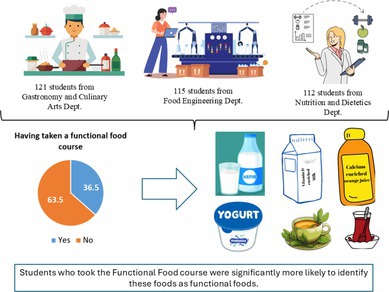 Figure 1
|
| % | |
|---|---|---|
| Department | ||
| Gastronomy and Culinary Arts (GCA) | 121 | 34.8 |
| Food Engineering (FE) | 115 | 33.0 |
| Nutrition and Dietetics (ND) | 112 | 32.2 |
| Universities | ||
| Necmettin Erbakan University, Konya | 131 | 37.6 |
| Selçuk University, Konya | 49 | 14.1 |
| Mustafa Kemal University, Hatay | 25 | 7.2 |
| Adnan Menderes University, Aydın | 25 | 7.2 |
| Yüzüncü Yıl University, Van | 18 | 5.2 |
| Çukurova University, Adana | 18 | 5.2 |
| Giresun University | 12 | 3.4 |
| Gaziantep University | 11 | 3.2 |
| Others | 59 | 16.9 |
| Gender | ||
| Female | 297 | 85.3 |
| Male | 51 | 14.7 |
| Grade | ||
| Freshman | 72 | 20.7 |
| Sophomore | 115 | 33.0 |
| Junior | 56 | 16.1 |
| Senior | 105 | 30.2 |
| Enrollment in the functional foods course | ||
| Yes | 127 | 36.5 |
| No | 221 | 63.5 |
| Age (year, ± SD) | 22.3 ± 3.7 | |
|
| % | |
|---|---|---|
| Diagnosis of disease | ||
| Yes | 129 | 37.1 |
| No | 219 | 62.9 |
| Diseases | ||
| Ophthalmic diseases | 45 | 34.9 |
| Vitamin D deficiency | 37 | 28.7 |
| Allergy | 33 | 26.6 |
| Anemia (iron) | 31 | 24.0 |
| Anemia (vitamin B12 deficiency) | 25 | 19.4 |
| Polycystic ovary syndrome | 6 | 4.7 |
| Depression | 5 | 3.9 |
| Ulcerative colitis | 4 | 3.1 |
| Diabetes mellitus | 3 | 2.3 |
| Cancer | 2 | 1.6 |
| Epilepsy | 1 | 0.8 |
| Celiac disease | 1 | 0.8 |
| Multiple sclerosis | 1 | 0.8 |
| Hypertension | 1 | 0.8 |
| Dieting | ||
| Yes | 32 | 9.2 |
| No | 316 | 90.8 |
| Types of diet | ||
| Weight loss diet | 19 | 59.4 |
| Gluten‐free diet | 5 | 15.6 |
| Low fat low cholesterol diet | 4 | 12.5 |
| High protein diet | 4 | 12.5 |
| Usage of dietary supplements | ||
| Yes | 108 | 31.0 |
| No | 240 | 69.0 |
| Dietary supplements | ||
| Vitamin D | 62 | 57.4 |
| Vitamin B12 | 61 | 56.5 |
| Iron | 34 | 31.5 |
| Fish oil | 17 | 15.7 |
| Zinc | 14 | 12.9 |
| Magnesium | 12 | 11.1 |
| Multivitamin | 8 | 7.4 |
| Multimineral | 3 | 2.8 |
| Calcium | 3 | 2.8 |
| Protein powder | 3 | 2.8 |
| Collagen | 2 | 1.9 |
| Kefir | Strawberry | Broccoli | Vitamin D enriched milk | Calcium‐enriched orange juice | ||||||
|---|---|---|---|---|---|---|---|---|---|---|
| Functional food | Not a functional food | Functional food | Not a functional food | Functional food | Not a functional food | Functional food | Not a functional food | Functional food | Not a functional food | |
| Departments | ||||||||||
| GCA | 70 (57.9%) | 51 (42.1%) | 41 (33.9%) | 80 (66.1%) | 54 (44.6%) | 67 (55.4%) | 56 (46.3%) | 65 (53.7%) | 60 (49.6%) | 61 (50.4%) |
| FE | 69 (60.0%) | 46 (40.0%) | 27 (23.5%) | 88 (76.5%) | 29 (25.2%) | 86 (74.8%) | 86 (74.8%) | 29 (25.2%) | 87 (75.7%) | 28 (24.3%) |
| ND | 67 (59.8%) | 45 (40.2%) | 44 (39.3%) | 68 (60.7%) | 47 (42.0%) | 65 (58.0%) | 83 (74.1%) | 29 (25.9%) | 78 (69.6%) | 34 (30.4%) |
|
|
|
|
|
| ||||||
| Gender | ||||||||||
| Female | 175 (58.9%) | 122 (41.1%) | 101 (34.0%) | 196 (66.0%) | 115 (38.7%) | 182 (61.3%) | 197 (66.3%) | 100 (33.7%) | 195 (65.7%) | 102 (34.3%) |
| Male | 31 (60.8%) | 20 (39.2%) | 11 (21.6%) | 40 (78.4%) | 15 (29.4%) | 36 (70.6%) | 28 (54.9%) | 23 (45.1%) | 30 (58.8%) | 21 (41.2%) |
|
|
|
|
|
| ||||||
| Grade | ||||||||||
| Freshman | 35 (48.6%) | 37 (51.4%) | 22 (30.6%) | 50 (69.4%) | 31 (43.1%) | 41 (56.9%) | 33 (45.8%) | 39 (54.2%) | 31 (43.1%) | 41 (56.9%) |
| Sophomore | 69 (60.0%) | 46 (40.0%) | 47 (40.9%) | 68 (59.1%) | 54 (47.0%) | 61 (53.0%) | 77 (67.0%) | 38 (33.0%) | 73 (63.5%) | 42 (36.5%) |
| Junior | 38 (67.9%) | 18 (32.1%) | 19 (33.9%) | 37 (66.1%) | 23 (41.1%) | 33 (58.9%) | 39 (69.6%) | 17 (30.4%) | 41 (73.2%) | 15 (26.8%) |
| Senior | 64 (61.0%) | 41 (39.0%) | 24 (22.9%) | 81 (77.1%) | 22 (21.0%) | 83 (79.0%) | 76 (72.4%) | 29 (27.6%) | 80 (76.2%) | 25 (23.8%) |
|
|
|
|
|
| ||||||
| Taking the functional foods course | ||||||||||
| Yes | 88 (69.3%) | 39 (30.7%) | 45 (34.4%) | 82 (64.6%) | 50 (39.4%) | 77 (60.6%) | 98 (77.2%) | 29 (22.8%) | 101 (79.5%) | 26 (20.5%) |
| No | 118 (54.3%) | 103 (46.6%) | 67 (30.3%) | 154 (69.7%) | 80 (36.2%) | 141 (63.8%) | 127 (57.5%) | 94 (42.5%) | 124 (56.1%) | 97 (43.9%) |
|
|
|
|
|
| ||||||
| Diagnosis of disease | ||||||||||
| Yes | 69 (53.5%) | 60 (46.5%) | 40 (31.0%) | 89 (69.0%) | 47 (36.4%) | 82 (63.6%) | 92 (71.3%) | 37 (28.7%) | 87 (67.4%) | 42 (32.6%) |
| No | 137 (62.6%) | 82 (37.4%) | 72 (32.9%) | 147 (67.1) | 83 (37.9%) | 136 (62.1%) | 133 (60.7%) | 86 (39.3%) | 138 (63.0%) | 81 (37.0%) |
|
|
|
|
|
| ||||||
| Dietary supplement | ||||||||||
| Yes | 62 (57.4%) | 46 (42.6%) | 39 (36.1%) | 69 (63.9%) | 41 (38.0%) | 67 (62.0%) | 77 (71.3%) | 31 (28.7%) | 75 (69.4%) | 33 (30.6%) |
| No | 144 (60.0%) | 96 (40.0%) | 73 (30.4%) | 167 (69.6%) | 89 (37.1%) | 151 (62.9%) | 148 (61.7%) | 92 (38.3%) | 150 (62.5%) | 90 (37.5%) |
|
|
|
|
|
| ||||||
| Students enrolled in the functional foods course ( | Students who did not enroll in the functional foods course ( |
| |||||||||
|---|---|---|---|---|---|---|---|---|---|---|---|
| Strongly disagree | Disagree | Undecided | Agree | Strongly agree | Strongly disagree | Disagree | Undecided | Agree | Strongly agree | ||
| FFs are likely to have a beneficial impact on my personal health | 5 (3.9%) | 1 (0.8%) | 12 (9.4%) | 36 (28.3%) | 73 (57.5%) | 12 (5.4%) | 13 (5.9%) | 43 (19.5%) | 65 (29.4%) | 88 (39.8%) |
|
| FFs can repair the damage caused by an unhealthy diet | 7 (5.5%) | 18 (14.2%) | 31 (24.4%) | 38 (29.9%) | 33 (26.0%) | 16 (7.2%) | 17 (7.7%) | 67 (30.3%) | 82 (37.1%) | 39 (17.6%) |
|
| FFs are intended only for those who have health problems | 92 (72.4%) | 20 (15.7%) | 8 (6.3%) | 2 (1.6%) | 5 (3.9%) | 116 (52.5%) | 66 (29.9%) | 26 (11.8%) | 5 (2.3%) | 8 (3.6%) |
|
| FFs promote my well‐being | 6 (4.7%) | 1 (0.8%) | 10 (7.9%) | 40 (31.5%) | 70 (55.1%) | 15 (6.8%) | 8 (3.6%) | 35 (15.8%) | 73 (33.0%) | 90 (40.7%) |
|
| I can prevent disease by eating FFs regularly | 7 (5.5%) | 9 (7.1%) | 39 (30.7%) | 44 (34.6%) | 28 (22.0%) | 11 (5.0%) | 30 (13.6%) | 67 (30.3%) | 82 (37.1%) | 31 (14.0%) |
|
| Functional foods make it easier to follow a healthy lifestyle | 3 (2.5%) | 1 (0.8%) | 17 (13.4%) | 51 (40.2%) | 55 (43.3%) | 12 (5.4%) | 20 (9.0%) | 46 (20.8%) | 84 (38.0%) | 59 (26.7%) |
|
| FFs contain unnatural substances | 48 (37.8%) | 41 (32.3%) | 24 (18.9%) | 8 (6.3%) | 6 (4.7%) | 62 (28.1%) | 72 (32.8%) | 62 (28.1%) | 17 (7.7%) | 8 (3.6%) |
|
| FFs are more expensive than conventional | 12 (9.4%) | 13 (10.2%) | 45 (35.4%) | 39 (30.7%) | 18 (14.2%) | 21 (9.5%) | 36 (16.3%) | 83 (37.6%) | 50 (22.6%) | 31 (14.0%) |
|
| It is not easy to find these products | 30 (23.6%) | 42 (33.1%) | 30 (23.6%) | 18 (14.2%) | 7 (5.5%) | 35 (15.8%) | 70 (31.7%) | 75 (33.9%) | 26 (11.8%) | 15 (6.8%) |
|
| The range of FFs on the market is limited | 22 (17.3%) | 21 (16.5%) | 44 (34.6%) | 25 (19.7%) | 15 (11.8%) | 25 (11.3%) | 59 (26.7%) | 83 (37.6%) | 34 (15.4%) | 20 (9.0%) |
|
| It's difficult to distinguish functional from conventional foods | 31 (24.4%) | 41 (32.3%) | 38 (29.9%) | 12 (9.4%) | 5 (3.9%) | 36 (16.3%) | 88 (39.8%) | 68 (30.8%) | 19 (8.6%) | 10 (4.5%) |
|
| I enjoy eating FFs | 4 (3.1%) | 7 (5.5%) | 33 (26.0%) | 42 (33.1%) | 41 (32.3%) | 18 (8.1%) | 29 (13.1%) | 63 (28.5%) | 70 (31.7%) | 41 (18.6%) |
|
| FFs taste worse than conventional foods | 44 (34.6%) | 39 (30.7%) | 30 (23.6%) | 11 (8.7%) | 3 (2.4%) | 48 (21.7%) | 76 (34.4%) | 72 (32.6%) | 19 (8.6%) | 6 (2.7%) |
|
| The information on the label is difficult to understand | 40 (31.5%) | 40 (31.5%) | 34 (26.8%) | 8 (6.3%) | 5 (3.9%) | 38 (17.2%) | 69 (31.2%) | 85 (38.5%) | 19 (8.6%) | 10 (4.5%) |
|
| FFs are simply a passing fad | 66 (52.0%) | 34 (26.8%) | 18 (14.2%) | 3 (2.4%) | 6 (4.7%) | 77 (34.8%) | 80 (36.2%) | 48 (21.7%) | 7 (3.2%) | 9 (4.1%) |
|
| FFs are completely unnecessary | 86 (67.7%) | 23 (18.1%) | 8 (6.2%) | 3 (2.4%) | 7 (5.5%) | 93 (42.1%) | 80 (36.2%) | 34 (15.4%) | 7 (3.2%) | 7 (3.2%) |
|
| For a healthy person it is pointless to use FFs | 77 (60.6%) | 30 (23.6%) | 12 (9.4%) | 4 (3.1%) | 4 (3.1%) | 92 (41.6%) | 72 (32.6%) | 42 (19.0%) | 11 (5.0%) | 4 (1.8%) |
|
| FFs are top science‐based products | 6 (4.7%) | 9 (7.1%) | 33 (26.0%) | 38 (29.9%) | 41 (32.3%) | 17 (7.7%) | 31 (14.0%) | 62 (28.1%) | 76 (34.4%) | 35 (15.8%) |
|
| Students enrolled in the functional foods course ( | Students who did not enroll in the functional foods course ( |
| |
|---|---|---|---|
| Purchasing | |||
| Yes | 120 (94.5%) | 172 (77.8%) |
|
| No | 7 (5.5%) | 49 (22.2%) | |
| Label | |||
| Yes | 113 (94.2%) | 154 (89.5%) |
|
| No | 7 (5.89) | 18 (10.5%) | |
| Health claim | |||
| Yes | 88 (73.3%) | 105 (61.0%) |
|
| No | 32 (26.7%) | 67 (39.0%) | |
| Nutrition claim | |||
| Yes | 68 (56.7%) | 83 (48.3%) |
|
| No | 52 (43.3%) | 89 (51.7%) | |
| Food composition | |||
| Yes | 104 (86.7%) | 130 (75.6%) |
|
| No | 16 (13.3%) | 42 (24.4%) | |
| Price | |||
| Yes | 87 (72.5%) | 101 (58.7%) |
|
| No | 33 (27.5%) | 71 (41.3%) | |
| Safety | |||
| Yes | 88 (73.3%) | 95 (55.2%) |
|
| No | 32 (26.7%) | 77 (44.8%) | |
Peer Reviews
No public reviews on file for this paper yet. If you reviewed it on a platform where reviews are public (OpenReview, ICLR, NeurIPS, ICML), you can paste yours below so the community can read it here.
Videos
No videos yet. Explain this paper in a talk, walkthrough, or lecture? Add one.
Taxonomy
TopicsConsumer Attitudes and Food Labeling · Culinary Culture and Tourism · Organic Food and Agriculture
Introduction
1
The growing awareness of the relationship between diet and health has substantially influenced food choices in recent decades (Shah et al. 2025). As global concerns about chronic diseases continue to rise, individuals are increasingly prioritizing food products that provide health benefits beyond fundamental nutritional value (Shahnaz et al. 2024).Considering these trends, functional foods (FFs) have attracted significant scholarly and commercial interest due to their bioactive constituents, which are associated with health promotion and the prevention of disease (Dixit et al. 2022).
A common definition for FFs does not exist. The American Dietetic Association (ADA) defines FFs as items that can have positive effects on health when consumed regularly and in sufficient quantities as part of the diet (American Dietetic Association 1999). The ADA has divided FFs into four categories: traditional foods (such as garlic and tomatoes), modified foods (enriched foods), medical foods (formulas that do not contain phenylalanine), and foods for special dietary purposes (American Dietetic Association 2009). FFs are generally defined as “foods or nutritional components that, in addition to meeting the body's basic nutritional needs, provide additional physiological and metabolic benefits for humans, and are therefore effective in preventing diseases and promoting a healthier life.” (Topolska et al. 2021) The International Life Sciences Institute defines FFs as foods that have positive effects on health due to their physiologically active nutritional components (ILSI, n.d.).
Although the market and scientific interest in FFs continue to grow, knowledge and attitudes toward these products vary considerably across different educational backgrounds and fields of study (Arayici et al. 2020). Students enrolled in food‐ and nutrition‐related disciplines—such as Nutrition and Dietetics (ND), Food Science and Engineering (FE), and Gastronomy and Culinary Arts (GCA)—will play a crucial role in shaping consumer perceptions and promoting healthier dietary practices (Aktaç et al. 2022). Therefore, it is essential to conduct a comprehensive assessment of their knowledge and attitudes toward FFs.
In the literature, limited research has compared students' perspectives across different food‐related disciplines, particularly in Türkiye. Therefore, this study aims to reveal the attitudes, behaviors, and knowledge of university students studying GCA, FE, and ND in Türkiye regarding FFs. By conducting this study, it is aimed to provide individuals in higher education undergraduate programs (gastronomy, food, and nutrition) with information about FFs consumer trends and perceptions.
Methods
2
Participants
2.1
Undergraduate students from the GCA, FE, and ND departments at various universities across Türkiye participated in the research. An examination of the course curricula at the universities in Türkiye revealed that some departments did not include a course on FFs. In other departments, such a course was offered as either a compulsory or elective subject under titles such as “FFs” or “FFs and Health.”
The research data were collected using an online survey form. The survey was distributed through email and social networks. The study included students who were currently receiving formal education in GCA, FE, or ND at a university in Türkiye and who voluntarily participated in the survey. The study excluded students who were not studying in Türkiye, those enrolled in the open or distance education system, graduate students, and students from other departments.
The sample size was determined using the G*Power 3.1.9.2 software (Faul et al. 2007). Assuming an equal distribution of students who enrolled in the FFs course or not, it was calculated that each group would consist of a minimum of 105 participants, based on an effect size of d = 0.5, a significance level of α = 0.05, and a statistical power of 0.95.
Survey Form
2.2
Participants were surveyed on various aspects, including general demographics (department, class, gender, age); physician‐diagnosed diseases; dietary habits; usage of dietary supplements; and enrollment in FFs courses. They were also required to assess kefir, strawberries, broccoli, vitamin D‐fortified milk, calcium‐fortified orange juice, oats, probiotic yogurt, green tea, and black tea concerning their functional nutrient content. These nine foods were selected by researchers based on the FF definition and examples in two practical guides of the Academy of Nutrition and Dietetics (American Dietetic Association 1999, 2009). The evaluation of students' perspectives on FFs utilized the expressions from Annunziata and Vecchio's study (Annunziata and Vecchio 2011). Additionally, students were questioned about the attributes they prioritize when purchasing FFs.
Statistical Analysis
2.3
The statistical analysis of the data was conducted using SPSS version 22. Categorical data are presented as frequencies and percentages. The Chi‐square test was used to evaluate students' assessments of food in terms of FF, their opinions and attitudes toward FFs, and the attributes they consider when purchasing FFs. Results with p‐values of less than 0.05 were deemed statistically significant.
Ethics Statement
2.4
Ethical approval for this study was obtained from Toros University Scientific Research and Publication Ethics Committee (2022/19, 28 Jan 2022). Informed consent was obtained from all individual participants included in the study.
Results
3
A total of 348 students participated in the study. Of these, 34.8% were enrolled in the GCA department, 33.0% in the FE department, and 32.2% in the ND department. The majority of the students were studying at Necmettin Erbakan University, Selçuk University, Mustafa Kemal University, and Adnan Menderes University. Additionally, 36.5% of the participants enrollment in FFs course. The mean age of the students was 22.3 ± 3.7 years (Table 1).
Among the students, 37.1% reported having a diagnosed disease. The three most prevalent conditions are ophthalmic diseases (34.9%), vitamin D deficiency (28.7%), and allergies (26.6%). Additionally, 9.2% of the students indicated that they were following a diet, with the most common type was a weight‐loss diet (59.4%). Furthermore, 31.0% of the students reported using dietary supplements, with the most frequently consumed supplements being vitamin D (57.4%), vitamin B_12_ (56.5%), and iron (31.5%) (Table 2).
Students were asked to evaluate whether the foods were FFs or not. The percentage of ND (39.3% and 42.0%) and GCA students (33.9% and 44.6%) who consider strawberries and broccoli as FFs was significantly higher than the rate of FE students (23.5% and 25.2%) (p < 0.05). The proportion of students from the departments of ND (74.1%, 69.6%, and 75.0%) and FE (74.8%, 75.7%, and 83.3%) who assessed vitamin D‐enriched milk, calcium‐enriched orange juice, and probiotic yogurt as FFs was significantly higher than that of students from the department of GCA (46.3%, 49.6%, and 52.9%) (p < 0.05). The percentage of students from the department of ND who evaluated oats (41.1%) as a FF was significantly higher than that of students from the department of FE (23.5%) (p < 0.05).
The proportion of ND students (38.4%) who assessed green tea as a FF was significantly greater than that of FE (26.1%) and GCA students (24.0%) (p < 0.05). The percentage of sophomore students (40.9%) who evaluated strawberries as a FF was significantly higher than that of senior students (22.9%) (p < 0.05). The proportions of freshman, sophomore and junior students (43.1%, 47.0%, and 41.1%, respectively) who evaluated broccoli as a FF were significantly higher than that of senior students (21.0%) (p < 0.05). The percentages of sophomore, junior, and senior students (67.0% and 63.5%; 69.6% and 73.2%; 72.4% and 76.2%, respectively) who evaluated milk enriched with vitamin D and orange juice enriched with calcium as FFs were significantly higher than those of freshman students (45.8% and 43.1%) (p < 0.05). The proportions of freshman and sophomore students (44.4% and 39.1%, respectively) who evaluated oats as a FF were significantly higher than that of senior students (21.9%) (p < 0.05). The percentage of senior students (85.6%) who evaluated probiotic yogurt as a FF was significantly higher than that of freshman and sophomore students (44.4% and 68.7%, respectively). The proportion of sophomore students was significantly higher than that of freshman students (p < 0.05). Among the students who enrolled in the FFs course, the percentage who considered kefir (69.3%), vitamin D‐enriched milk (77.2%), calcium‐enriched orange juice (79.5%), probiotic yogurt (84.1%), green tea (43.3%), and black tea (27.6%) as FFs was significantly higher than those of students who did not enroll the course (kefir: 54.3%, vitamin D‐enriched milk: 57.5%, calcium‐enriched orange juice: 56.1%, probiotic yogurt: 62.0%, green tea: 21.3%, and black tea: 16.3%; p < 0.05). Among the students who were diagnosed with the disease by a physician, the proportion of those who evaluated vitamin D‐enriched milk (71.3%) as a FF was significantly higher (p < 0.05) than that of undiagnosed students (60.7%). No significant differences were found between the rates of evaluating foods in terms of FFs according to gender and dietary supplement usage (Table 3).
The opinions and thoughts of the students about FFs were evaluated according to their status of enrollment in the FFs course. Among the students who enrolled in the FFs course, the statements “FFs are likely to have a beneficial impact on my personal health” (57.5%), “FFs promote my well‐being” (55.1%), “FFs make it easier to follow a healthy lifestyle” (43.3%), “I enjoy eating FFs”. (32.3%), “FFs are top science‐based products” (32.3%), and “I trust the information given about health effects” (25.2%) were significantly higher compared to the students who did not enroll in the course (39.8%, 40.7%, 26.7%, 18.6%, 15.8%, and 14.0%, respectively). The proportion of students who did not enroll in the course and responded, “I am undecided” to the statement “The information on the label is difficult to understand” (38.5%) was significantly higher than that of students who enrolled in the course (26.8%) (p < 0.05).
Among the students enrolled in the FFs course, the proportions of those who strongly disagree with the statements “FFs are intended only for those who have health problems” (72.4%), “FFs taste worse than conventional foods” (34.6%), “The information on the label is difficult to understand” (31.5%), “FFs are simply a passing fad” (52.0%), “FFs are completely unnecessary” (67.7%), and “For a healthy person it is pointless to use FFs” (58.3%) were significantly higher (p < 0.05) than those of students who did not enroll in the course (52.5%, 21.7%, 17.2%, 34.8%, 42.1%, and 33.5%, respectively). Among the students who enrolled in the FFs course, the proportion of those who purchased FFs (94.5%) was significantly higher than among those who did not enroll in the course (77.8%). Additionally, among the students who enrolled in the course, the proportions of those who paid attention to health claims (73.3%), food composition (86.7%), price (72.5%), and safety (73.3%) when purchasing FFs were significantly higher than those among students who did not enroll in the course (61.0%, 75.6%, 58.7%, and 55.2%, respectively) (Table 5).
Discussion
4
Interest in nutrition, a modifiable risk factor, has increased to improve quality of life and protect health in public. The concept of FFs, recognized as an alternative and shown by studies to have health‐improving effects, has become particularly important for individuals working in fields related to food and nutrition. Consequently, this study was conducted to determine the understanding of the FFs concept, purchasing preferences, and knowledge of students in university programs related to food and nutrition, excluding health professionals.
The study found that a high proportion of students in the department of FE identified enriched foods (vitamin D‐enriched milk, calcium‐enriched orange juice, and probiotic yogurt) as FFs. Conversely, students in the department of GCA predominantly defined traditional foods as FFs. Among students in the department of ND, the proportion of those who defined both traditional foods (strawberries, broccoli, oats, and green tea) and enriched foods as FFs was notably high (Table 3). This suggests that students in the department of ND have greater knowledge of the subject compared to those in other departments. This disparity is likely attributable to the curriculum of the department of ND, which places a greater emphasis on food and health‐related subjects. In the study conducted by Arayici et al. (2020), it was found that students in the department of ND demonstrated a higher level of knowledge about FFs. The lower level of knowledge about FFs in the other departments included in the study might be attributed to the prioritization of concerns regarding subjective quality and market availability, driven by commercial interests (Aygül et al. 2018). Studies in the literature have shown that the knowledge level of individuals working in the health field about FFs is higher compared to those in other departments (Korzen‐Bohr and Jensen 2006; Landström et al. 2009). In a study conducted by Aygül et al. (2018), it was shown that participants were more likely to trust information about FFs when it was provided by dietitians rather than by individuals working in the food industry. Similarly, in a study by Morawska et al. (2016), it was shown that students in the department of ND have higher knowledge levels about FFs compared to students in the Faculty of Pharmacy. This difference was attributed to the department of ND offering more courses related to both health and food and nutrition.
The study found that students' knowledge of FFs increased in more advanced grades (Table 3). Despite varying results, it has been reported that as the level of grade increases, the number of individuals' knowledge about FFs also increases (Demir 2018; Derya 2015).
Similarly, in a study conducted on ND students in Türkiye, it was reported that the mean knowledge score about FFs was significantly lower in freshman students (23.7 ± 5.0) compared to senior students (29.4 ± 3.1) (Demir and Aktaş 2018). The results of the present study also support this finding. Additionally, in a study by Annunziata and Vecchio (2011), it was reported that the frequency of consuming FFs increases as the level of education rises (Annunziata and Vecchio 2011). In the study, it was found that gender and the use of dietary supplements did not affect the knowledge about FFs (Table 3). Similarly, Annunziata and Vecchio (2011) reported that gender did not influence the knowledge about FFs, but that knowledge increased in the presence of a health‐related condition (Annunziata and Vecchio 2011). It is hypothesized that the findings related to dietary supplements are influenced by the lack of inquiries regarding participants' use of these supplements for disease prevention or health enhancement.
There are a limited number of studies in the literature evaluating the effect of taking courses on FFs on attitudes toward these foods. According to the results of this research, it could be said that the attitudes of students who have enrolled in the FFs course are more positive toward FFs compared to those who have not enroll in the course (Table 4). In a study conducted among university students, Schnettler et al. (2016) stated that insufficient knowledge about FFs negatively affects both the belief in their effects and their consumption (Schnettler et al. 2016).
Considering that nutrition has positive effects on health, it is stated that consumers particularly prefer FFs due to their health‐promoting benefits (Conroy et al. 2021; Nong et al. 2022). This finding is supported by a study conducted by Kraus et al. (2015), which reported that consumers prefer to purchase FFs because they believe these foods have positive effects on health and enhance quality of life (Kraus 2015).
Awareness of the health effects of FFs is a significant factor influencing their purchase (Baker et al. 2022). In this study, the rate of purchasing FFs was found to be significantly higher among the students who enrolled in the FFs course. However, it was determined that they paid more attention to health claims, food composition, price, and safety (Table 5).
The study demonstrated that label information and health claim influence purchasing behavior (Table 5). Similarly, previous studies indicate that health‐related claims enhance the likelihood of purchasing FFs (Masson et al. 2016; Vecchio et al. 2016). When the studies on the issue are examined, it is reported that they tend to buy FFs with the idea that they have protective effects especially against cardiovascular diseases and cancer (Ares et al. 2008; van Kleef et al. 2005).
Implications for Research and Practice
5
Students enrolled in the FFs course, and those from the department of ND demonstrated a high rate of identifying both traditional and enriched foods as FFs. The attitudes of students who enrolled in the FFs course toward FFs were found to be more moderate. Additionally, these students paid greater attention to health claims, food composition, price, and safety when purchasing FFs.
The departments of GCA, FE, and ND have crucial roles in advancing public health. These departments have significant potential to collaborate in enhancing public knowledge about FFs, developing new FFs, and presenting them to consumers. To ensure that students in these departments acquire adequate knowledge, it is recommended to incorporate a course on FFs into their curriculum and to encourage students to enroll in this course.
Author Contributions
Şenay Burçin Alkan: conceptualization (equal), formal analysis (equal), investigation (equal), methodology (equal), resources (equal), software (equal), writing – original draft (equal), writing – review and editing (equal). Hilal Öz: conceptualization (equal), data curation (equal), investigation (equal), resources (equal), software (equal), writing – original draft (equal). Berna Madalı Kafes: conceptualization (equal), formal analysis (equal), investigation (equal), methodology (equal), writing – review and editing (equal). Hasan Hüseyin Kara: conceptualization (equal), investigation (equal), methodology (equal), supervision (equal), writing – review and editing (equal).
Disclosure
The authors have nothing to report.
Ethics Statement
Ethical approval for this study was obtained from Toros University Scientific Research and Publication Ethics Committee (2022/19, January 28, 2022). Informed consent was obtained from all individual participants included in the study.
Conflicts of Interest
The authors declare no conflicts of interest.
The reference list from the paper itself. Each links out to its DOI / PubMed record.
- 1Aktaç, Ş. , S. Kundakçı , S. N. Kartal , and B. E. Sarıtaş . 2022. “Sustainable Nutrition Knowledge and Attitudes of University Students Studying in Departments Related to Nutrition.” Acıbadem Üniversitesi Sağlık Bilimleri Dergisi 13, no. S 1: 46–54.
- 2American Dietetic Association . 1999. “Position of the American Dietetic Association: Functional Foods.” Journal of the American Dietetic Association 99, no. 10: 1278–1285. 10.1016/S 0002-8223(99)00314-4.10524397 · doi ↗ · pubmed ↗
- 3American Dietetic Association . 2009. “Position of the American Dietetic Association: Functional Foods.” Journal of the American Dietetic Association 109, no. 4: 735–746. 10.1016/j.jada.2009.02.023.19338113 · doi ↗ · pubmed ↗
- 4Annunziata, A. , and R. Vecchio . 2011. “Functional Foods Development in the European Market: A Consumer Perspective.” Journal of Functional Foods 3, no. 3: 223–228. 10.1016/J.JFF.2011.03.011. · doi ↗
- 5Arayici, M. E. , U. Yucel , and Z. A. Ocek . 2020. “Knowledge and Attitudes of Ege University Midwifery, Nutrition‐Dietetic, and Nursing Students About Natural Functional Foods.” Journal of Basic and Clinical Health Sciences 4, no. 3: 364–370. 10.30621/jbachs.2020.1283. · doi ↗
- 6Ares, G. , A. Giménez , and A. Gámbaro . 2008. “Uruguayan Consumers' Perception of Functional Foods.” Journal of Sensory Studies 23, no. 5: 614–630. 10.1111/j.1745-459X.2008.00176.x. · doi ↗
- 7Aygül, İ. , F. Kartal , A. Ş. Sayıbakan , G. Çakar , H. Akbulut , and Ş. Yıldırım . 2018. “Functional Food Awareness of Students and Instructors From the Faculty of Health Sciences.” Gümüşhane University Journal of Health Sciences 7, no. 4: 54–64.
- 8Baker, M. T. , P. Lu , J. A. Parrella , and H. R. Leggette . 2022. “Investigating the Effect of Consumers' Knowledge on Their Acceptance of Functional Foods: A Systematic Review and Meta‐Analysis.” Food 11, no. 8: 1135. 10.3390/foods 11081135.PMC 902895635454722 · doi ↗ · pubmed ↗