Are reads required? High-precision variant calling from bacterial genome assemblies
Ryan R. Wick, Louise M. Judd, Timothy P. Stinear, Ian R. Monk

TL;DR
This study compares methods for identifying genetic differences in bacteria, finding that traditional read-based methods are more accurate than newer assembly-based approaches.
Contribution
The study provides a benchmark comparison of assembly-based versus read-based variant calling in bacterial genomes.
Findings
Read-based methods consistently achieved high accuracy in variant calling.
Assembly-based approaches were less reliable due to dependence on assembly quality.
Assembly-based methods require better assembly techniques to be effective.
Abstract
Accurate nucleotide variant calling is essential in microbial genomics, particularly for outbreak tracking and phylogenetics. This study evaluates variant calls derived from genome assemblies compared to traditional read-based variant-calling methods, using seven closely related Staphylococcus aureus isolates sequenced on Illumina and Oxford Nanopore Technologies platforms. By benchmarking multiple assembly and variant-calling pipelines against a ground truth dataset, we found that read-based methods consistently achieved high accuracy. Assembly-based approaches performed well in some cases but were highly dependent on assembly quality, as errors in the assembly led to false-positive variant calls. These findings underscore the need for improved assembly techniques before the potential benefits of assembly-based variant calling (such as reduced computational requirements and simpler…
Genes, proteins, chemicals, diseases, species, mutations and cell lines named across the full text — each resolved to its canonical identifier and authoritative record.
Click any figure to enlarge with its caption.
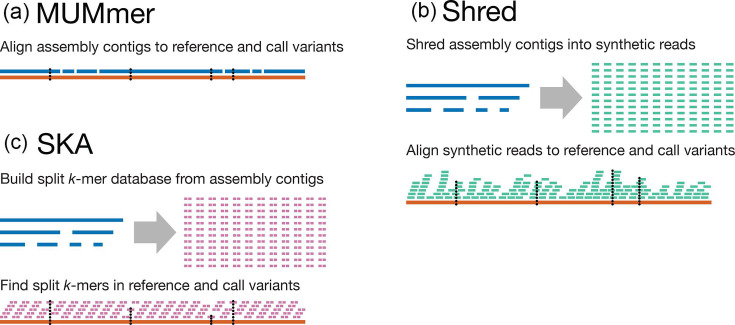 Fig. 1
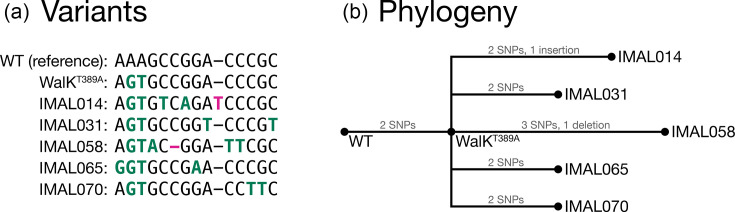 Fig. 2
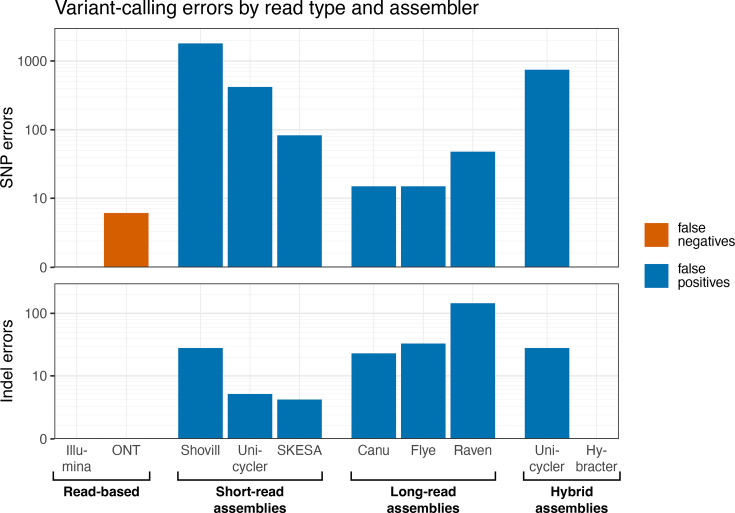 Fig. 3
| SNPs | Indels | |||||||||
|---|---|---|---|---|---|---|---|---|---|---|
|
|
|
|
|
|
|
|
|
|
| |
|
| 782 | 0 | 4,669 | 1.0 | 0.14 | 68 | 0 | 719 | 1.0 | 0.086 |
|
| 782 | 0 | 4,001 | 1.0 | 0.16 | 68 | 0 | 699 | 1.0 | 0.089 |
|
| 374 | 408 | 7,431 | 0.48 | 0.048 | 0 | 68 | 0 | 0.0 |
|
- —http://dx.doi.org/10.13039/501100000925 National Health and Medical Research Council
- —http://dx.doi.org/10.13039/501100000923 Australian Research Council
- —http://dx.doi.org/10.13039/501100000923 Australian Research Council
Peer Reviews
No public reviews on file for this paper yet. If you reviewed it on a platform where reviews are public (OpenReview, ICLR, NeurIPS, ICML), you can paste yours below so the community can read it here.
Videos
No videos yet. Explain this paper in a talk, walkthrough, or lecture? Add one.
Taxonomy
TopicsGenomics and Phylogenetic Studies · Bacterial biofilms and quorum sensing · Bacterial Identification and Susceptibility Testing
Data Summary
Supplementary methods, data, figures and tables are available at github.com/rrwick/Are-reads-required, which is also archived on Zenodo (10.5281/zenodo.14868870).
BioProject: PRJNA1193226.
BioSample: SAMN45134309, SAMN45134310, SAMN45134311, SAMN45134312, SAMN45134313, SAMN45134314, SAMN45134315.
SRA reads: SRR31579284, SRR31579285, SRR31579286, SRR31579287, SRR31579288, SRR31579289, SRR31579290, SRR31579291, SRR31579292, SRR31579293, SRR31579294, SRR31579295, SRR31579296, SRR31579297.
Introduction
Accurate identification of genetic variants is crucial in microbial genomics, particularly in applications such as building phylogenies, tracking outbreaks and studying evolutionary processes [12]. SNPs are often the primary focus of variant-calling efforts, but other variants, such as insertions and deletions (indels), can also provide valuable information [3]. High-precision variant calls (i.e. with few to no false positives) are especially important for closely related samples, where even small differences, such as ten SNPs, can determine whether or not bacterial isolates are considered part of the same outbreak [4].
In many ways, genome assemblies offer significant advantages over whole-genome sequencing reads: they have smaller file sizes, are easier to manage and are conceptually simpler. Long-read sequencing, such as from Oxford Nanopore Technologies (ONT) platforms, can usually enable complete genome assemblies, where each genomic element is assembled into a single contiguous sequence, revealing the large-scale structure of the genome [5]. Given these benefits, it would be convenient to extract variants directly from assemblies, removing the need to store and process reads. However, the question remains: can assembly-based variant calling achieve the level of accuracy required for microbial analyses?
To explore this question, we investigated the accuracy of variant calls from both read-based and assembly-based methods from a series of Staphylococcus aureus suppressor mutants. These isolates were sequenced using both Illumina short reads and ONT long reads. By comparing multiple variant-calling approaches, we aimed to determine whether read-based methods are necessary for precise microbial variant detection, or whether assembly-based approaches can provide similarly accurate results.
Methods
Isolates and mutant generation
In this study, we used seven closely related bacterial isolates. The parental strain NRS384 is a USA300 community-associated methicillin-resistant clone of S. aureus. A targeted mutant, WalK^T389A^, was constructed by altering the essential histidine kinase WalK to inactivate its phosphatase activity [6]. Suppressor mutants arose at high frequency during aerobic growth of WalK^T389A^ and were distinguished by phenotypic analysis on sheep blood agar and Micrococcus luteus agar that showed changes in haemolytic activity, Atl activity and/or pigmentation (Fig. S1, available in the online Supplementary Material). Suppressors (sample names beginning with IMAL) were single-colony purified and stored at −80 °C.
Sequencing
Genomic DNA was extracted from 1 ml of overnight culture (DNeasy Blood and Tissue Kit, Qiagen) pre-treated with 100 µg of lysostaphin (Sigma-Aldrich, L7386) [6]. ONT sequencing was performed on an R10.4.1 MinION flow cell using the native barcoding kit (SQK-NBD114-96) and then basecalled using Dorado v0.7.3 using the [email protected] model. ONT reads were quality-controlled by discarding any read with an average qscore (as reported by Dorado) of less than 12.5 or a length of less than 1 kbp. Illumina sequencing was performed on a NextSeq 2000 using the NextSeq 1000/2000 P2 Reagents v3 kit (300 Cycles; Illumina, 20046813) to generate 150 bp paired-end reads. Illumina reads were quality-controlled using fastp [7] v0.23.4 with default parameters. See Table S1 for read details and accessions.
Reference assemblies
For each of the seven genomes, we generated carefully curated ground-truth assemblies using Trycycler [5] v0.5.5, Polypolish v0.6.0 and Pypolca [8] v0.3.1, and each assembly was reorientated to a consistent starting position using Dnaapler [9] v0.8.1. To check for potential errors, we ran Clair3 [10] v1.0.10 (using ONT reads), Sniffles2 [11] v2.4 (using ONT reads) and freebayes [12] v1.3.8 (using Illumina reads) to screen for variants (i.e. potential errors) in the assemblies, each of which found no discrepancies. Each assembly contained a 2.88 Mbp chromosome (which differed slightly across the seven genomes) and two small plasmids (4,439 bp and 3,125 bp, which were identical across all seven genomes).
Read-based variant calling
For each isolate, we used Rasusa [13] v2.1.0 to randomly subsample both the ONT and Illumina read sets to 20× (low), 50× (medium) and 100× (high) depths, calculated as total read bases divided by the genome size. Each subsampled read set was then used to call variants against the reference assembly (WT NRS384), using Clair3 v1.0.10 for ONT reads and freebayes v1.3.8 for Illumina reads. For Clair3, variants were kept that had a filter status of ‘PASS’ [14]. For freebayes, variants were kept that had a quality score ≥100 (the threshold used by Snippy [15]). See supplementary methods for the exact commands used.
Assembly-based variant calling
Each subsampled read set was then assembled using a variety of methods. Shovill v1.1.0, Unicycler [16] v0.5.1 and SKESA [17] v2.5.1 were used for short-read-only assemblies (both Shovill and Unicycler serving as wrappers for SPAdes [18] v4.0.0). Canu [19] v2.2, Flye [20] v2.9.5 and Raven [21] v1.8.3 were used for long-read-only assemblies. Unicycler v0.5.1 and Hybracter [22] v0.9.0 were used for hybrid (both short- and long-read) assemblies. Long-read-only assemblies were additionally polished using Medaka [23] v2.0.0 using its bacterial model.
Variants were called from each assembly (all assemblies of subsampled reads as well as our ground-truth assemblies) using three different methods (Fig. 1). The first method, which we abbreviate as ‘MUMmer’, uses the dnadiff tool from MUMmer [24] v4.0.0rc1 to directly align the assembly to the reference genome (WT NRS384) and identify differences, which were then converted to VCF using all2vcf [25] v0.7.8. The second method, which we abbreviate as ‘Shred’, uses wgsim to generate synthetic reads (150 bp, error-free, 100× depth), aligns them to the reference with BWA MEM [26] v0.7.18 and then calls variants using freebayes v1.3.8 (with the same ≥100 quality threshold used in our read-based variant calls). The third method uses the ska map command from SKA2 [27] v0.3.11 to find variants against the reference. Each of these methods is bundled into an easy-to-run script available in supplementary methods.
Methods for calling variants from assemblies. (a) The MUMmer method relies on directly aligning the assembly’s contigs to the reference genome, with variants called from these alignments. (b) The Shred method produces synthetic error-free reads from the assembly’s contigs and aligns them to the reference genome, allowing for the use of read-based variant callers such as freebayes. (c) The SKA method uses split k-mers to efficiently find SNPs between the assembly’s contigs and the reference genome.
Variant call assessment
In total, we produced 756 VCF files: 42 from read-based variant calling (2 read types × 3 depths × 7 isolates), 21 from ground-truth assemblies (3 variant-calling methods × 7 isolates), 189 from short-read assemblies (3 assembly methods × 3 depths × 3 variant-calling methods × 7 isolates), 378 from long-read assemblies [3 assembly methods × 3 depths × 3 variant-calling methods × 2 polishing methods (no polishing and Medaka) × 7 isolates] and 126 from hybrid assemblies (2 assembly methods × 3 depths × 3 variant-calling methods × 7 isolates).
To establish a truth set of variants, we built a whole-genome multiple sequence alignment using each of the variant-calling methods by applying the variants to the reference genome (WT NRS384) using BCFtools [28] v1.21 and Trycycler v0.5.5. The following methods all produced the same results: Illumina-read freebayes (all read depths), ONT-read Clair3 (100× depth), ground-truth assembly Shred and MUMmer and Hybracter assembly Shred and MUMmer (all read depths). Since all of these methods produced the same variants, we considered these to be the ground-truth variants against which all methods were then assessed (one ground-truth VCF for each of the seven isolates).
To quantify the accuracy of the variant calls, we used vcfdist [29] v2.5.3 to compare each VCF file to its corresponding ground-truth VCF file. The following classification metrics were counted for both SNPs and indels and stored in Table S2: true positives (TPs), false negatives (FNs) and false positives (FPs). This allowed for the calculation of sensitivity ( , the probability that a true variant will be called) and precision ( , the probability that a called variant is true) (Table S3). To investigate potential causes of false-positive variant calls, we annotated the genome with repeat regions (via minimap2 self-alignment) and low-complexity regions (via Dustmasker [30] and tantan [31]) and assessed the position of each variant call relative to these features (Tables S4–S6).
Results
Ground-truth variants
Totalled across all seven isolates, there were 23 ground-truth SNPs and 2 ground-truth indels (Fig. 2a). As expected, the two SNPs introduced to create the WalK^T389A^ mutation (position 26287 A>G and 26289 A>T) were included in the ground-truth variants.
The relationship between the seven S. aureus NRS384 isolates used in this study. (a) An invariant-free multiple sequence alignment, showing all variants between the isolates and the WT reference: 23 SNPs (green) and 2 indels (pink). (b) The phylogenetic relationship between the isolates, as constructed by [1] IQ-TREE v2.3.6 (using the --polytomy option and rooted on the WT reference).
Assembly-based variant-calling methods
We first assessed which of the three methods for assembly-based variant calling performed best, with Table 1 showing SNP and indel metrics based on all 714 assembly-based VCF files. Both MUMmer and Shred had perfect sensitivity, i.e. they never failed to call an existing SNP or indel. SKA failed to call SNPs in close proximity to other variants and could not call indels, both limitations of its split-k-mer-based method.
Table S3 shows summary statistics separated by assembly type: short-read-based (Shovill, SKESA and Unicycler) vs long-read-based (Canu, Flye, Raven and Hybracter). Sensitivity was consistent across variant-calling methods and assembly types. For all assembly-based variant calling methods, SNP precision was higher for long-read-based assemblies than short-read-based assemblies. Indel precision showed more variation: for Shred, short-read-based assemblies had much better indel precision, whilst for MUMmer, long-read-based assemblies were slightly better.
A large proportion of FPs were in repeat regions, particularly for certain assembly methods (Table S6). For example, over 75% of FPs in Unicycler-hybrid assemblies fell within repeat regions, which make up only 8.1% of the genome. Low-complexity regions were also enriched for FPs in some cases, though to a lesser extent than repeats.
Overall, MUMmer and Shred performed similarly, but Shred produced slightly fewer FPs for both SNPs and indels. We therefore chose to only use Shred-based variant calls, discarding MUMmer- and SKA-based variant calls for the subsequent analyses.
Read- and assembly-based variant calling
Using only the best-performing assembly-based variant-calling method (Shred), we then compared read-based and assembly-based variant calls (Fig. 3). Overall, the best results came from Illumina-read variant calls (freebayes) and Hybracter-assembly variant calls, both of which were error-free. ONT-read variant calls (Clair3) contained no FPs but did miss some SNPs at the 20× and 50× read depths (Fig. S2). All other methods were prone to false-positive calls for both SNPs and indels.
Variant-calling errors for both read-based and assembly-based variant-calling methods. For each method, the errors were summed across all genomes and read depths. See Fig. S2 for the results for each depth separately and for sensitivity and precision values. The y-axes have a pseudo-log transformation.
Short-read assemblies were particularly prone to SNP errors, whilst long-read assemblies were more prone to indel errors. SKESA was the best-performing short-read assembler, likely due to its conservative heuristics (it prefers breaking contigs over assembling uncertain sequences). Canu was the best-performing long-read assembler, though Flye did nearly as well. For hybrid assemblers, there was a marked difference between Unicycler (which uses a short-read-first assembly method) and Hybracter (which uses a long-read-first assembly method), the latter performing much better for both SNPs and indels (Fig. 3).
Medaka polishing
For each of the long-read assemblies, we performed polishing with Medaka in an attempt to improve the sequence accuracy. Surprisingly, this caused a large increase in the total number of variant-calling errors (Fig. S3). Further investigation revealed that these Medaka-introduced errors were primarily caused by two factors. The first was caused by an 850 bp region of homologous sequence shared between the S. aureus chromosome and the 4.4 kbp plasmid. The inability to assemble small plasmids is a common error in long-read assemblies [32], leading to the absence of the 4.4 kbp plasmid in some assemblies. When this occurred, Medaka’s alignment of reads to the assembly resulted in plasmid reads erroneously aligning to the chromosome, causing errors in the consensus algorithm.
The second factor related to increasing Medaka errors was when the assembly contained a duplicated sequence from the genome. This occurred when the start and end of a circular contig overlapped and when a region of the genome was assembled into both a primary and an alternative sequence. When these issues occurred, Medaka was prone to introducing errors in the duplicated regions, leading to false-positive assembly-based variant calls. Canu was prone to both start–end overlaps (up to 72 kbp) and alternative-sequence contigs (what it calls ‘bubbles’, up to 95 kbp), leading to the largest increase in variant-calling errors after Medaka polishing.
In assemblies where neither of these factors was present, we found that Medaka often improved the accuracy of assembly-based variant calls (Table S7). This suggests that Medaka-polishing can be beneficial for variant calling when the assembly is correctly finished and contains the entire genome with no duplicated sequence [33].
Discussion
In this study, we examined variant calling in a group of closely related S. aureus isolates, which only had 25 combined variants across six mutant strains relative to the WT strain. We found that it was possible to obtain precise variant calls from genome assemblies (i.e. without directly using the reads), but this required very high-quality assemblies: only our ground-truth assemblies (Trycycler with manual curation) and Hybracter assemblies (a long-read-first hybrid assembly pipeline) yielded perfect variant calls. All other assembly methods resulted in false-positive calls, sometimes exceeding 100 errors per genome, leading to poor precision. This suggests that most genome assemblies are not suitable for variant calling if high precision is required.
In general, we found that short-read assemblies were more prone to false-positive SNP calls, whilst ONT assemblies were more prone to false-positive indel calls. Our ONT assemblies were based on the latest ONT chemistry and basecalling model, and it is likely that older ONT assemblies will have reduced precision for both SNPs and indels. Whilst we expected Medaka polishing to improve assembly-based variant calls for ONT assemblies, missing or duplicated sequences in the assemblies often led to Medaka introducing errors. This emphasizes the need for an assembly to be structurally correct before Medaka polishing.
Whilst we compared three different methods for assembly-based variant calling (MUMmer, Shred and SKA), we did not attempt to optimize any of these methods. This is a key limitation of this study, and so, higher precision assembly-based variant-calling methods are likely possible. Such optimizations might include masking parts of the reference genome (e.g. repeats and low-complexity regions; see Table S6) or excluding parts of the assembly (e.g. short contigs and low-quality bases [34]). If variant calling from assemblies is necessary (e.g. because reads are not available), then further work is required to determine the optimal method. Since SKA’s split-k-mer approach cannot identify indels or closely spaced SNPs, the optimal assembly-based variant-calling method will likely involve alignment.
The S. aureus genomes used in this study were relatively easy to assemble – our Illumina assemblies often contained fewer than 100 contigs (Table S2), and error-free ONT assemblies were possible (Table S7). More challenging genomes (e.g. containing more repetitive regions) would likely make assembly-based variant calling even more challenging. Of the 30 samples assembled in the Hybracter manuscript [22], 12 had zero errors in their assembly, whilst 18 contained errors. This suggests that even when performing a robust Hybracter hybrid assembly, false-positive assembly-based variant calls may occur for approximately half of bacterial genomes. Also, the S. aureus genomes in this study contained no structural differences relative to the reference genome. When structural differences occur, there is the possibility of more variant-calling errors for both read- and assembly-based approaches.
In conclusion, we found that assembly-based variant calling is prone to false-positive errors, so traditional read-based variant calling is preferred when possible. However, error-free assemblies can produce error-free variant calls, so as sequencing and assembly methods become more reliable in the future, assembly-based variant calls may become more feasible.
Supplementary material
10.1099/acmi.0.001025.v3Uncited Supplementary Material 1.
10.1099/acmi.0.001025.v3Uncited Supplementary Material 2.
The reference list from the paper itself. Each links out to its DOI / PubMed record.
- 1Minh BQ Schmidt HA Chernomor O Schrempf D Woodhams MD et al IQ-TREE 2: new models and efficient methods for phylogenetic inference in the genomic era Mol Biol Evol 2020371530153410.1093/molbev/msaa 01532011700 PMC 7182206 · doi ↗ · pubmed ↗
- 2Gorrie CL Da Silva AG Ingle DJ Higgs C Seemann T et al Key parameters for genomics-based real-time detection and tracking of multidrug-resistant bacteria: a systematic analysis Lancet Microbe 20212 e 575e 58310.1016/S 2666-5247(21)00149-X 35544081 · doi ↗ · pubmed ↗
- 3Redelings BD Suchard MA Incorporating indel information into phylogeny estimation for rapidly emerging pathogens BMC Evol Biol 200774010.1186/1471-2148-7-4017359539 PMC 1853084 · doi ↗ · pubmed ↗
- 4Gorrie CL Mirčeta M Wick RR Edwards DJ Thomson NR et al Gastrointestinal carriage is a major reservoir of Klebsiella pneumoniae infection in intensive care patients Clin Infect Dis 20176520821510.1093/cid/cix 27028369261 PMC 5850561 · doi ↗ · pubmed ↗
- 5Wick RR Judd LM Cerdeira LT Hawkey J Méric G et al Trycycler: consensus long-read assemblies for bacterial genomes Genome Biol 20212226610.1186/s 13059-021-02483-z 34521459 PMC 8442456 · doi ↗ · pubmed ↗
- 6Sharkey LKR Guerillot R Walsh CJ Turner AM Lee JYH et al The two-component system Wal KR provides an essential link between cell wall homeostasis and DNA replication in Staphylococcus aureusm Bio 202314 e 022622310.1128/mbio.02262-2337850732 PMC 10746227 · doi ↗ · pubmed ↗
- 7Chen S Zhou Y Chen Y Gu J fastp: an ultra-fast all-in-one FASTQ preprocessor Bioinformatics 201834 i 884i 89010.1093/bioinformatics/bty 56030423086 PMC 6129281 · doi ↗ · pubmed ↗
- 8Bouras G Judd LM Edwards RA Vreugde S Stinear TP et al How low can you go? short-read polishing of oxford nanopore bacterial genome assemblies Microb Genom 20241000125410.1099/mgen.0.00125438833287 PMC 11261834 · doi ↗ · pubmed ↗