Correction: The risk of believing that emotions are bad and uncontrollable: association with orthorexia nervosa
L. Vuillier, M. Greville-Harris, R. L. Moseley

Abstract
Genes, proteins, chemicals, diseases, species, mutations and cell lines named across the full text — each resolved to its canonical identifier and authoritative record.
Click any figure to enlarge with its caption.
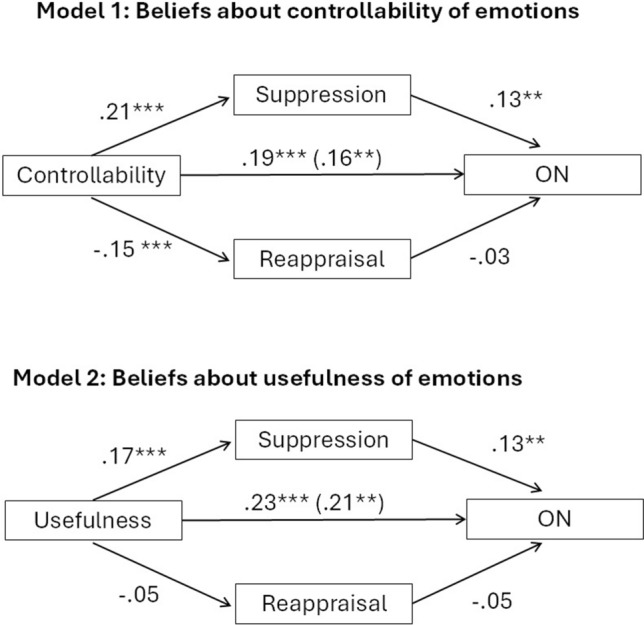 Figure 1
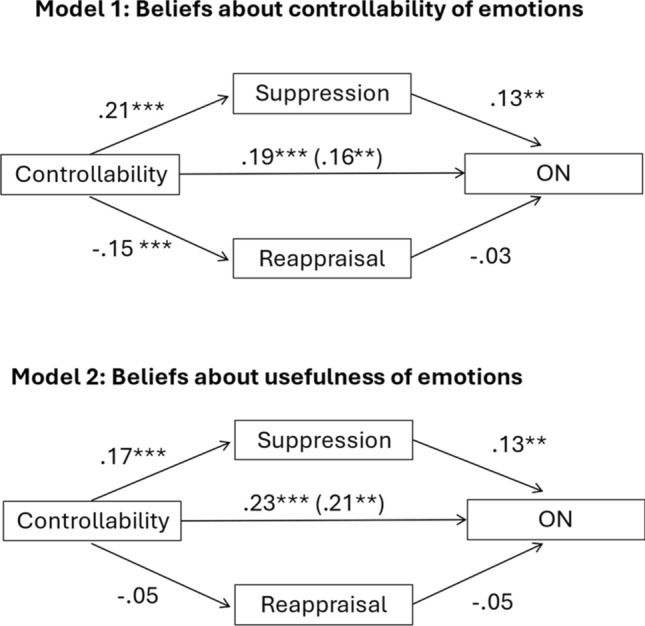 Figure 2
Peer Reviews
No public reviews on file for this paper yet. If you reviewed it on a platform where reviews are public (OpenReview, ICLR, NeurIPS, ICML), you can paste yours below so the community can read it here.
Videos
No videos yet. Explain this paper in a talk, walkthrough, or lecture? Add one.
Taxonomy
TopicsEating Disorders and Behaviors
**Correction: Eating and Weight Disorders – Studies on Anorexia, Bulimia and Obesity (2025) 30:8 ** 10.1007/s40519-024-01710-3
In this article [1], the wrong figure appeared as Fig. 1; the second model on that Figure should say usefulness rather than controllability.
For completeness and transparency, the old incorrect and correct versions are displayed below.
Incorrect Fig. 1
Fig. 1. Mediation models representing the relationship between beliefs about emotional controllability (model 1) or beliefs about the usefulness of emotions (model 2) and ON symptoms, mediated via suppression but not reappraisal. *** denotes < 0.001 significance, ** denote < 0.01 significance
Correct Fig. 1
Fig. 1. Mediation models representing the relationship between beliefs about emotional controllability (model 1) or beliefs about the usefulness of emotions (model 2) and ON symptoms, mediated via suppression but not reappraisal. *** denotes < 0.001 significance, ** denote < 0.01 significance