The clinical condition rather than cerebrospinal fluid levels may guide the optimal duration of antimicrobial therapy among neonates with bacterial meningitis: A single‐center retrospective study
Ya Hu, Xingyuan Li, Hong Wei, Yuanyuan Luo, Hongdong Li

TL;DR
This study suggests that the clinical condition of neonates with bacterial meningitis, rather than cerebrospinal fluid levels, should guide the duration of antimicrobial therapy.
Contribution
The study introduces a new perspective on using clinical condition over CSF levels to determine antimicrobial treatment duration in neonatal bacterial meningitis.
Findings
No significant differences were found in clinical symptoms, blood levels, or complications between neonates with normal and abnormal CSF at discharge.
The duration of antimicrobial therapy may depend on the patient's clinical condition rather than CSF levels.
Short- and long-term complications showed no statistical differences between the two groups.
Abstract
Neonatal bacterial meningitis is serious and accounts for high morbidity and mortality in developing countries, but the duration of antimicrobial treatment is not well established. Cerebrospinal fluid (CSF) levels are important factors for diagnosing and monitoring the occurrence and development of bacterial meningitis. In this study, we aimed to compare the clinical characteristics and outcomes of neonatal bacterial meningitis with normal CSF and abnormal CSF at discharge. We enrolled neonates with bacterial meningitis who were admitted to the neonatology department of the Children's Hospital of Chongqing Medical University between August 1, 2019 and January 1, 2021. The children's clinical data, laboratory data, and outcomes were recorded and analyzed. Fifty‐five neonates met the inclusion criteria in our study. Other than CSF protein levels, there was no significant difference in…
Genes, proteins, chemicals, diseases, species, mutations and cell lines named across the full text — each resolved to its canonical identifier and authoritative record.
Click any figure to enlarge with its caption.
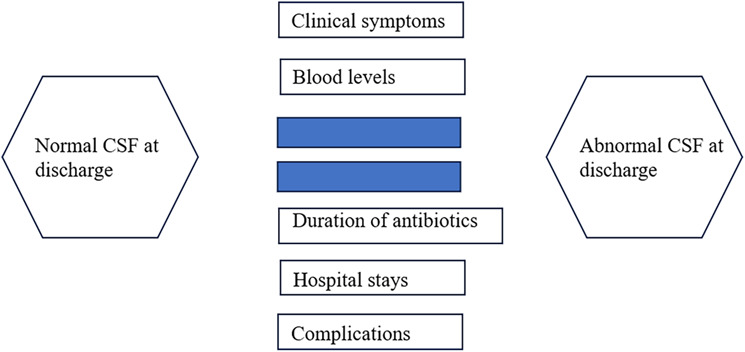 Figure 1
|
| Normal‐CSF |
| |
|---|---|---|---|
|
| Group ( | ||
|
| |||
| Male gender, |
|
| 0.721 |
| Multiplets, |
|
| 0.467 |
| Preterm infant, |
|
| 0.152 |
| Gestational age (weeks) |
|
| 0.504 |
| Birth weight (kilograms) |
|
| 0.431 |
| Weight on admission (kilograms) |
|
| 0.570 |
| Admission age (hours) |
|
| 0.362 |
|
| |||
| Vaginal delivery |
|
| 0.393 |
| Meconium stained amniotic fluid |
|
| 0.490 |
| Premature rupture of membranes |
|
| 0.587 |
| Intrauterine distress |
|
| 1.000 |
| Chorioamnionitis |
|
| 1.000 |
|
| Normal‐CSF |
| |
|---|---|---|---|
|
| Group ( | ||
|
| 5 (17.2) | 6 (23.1) | 0.589 |
|
| 2 (6.9) | 1 (3.8) | 1.000 |
|
| 20 (69.0) | 18 (69.2) | 0.983 |
|
| 1 (3.4) | 0 (0.0) | 1.000 |
|
| 11 (37.9) | 11 (42.3) | 0.741 |
|
| 0 (0.0) | 1 (3.8) | 0.473 |
|
| 0 (0.0) | 1 (3.8) | 0.473 |
|
| 1 (3.4) | 0 (0.0) | 1.000 |
|
| 0 (0.0) | 2 (7.7) | 0.219 |
|
| Normal‐CSF |
| |
|---|---|---|---|
|
| Group ( | ||
|
| 24.0 (13.5, 33.0) | 22.5 (19.0, 36.0) | 0.669 |
|
| 2.0 (1.0, 2.0) | 2.0 (1.0, 2.0) | 0.395 |
|
| 25 (86.2) | 25 (96.2) | 0.355 |
|
| 18 (62.1) | 14 (53.8) | 0.537 |
|
| Normal‐CSF |
| |
|---|---|---|---|
|
| Group ( | ||
|
| 36.0 (21.0, 58.0) | 37.0 (20.8, 60.3) | 0.887 |
|
| 1 (3.4) | 1 (3.8) | 1.000 |
|
| −0.8 (−1.3, −0.0) | −1.0 (−1.5, −0.6) | 0.843 |
|
| 6 (20.7) | 4 (15.4) | 0.733 |
|
| 4 (13.8) | 1 (13.8) | 0.355 |
|
| 19 (65.5) | 15 (57.7) | 0.551 |
|
| 4 (13.8) | 4 (15.4) | 1.000 |
- —Scientific and Technological Research Program of Chongqing Municipal Education Commission
Peer Reviews
No public reviews on file for this paper yet. If you reviewed it on a platform where reviews are public (OpenReview, ICLR, NeurIPS, ICML), you can paste yours below so the community can read it here.
Videos
No videos yet. Explain this paper in a talk, walkthrough, or lecture? Add one.
Taxonomy
TopicsBacterial Infections and Vaccines · Neonatal and Maternal Infections · Pneumonia and Respiratory Infections
INTRODUCTION
1
Bacterial meningitis is a serious acute infectious disease of the central nervous system with high morbidity and mortality, especially in neonates, because of the immature blood‒brain barrier (BBB).1, 2 Neonatal bacterial meningitis can cause acute complications involving ventriculitis and subdural effusion. Moreover, long‐term neurological sequelae, including cerebral palsy, seizures, hydrocephalus, or cognitive impairment may be present in up to 50% of survivors.3, 4 Thus, early diagnosis and an adequate duration of antibiotic treatment are crucial for favorable outcomes.
Cerebrospinal fluid (CSF) culture is the gold standard for confirming neonatal bacterial meningitis.5 However, CSF culture often has a low yield due to the limited sensitivity of culture techniques, and we often use CSF levels (such as leukocyte count, glucose, and total protein) to diagnose bacterial meningitis. Continuous monitoring of CSF levels during antimicrobial treatment of bacterial meningitis in young infants is recommended by some specialists, which may prolong the use of antibiotics.6 However, there are controversies in the guidelines in the warrants regarding the indications for repeat lumbar puncture or in the explanation of the results.7, 8 In addition, prolongation of antibiotic treatment may increase the resistance of pathogenic bacteria and lead to potential diseases such as necrotizing enterocolitis, and candidiasis in neonates.9, 10 Hence, it is very important to explore the predictive value of end‐of‐therapy CSF levels in neonates.
The objective of the present study was to compare the outcomes of neonates with bacterial meningitis whose CSF levels are normal or abnormal at discharge, which could contribute to guidance for the optimal duration of antibiotics on evidence‐based data.
MATERIALS AND METHODS
2
Data collection
2.1
The study was approved by the Institutional Review Board of the Children's Hospital of Chongqing Medical University. All methods were performed in accordance with the relevant guidelines and regulations.11 Written informed consent to participate in this study was provided by the participants' legal guardian. Medical records were collected for neonates with bacterial meningitis by Research Electronic Data Capture. Symptoms or clinical findings were categorized as not present if they were not mentioned in the medical records. After screening, 55 neonates with bacterial meningitis were enrolled between August 1, 2019 and January 1, 2021, according to our exclusion and inclusion criteria, and all of their clinical symptoms had disappeared at discharge. Demographic characteristics, including sex, birth weight, gestational age, and admission age and maternal conditions such as vaginal delivery, meconium‐stained amniotic fluid, premature rupture of membrane, intrauterine distress, and prenatal infection, were collected. Most clinical symptoms of neonatal meningitis included the presence of fever, tachypnea, apnea, feeding difficulties, and any neurologic symptoms (seizures, hypersomnia, irritability, limb jitter, and screaming). Laboratory findings that were collected included white blood cell count (WBC), platelet (PLT), C‐reactive protein (CRP), procalcitonin (PCT), blood culture, and CSF levels (culture, WBC, protein, glucose, and chloride). The duration of antibiotic treatment, neurological‐related examination at discharge, and clinical outcomes for as long as one and a half years were also collected simultaneously.
Inclusion and exclusion criteria
2.2
The inclusion criteria were as follows: (1) neonates with positive CSF culture and (2) neonates with negative CSF culture but abnormal CSF levels and definite clinical manifestations. The standard of abnormal CSF levels in neonates were defined as described before: in term, babies were defined as having a CSF WBC count >32 × 10^6^/L and a protein level >1.70 g/L, while it was defined in preterm babies as a CSF WBC count >29 × 10^6^/L, a protein level >1.50 g/L with either a CSF WBC count or a protein level that met the criteria allowing for a diagnosis of bacterial meningitis.5 The exclusion criteria were as follows: (1) age of full‐term neonates at admission >28 days or corrected gestational age of preterm infants at admission >44 weeks, (2) hospital stay <3 days with incomplete information, (3) severe congenital malformation or hereditary metabolic diseases, (4) antibiotic therapy administered before admission, and (5) intracranial lesions such as intracranial hemorrhage or ventricular dilation.
Statistical analysis
2.3
Continuous variables are presented as the mean ± standard deviation or median and interquartile range. Differences in categorical variables between the groups were analyzed using the χ ^2^ test or Fisher's exact test. The Mann‒Whitney U test or t test was used to compare continuous variables between the groups. A p value <0.05 was considered to indicate statistical significance. All statistical analyses were performed using SPSS 26.0 (IBM Corp.).
RESULTS
3
Comparison of demographic characteristics and clinical symptoms of patients with normal and abnormal CSF levels at discharge
3.1
During the study period, 55 eligible neonates with bacterial meningitis were identified. There were no significant differences in gestational age, birth weight, sex, admission age, or maternal factors of patients with meningitis with and without normal CSF levels at discharge (p > 0.05) (Table 1). Meanwhile, the most common presenting symptoms of patients with meningitis in both groups were tachypnea (69.0% and 69.2%, respectively), hypersomnia (37.9% and 42.3%, respectively), and fever (17.2% and 23.1%, respectively). However, clinical symptoms such as fever, tachypnea, apnea, feeding difficulties, and neurologic symptoms (hypersomnia, irritability, seizures, limb jitter, and screaming) also showed no statistically significant differences between the two groups (p > 0.05) (Table 2).
Blood and CSF levels at admission and at discharge
3.2
In terms of laboratory parameters, the blood parameters (WBC, neutrophils, PLT, CRP, and PCT) at admission and discharge showed no significant differences between the abnormal CSF group and the normal CSF group (p > 0.05). The WBC count in the blood varied between 6.2 and 16.8 × 10^9^/L with a mean value of 11.5 × 10^9^/L in the abnormal CSF group at discharge, while the WBC count varied between 8.1 and 14.9 × 10^9^/L with a mean value of 11.5 × 10^9^/L in the normal CSF group. These results showed that the WBC counts had returned to normal levels at discharge, while CRP in a few neonates remained higher than 8 mg/L (6.9% and 3.8%, respectively). There was a statistically higher level of CSF protein in the abnormal CSF group than in the normal CSF group, both at the initial CSF analysis after admission (median 2.5 g/L vs. 2 g/L) and at discharge (median 2 g/L vs. 1.1 g/L) (p < 0.05). The CSF WBC counts showed no significant differences between the two groups at the time of admission (median 60 vs. 100 × 10^6^/L) and discharge (median 6 vs. 3 × 10^6^/L) (p > 0.05). In the normal CSF group, protein concentrations <1.5 g/L and WBC counts <29 × 10^6^/L were found in all neonates, indicating that the CSF levels had recovered after antimicrobial therapy.
Antibiotic treatment
3.3
In our study, proven meningitis (positive cultures of CSF) was obtained in only 3 (5.5%) cases (2 cases in the abnormal CSF group vs. 1 case in the normal CSF group). Positive cultures of blood were obtained in 6 (20.6%) cases in the abnormal CSF group, and the pathogens were Escherichia coli (2/29), Staphylococcus epidermidis (2/29), Klebsiella pneumoniae (1/29), and Streptococcus agalactiae (1/29). While positive cultures of blood were obtained in 5 (19.2%) cases in the normal CSF group, the pathogens were K. pneumoniae (2/26), E. coli (1/26), Enterobacter cloacae (1/26), and Listeria monocytogenes (1/26) (data not shown). Generally, the initial empirical antibiotic therapy of neonatal bacterial meningitis in our center was penicillin, combined with a third‐generation cephalosporin before bacteriological results.12 If multidrug‐resistant bacteria were confirmed or clinical improvement was not apparent after 48 h of antimicrobial therapy, special antibiotics such as carbapenems and glycopeptides were used. The duration of antibiotic treatment ranged from 13.5 to 33.0 days (mean 24 days) in the abnormal CSF group, while the duration of antibiotic treatment ranged from 19.0 to 36.0 days (mean 22.5 days) in the normal CSF group. This result indicated that the duration of antibiotics was at least nearly 3 weeks in the normal CSF group. However, there were no significant differences in the duration of antibiotic treatment, dual antibiotic application, or usage of carbapenems (meropenem and imipenem), and glycopeptides (vancomycin and teicoplanin) between the two groups (p > 0.05) (Table 3).
Short‐ and long‐term complications in infants—Sequelae after discharge from the hospital
3.4
One of these infants in each group died during the hospital stay, but they did not die of bacterial meningitis or its sequelae. One neonate in the abnormal CSF group died of gastric perforation, and another neonate in the normal CSF group died of withdrawing treatment due to severe pneumonia. Tests of infant motor performance (TIMP), amplitude integrated electroencephalogram (aEEG), video electroencephalogram (VEEG), brain‐stem auditory evoked potential (BAEP), and magnetic resonance imaging (MRI)/computed tomography (CT) at the time of discharge were routinely used to evaluate the short‐term complications of neonates. All neonates in the two groups had low TIMP scores at discharge, and more than half of the neonates in the two groups had abnormal CT/MRI results (57.6% and 56.5%, respectively). None of the neonates in either group had a recurrence of meningitis during follow‐up (data not shown). There were no significant differences in length of hospitalization, TIMP score, abnormal aEEG/VEEG, abnormal BAEP, or abnormal MRI/CT between the two groups (p > 0.05) (Table 4). Long‐term complications of bacterial meningitis, such as cerebellar atrophy, encephalomalacia, hydrocephalus, seizure disorder, subdural empyema, and cerebral palsy, were called neurological sequelae and showed no significant differences between the two groups (Table 4).
DISCUSSION
4
Neonatal bacterial meningitis is associated with substantial morbidity and mortality and requires appropriate use of antibiotics. The guidelines for the duration of antimicrobial therapy are based on the etiology of neonatal bacterial meningitis. Generally, a duration of 14 days was reported for group B streptococcus, L. monocytogenes and Streptococcus pneumonia meningitis, while a duration of 21 days was reported for Pseudomonas and gram‐negative microorganisms.13, 14 Longer antimicrobial courses are recommended for infants with meningitis with complications such as brain abscesses, ventriculitis, or brain infarctions.14 However, the incidence of CSF culture‐confirmed meningitis is quite low, indicating that these negative culture patients receive antimicrobial therapy empirically by physicians. Moreover, neonates with an initial positive CSF culture had persistent positive bacterial cultures on the second CSF sample, which might prolong antimicrobial therapy.15 In our study, we found that the adverse outcomes in neonates whose clinical symptoms disappeared at discharge but who had abnormal CSF levels were not significantly different from those in neonates with normal CSF levels at discharge. This suggests that the duration of antibiotics for bacterial meningitis depends on the clinical condition of the patient rather than the CSF levels. In fact, Zhou et al. found that if an effective course of antibiotics is sufficient for a child with bacterial meningitis, antibiotics may be discontinued, and the CSF may be regularly followed up and rechecked.16 We also repeated lumbar punctures after discharge for surveillance of the recurrence of bacterial meningitis once a week.
The duration of antibiotic utilization with neonatal bacterial meningitis remains controversial. The duration of antibiotics is long and frequently associated with neurological sequelae, even though the CSF is sterile and the baby has no clinical symptoms, because the neonatologist fears premature discontinuation of therapy.17 A multicenter retrospective study showed that longer than 3 weeks of administration of third‐generation cephalosporin had no impact on the neonate's prognosis.12 Mathur et al. compared the effectiveness of a 10‐day versus a 14‐day course of antibiotic therapy in neonates with meningitis and suggested that a course of antibiotic therapy as short as 10 days is effective and associated with lower mortality and adverse outcomes.18 In our study, we found that the duration of antibiotic treatment, even the utilization of special antibiotics such as carbapenems and glycopeptides, showed no significant difference between the two groups. Excessive use of antibiotics in neonates is one of the major risk factors for the development of antibiotic resistance and the side effects of decreased bacterial biodiversity and modulation of host metabolism.19, 20 In addition, excessive use of antibiotics prolongs hospital stays and aggravates the substantial economic burden of the patients.21
CSF culture is the gold standard for confirming neonatal bacterial meningitis, but the combination of deeper interpretation of CSF levels and clinical symptoms is also important for diagnosing bacterial meningitis because of the difficulty in obtaining positive cultures.22, 23, 24 Surveillance of CSF culture or levels relies on repeated lumbar puncture during antimicrobial therapy, which has been advocated by some experts before.6 However, a survey across the northwest of England revealed that only 18.2% of pediatricians routinely repeated lumbar punctures in neonatal meningitis patients.25 The adverse outcomes in the current study showed no significant difference between the two groups with or without normal CSF levels at discharge, indicating that the preferred option of repeating the lumbar puncture is based on the clinical condition. Following the management guidelines published by the Infectious Disease Society of North America, repeated lumbar puncture is recommended for patients who do not have apparent clinical improvement after 48 h of antimicrobial therapy.13, 26
Our study also found that only CSF protein had a significant difference between the two groups, both at the initial CSF analysis after admission and at discharge, and the results showed that CSF protein in the abnormal CSF group was higher than the normal ranges during the hospital stay (the lowest was 1.7 g/L in the current study). Protein concentrations were relatively stable in children and adolescents owing to their solid BBB. When meningitis occurs in neonates with an immature BBB, the disruption and increased permeability of the BBB lead to increased CSF protein concentrations.27 Tan et al. revealed that high CSF protein after 2 weeks of antimicrobial therapy was associated with poor outcome from 0 to 3 months of age, which is contrary to our results.28 The reason for our disputation is that the difference in the values between the groups at the time of discharge is not a finding of this study but a direct consequence of the definition of the groups.
There were some limitations to our study. First, it was a retrospective study, leading to potential bias when collecting clinical data from our medical charts. Some patients failed to receive follow‐up after discharge from the hospital. Second, all our data were obtained from a single center, leading to relatively small sample sizes, and larger sample sizes may provide more convincing results. Third, we excluded neonates who had received antimicrobial treatment prior to admission in our study, as some researchers have found that antibiotics prior to admission reduce CSF‐positive culture rates by nearly 30%.22, 29 Hence, further research is needed to confirm whether such relevance exists in our study.
In conclusion, this study demonstrated that there were no significant differences in the length of hospitalization or the prognosis of short‐ and long‐term complications in patients with or without normal CSF levels at discharge, indicating that the duration of antibiotic therapy in neonatal bacterial meningitis may depend on the clinical condition of the patient rather than the CSF levels. Further multicenter studies with large sample sizes of clinical data could be implemented to validate the results.
AUTHOR CONTRIBUTIONS
Ya Hu was involved in conceptualization, data curation, and investigation. Yuanyuan Luo, Xingyuan Li, and Hong Wei helped in data curation, software, and formal analysis. Hongdong Li contributed to conceptualization, writing, supervision, and validation.
CONFLICT OF INTEREST STATEMENT
The authors declare that the research was conducted in the absence of any commercial or financial relationships that could be construed as a potential conflict of interest.
ETHICS STATEMENT
The study was approved by the Institutional Review Board of the Children's Hospital of Chongqing Medical University. All methods were performed in accordance with the relevant guidelines and regulations.11 Written informed consent to participate in this study was provided by the participants' legal guardian.
The reference list from the paper itself. Each links out to its DOI / PubMed record.
- 1Kuti BP , Bello EO , Jegede TO , Olubosede O . Epidemiological, clinical and prognostic profile of childhood acute bacterial meningitis in a resource poor setting. J Neurosci Rural Pract. 2015;6(4):549‐557.26752902 10.4103/0976-3147.165424 PMC 4692015 · doi ↗ · pubmed ↗
- 2van de Beek D , Brouwer MC , Koedel U , Wall EC . Community‐acquired bacterial meningitis. Lancet. 2021;398(10306):1171‐1183.34303412 10.1016/S 0140-6736(21)00883-7 · doi ↗ · pubmed ↗
- 3Okike IO , Johnson AP , Henderson KL , et al. Incidence, etiology, and outcome of bacterial meningitis in infants aged <90 days in the United Kingdom and Republic of Ireland: prospective, enhanced, national population‐based surveillance. Clin Infect Dis. 2014;59(10):e 150‐e 157.24997051 10.1093/cid/ciu 514 · doi ↗ · pubmed ↗
- 4Thigpen MC , Whitney CG , Messonnier NE , et al. Bacterial meningitis in the United States, 1998‐2007. N Engl J Med. 2011;364(21):2016‐2025.21612470 10.1056/NEJ Moa 1005384 · doi ↗ · pubmed ↗
- 5Wang H , Zhu X . Cerebrospinal fluid culture‐positive bacterial meningitis increases the risk for neurologic damage among neonates. Ann Med. 2021;53(1):2199‐2204.34787529 10.1080/07853890.2021.2004318 PMC 8604535 · doi ↗ · pubmed ↗
- 6Ouchenir L , Renaud C , Khan S , et al. The epidemiology, management, and outcomes of bacterial meningitis in infants. Pediatrics. 2017;140(1).10.1542/peds.2017-047628600447 · doi ↗ · pubmed ↗
- 7Durack DT , Spanos A . End‐of‐treatment spinal tap in bacterial meningitis. Is it worthwhile. JAMA. 1982;248(1):75‐78.7087096 · pubmed ↗
- 8Ting JY , Roberts A , Khan S , et al. Predictive value of repeated cerebrospinal fluid parameters in the outcomes of bacterial meningitis in infants <90 days of age. P Lo S One. 2020;15(8):e 0238056.32857801 10.1371/journal.pone.0238056 PMC 7454955 · doi ↗ · pubmed ↗