[B(O2C2(CF3)4)2]− ([FPB]−): Repurposing This Weakly Coordinating Anion for Solid-State Molecular Organometallic (SMOM) Chemistry
Kristof M. Altus, M. Arif Sajjad, Stuart A. Macgregor, Andrew S. Weller

TL;DR
This paper explores a new use for a specific anion in solid-state chemistry to create and study a unique organometallic complex.
Contribution
The paper introduces a new application of the [FPB]− anion in solid-state molecular organometallic chemistry.
Findings
A σ-alkane complex was isolated and characterized using [FPB]−.
Na+[FPB]− and [H(OEt2)2][FPB] were synthesized and reported.
Periodic DFT and IGMH analysis supported the structural characterization.
Abstract
The perfluoropinacol borate-based anion [B(O2C2(CF3)4)2]−, [FPB] –, is developed as a weakly coordinating anion for single-crystal to single-crystal organometallic solid/gas reactivity, resulting in the isolation and characterization (including periodic DFT and IGMH analysis) of the σ-alkane complex [Rh(Cy2PCH2CH2PCy2)(exo-η2η2-norbornane)][FPB]. The synthetically useful solvent-free Na+ salt, Na[FPB], and oxonium acid [H(OEt2)2][FPB] are also reported.
Genes, proteins, chemicals, diseases, species, mutations and cell lines named across the full text — each resolved to its canonical identifier and authoritative record.
Click any figure to enlarge with its caption.
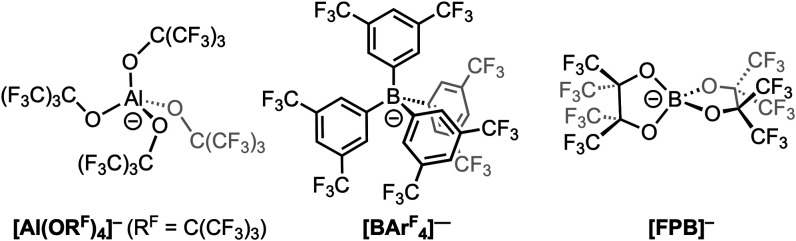 Figure 1
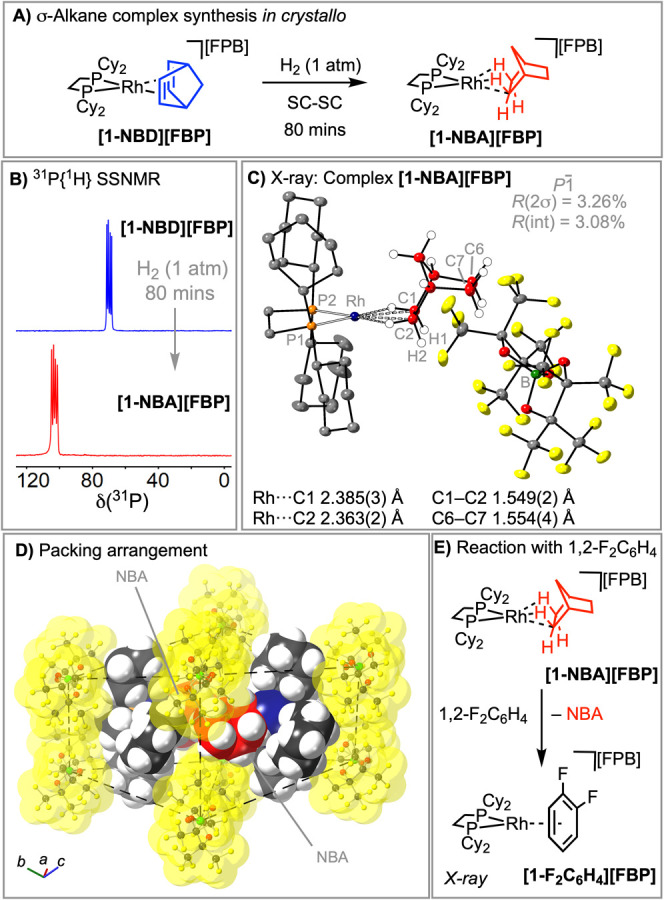 Figure 2
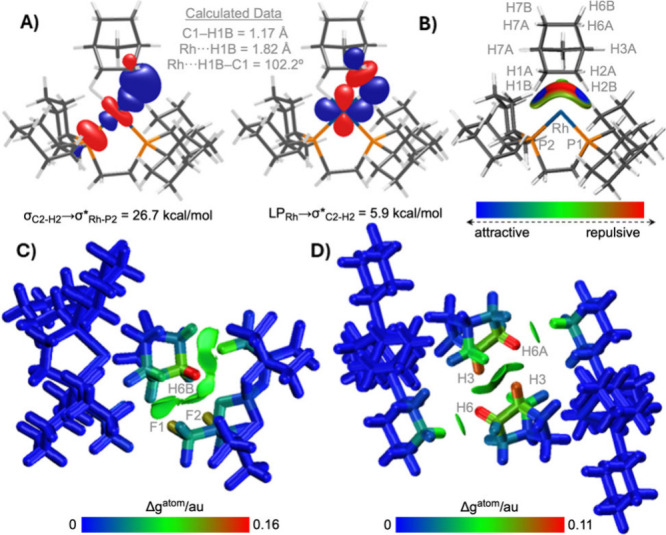 Figure 3
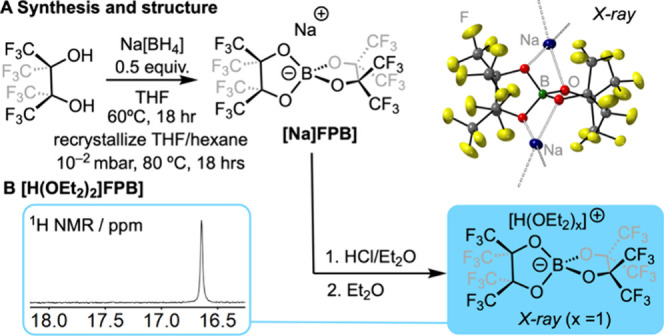 Figure 4
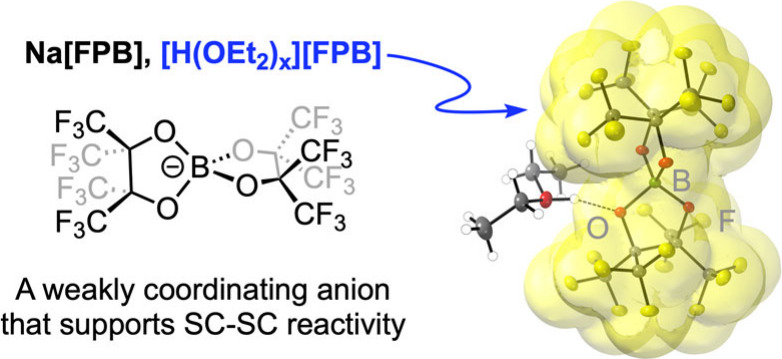 Figure 5
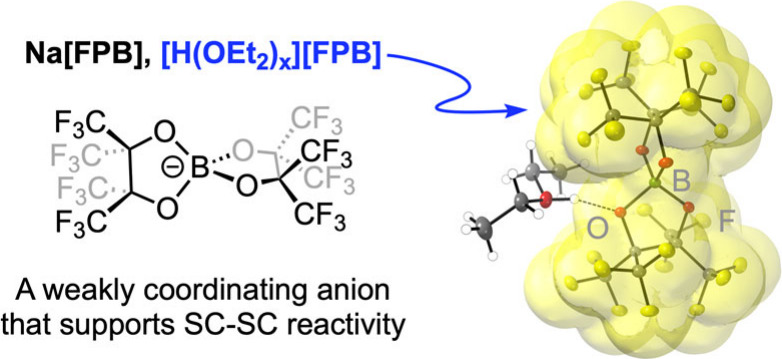 Figure 6
- —Engineering and Physical Sciences Research Council10.13039/501100000266
- —Engineering and Physical Sciences Research Council10.13039/501100000266
Peer Reviews
No public reviews on file for this paper yet. If you reviewed it on a platform where reviews are public (OpenReview, ICLR, NeurIPS, ICML), you can paste yours below so the community can read it here.
Videos
No videos yet. Explain this paper in a talk, walkthrough, or lecture? Add one.
Taxonomy
TopicsOrganoboron and organosilicon chemistry · Organometallic Complex Synthesis and Catalysis · Synthesis and characterization of novel inorganic/organometallic compounds
Weakly coordinating anions (WCAs) have been instrumental in the development of the synthetic and catalytic organometallic and main-group chemistry of reactive cationic species. ?−? ? ? The ideal WCA should be chemically robust and of low polarizability, with the negative charge delocalized over a large surface area. While there are many different WCAs,? the most popular are based upon alkoxyaluminates, [Al(OR^F^)4]^−^ (e.g., OR^F^ = OC(CF_3_)3, OCH(CF_3_)2),? or arylborates, e.g., [BAr^F^ 4]^−^ (Ar^F^ = 3,5-(CF_3_)2_C_6_H_3),? Chart.
We have used the [BAr^F^ 4]^−^ anion extensively in single-crystal to single-crystal (SC-SC) solid-state molecular organometallic chemistry (SMOM), ?−? ? ? ? ? where partnering with a reactive transition metal cation allows for the isolation of solution-unstable complexes by solid/gas reactivity. For example, the stable σ-alkane complex [Rh(Cy_2_PCH_2_CH_2_PCy_2_)(endo-η^2^η^2^-NBA)][BAr^F^ 4] [1-NBA][BAr ^ F ^ _ 4 _ ] (NBA = norbornane) results from reaction of a norbornadiene precursor with H_2_.? The framework of [BAr^F^ 4]^−^ anions supports metal-centered reactivity, ?−? ? has CF_3_ groups that promote substrate diffusion ?,? and provides stability from noncovalent interactions. ?,? In this system, different anions, such as [Al(OR^F^)4]^− ^ ? or [B(3,5-Cl_2_–C_6_H_3_)4]^−^ ? either do not support SC-SC reactivity or result in NBA displacement to ultimately form an arene-coordinated zwitterion.
The multistep synthesis? of solvent-free precursor M[BAr^F^ 4] (M = Li^+^, Na^+^, K^+^) creates a motivation to identify alternative anions that can facilitate SC-SC transformations. These anions should be cost-competitive and easily prepared on the gram scale as solvate-free salts of group 1 cations. The perfluoropinacol borate-based anion [B(O_2_C_2_(CF_3_)4)2]^−^, [FPB] ^–^ (Chart), offers these advantages. While its potential for use in organometallic chemistry has been suggested,? this has not been reported outside of a patent disclosing its use in olefin polymerization.? The stability of its group 1 salts, however, is demonstrated in its use as battery electrolytes. ?−? ? We show here that [FPB] ^ – ^ can be used as a WCA for SMOM, by its use in the synthesis of a σ-alkane complex using SC-SC methods.
Solvate-free Na[FPB] is synthesized from commercial perfluoropinacol and Na[BH_4_] in THF solvent, using the reported method for group 1 cation salts, which have been structurally characterized as etherate solvates. ?−? ? ? ? Heating the resulting solid under dynamic vacuum (10^–2^ mbar) at 80 °C (18 h) forms free-flowing powdered Na[FPB].? A single-crystal X-ray diffraction (SCXRD) study of Na[FPB] (crystals isolated from hot 1,2-dichloroethane) revealed a 1D coordination polymer with B–O···Na linkages, SchemeA. Solution NMR data? (THF-d 8) showed no significant resonances associated with THF-h 8 in the ^1^H NMR spectrum. The cost of preparing Na[FPB] is competitive with Na[BAr^F^ 4], ∼£10 versus £7/mmol (January 2025 online prices); while the Process Mass Intensity metric (PMI) favors Na[FPB], 22.6 versus 52.6.? [Caution!] These advantages, however, should be balanced with the toxicity associated with the starting perfluoropinacol reagent;? see the Supporting Information.
The synthetically useful oxonium acid ?,?
[H(OEt _ 2 _ ) _ 2 _ ][FPB] can be prepared as a free-flowing white microcrystalline powder by addition of HCl to Na[FPB] in Et_2_O solvent, following by filtration and removal of solvent [δ(^1^H) = 16.6 H(OEt_2_)2, CD_2_Cl_2_], SchemeB. Addition of an excess of Proton Sponge (PS, 1,8-bis(dimethylamino)naphthalene) to [H(OEt _ 2 _ ) _ 2 _ ][FPB] resulted in a mixture of unchanged PS and [PS-H][FPB]/Et_2_O, from which reliable integrals could be obtained in the ^1^H NMR spectrum. This allows for the determination of Et_2_O solvation of the oxonium acid in the bulk powder, i.e., [H(OEt_2_)2]^+^. Analysis by SCXRD (crystals grown from CH_2_Cl_2_/Et_2_O) revealed two polymorphs, one of which gave a solvable structure (Supporting Information). This reveals this polymorph to have only one Et_2_O solvent molecule, which sandwiches the proton with the [FPB] ^ – ^ anion (see Figure S56).
The utility of Na[FPB] as a supporting anion for SC-SC solid–gas reactivity is demonstrated by the synthesis of [Rh(Cy_2_PCH_2_CH_2_PCy_2_)(NBD)][FPB], [1-NBD][FPB] (NBD = norbornadiene), and its onward solid/gas reactivity with H_2_ to form the indefinitely stable σ-alkane complex [Rh(Cy_2_PCH_2_CH_2_PCy_2_)(exo-η^2^η^2^-NBA)][FPB], [1-NBA]-[FPB], FigureA. Complex [1-NBD][FPB] is isolated as block-like red crystals by a straightforward route using Na[FPB], [Rh(NBD)Cl_2_]2 and Cy_2_PCH_2_CH_2_PCy_2_. The SCXRD structure shows an orthobifastigium arrangement of [FPB]^−^ anions surrounding two crystallographically equivalent [Rh(Cy_2_PCH_2_CH_2_PCy_2_)(NBD)]^+^ cations, in which the NBD ligands are directed toward each other (Figure S52). Solution and solid-state NMR (SSNMR) data support this formulation. Addition of H_2_ (1 bar) to crystals of [1-NBD][FPB] (50 mg scale) over 80 min results in the quantitative formation of [1-NBA][FPB] in a SC-SC transformation. The resulting ^31^P{^1^H} SSNMR spectrum shows a characteristic? downfield shift and increase in J(RhP) on formation of the σ-alkane complex (155 and 195 Hz), FigureB. In the ^13^C{^1^H} SSNMR spectrum of [1-NBA][FPB] signals due to NBD are absent, with broad signals due to the anion observed at δ 121.8 (vbr), 86.4 (br).
The SCXRD structure of [1-NBA][FPB] (FigureC) shows a NBA-alkane ligand binding through two 3c-2e Rh···H–C interactions [Rh···C 2.385(3) and 2.363(2) Å] to give a formally d_ ^8^ , 16-electron Rh(I) center, similar to [1-NBA][BAr ^ F ^ _ 4 _ ].? The H atoms associated with this interaction were located. However, in contrast with [1-NBA][BAr ^ F ^ _ 4 _ ], the chelating NBA ligand binds through two exo-C–H groups, the same as observed for the metastable [1-NBA][B(3,5-Cl _ 2 _ -C _ 6 _ H _ 3 _ ) _ 4 _ ].? As for [1-NBD][FPB] the anions adopt an orthobifastigium arrangement (space group P-1, FigureD), and there is no significant change in the unit cell volume (3% difference). Uniquely for σ-alkane complexes synthesized using SMOM methods, ?−? ? ? ? this packing directs the alkane ligands in the crystallographically equivalent cations to face one another, and the metal centers to be relatively close (∼10 Å). As for [1-NBA][BAr ^ F ^ _ 4 _ ], complex [1-NBA][FPB] is stable at 298 K under an Ar atmosphere (1 month by ^31^P{^1^H} SSNMR). It reacts rapidly with 1,2-F_2_C_6_H_4 solvent to displace the alkane to form the arene-adduct, [1-F _ 2 _ C _ 6 _ H _ 4 _ ][FPB],? as characterized by SCXRD (FigureE, Figure S54).
[1-NBA][FPB] was characterized computationally using periodic-DFT calculations. Geometry optimization relaxing the H atom positions shows elongation of the C1–H1A and C2–H2B bonds to 1.17 Å, and NBO calculations indicate dominant C–H → Rh σ-donation (FigureA). These, and other computed metrics (Figures S33–S36), all signal a σ-alkane complex. The η^2^ C–H binding mode is also reflected in the computed Rh···H–C angles (102°) and the Independent Gradient Model plot based on Hirshfeld partitioning (IGMH, FigureB).
The NBA solid-state binding energy in [1-NBA][FPB] (i.e., the energy required to remove one NBA ligand from the unit cell) is computed to be 49.5 kcal/mol and compares with a molecular binding energy (for the isolated cation) of 36.5 kcal/mol. This gives a solid-state stabilization energy (SSSE) of 12.5 kcal/mol, similar to that computed for the endo-bound NBA in [1-NBA][BAr ^ F ^ _ 4 _ ] (14.0 kcal/mol).? For [1-NBA][BAr ^ Cl ^ _ 4 _ ] (which also exhibits exo-NBA binding), the NBA solid-state binding energy is 50.7 kcal/mol, and the SSSE is 14.9 kcal/mol. Thus, the [BAr^F^ 4]^−^ and [FPB]^−^ lattices in [1-NBA][BAr ^ F ^ _ 4 _ ] and [1-NBA][FPB] have similar influence on alkane binding across different topologies and NBA binding modes. In [1-NBA][BAr ^ Cl ^ _ 4 _ ] the computed exo to endo rearrangement of one NBA ligand within the unit cell resulted in a destabilization of +2.3 kcal/mol. In [1-NBA][FPB] this is computed to be +8.4 kcal/mol, while in the absence of any solid-state environment this difference collapses to 0.3 kcal/mol. This emphasizes the role of the solid-state 2° microenvironment in controlling structure and stability. ?,?
The role of the 2° microenvironment was further probed via IGMH plots of nearest neighbor ion pairs, in particular those highlighting interactions between the NBA ligand and the adjacent [FPB] ^–^ anion (FigureC) and between NBA ligands arising from the unusual back-to-back cation packing motif (FigureD). In both cases, green isosurfaces indicate regions of stabilizing dispersion interactions, while the atom color coding highlights the largest % atomic contributions in red. H6B···F1/F2 contacts contribute most to NBA···[FPB] ^ – ^ dispersion while the H3···H6A contacts are most prominent in the cation–cation pair. These interactions reflect correspondingly short computed nonbonded distances (H6A···F1 = 2.39 Å; H6A···F2 = 2.61 Å; H3···H7B = 2.49 Å). In total, forty-two short H···F contacts (i.e., <Σ_vdW radii_ ? + 10%) are present around the cation in [1-NBA][FPB]. A further estimate of interion dispersion comes from the computed cation–anion interaction energies: with PBE+D3 these range from 32 to 68 kcal/mol and these drop by 5–15% when recomputed without the D3 correction (Figures S38–S45).
In conclusion, we show that the [FPB] ^ – ^ anion supports SC-SC solid/gas reactivity at reactive cationic metal centers. The ease of synthesis of a variety of synthetically useful salts, robustness, and low cost of [FPB] ^–^ mean that it perhaps should be considered more widely in the toolbox of organometallic and main-group chemistry more generally, when suitable precautions are taken for the safe handling of perfluoropinacol and its derivatives.
Supplementary Material
The reference list from the paper itself. Each links out to its DOI / PubMed record.
- 1Riddlestone I. M.Kraft A.Schaefer J.Krossing I.Taming the Cationic Beast: Novel Developments in the Synthesis and Application of Weakly Coordinating Anions Angew. Chem., Int. Ed.201857139821402410.1002/anie.20171078229266644 · doi ↗ · pubmed ↗
- 2Bochmann M.The Chemistry of Catalyst Activation: The Case of Group 4 Polymerization Catalysts Organometallics 2010294711474010.1021/om 1004447 · doi ↗
- 3Ittel S. D.Johnson L. K.Brookhart M.Late-Metal Catalysts for Ethylene Homo- and Copolymerization Chem. Rev.20001001169120410.1021/cr 980464411749263 · doi ↗ · pubmed ↗
- 4Engesser T. A.Lichtenthaler M. R.Schleep M.Krossing I.Reactive p-block cations stabilized by weakly coordinating anions Chem. Soc. Rev.20164578989910.1039/C 5CS 00672 D 26612538 PMC 4758321 · doi ↗ · pubmed ↗
- 5Krossing I.The Facile Preparation of Weakly Coordinating Anions: Structure and Characterisation of Silverpolyfluoroalkoxyaluminates Ag Al(ORF)4, Calculation of the Alkoxide Ion Affinity Chem.Eur. J.2001749050210.1002/1521-3765(20010119)7:2<490::AID-CHEM 490>3.0.CO;2-I 11271536 · doi ↗ · pubmed ↗
- 6Brookhart M.Grant B.Volpe A. F.Jr.[(3,5-(CF 3)2C 6H 3)4B]−[H(O Et 2)2]+: a convenient reagent for generation and stabilization of cationic, highly electrophilic organometallic complexes Organometallics 1992113920392210.1021/om 00059 a 071 · doi ↗
- 7Pike S. D.Chadwick F. M.Rees N. H.Scott M. P.Weller A. S.Krämer T.Macgregor S. A.Solid-State Synthesis and Characterization of σ-Alkane Complexes, [Rh(L 2)(η2,η2-C 7H 12)][B Ar F 4] (L 2 = Bidentate Chelating Phosphine)J. Am. Chem. Soc.201513782083310.1021/ja 510437 p 25506741 · doi ↗ · pubmed ↗
- 8Chadwick F. M.Mc Kay A. I.Martinez-Martinez A. J.Rees N. H.Krämer T.Macgregor S. A.Weller A. S.Solid-state molecular organometallic chemistry. Single-crystal to single-crystal reactivity and catalysis with light hydrocarbon substrates Chem. Sci.201786014602910.1039/C 7SC 01491 K 28989631 PMC 5625289 · doi ↗ · pubmed ↗