Swyer‐James‐MacLeod Syndrome Presenting With Hemoptysis Managed by Bronchial Artery Embolization
Dhiran Sivasubramanian, Karthick Balasubramanian, Virushnee Senthilkumar, Sathwik Sanil, Smrti Aravind, Nithish Nanda Palanisamy

TL;DR
This paper discusses a case where Swyer-James-MacLeod syndrome in an adult caused coughing up blood and was successfully treated with a specific procedure.
Contribution
The paper highlights bronchial artery embolization as an effective treatment for hemoptysis in adult SJMS cases.
Findings
SJMS can present in adults with hemoptysis.
Bronchial artery embolization is effective for managing significant hemoptysis in SJMS.
SJMS may be misdiagnosed as other pulmonary conditions like pulmonary embolism.
Abstract
Swyer‐James‐MacLeod syndrome (SJMS), though typically diagnosed in childhood, can present in adults with symptoms like hemoptysis and may be misdiagnosed as other pulmonary conditions like pulmonary embolism. Bronchial artery embolization is an effective treatment for controlling significant hemoptysis in SJMS. Swyer‐James‐MacLeod syndrome (SJMS) can present in adults with symptoms like hemoptysis and may be misdiagnosed as other pulmonary conditions like pulmonary embolism. Bronchial artery embolization is an effective treatment for controlling significant hemoptysis in SJMS.
Genes, proteins, chemicals, diseases, species, mutations and cell lines named across the full text — each resolved to its canonical identifier and authoritative record.
Click any figure to enlarge with its caption.
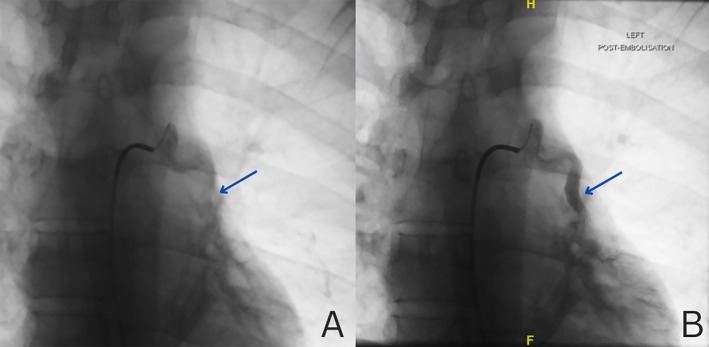 Figure 1
 Figure 2
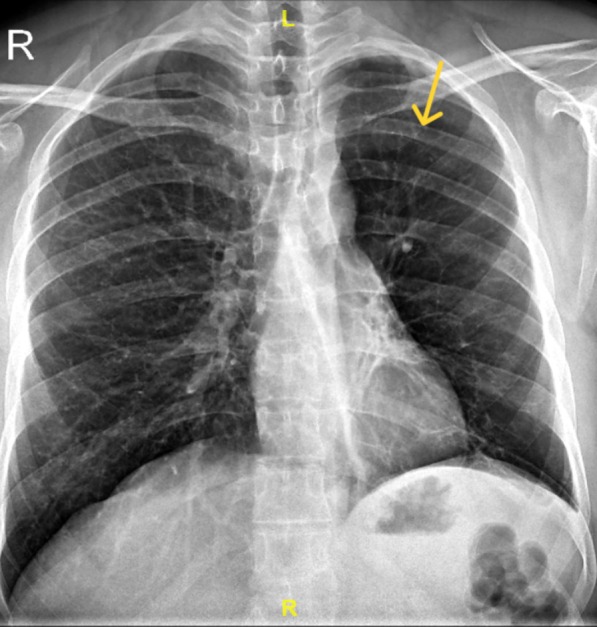 Figure 3
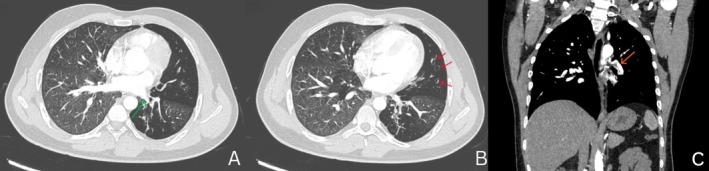 Figure 4
Peer Reviews
No public reviews on file for this paper yet. If you reviewed it on a platform where reviews are public (OpenReview, ICLR, NeurIPS, ICML), you can paste yours below so the community can read it here.
Videos
No videos yet. Explain this paper in a talk, walkthrough, or lecture? Add one.
Taxonomy
TopicsCongenital Diaphragmatic Hernia Studies · Tracheal and airway disorders · Vascular Anomalies and Treatments
A 29‐year‐old Indian male presented with a year‐long history of hemoptysis, escalating over the past month to 15–20 mL per episode, occurring approximately 10 times daily. He had a history of childhood‐onset asthma, with episodic wheezing and breathlessness triggered by cold and dust exposure. There was no history of tuberculosis or other comorbidities. Physical examination revealed coarse crepitations in the left infrascapular area, while vital signs were normal. Pulmonary function test showed FVC 3.14 L (77.4% predicted), FEV_1_ 2.21 L (62.9%), and FEV1/FVC 0.70. Chest radiography showed a hyperlucent left lung (Figure 1). Computed tomography (CT) revealed diffuse hyperlucent areas, along with fibrotic and bronchiectatic changes in the left lower lobe and lingula, reduced left lung volume, hypoplastic left pulmonary arteries, and a hypertrophied left bronchial artery (Figure 2)—findings consistent with SJMS. Given the persistent and worsening hemoptysis and the presence of a hypertrophied bronchial artery, the patient underwent bronchial artery embolization (Figure 3). Post‐procedure, hemoptysis ceased, and the patient remained stable during follow‐up. SJMS is a rare pulmonary disorder characterised by unilateral hyperlucency, hypoplasia of the pulmonary vasculature, and the presence of bronchiectasis [1, 2]. While often diagnosed in childhood, adult presentations can occur and may mimic other pulmonary conditions [1, 2], leading to misdiagnosis. Bronchial artery embolization can be an effective treatment for significant hemoptysis associated with SJMS.
Author Contributions
Dhiran Sivasubramanian: conceptualization, data curation, project administration, supervision, original draft writing, review, and editing. Karthick Balasubramanian: patient evaluation, conceptualization, investigation, review, and editing. Virushnee Senthilkumar: conceptualization, data curation, investigation, and project administration. Sathwik Sanil: conceptualization, investigation, project administration. Smrti Aravind: visualization, writing – review, and editing. Nithish Nanda Palanisamy: image selection, data curation.
Ethics Statement
All the data of this study were taken from the medical records of the patient. This report does not contain any personal information that could lead to the identification of the patient.
Consent
The authors declare that written informed consent was obtained for the publication of this manuscript and accompanying images using the consent form provided by the Journal.
Conflicts of Interest
The authors declare no conflicts of interest.
The reference list from the paper itself. Each links out to its DOI / PubMed record.
- 1G. D. Lema , E. E. Melaku , H. A. Tekle , G. B. Aydagnuhm , and E. D. Gebeyaw , “Swyer–James–Macleod Syndrome Mimicking Pulmonary Embolism in Adults: A Case Report,” Journal of Medical Case Reports 18 (2024): 359, 10.1186/s 13256-024-04680-3.39113117 PMC 11308721 · doi ↗ · pubmed ↗
- 2H. K. Ahmed , F. H. Kakamad , S. M. Mustafa , et al., “Adult Swyer‐James‐Mac Leod Syndrome; a Case Report With Literature Review,” International Journal of Surgery Open 43 (2022): 100487, 10.1016/j.ijso.2022.100487. · doi ↗