The types of school attended by the ALSPAC children from1997 to 2011 (ages 5 to 19 years): A Focus on Christian Faith Schools
Hamid Reza Tohidinik, Mark Mumme, Jean Golding, Andrew O Agbaje, Howard Worsley

TL;DR
This study provides data on the types of schools attended by children in the ALSPAC cohort from ages 5 to 19, with a focus on Christian faith schools.
Contribution
The paper introduces a detailed dataset on school types attended by ALSPAC children, including Christian faith schools and other characteristics.
Findings
The dataset includes school size, sex composition, and whether schools are Christian faith-based.
Information is provided on how researchers can access the anonymized data for further analysis.
The study covers children from 1991-1992 cohorts attending schools in Bristol and surrounding areas.
Abstract
The Avon Longitudinal Study of Parents and Children (ALSPAC) is a longitudinal study following ~14,000 children from pregnancy through until adulthood. They were all born to women resident during pregnancy in a geographic area which comprised the city of Bristol, surrounding suburbs, rural areas, villages and towns. During their childhood almost all attended either state or private schools. The present Data Note describes the basic details of the schools attended by the cohort of children born in 1991-2, obtained by linking the names of the cohort children to the schools they attended during each school year and then anonymising the data. Details include the size of school in terms of the number of children enrolled, school sex composition, whether it is a Christian faith school (including the type of faith), whether it is fee-paying, and whether it is a boarding school. This document…
Genes, proteins, chemicals, diseases, species, mutations and cell lines named across the full text — each resolved to its canonical identifier and authoritative record.
Click any figure to enlarge with its caption.
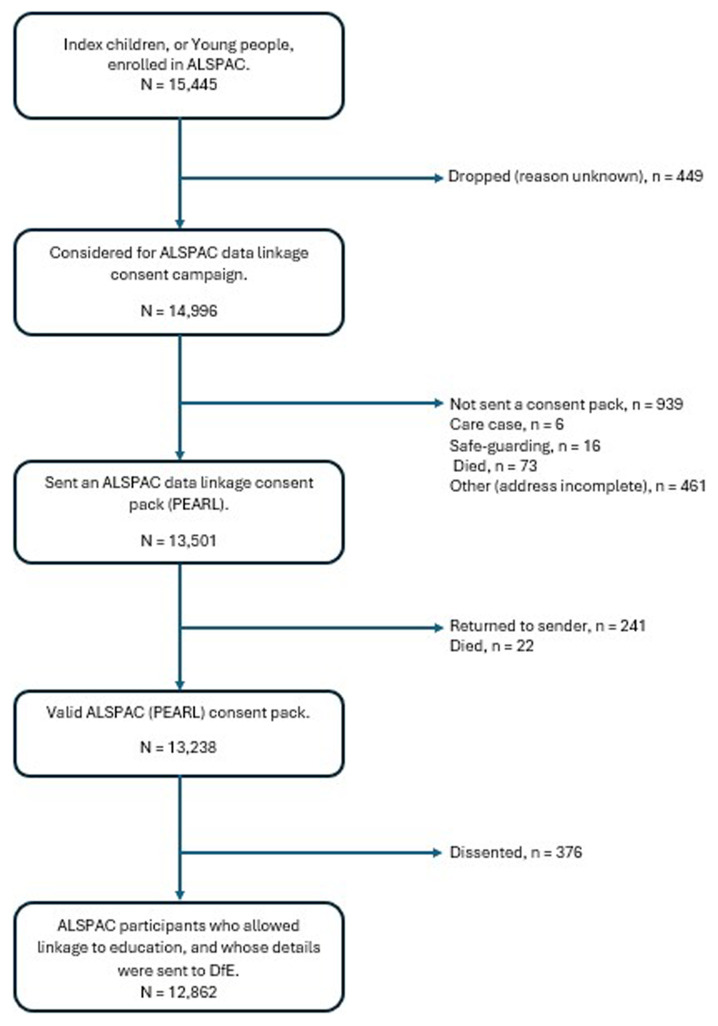 Figure 1
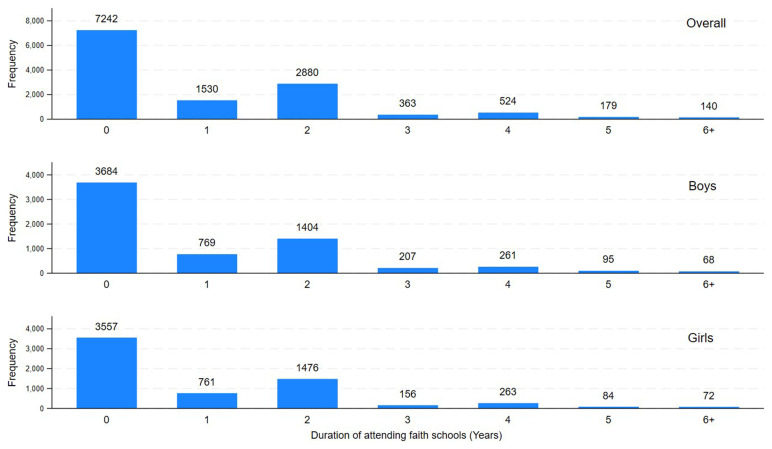 Figure 2
| Key Stage (KS) | Number |
|---|---|
| KS1 | 11,279 |
| KS2 | 12,233 |
| KS3 | 10,851 |
| KS4 | 11,764 |
| KS5 | 9,449 |
| Variable | Variable name in school data
| Variable coding |
|---|---|---|
| Activity level | activity_level1997 to
| KS1 vs KS2 vs KS3 vs KS4 vs KS5 |
| Religious category of the schools | religious_character1997 to
| Anglican vs Roman Catholic vs Other Christian vs
|
| Phase of education | phase_of_education1997 to
| Primary vs Secondary vs All-Through vs 16 Plus vs
|
| Boarding status | boarders_situation1997 to
| Boarding School vs College/FE Residential
|
| Establishment type | establishment_type1997 to
| Colleges vs Local Authority Maintained School vs
|
| Gender composition | gender_of_pupils1997 to
| Mixed vs Girls only vs Boys only |
| Duration of attending Christian faith schools | religious_school_years (derived
| Continuous (Years) |
| Attended Christian faith school ever | religious_school_binary (derived
| Binary (Non-faith vs at least one Christian faith
|
| Level of attendance at a Christian faith school | Faith_school_level (derived
| Non-faith vs Primary included vs After primary
|
| Religious category | KS categories |
|---|---|
| Anglican | Anglican |
| Anglican/Christian | |
| Anglican/Church of England | |
| Church of England | |
| Church of England/Methodist | |
| Church of England/United Reformed Church | |
| Roman Catholic | Roman Catholic |
| Roman Catholic/Church of England | |
| Roman Catholic/Anglican | |
| Catholic | |
| Church of England/Roman Catholic | |
| Other Christian | Methodist |
| Christian | |
| Anglican/Evangelical | |
| Church of England/Evangelical | |
| Protestant/Evangelical | |
| Seventh Day Adventist | |
| Plymouth Brethren Christian Church | |
| Quaker | |
| Other | Jewish |
| Islam | |
| Inter- / non- denominational | |
| No religious character | Does not apply |
| None | |
| [blank] | |
| Type of Establishment | KS labelling |
| Colleges | Colleges |
| Local authority maintained schools | Local authority maintained schools |
| Special schools | Special schools |
| Independent schools | Independent schools |
| Other | Academies |
| Other types | |
| Universities | |
| Welsh schools | |
| Phase of Education | KS labelling |
| Primary | Primary |
| Middle deemed primary | |
| Secondary | Secondary |
| Middle deemed secondary | |
| All-through | All-through |
| 16 plus | 16 plus |
| Not applicable | Not applicable |
| Sex, N | Establishment type, N | Boarding status, N | Sex composition, N | |||||||||
|---|---|---|---|---|---|---|---|---|---|---|---|---|
| Academic
| Approximate
| Female | College | Local
| Special
| Independent
| Other | Boarding
| No
| Mixed | Girls
| Boys
|
| 1997–98 | 5–6 | 1368 | - | 2,683 | 13 | 10 | <5 | <5 | 2,704 | 2,704 | <5 | <5 |
| 1998–99 | 6–7 | 3622 | - | 7,268 | 19 | 98 | <5 | 38 | 7,346 | 7,373 | 12 | <5 |
| 1999–2000 | 7–8 | 1133 | - | 2,217 | 5 | 36 | <5 | 15 | 2,242 | 2,253 | 5 | <5 |
| 2000–01 | 8–9 | <5 | - | <5 | <5 | <5 | <5 | <5 | <5 | <5 | <5 | <5 |
| 2001–02 | 9–10 | 1394 | - | 2,607 | 24 | 133 | <5 | 40 | 2,723 | 2,749 | 15 | <5 |
| 2002–03 | 10–11 | 3594 | - | 7,032 | 43 | 286 | <5 | 81 | 7,275 | 7,337 | 23 | <5 |
| 2003–04 | 11–12 | 1134 | - | 2150 | 10 | 105 | <5 | 26 | 2,238 | 2,250 | 15 | <5 |
| 2004–05 | 12–13 | 1289 | - | 2,409 | 32 | 131 | 37 | 46 | 2,562 | 2,576 | 21 | 12 |
| 2005–06 | 13–14 | 3390 | - | 6,540 | 87 | 325 | 64 | 108 | 6,906 | 6,911 | 53 | 52 |
| 2006–07 | 14–15 | 1392 | 9 | 2,388 | 43 | 296 | 37 | 93 | 2,671 | 2,691 | 65 | 17 |
| 2007–08 | 15–16 | 4263 | 346 | 7,033 | 91 | 746 | 306 | 260 | 8,079 | 8,270 | 185 | 67 |
| 2008–09 | 16–17 | 3698 | 1,446 | 4,565 | 25 | 518 | 390 | 285 | 5,813 | 6,701 | 177 | 66 |
| 2009–10 | 17–18 | 3021 | 2,059 | 2,622 | 6 | 479 | 429 | 298 | 3,851 | 5,402 | 132 | 61 |
| 2010–11 | 18–19 | 1209 | 1,067 | 820 | <5 | 185 | 192 | 124 | 1,306 | 2,199 | 51 | 16 |
| 2011–12 | 19–20 | 144 | 191 | 52 | <5 | 12 | 41 | 13 | 114 | 288 | 6 | <5 |
| Year | Sex | Activity level
| School religious character, N | |||
|---|---|---|---|---|---|---|
| Non faith
| Anglican | Roman Catholic | Other Christian | |||
| 1997–8 | Boys | KS1 | 990 | 278 | 70 | <5 |
| Girls | KS1 | 981 | 310 | 77 | <5 | |
| 1998–9 | Boys | KS1 | 2732 | 813 | 212 | 6 |
| Girls | KS1 | 2560 | 833 | 220 | 9 | |
| 1999–2000 | Boys | KS1 | 829 | 233 | 59 | <5 |
| Girls | KS1 | 812 | 243 | 77 | <5 | |
| 2000–1 | Boys | KS1 | <5 | <5 | <5 | <5 |
| Girls | KS2 | <5 | <5 | <5 | <5 | |
| 2001–2 | Boys | KS2 | 925 | 365 | 72 | 8 |
| Girls | KS2 | 936 | 378 | 73 | 7 | |
| 2002–3 | Boys | KS2 | 2529 | 1017 | 201 | 20 |
| Girls | KS2 | 2395 | 974 | 209 | 16 | |
| 2003–4 | Boys | KS2 | 778 | 290 | 52 | 8 |
| KS3 | <5 | <5 | <5 | <5 | ||
| Girls | KS2 | 759 | 290 | 80 | 3 | |
| KS3 | <5 | <5 | <5 | <5 | ||
| 2004–5 | Boys | KS2 | <5 | <5 | <5 | <5 |
| KS3 | 1140 | 73 | 73 | 32 | ||
| Girls | KS3 | 1152 | 66 | 63 | 8 | |
| 2005–6 | Boys | KS3 | 3270 | 150 | 132 | 70 |
| KS4 | <5 | <5 | <5 | <5 | ||
| Girls | KS3 | 3090 | 139 | 140 | 20 | |
| KS4 | <5 | <5 | <5 | <5 | ||
| 2006–7 | Boys | KS4 | 1197 | 76 | 67 | 41 |
| Girls | KS4 | 1247 | 67 | 55 | 23 | |
| 2007–8 | Boys | KS4 | 3401 | 157 | 139 | 87 |
| KS5 | 362 | 47 | 56 | 10 | ||
| Girls | KS4 | 3336 | 149 | 144 | 43 | |
| KS5 | 450 | 58 | 78 | 5 | ||
| 2008–9 | Boys | KS4 | 1019 | 58 | 40 | 28 |
| KS5 | 1668 | 168 | 208 | 56 | ||
| Girls | KS4 | 1060 | 50 | 41 | 7 | |
| KS5 | 2049 | 174 | 292 | 25 | ||
| 2009–10 | Boys | KS4 | 10 | <5 | <5 | <5 |
| KS5 | 2107 | 181 | 225 | 51 | ||
| Girls | KS4 | <5 | <5 | <5 | <5 | |
| KS5 | 2536 | 172 | 279 | 30 | ||
| 2010–11 | Boys | KS5 | 878 | 75 | 78 | 26 |
| Girls | KS5 | 1057 | 52 | 93 | 7 | |
| 2011–12 | Boys | KS5 | 132 | 8 | 9 | <5 |
| Girls | KS5 | 136 | <5 | 5 | <5 | |
| Year | Boarding status | School religious character, N | |||
|---|---|---|---|---|---|
| Non faith
| Anglican | Roman Catholic | Other Christian | ||
| 1997–8 | Boarding school | <5 | <5 | <5 | <5 |
| No boarders | 1969 | 588 | 147 | <5 | |
| 1998–9 | Boarding school | 14 | 20 | <5 | <5 |
| No boarders | 5277 | 1626 | 432 | 11 | |
| 1999–2000 | Boarding school | 5 | 8 | <5 | <5 |
| No boarders | 1636 | 468 | 136 | <5 | |
| 2000–1 | Boarding school | <5 | <5 | <5 | <5 |
| No boarders | <5 | <5 | <5 | <5 | |
| 2001–2 | Boarding school | 14 | 18 | <5 | 8 |
| No boarders | 1846 | 725 | 145 | 7 | |
| 2002–3 | Boarding school | 28 | 29 | <5 | 24 |
| No boarders | 4892 | 1961 | 410 | 12 | |
| 2003–4 | Boarding school | 7 | 12 | <5 | 7 |
| No boarders | 1532 | 569 | 133 | <5 | |
| 2004–5 | Boarding school | 13 | 22 | <5 | 42 |
| No boarders | 2280 | 117 | 132 | 33 | |
| 2005–6 | Boarding school | 34 | 49 | 8 | 17 |
| No boarders | 6329 | 240 | 264 | 73 | |
| 2006–7 | Boarding school | 35 | 28 | 5 | 25 |
| No boarders | 2400 | 115 | 117 | 39 | |
| 2007–8 | Boarding school | 116 | 64 | 11 | 69 |
| No boarders | 7250 | 347 | 406 | 76 | |
| 2008–9 | Boarding school | 161 | 68 | <5 | 52 |
| No boarders | 4791 | 382 | 576 | 64 | |
| 2009–10 | Boarding school | 180 | 68 | 8 | 42 |
| No boarders | 3034 | 285 | 493 | 39 | |
| 2010–11 | Boarding school | 79 | 30 | <5 | 14 |
| No boarders | 1021 | 97 | 169 | 19 | |
| 2011–2 | Boarding school | 7 | 5 | <5 | <5 |
| No boarders | 92 | 6 | 14 | <5 | |
| Year | School sex
| School religious character, N | |||
|---|---|---|---|---|---|
| Non faith
| Anglican | Roman Catholic | Other Christian | ||
| 1997–8 | Mixed | 1969 | 588 | 147 | <5 |
| Unisex | <5 | <5 | <5 | <5 | |
| 1998–9 | Mixed | 5280 | 1646 | 432 | 15 |
| Unisex | 12 | <5 | <5 | <5 | |
| 1999–2000 | Mixed | 1637 | 476 | 136 | <5 |
| Unisex | 5 | <5 | <5 | <5 | |
| 2000–1 | Mixed | <5 | <5 | <5 | <5 |
| Unisex | <5 | <5 | <5 | <5 | |
| 2001–2 | Mixed | 1846 | 743 | 145 | 15 |
| Unisex | 15 | <5 | <5 | <5 | |
| 2002–3 | Mixed | 4902 | 1990 | 409 | 36 |
| Unisex | 22 | <5 | <5 | <5 | |
| 2003–4 | Mixed | 1526 | 580 | 133 | 11 |
| Unisex | 14 | <5 | <5 | <5 | |
| 2004–5 | Mixed | 2265 | 137 | 134 | 40 |
| Unisex | 29 | <5 | <5 | <5 | |
| 2005–6 | Mixed | 6268 | 285 | 270 | 88 |
| Unisex | 97 | <5 | <5 | <5 | |
| 2006–7 | Mixed | 2368 | 140 | 120 | 63 |
| Unisex | 76 | <5 | <5 | <5 | |
| 2007–8 | Mixed | 7314 | 404 | 414 | 138 |
| Unisex | 235 | 7 | <5 | 7 | |
| 2008–9 | Mixed | 5571 | 446 | 576 | 108 |
| Unisex | 226 | <5 | 5 | 8 | |
| 2009–10 | Mixed | 4478 | 348 | 502 | 74 |
| Unisex | 179 | 5 | <5 | 7 | |
| 2010–11 | Mixed | 1871 | 127 | 169 | 32 |
| Unisex | 64 | <5 | <5 | <5 | |
| 2011–2 | Mixed | 260 | 11 | 14 | <5 |
| Unisex | 8 | <5 | <5 | <5 | |
| Academic Year | Establishment type | School religious character, N | |||
|---|---|---|---|---|---|
| Non faith
| Anglican | Roman Catholic | Other Christian | ||
| 1997–8 | Local authority | 1948 | 588 | 147 | <5 |
| Special school | 13 | <5 | <5 | <5 | |
| Independent school | 10 | <5 | <5 | <5 | |
| 1998–9 | Local authority | 5211 | 1624 | 432 | <5 |
| Special school | 19 | <5 | <5 | <5 | |
| Independent school | 62 | 22 | <5 | 14 | |
| 1999–2000 | Local authority | 1613 | 468 | 136 | <5 |
| Special school | 5 | <5 | <5 | <5 | |
| Independent school | 24 | 8 | <5 | <5 | |
| 2000–1 | Local authority | <5 | <5 | <5 | <5 |
| Special school | <5 | <5 | <5 | <5 | |
| Independent school | <5 | <5 | <5 | <5 | |
| Other | <5 | <5 | <5 | <5 | |
| 2001–2 | Local authority | 1739 | 723 | 145 | <5 |
| Special school | 24 | <5 | <5 | <5 | |
| Independent school | 98 | 20 | <5 | 15 | |
| 2002–3 | Local authority | 4664 | 1959 | 407 | <5 |
| Special school | 43 | <5 | <5 | <5 | |
| Independent school | 217 | 32 | <5 | 34 | |
| 2003–4 | Local authority | 1451 | 567 | 132 | <5 |
| Special school | 10 | <5 | <5 | <5 | |
| Independent school | 79 | 14 | <5 | 11 | |
| 2004–5 | Local authority | 2159 | 117 | 132 | <5 |
| Special school | 32 | <5 | <5 | <5 | |
| Independent school | 66 | 22 | <5 | 39 | |
| Other | 37 | <5 | <5 | <5 | |
| 2005–6 | Local authority | 6025 | 245 | 264 | 6 |
| Special school | 87 | <5 | <5 | <5 | |
| Independent school | 189 | 44 | 8 | 84 | |
| Other | 64 | <5 | <5 | <5 | |
| 2006–7 | College | 8 | <5 | <5 | <5 |
| Local authority | 2157 | 114 | 116 | <5 | |
| Special school | 43 | <5 | <5 | <5 | |
| Independent school | 199 | 29 | 5 | 63 | |
| Other | 37 | <5 | <5 | <5 | |
| 2007–8 | College | 219 | <5 | 127 | <5 |
| Local authority | 6407 | 345 | 275 | 6 | |
| Special school | 90 | <5 | <5 | <5 | |
| Independent school | 528 | 65 | 14 | 139 | |
| Other | 305 | <5 | <5 | <5 | |
| 2008–9 | College | 971 | <5 | 475 | <5 |
| Local authority | 4092 | 366 | 102 | 5 | |
| Special school | 25 | <5 | <5 | <5 | |
| Independent school | 340 | 63 | <5 | 111 | |
| Other | 369 | 21 | <5 | <5 | |
| 2009–10 | College | 1588 | <5 | 471 | <5 |
| Local authority | 2340 | 254 | 23 | 5 | |
| Special school | 6 | <5 | <5 | <5 | |
| Independent school | 329 | 65 | 10 | 75 | |
| Other | 394 | 34 | <5 | <5 | |
| 2010–11 | College | 905 | <5 | 162 | <5 |
| Local authority | 725 | 87 | 8 | <5 | |
| Special school | <5 | <5 | <5 | <5 | |
| Independent school | 121 | 30 | <5 | 33 | |
| Other | 182 | 10 | <5 | <5 | |
| 2011–2 | College | 177 | <5 | 14 | <5 |
| Local authority | 47 | 5 | <5 | <5 | |
| Independent school | 5 | <5 | <5 | <5 | |
| Other | 39 | <5 | <5 | <5 | |
- —John Templeton Foundation
- —Department for Education and Skills
- —Wellcome Trust and MRC
- —Wellcome Trust
- —The UK Medical Research Council (MRC) and Wellcome Trust
Peer Reviews
No public reviews on file for this paper yet. If you reviewed it on a platform where reviews are public (OpenReview, ICLR, NeurIPS, ICML), you can paste yours below so the community can read it here.
Videos
No videos yet. Explain this paper in a talk, walkthrough, or lecture? Add one.
Taxonomy
TopicsHealth, Environment, Cognitive Aging · Birth, Development, and Health · Child Nutrition and Water Access
Introduction
The environment in which children grow and develop has a profound impact on their overall well-being/health and future prospects. Among the various components of this environment, schools hold a particularly influential position by playing a pivotal role in shaping their physical, mental, and social health as well as their educational development ( Edgerton & McKechnie, 2022; Miyazaki & Stack, 2015; Pallan et al., 2014; Patalay et al., 2020).
Schools, often considered as a second home for children, serve as more than just centres for education; they provide a context in which children develop key life skills, establish social relationships ( Pacheco et al., 2022), and learn healthy behaviours ( Morton et al., 2016).
To comprehend the complex interplay between school characteristics, child and adolescent health, and educational achievement, it is useful to encompass a diverse range of school attributes in population health studies. This is particularly pertinent in longitudinal studies, as it enables researchers to comprehensively assess their influence on shaping the trajectory of children's lives while minimizing potential bias. Nevertheless, the backgrounds of the schools are rarely considered in studies of health and development (apart from academic achievements ( Edgerton & McKechnie, 2022)).
One of the least studied school identities concerns the contribution of faith schools. In England the number of Church of England (C of E) faith schools started expanding in 2001, resulting in considerable controversy. By 2004, about one-third of primary, and one-sixth of secondary schools were faith schools ( Cush, 2005). Yeshanew et al. carried out a comprehensive study comparing the academic results of faith with non-faith primary schools. They showed that the pupils in Roman Catholic and C of E schools performed slightly better than those in non-faith schools, and that pupils with special educational needs were particularly advantaged by being in a faith school ( Yeshanew et al., 2008).
Although fewer in number, the secondary faith schools in England are predominantly Christian, 58% of these were Roman Catholic and 35% C of E. Allen and West (2011) showed that the social composition of attendees at the faith secondary schools varied with fewer children having free school meals but more of Black African and Afro-Caribbean backgrounds than the population attending non-faith secondary schools. They noted that there were fewer such schools in the south-west of the country ( Allen & West, 2011).
The Avon Longitudinal Study of Parents and Children (ALSPAC) is a longitudinal birth cohort with a wide range of genetic, psychological, physical, and environmental data ( Boyd et al., 2013; Fraser et al., 2013; Golding et al., 2001; Northstone et al., 2019). The aim of this data note is to provide an overview of the existing data on characteristics of schools that ALSPAC children attended during their childhood and adolescence. It provides important information for future ALSPAC users who are interested in this subject, to use it for testing their own hypotheses concerning the advantages and disadvantages of attending a Christian faith school.
Methods
The ALSPAC sample and the study children
ALSPAC is a longitudinal birth cohort in which all pregnant women resident in Avon, UK with expected dates of delivery between 1st April 1991 and 31st December 1992 were invited to take part. 20,248 pregnancies have been identified as being eligible and the initial number of pregnancies enrolled was 14,541. Of the initial pregnancies, there was a total of 14,676 foetuses, resulting in 14,062 live births and 13,988 children who were alive at 1 year of age. When the oldest children were approximately 7 years of age, an attempt was made to bolster the initial sample with eligible cases who had failed to join the study originally. As a result, when considering variables collected from the age of seven onwards there are data available for more than the 14,541 pregnancies mentioned above: The number of new pregnancies not in the initial sample (known as Phase I enrolment) that are currently represented in the released data and reflecting enrolment status at the age of 24 is 906, resulting in an additional 913 children being enrolled (456, 262 and 195 recruited during Phases II, III and IV respectively). The total sample size for analyses using any data collected after the age of seven is therefore 15,447 pregnancies, resulting in 15,658 foetuses. Of these 14,901 children were alive at 1 year of age. The children have been followed ever since, through infancy, toddlerhood, the pre-school, infant and primary school phases and on to secondary school and college. Here we map the features of the schools attended from years 1997 to 2011.
Further details on the ALSPAC study have been published elsewhere ( Boyd et al., 2013; Fraser et al., 2013; Northstone et al., 2019; Golding et al., 2001). The study website contains details of all data available through a fully searchable data dictionary and variable search tool: http://www.bristol.ac.uk/alspac/researchers/our-data/.
Obtaining details of the schools attended (History of linkage of ALSPAC to education records)
** Early education data linkage – before the Project to Enhance ALSPAC through Record Linkage (PEARL) **
Permission to link to the externally collected educational and medical records of the index children participating in ALSPAC was originally sought from the accompanying adult at a study-data collection ‘clinic’ run between September 1998 and September 2000, called the ‘Focus@7’ clinic. In total, 7,843 out of the 13,146 children recruited during the initial phase of ALSPAC and enrolled at the time attended this clinic. Additionally, 456 children who attended were recruited into ALSPAC after the initial phase. Therefore, in May 2003, the ALSPAC Ethics & Law Committee (ALEC) reviewed the approach and decided that, in line with the Data Protection Act, it was not necessary for ALSPAC to obtain written consent before using the data, but that data on children where parents objected at the Focus@7 clinic - or for whom permission was subsequently withdrawn - should not be requested. In total 15 objections were registered at this stage (14 at the clinic visit, and 1 subsequently).
Following the decision by ALEC, the four Local Education Authorities (LEA) that covered the former Avon area (Bristol, South Gloucestershire, Bath & North East Somerset and North Somerset) were approached and agreed that ALSPAC would be allowed to access these data. The School Entry Assessment and Key Stage 1 records were first linked to each other using the LEA PIN numbers and name, date of birth and sex. This was done by ALSPAC’s data linkage team using a deterministic linkage methodology. The resulting master list of children was then linked to ALSPAC identifiers using names and dates of birth. This early education dataset was initially made available by ALSPAC for research in early 2004.
Subsequently, the Department for Education (DfE) (or the Department for Children, Schools and Families (DCSF) as it was until 2010) introduced the National Pupil Database (NPD). The NPD was established in 2002 (but includes records going back to academic year 1995/1996) and is a longitudinal database of pupils who attend state-maintained schools and colleges. The NPD holds detailed information about children’s education at different stages, exam and test results, absence and exclusion data, as well as pupil characteristic data such as ethnicity, language, free school meals entitlement, and details of any Special Educational Needs (SEN). The DfE introduced the Unique Pupil Number (UPN) in 1999 to facilitate the collection of data across the school system; later updating this to the Pupil Matching Reference–anonymous (PMRa). This enables the linkage of participants’ identifiers to a systematically compiled pupil register.
In 2002, ALSPAC obtained these linked NPD records for the ALSPAC participants. In order to satisfy the confidentiality requirements of both ALSPAC and the DfE, the linking work was carried out by an independent charity, The Fischer Family Trust (FFT), acting as a trusted third party. ALSPAC supplied the FFT with names, dates of birth and current postcode for all members of the eligible cohort, whilst DfE supplied similar details relating to all the individual datasets in the NPD. The FFT then linked ALSPAC identifiers to the DfE’s UPN by matching the available data separately for each data set (i.e., separate matches for each of the several datasets held and maintained by the DfE). This occasionally resulted in a single ALSPAC child being linked to different pupils in different years/datasets. Such cases were subject to quality checks conducted by ALSPAC to validate the linkage. In addition, a small number of bad matches were identified by investigating cases for whom the reported national curriculum year was 2 or more years out from the expected national curriculum year.
ALSPAC obtained updates from the DfE for Key Stage 1 (KS1), Key Stage 2 (KS2, first made available by ALSPAC from 2008), Key Stage 3 (KS3, also available from 2008) and Key Stage 4 (available from 2010) at a national level (England) replacing the datasets previously linked at a local authority level. The School Entry Assessment data collected locally was not updated as these data are not held in the NPD. These updates were obtained using the existing UPN, as established by FFT, with the data of those who dissented removed.
Ethical approval and consent
Ethical approval for the study was obtained from the ALSPAC Law and Ethics Committee (ALEC; IRB00003312; date: 01-06-2010) and the local research ethics committees (NHS Haydock REC: 10/H1010/70; date: 03-02-2011). The education data was provided by the DfE following their internal decision-making process, under Data Request Number DR120430.04 (dated 30-04-2012), which states that 'ALSPAC operates as a resource for the entire research community’ and 'The [education] data are pseudonymised and then used by researchers and research projects approved by the ALSPAC executive.’ Consent for the use of data collected via questionnaires (implied consent) and clinics (informed consent) was obtained from participants following the recommendations of the ALSPAC Ethics and Law Committee at the time. Questionnaires were completed in the participants’ own home and return of the questionnaires was taken as continued consent for their data to be included in the study ( Birmingham, 2018). Full details of the approvals are available from the study website. Study members have the right to withdraw their consent for elements of the study or from the study entirely at any time.
PEARL consent campaign
When the ALSPAC children reached legal adulthood (age 18 years), the ALSPAC data linkage team, through the Project to Enhance ALSPAC through Record Linkage (PEARL), sent them 'fair processing' materials describing ALSPAC’s intention to link to their routine health and administrative data from national databases, including education, and gave them a clear means to consent or object via a written form. Participants were informed that ALSPAC would attempt to link to their records unless they opted out. Data were not extracted for participants who objected, or who were not sent fair processing materials. The enrolled sample of the ALSPAC cohort at this stage consisted of 15,445 individuals, and 14,996 of these were initially included in the PEARL consent campaign. The PEARL campaign sent out a total of 13,501 consent packs to the ALSPAC young people (the children now being young adults in their own right). Participants were asked to consider allowing data linkage to health, education, crime and environmental data. The education was split into compulsory schooling, further education and higher education, and the participants could allow, or opt out of, any or all of these three categories. There were 263 consent packs which were known not to have been received by the participant. A record was made of those participants who did not receive the pack (e.g. item returned to sender). At the time these data were obtained there were 12,862 participants who had allowed their education records from DfE to be accessed by ALSPAC. Note that these consent figures represent a point in time; consent is ongoing, and numbers have changed over time. The summary of the current school data linkage for ALSPAC children is presented in Figure 1.
Flowchart of school data linkage for ALSPAC children.
The available data set comprises those who explicitly consented together with those who chose not to opt-out. Those who either dissented or were not provided with a consent pack have had their data removed and set to missing.
The ALSPAC extract of the NPD data comprises datasets from the academic years 1997/1998 to 2011/2012. The schools in this dataset are those recorded as the school at which the participants completed their Key Stage assessments, Key Stages 1 to 5, and are drawn from the DfE’s Key Stage attainment datasets. The number of ALSPAC participants who were identified and matched by the DfE at each Key Stage are presented in Table 1.
Variables:
The school data were converted from long format to wide format to capture the student's school characteristics at different years separately and link them to the ALSPAC core data for further analysis. The school variables utilized in this paper are listed in Table 2.
The ALSPAC participants, as pupils, may have attended several schools throughout their education. It is also important to note that the dataset records the characteristics of the school as it was during the academic year that the DfE extract related to, and that the school may have changed over the years in some way or even closed or merged, either during the period recorded or since. The school characteristics were consolidated into groupings as shown in Table 3. All the schools were given a random study ID (study_urn1997, study_urn1998, ..., study_urn2011) which is unique for this project; so that the schools are individually labelled but cannot be re-identified.
Statistical analysis
We examined the distribution of children in the schools from 1997 to 2011 according to the type of establishment, whether boarders were taken, religious categories, and sex of children in the school. In cases where the number of students was small within a specific category, we opted to merge those categories with adjacent ones for analysis. All statistical analyses were performed using Stata 17.0 (StataCorp LLC, College Station, TX, USA), licensed to the University of Bristol.
Results
Of the 12862 children, 6488 (50.5%) were male. They predominantly attended community schools under local authority administration until the age of ~17 (in the academic year 2009–10), with the lowest proportion of records for 2009-10 (46.8%) and the highest in 1997–8 (99.1%) at ages 5–7. Subsequently, most transitioned to attending college. The majority of the students were non-boarding day pupils, accounting for at least 89.8% in 2011–12, and studied in mixed-sex schools (minimum of 96.5% in 2008–9 and 2009–10) ( Table 4). Thirty nine students attended more than one school during an academic year.
A majority of participants attended non-faith schools during the whole period of follow-up (minimum of 66.9% in 2002–3). Anglican schools were the predominant Christian faith schools until 2006–7 (ranged between 4.1% and 27.0%), but after that the number of students were slightly higher in Roman Catholic schools (maximum of 9.0% in 2009–10) ( Table 5). Figure 2 represents the number of years pupils attended Christian faith schools during their life with similar distributions observed among girls and boys. In total, 5616 (43.7%) attended a Christian faith school at least once in their life. Among them, 4562 (81.6%) attended a Christian faith school during primary school, while the remaining 18.4% attended a Christian faith school only after primary school. Mean duration of attending the Christian faith schools was 0.95 years (SD:1.33, Range: 0–7 years) in all children. It was 2.17 years (SD:1.17) for those who ever attended a Christian faith school. The majority of boarding schools tended to be faith schools until 2007–8, but in later years they were mostly non-faith ( Table 6). Schools’ religious characters by sex composition and establishment type are presented in Table 7 and Table 8.
Years attended Christian faith schools by ALSPAC children overall, girls, and boys.
Considerations when using the school data in ALSPAC
Strengths and limitations of the data
One of the notable strengths of these data is the availability of faith school data linked to ALSPAC parents’ and children’s data. This unique feature presents a valuable opportunity for researchers to explore the causal relationship between characteristics of schools including type of establishment, boarding status, sex composition, and particularly childhood attendance at Christian faith schools and subsequent outcomes in physical, behavioural, and mental health, as well as academic achievement. This advantage is underscored by the dataset's capacity to minimize bias and enable the control of potential individual and parental confounders in these associations within the context of a longitudinal study. A further advantage lies in the fact that the data are not biased in regard to the source of information – for example, a parent might have been tempted to claim erroneously that the child attended a fee-paying school.
One limitation is that there are probably too few children attending single-sex schools or boarding schools for valid analysis into their advantages or disadvantages. Conversely, there are relatively large numbers of children attending Church of England and Roman Catholic faith schools for detailed analysis concerning the effects that such schooling may present. Finer detail concerning other aspects of these schools are available from questionnaires completed by the head teachers, which will be able to be used to provide further context to the basic school information described here ( Tunstall et al., in preparation).
It is important to note that in this dataset, there are very few students who attended non-Christian faith schools, and these students have been merged with those who did not attend any faith schools. Among students who never attended Christian faith schools (categorized as "Non-faith" in Table 5– Table 8), only 7 had Jewish mothers, and 25 had Muslim mothers. Given that there is only one Muslim faith school and no Jewish school in Bristol, the maximum number of pupils who likely attended non-Christian faith schools is 25. Consequently, any future studies using these data will only be able to assess the association of attending Christian faith schools.
In this data note we only focused on some administrative aspects of schools such as type of establishment, boarding status, religious categories, and sex composition. However, other information about children’s education at different stages such as exam results, absence, as well as pupil characteristic data such as ethnicity, language, free school meals entitlement, and details of any Special Educational Needs (SEN) have also been linked to ALSPAC participants (e.g. Tunstall et al., in preparation).
The data presented in this study is limited to England and does not encompass other regions of the UK. The dataset does not provide explanations for missing individuals, such as relocation overseas, illness, or participation in homeschooling. Additionally, consents may change over time, resulting in a decrease in the number of participants.
The value and strength of longitudinal studies, and birth cohorts in particular, lies in the data collected on multiple and repeated life course exposures. However, attrition is inevitable in large prospective, population-based studies. Traditional approaches to follow-up become increasingly challenging and expensive as the ALSPAC participants enter adulthood and potentially move out of the original area. This education data was obtained using data linkage between study participants and information held on them in the electronic records of routine national databases. Data linkage has added value to ALSPAC in several important ways. It is a cost-effective and comprehensive source of both retrospective and prospective measures of exposure and outcome status, and a tool for dealing with ‘missingness’ of data because not all participants complete all the questionnaires they are sent. It is also a form of cross-validation of data obtained from different sources and a means to obtain “objective” assessments of exposures and outcomes whose measurement is less subject to self-report or participant biases or memory losses.
Ethical approval and consent
Ethical approval for the study was obtained from the ALSPAC Law and Ethics Committee (ALEC; IRB00003312; date: 01-06-2010) and the local research ethics committees (NHS Haydock REC: 10/H1010/70; date: 03-02-2011). The education data was provided by the DfE following their internal decision-making process, under Data Request Number DR120430.04 (dated 30-04-2012), which states that 'ALSPAC operates as a resource for the entire research community’ and 'The [education] data are pseudonymised and then used by researchers and research projects approved by the ALSPAC executive.’ Consent for the use of data collected via questionnaires (implied consent) and clinics (informed consent) was obtained from participants following the recommendations of the ALSPAC Ethics and Law Committee at the time. Questionnaires were completed in the participants’ own home and return of the questionnaires was taken as continued consent for their data to be included in the study ( Birmingham, 2018). Full details of the approvals are available from the study website. Study members have the right to withdraw their consent for elements of the study or from the study entirely at any time. When the ALSPAC children reached legal adulthood (age 18 years), the ALSPAC data linkage team, through the Project to Enhance ALSPAC through Record Linkage (PEARL), sent them 'fair processing' materials describing ALSPAC’s intention to link to their routine health and administrative data from national databases, including education, and gave them a clear means to consent or object via a written form.
The reference list from the paper itself. Each links out to its DOI / PubMed record.
- 1Allen R West A : Why do faith secondary schools have advantaged intakes? The relative importance of neighbourhood characteristics, social background and religious identification amongst parents. Brit Educ Res J. 2011;37(4):691–712. 10.1080/01411926.2010.489145 · doi ↗
- 2Birmingham K : Pioneering ethics in a longitudinal study: the early development of the ALSPAC Ethics and Law Committee.Bristol: Policy Press,2018. 10.51952/9781447340423 · doi ↗
- 3Boyd A Golding J Macleod J : Cohort Profile: the 'children of the 90s'--the index offspring of the Avon Longitudinal Study of Parents and Children. Int J Epidemiol. 2013;42(1):111–127. 10.1093/ije/dys 064 22507743 PMC 3600618 · doi ↗ · pubmed ↗
- 4Cush D : The faith schools debate. Brit J Sociol Educ. 2005;26(3):435–442. 10.1080/01425690500128957 · doi ↗
- 5Edgerton E Mc Kechnie J : The relationship between student's perceptions of their school environment and academic achievement. Front Psychol. 2022;13: 959259. 10.3389/fpsyg.2022.959259 36817376 PMC 9929545 · doi ↗ · pubmed ↗
- 6Fraser A Macdonald-Wallis C Tilling K : Cohort profile: the Avon Longitudinal Study of Parents and Children: ALSPAC mothers cohort. Int J Epidemiol. 2013;42(1):97–110. 10.1093/ije/dys 066 22507742 PMC 3600619 · doi ↗ · pubmed ↗
- 7Golding J Pembrey M Jones R : ALSPAC--the Avon Longitudinal Study of Parents and Children. I. Study methodology. Paediatr Perinat Epidemiol. 2001;15(1):74–87. 10.1046/j.1365-3016.2001.00325.x 11237119 · doi ↗ · pubmed ↗
- 8Miyazaki Y Stack M : Examining individual and school characteristics associated with child obesity using a multilevel growth model. Soc Sci Med. 2015;128:57–66. 10.1016/j.socscimed.2014.12.032 25589033 · doi ↗ · pubmed ↗