Author Correction: Tanshinone IIA affects the malignant growth of Cholangiocarcinoma cells by inhibiting the PI3K-Akt-mTOR pathway
Huayuan Liu, Caiyun Liu, Mengya Wang, Dongxu Sun, Pengcheng Zhu, Ping Zhang, Xueying Tan, Guangjun Shi

Abstract
Genes, proteins, chemicals, diseases, species, mutations and cell lines named across the full text — each resolved to its canonical identifier and authoritative record.
Click any figure to enlarge with its caption.
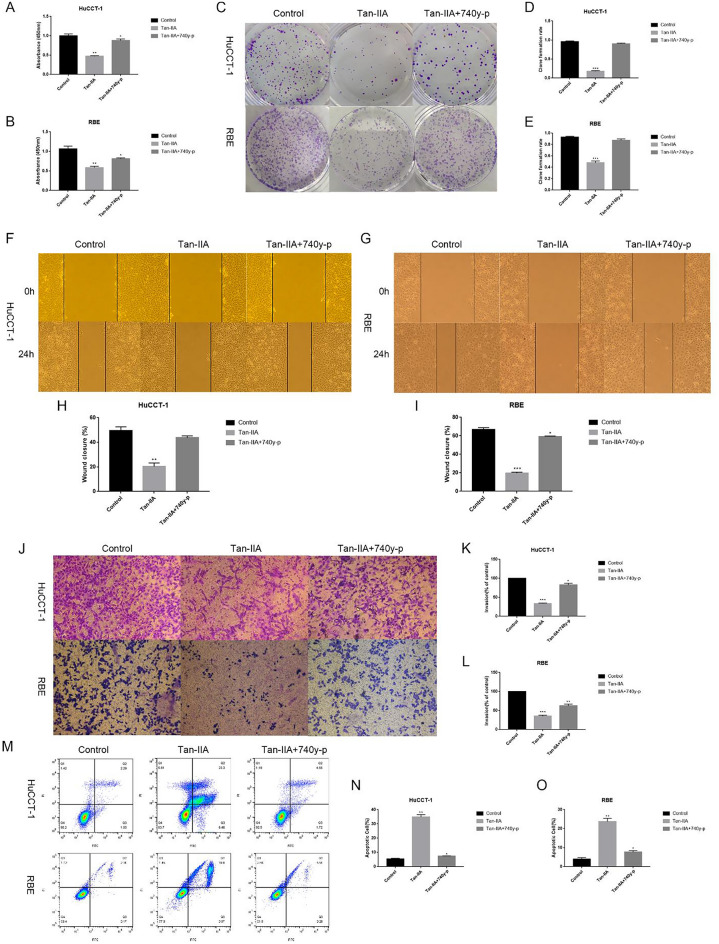 Figure 4
Peer Reviews
No public reviews on file for this paper yet. If you reviewed it on a platform where reviews are public (OpenReview, ICLR, NeurIPS, ICML), you can paste yours below so the community can read it here.
Videos
No videos yet. Explain this paper in a talk, walkthrough, or lecture? Add one.
Taxonomy
TopicsGinger and Zingiberaceae research
Correction to: Scientific Reports 10.1038/s41598-021-98948-z, published online 29 September 2021
The original version of this Article contained errors in Figure 4, panels F and G, where the 0h image of the “Tan-IIA+740y-p” group was incorrectly used as the image of the “Tan-IIA group”. The original Fig. 4 and accompanying legend appear below.Fig. 4PI3K agonists attenuate the tumor suppressive effect of Tan-IIA. After the addition of 740y-p (10 µg/mL) to the system in which Tan-IIA (24 h IC50 concentration) and Cholangiocarcinoma cells were co-cultured, the tumor suppressive effect of Tan-IIA was attenuated. (A–E) The inhibitory effect of Tan-IIA on the proliferation of Cholangiocarcinoma cells decreased after the addition of 740y-p. (F–L) The ability of Tan-IIA to inhibit the invasion and migration of Cholangiocarcinoma cells was reduced after the addition of 740y-p. (M–O) The apoptosis-inducing effect of Tan-IIA on Cholangiocarcinoma cells was diminished after 740y-p was added. Compared with control, *p < 0.05; **p < 0.01; ***p < 0.001.
The original Article has been corrected.