Exploring the Anticancer Properties of 1,2,3-Triazole-Substituted Andrographolide Derivatives
Joana R. L. Ribeiro, Juliana Calheiros, Rita A. M. Silva, Bruno M. F. Gonçalves, Carlos A. M. Afonso, Lucília Saraiva, Maria-José U. Ferreira

TL;DR
Researchers synthesized and tested new andrographolide derivatives with triazole groups, finding some to be effective at stopping cancer cell growth and inducing cell death.
Contribution
The study introduces novel triazole-substituted andrographolide derivatives with enhanced anticancer activity and explores their mechanisms.
Findings
Compounds 9, 14, 16, and 17 showed improved antiproliferative activity compared to the parent compound.
Derivative 12 induced G2/M cell cycle arrest and apoptosis in PANC-1 cells.
Compound 12 reduced cell migration and synergized with 5-fluorouracil in pancreatic cancer cells.
Abstract
Background/Objectives: The search for new anticancer agents from natural sources remains a key strategy in drug discovery. This study aimed to synthesize and evaluate novel triazole derivatives of the diterpenic lactone andrographolide for their antiproliferative activity against various cancer cell lines. Methods: Twenty-two new triazole derivatives (5–26), of the triacetyl derivative (2) of the diterpenic lactone andrographolide (1), were synthesized via the azide-alkyne “click reaction”. The antiproliferative effects of compounds 1–26 were evaluated using the sulforhodamine B assay against a panel of cancer cell lines and a non-tumorigenic colon cell line. A representative compound, triazole derivative 12, was further evaluated in human pancreatic ductal adenocarcinoma (PANC-1) cells for its effects on the cell cycle, apoptosis, migration, and drug synergy with 5-fluorouracil.…
Genes, proteins, chemicals, diseases, species, mutations and cell lines named across the full text — each resolved to its canonical identifier and authoritative record.
Click any figure to enlarge with its caption.
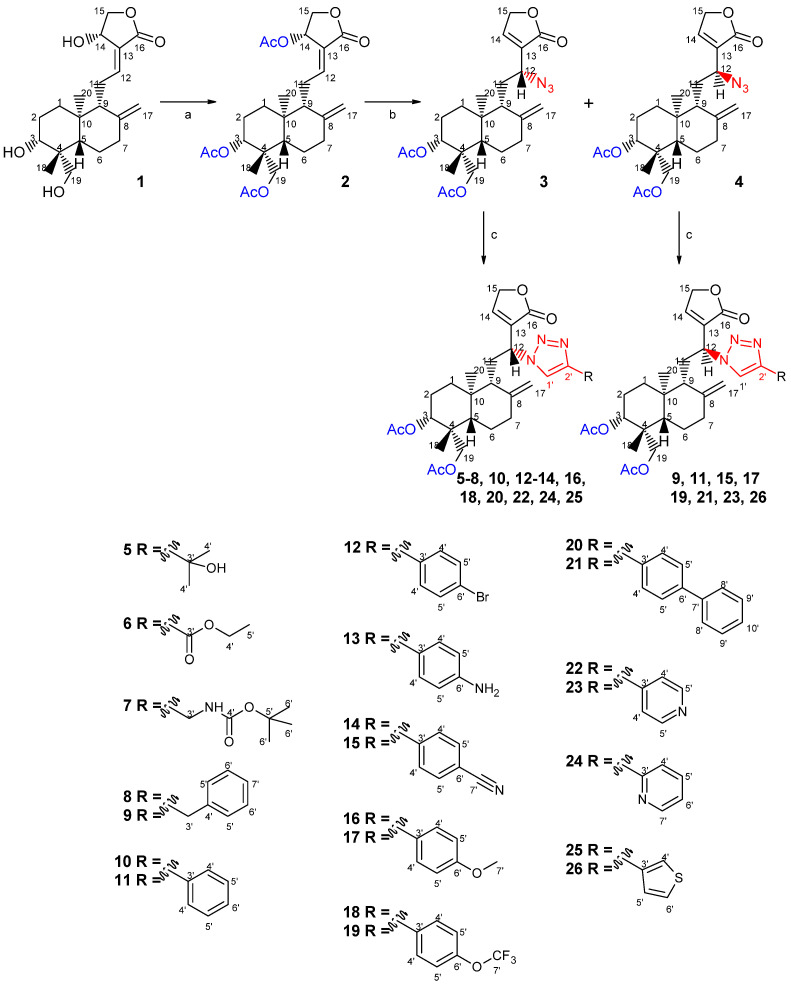 Scheme 1
- —Fundação para a Ciência e a Tecnologia (FCT), Portugal
- —PhD grant
- —Infrastructure Project
- —National NMR Network (PTNMR)
- —FEDER
- —FEDER
- —PIDDAC
Peer Reviews
No public reviews on file for this paper yet. If you reviewed it on a platform where reviews are public (OpenReview, ICLR, NeurIPS, ICML), you can paste yours below so the community can read it here.
Videos
No videos yet. Explain this paper in a talk, walkthrough, or lecture? Add one.
Taxonomy
TopicsAndrographolide Research and Applications · PARP inhibition in cancer therapy · Toxin Mechanisms and Immunotoxins
1. Introduction
Cancer remains one of the leading causes of mortality worldwide, accounting for approximately 10 million deaths in 2022 [1]. In addition, an increase in the number of cancer cases and deaths is expected due to factors such as population growth, aging, and the adoption of lifestyles that expose people to more cancer risk factors [2]. Despite significant and promising advancements in cancer treatment, conventional therapies still exhibit severe adverse effects and are frequently associated with resistance and relapse. These challenges are related with the highly heterogeneous nature of cancer as a disease, which consists of various cell types with different molecular characteristics and varied responses to treatment [3,4]. Consequently, there is an urgent need to explore alternative therapeutic approaches.
Natural products have long been recognized for their potential in cancer management. Indeed, over 60% of currently used anticancer agents are derived from natural sources or inspired by natural compounds [5]. In this regard, one particularly promising natural compound is andrographolide (1, Scheme 1), a diterpene lactone found in the medicinal plant Andrographis paniculate, which has been used in traditional Chinese medicine [6]. The potential of andrographolide for the development of new antineoplastic drugs is clearly supported by the increasing number of publications reporting its anticancer effects over the last 15 years [7]. Among several other biological activities, numerous studies have demonstrated the ability of andrographolide to inhibit the growth and proliferation of various cancer cell lines, including those of breast [8], lung [9], prostate [10], and hematological origins [11], among others, as well as its antitumor properties in in vivo models. The anticancer properties of andrographolide have been attributed to several key factors: first, it exhibits the ability to modulate various signaling pathways and cellular processes involved in cancer progression, including NF-κB [12], STAT3 [13], and PI3K/Akt/mTOR [14]. This multitargeted nature allows it to interfere with various aspects of tumor development, survival, and proliferation. It is important to note that in the context of complex diseases, such as cancer, therapeutic approaches based on multifunctional drugs have shown improved efficacy over single-target agents [15,16]. While the underlying mechanisms of action of andrographolide have not yet been fully elucidated, ongoing research has identified some relevant anticancer mechanisms of andrographolide, which include induction of cell cycle arrest [17], promotion of apoptosis [17], inhibition of cancer cell proliferation [18], angiogenesis [19] and metastasis. Second, andrographolide has shown the ability to act synergistically with conventional chemotherapeutic agents [20], revealing its potential benefit as part of combination treatment plans. Third, it has demonstrated the capacity to overcome multidrug resistance in certain cancer cell lines [21,22]. Finally, the relative affordability and natural abundance of andrographolide makes this compound an ideal candidate for designing hit/lead compounds to develop novel anticancer agents.
Despite its enormous potential, andrographolide has been found to possess some limitations, namely its poor bioavailability, short half-life, and nonspecific cellular distribution [23,24], as well as some safety concerns that have been raised regarding nephrotoxicity [25] and reproductive toxicity [26].
Chemical modification of natural product scaffolds, including andrographolide, has proven to be a successful strategy to address these types of shortcomings by generating derivatives with improved potency, selectivity, and pharmacokinetic properties to become clinically useful drugs, particularly in the field of cancer treatment [27,28,29,30]. Previous structure–activity relationship (SAR) studies have shown that targeted modifications to specific positions on the andrographolide backbone can enhance both its biological activity and physicochemical properties, including solubility and bioavailability. These structural modifications have primarily focused on key functional sites such as the five-membered lactone ring (especially at positions C-14 and C-15), the C-12 position, and the hydroxyl groups at C-3 and C-19. Additional efforts have targeted the exocyclic double bond. SAR studies have consistently demonstrated that such modifications can significantly impact its cytotoxic activity [31]. For example, esterification of hydroxyl groups at C-3, C-14, C-17, and C-19 have been associated with improved anticancer activity relative to the parent compound [32,33,34,35]. Additionally, C-12-substituted aryl amino 14-deoxy-andrographolide derivatives have demonstrated enhanced cytotoxic effects across a range of cancer cell lines [36,37], underscoring the potential of this position for further optimization. More recently, the incorporation of an aryl-carbamate moiety at the C-14 position has yielded derivatives with potent anti-pancreatic cancer activity, attributed to downregulation of oncogenic p53 expression and inhibition of multiple malignant phenotypes in pancreatic cancer models [28]. While significant progress has been made, the andrographolide scaffold remains a versatile platform with further opportunities for structural diversification aimed at enhancing its therapeutic potential.
Click chemistry reactions, particularly the Cu(I)-catalyzed Huisgen 1,3-dipolar cycloaddition between alkynes and azides, were quickly recognized as a powerful tool for modifying various natural compounds. Indeed, this modification met the criteria established in 2001 by Professor K. Barry Sharpless, who coined the concept of “click chemistry” as the ideal strategy to modify natural products. These criteria include being reliable, selective, modular, wide in scope, giving very high yielding reactions, generating only inoffensive by-products that can be removed without chromatography, and being stereospecific [38,39]. This modification enables the direct incorporation of various functional groups accompanied by the formation of the multifunctional 1,2,3-triazole motif. Not only has this modification been shown to improve pharmacological activities, including anticancer properties, but it also enhances metabolic stability and drug-like properties [40,41,42]. These positive effects could be linked to the 1,2,3-triazole motif’s ability to act as a basic and hydrophilic connecting group or as bioisosteres of 5- or 6-membered heterocycles or an amide group. In addition, this motif can noncovalently interact with several biological targets through hydrogen bonds, dipole–dipole bonds, and van der Waals forces [43].
The introduction of the 1,2,3-triazole moiety into the andrographolide scaffold represents an opportunity to explore the generation and evaluation of novel andrographolide-1,2,3-triazole conjugates as potentially more effective anticancer candidates.
Thus, continuing our ongoing research program, which aims to find plant-derived compounds as anticancer agents for overcoming drug resistance [44,45,46,47,48], this work reports the generation of a library of new C-12 andrographolide-1,2,3-triazole hybrids. Herein, detailed information regarding the preparation protocol is provided, as well as the structural characterization data. All newly prepared derivatives underwent preliminary antiproliferative evaluation against a panel of cancer cell lines and a non-tumorigenic cell line. One of the compounds, compound 12, was chosen for further experiments for a preliminary investigation of its mechanism of action.
2. Results and Discussion
2.1. Chemistry
Considering the reactivity of andrographolide (1) functional groups, a γ-butyrolactone moiety; a double bond between C-8 and C-17; another between C-12 and C-13; and three hydroxyl groups at C-3, C-14, and C-19, we envisioned the introduction of the azide moiety at C-12 as a starting point for the preparation of 1,2,3-triazole derivatives. Our approach, as outlined in Scheme 1, began with the protection of the hydroxyl groups. Andrographolide reacted with acetic anhydride in the presence of ZnCl_2_ to afford the intermediate triacetyl derivative 2 quantitatively. This transformation was selected as the first step to limit the high reactivity of hydroxyl groups and generate a better leaving group at C-14.
The C-12 position was then functionalized by reacting compound 2 with sodium azide in methanol (Scheme 1, reaction b). As expected, through Michael addition at C-12 followed by elimination of the acetyl group at C-14, a mixture of epimers was obtained, which was afterwards separated by column chromatography, yielding azide derivatives 3 and 4 in a ratio of 3:1 (yields of 47% and 14%, respectively). The structures of these derivatives were assigned based on their NMR data, including 2D-NMR experiments. When comparing the ^1^H and ^13^C-NMR spectra of compounds 3 and 4 with those of the triacetyl derivative 2, as expected, the signal of the trisubstituted double bond H-12 (δH 6.99) and the corresponding carbon resonance (δC 150.1) were absent, whereas new signals of the geminal proton to the azide function and the corresponding carbon appeared at δH ≈ 4 and δC ≈ 56. Moreover, the new olefinic signal assigned to H-14, at δH 7.41 (3) and 7.37 (4), and the corresponding signal in the ^13^C-NMR spectrum, at δC 145.9 (3) and 147.4 (4), substantiated the formation of the new double bond at C-13, which was also corroborated by the absence of the proton and carbon signals of the acetyl group at C-14.
Further reaction of compounds 3 and 4 with different alkynes, by “click” chemistry [49], allowed the formation of twenty-two new 1,2,3-triazole derivatives (5–26) (Scheme 1, reaction c) in reduced-to-good yields (8–88%). The formation of the triazole ring was easily identified by the ^1^H-NMR data due to the presence of a singlet at δH 7.26 to 8.23. Additional proton and carbon signals, corresponding to the substituent of the triazole moiety, were also observed. Moreover, the signal corresponding to H-12, which was overlapped in both epimeric azines 3 and 4, appeared in triazole derivatives as a well-defined doublet of doublets (dd, J ≅ 11.2, 3.5 Hz) (compounds 9, 11, 15, 17 19, 21, 23, 26) or a broad doublet (br d, J12-11 ≅ 11.5 Hz) (compounds 5–8, 10, 12–14, 18, 20, 22, 24, 25), due to different J12-11 coupling patterns in both sets of epimers. The distinct J12-11 coupling patterns of both sets of derivatives is in agreement with other data from the literature [50], as well with our previous results of a library of nitrogen-containing andrographolide derivatives [22], where a well-defined doublet of doublets was associated with 12S configuration and a broad doublet to 12R. The stereochemistry at C-12 was also substantiated by nuclear Overhauser effects observed in NOESY experiments. Thus, in azide derivative 3, a NOE correlation between H-12 and the H-9β, which was absent in the corresponding epimer 4, agreed with a 12R configuration. Similarly, a strong NOE interaction between H-12/H-9 was also observed in the NOESY spectrum of compound 10, which was selected as a representative of azide 3 derivatives, thus confirming the 12R configuration in this set of compounds. Conversely, as in azide derivative 4, no nuclear Overhauser effect was found between H-12/H-9 in epimer 11, in agreement with 12S stereochemistry for the set of azide 4 derivatives (see Supplementary Information, Figure S10).
Preparation of triacetyl andrographolide (2), azide andrographolide (3 and 4), and triazole derivatives (5–26). Reagents and conditions: (a) acetic anhydride (40 equiv.), zinc chloride (0.13 equiv.), room temperature, 2 h, quantitative; (b) sodium azide (2.4 equiv.), methanol, room temperature, 1 day, 3: 47%, 4: 14%; (c) corresponding alkyne (1.2 equiv.), CuSO4.5H2O (5 mol%), sodium ascorbate (10 mol%), ethanol:water 50%, 50°C, 2 h–3 days, 5: 38%, 6: 31%, 7: 52%, 8: 46%, 9: 49%, 10: 37%, 11: 31%, 12: 83%, 13: 8%, 14: 47%, 15: 36%, 16: 43%, 17: 18%, 18: 51%, 19: 25%, 20: 76%, 21: 44%, 22: 44%, 23: 21%, 24: 88%, 25: 82%, 26: 21%.
2.2. Biological Studies
2.2.1. In Vitro Antiproliferative Activity
The antiproliferative properties of andrographolide and all prepared derivatives (2–26) were evaluated against a panel of different cancer cell lines, including human pancreatic ductal adenocarcinoma (PANC-1), colorectal adenocarcinoma (HCT116), melanoma (A375), breast adenocarcinoma (MCF-7) and a non-tumorigenic colon (CCD-18Co) cell line using the sulforhodamine B assay. The cell lines were treated with increasing concentrations of each compound, and the IC_50_ (concentration that inhibits 50% of cell growth) values were determined after 48 h of incubation, as summarized in Table 1.
In general, most of the compounds showed significant antiproliferative activity, with IC_50_ values lower than 10 µM, in all the cancer cell lines. It was observed that the esterification of andrographolide hydroxyl groups with a lipophilic substituent significantly enhanced the antiproliferative activity in all cell lines tested, likely due to improved cellular permeability. When comparing with the parental compound (1, IC_50_ = 3.1 µM), the introduction of the triazole moiety increased the antiproliferative activity of compounds 9, 14, 16, 17, 20, and 24 (IC_50_ ranging from 1.8 µM to 3.0 µM) against the PANC-1 cell line. Against the HCT116, A375, and MCF-7 cancer cell lines, most of the derivatives were found to have higher antiproliferative activity than the parental compound 1. Except for compounds 3, 5, and 24, all derivatives showed better antiproliferative activity, with IC_50_ ranging from 1.2 µM to 4.8 µM, against HCT116 cells than the parental compound 1 (IC_50_ = 5.1 µM). In A375 cells, the parental compound 1 (IC_50_ = 4.0 µM) also exhibited lower antiproliferative activity than most of the derivatives (IC_50_ ranging from 0.9 µM to 3.6 µM), with the exception of compounds 5, 8, 10, 11, 13, 18, and 19. Again, in MCF-7 cells, only compounds 5, 7, 8, 13, and 20, showed lower antiproliferative activity compared to the parental compound 1 (IC_50_ = 13.5 µM), while all the other compounds showed IC_50_ values ranging from 3.8 µM and 11.0 µM. Interestingly, the IC_50_ values for the compounds in MCF-7 cells were slightly higher compared to the other cancer cell lines tested. One possible explanation for the relatively higher IC_50_ values in MCF-7 cells may relate to intrinsic differences in cell line biology. MCF-7 is an estrogen receptor-positive (ER^+^) breast cancer cell line known to have a slower proliferation rate and a distinct apoptotic response compared to more aggressive and p53-deficient cell lines like PANC-1. Moreover, MCF-7 cells are deficient in caspase-3, a key executioner of apoptosis, which may partially attenuate the apoptotic response to the compounds and contribute to the reduced sensitivity.
In addition, the antiproliferative effect of the compounds was evaluated on the non-tumorigenic (CCD-18Co) cell line. Comparison of the IC_50_ values in the CCD-18Co cells with those obtained in cancer cell lines revealed that most compounds exhibited some degree of selectivity towards the PANC-1, HCT116, and A375 cell lines. In contrast, only a few compounds exhibited modest selectivity in the MCF-7 cell line.
Compound 12 was selected as a representative compound for further studies in the pancreatic ductal adenocarcinoma (PANC-1) cells to carry out preliminary exploration of its mechanism of action. This compound was selected based on two main factors: its representative biological profile and its availability in greater quantity. This cell line was selected considering that pancreatic ductal adenocarcinoma is a lethal solid malignancy with limited therapeutic options.
2.2.2. Cell Cycle Assay
To elucidate the antiproliferative activity of compound 12, cell cycle analysis was performed in the PANC-1 cancer cell line. The cell cycle is a highly controlled process where cellular DNA is replicated and then equally partitioned in two daughter cells. The cell cycle is composed of two distinct phases: the interphase, where the cell grows and undergoes three distinct periods—the G1 (pre-DNA synthesis), S (DNA synthesis), and G2 (pre-division) phases—and mitosis, where cell undergoes division. The newly formed daughter cells then enter the preparatory phases of interphase, and start the G0 phase (quiescence) [51]. As shown in Table 1 and Figure 1A, compound 12 exhibited an IC_50_ value of 3.4 ± 0.9 µM, after 48 h of treatment. Thus, PANC-1 cells were treated with compound 12 at 3 and 6 µM for 48 h and then analyzed by flow cytometry (Figure 1B,C). Treatment with 3 μM and 6 μM resulted in a significant increase in the G2/M population compared to the control (Figure 1B, upper panel; and Figure 1C), indicating that this compound can induce cell cycle arrest at this phase, which is consistent with its observed cell growth inhibition properties. Considering these results, we explored the effects of this compound on the level of the cell cycle-regulatory protein, the cyclin-dependent kinase (CDK) inhibitor p21, by Western blot analysis. The results showed that treatment of PANC-1 cells with 3 and 6 µM of compound 12 for 48 h increased the expression of p21 in a dose-dependent manner (Figure 1E). Considering that p21 inhibits the kinase activity of CDK2/cyclin-E complexes, which promote the progression of the G2 phase of the cell cycle, our findings suggest that the upregulation of p21 induced by compound 12 led to cell cycle arrest at the G2/M phase, resulting in the inhibition of cell proliferation.
2.2.3. Annexin V-FITC/PI Double-Staining Assay
To further investigate the mechanism of action of the triazole derivative 12, an apoptosis analysis was subsequently performed in PANC-1 cells. The early stages of apoptosis are characterized by the disruption of membrane asymmetry and the translocation of phosphatidylserine from the inner to the outer leaflet of the plasma membrane, which can be detected using Annexin V-FITC, a protein with high affinity for phosphatidylserine. In the later stages of apoptosis, the cell membrane loses its integrity, allowing propidium iodide (PI) to penetrate into the cell [52]. Thus, PANC-1 cells treated with compound 12 at 3 and 6 μM for 48 h were analyzed by flow cytometry after Annexin V-FITC and PI staining (Figure 1B, bottom panel; and Figure 1D). This analysis can distinguish and quantify viable cells (annexin V−, PI−), early apoptotic cells (annexin V+, PI−), late apoptotic cells (annexin V+, PI+), and necrotic cells (annexin V−/PI+). As observed in Figure 1B, treatment with compound 12 led to a significant increase in the percentage of apoptotic cells (Annexin V+) from 4.35% (2% early apoptotic and 2.35% late apoptotic) in DMSO-treated cells to 17.28% (7.08% early apoptotic and 10.2% late apoptotic) and 26.8% (13.3% early apoptotic and 13.5% late apoptotic) at 3 and 6 µM, respectively. These results suggest that compound 12 exhibited potential as an apoptotic inducer, which led us to evaluate the effect of compound 12 on the levels of cleaved poly(ADP-ribose)polymerase 1 (PARP-1). Cleavage of PARP-1 into an 89 kDa protein, cleaved PARP-1, occurs during programmed cell death (apoptosis) as a result of proteolytic processing by active caspase-3. Thus, cleaved PARP-1 is recognized as a marker of apoptosis [53]. As shown in Figure 1E, treatment with 3 and 6 μM of compound 12 induced a significant increase in the levels of cleaved PARP-1, confirming its ability to induce apoptosis.
2.2.4. Scratch (Wound Healing) Assay
Metastasis remains the greatest challenge in the clinical management of cancer. Cell migration is a key process that, during the whole cascade of cancer development, contributes to tumor invasion and metastasis. The scratch assay is a common in vitro technique used to assess two-dimensional cell migration and motility. It involves creating an artificial scratch or “wound” in a confluent monolayer of cells and then monitoring the progression of the wound over time [54,55]. Therefore, a wound healing assay was used to evaluate the effect of compound 12 on the cell migration ability of PANC-1 cells. Treatment with 1.35 µM (IC_10_, a concentration which has no significant effect on cell proliferation) of compound 12 significantly reduced the wound closure in PANC-1 within a period of 6 h and 24 h compared to control (Figure 2A,B). These data suggest that compound 12 exhibits anti-migratory activity in PANC-1 cells.
2.2.5. Drug Combination Assay
For the combination studies, 5-fluorouracil (5-FU) was chosen based on its clinical relevance and frequent use as a chemotherapeutic agent in the treatment of several cancers represented in our study, particularly colorectal (HCT116) and breast cancer (MCF-7). While 5-FU is not the first-line agent for pancreatic cancer, it has been used in certain treatment regimens in combination therapies such as FOLFIRINOX. However, resistance to 5-FU through diverse mechanisms is commonly reported, presenting a challenge to effective treatment. One of the approaches that have been explored to overcome this resistance and enhance the therapeutic efficacy is to combine 5-FU with other chemotherapeutic agents and/or alternative treatment approaches. Therefore, the potential synergistic effect of compound 12 in combination with 5-FU was evaluated by treating PANC-1 cancer cells with 1.35 µM of compound 12, alone and in combination with a concentration range of 5-FU (3.75–60 µM) for 48 h. Using the CompuSyn software (version 1.0), a multiple drug effect analysis was performed for each combination, to determine combination index (CI) and dose-reduction index (DRI) values. CI values indicate the effect of combining multiple drugs as synergistic (CI < 1), additive (CI = 1), or antagonistic (CI > 1). DRI values represent the fold decrease in the dose of a drug needed when in combination to achieve the same efficacy as the drug alone. DRI values > 1 are favorable given the concern for toxicity when combining multiple drugs. As observed in Figure 3, a synergistic effect was observed between compound 12 and 5-FU at 3.75 and 7.5 µM, with CI values of 0.87 and 0.90, respectively. The DRI values validated this effect, since the higher values were obtained for the combinations of compound 12 with 3.75 and 7.5 µM of 5-FU. These findings indicated that the combination of compound 12 with 5-FU could be a promising strategy to improve the therapeutic efficacy of 5-FU, re-sensitizing pancreatic cancer cells to its effect. Importantly, at higher concentrations of 5-FU, the CI values shift toward additivity or mild antagonism. This phenomenon is not uncommon in combination therapy studies and may reflect dose-dependent pharmacodynamic interactions. At lower concentrations, compound 12 may potentiate the effects of 5-FU through complementary mechanisms, such as enhancing cell cycle arrest or increasing sensitivity to DNA damage. However, at higher concentrations, factors such as saturation of cytotoxic pathways, activation of stress responses, or overlapping toxicities may diminish the combinatorial advantage, resulting in reduced efficacy or antagonistic effects. Collectively, these findings highlight that the most pronounced synergistic effects occur at lower doses, which could be advantageous for developing combination regimens that maintain efficacy while minimizing toxicity.
3. Materials and Methods
3.1. Chemistry
3.1.1. General Remarks
Andrographolide was purchased from Sigma Aldrich (Steinheim, Germany), in over 90% purity. Reagent-grade chemicals and analytical-grade solvents used in reactions and workups were purchased from Alfa Aesar (Heysham, Lancashire, UK), Sigma-Aldrich (Steinheim, Germany), or Merck (Darmstadt, Germany). Deuterated chloroform used for NMR analysis was purchased from Merck (Darmstadt, Germany) with a degree of purity higher than 95%. Column chromatography was performed using silica gel 230–400 mesh ATM (Merck, (Darmstadt, Germany). Thin-layer chromatography (TLC), used to monitor all reactions, was carried out on pre-coated silica gel 60 F254 (Merck, Darmstadt, Germany) and visualized under UV light (λ 254 and 366 nm) and/or by exposure to a solution of sulfuric acid–methanol (1:1) followed by heating. Preparative thin-layer chromatography was performed with silica gel 60 GF254 0.040–0.063 mm (Merck, Darmstadt, Germany). The 1D and 2D NMR spectra were recorded on a Bruker Fourier 300 Ultra-Shield spectrometer (Bruker, Rheinstetten, Germany), using CDCl_3_ as internal standard. Chemical shifts (δ) are reported in parts per million (ppm), and coupling constants (J) in hertz (Hz). Multiplicities are given as s (singlet), d (duplet), t (triplet), q (quartet), quint (quintuplet), and m (multiplet). Spectra were assigned using appropriate COSY, DEPT, HSQC, and HMBC sequences. The low-resolution mass spectrometry was performed using a Waters AcquityTM triple quadruple spectrometer (Waters, Wilmslow, UK).
3.1.2. NMR Data of Andrographolide (1)
White powder; ^1^H-NMR (300 MHz, CDCl_3_) δ = 6.62 (1H, td, J = 6.8, 1.7 Hz, H-12), 5.70 (1H, d, J = 6.1 Hz, H-14-OH), 5.04 (1H, d, J = 4.9 Hz, H-3-OH), 4.91 (1H, br t, J = 6.1 Hz, H-14), 4.81 (1H, br s, H-17a), 4.63 (1H, br s, H-17b), 4.39 (1H, dd, J = 9.9, 6.1 Hz, H-15a), 4.12 (1H, dd, J = 7.5, 2.9 Hz, H-19-OH), 4.03 (1H, dd, J = 9.9, 2.1 Hz, H-15b), 3.84 (1H, dd, J = 11.0, 2.9 Hz, H-19a), 3.27 (2H, m, H-3 and H-19b), 2.46 (2H, m, H-11), 2.32 (2H, m, H-7), 1.95 (2H, m, H-2), 1.74 (2H, m, H-6), 1.63 (2H, m, H-1), 1.30 (1H, m, H-9), 1.20 (1H, m, H-5), 1.08 (3H, s, H-18), 0.66 (3H, s, H-20) ppm. ^13^C-NMR (75 MHz, DMSO-d6) δ = 169.9 (C-16), 147.6 (C-12), 146.3 (C-8), 129.0 (C-13), 108.2 (C-17), 78.4 (C-3), 74.3 (C-15), 64.5 (C-14), 62.6 (C-19), 55.5 (C-9), 54.4 (C-5), 42.3 (C-4), 38.6 (C-10), 37.5 (C-7), 36.5 (C-1), 27.9 (C-2), 23.9 (C-6 and C-11), 23.0 (C-18), 14.7 (C-20) ppm. ESI-MS (positive mode) m/z (rel. Int) 477 [M + H]^+^. These data agree with the literature [56,57].
3.1.3. Preparation of 3,14,19-Triacetyl Andrographolide (2)
Zinc chloride (76 mg, 0.56 mmol) was added to a solution of andrographolide (1, 1.5 g, 4.28 mmol) in acetic anhydride (16.2 mL, 171.2 mmol). The mixture was stirred for 2 h at room temperature. After completing the reaction, the excess acetic anhydride evaporated. The crude reaction was dissolved in dichloromethane:water = 1:1. The organic layer was then washed with a saturated solution of sodium bicarbonate, water, and brine; dried over anhydrous sodium sulphate; filtered; and evaporated. The compound was obtained as a white amorphous powder (quantitative yield). ^1^H-NMR (300 MHz, CDCl_3_) δ = 6.99 (1H, td, J = 6.8, 1.7 Hz, H-12), 5.91 (1H, dt, J = 6.2, 1.7 Hz, H-14), 4.89 (1H, br s, H-17a), 4.60 (1H, dd, J = 11.2, 4.3 Hz, H-3), 4.52 (1H, dd, J = 11.2, 6.2 Hz, H-15a), 4.51 (1H, br s, H-17b), 4.34 (1H, d, J = 11.8 Hz, H-19a), 4.23 (1H, dd, J = 11.2, 1.8 Hz, H-15b), 4.11 (1H, d, J = 11.8 Hz, H-19b), 2.10 (3H, s, H-14OCOCH_3_), 2.03 (6H, s, H-3OCOCH_3_ and H-19OCOCH_3_), 1.32 (1H, m, H-9), 1.02 (3H, s, H-18), 0.74 (3H, s, H-20) ppm. ^13^C-NMR (75 MHz, CDCl_3_) δ = 170.9 (C-19OCOCH_3_), 170.5 (C-3OCOCH_3_), 170.4 (C-14OCOCH_3_), 169.0 (C-16), 150.1 (C-12), 146.5 (C-8), 124.0 (C-13), 108.9 (C-17), 79.6 (C-3), 71.6 (C-15), 67.8 (C-14), 64.7 (C-19), 55.8 (C-5), 55.2 (C-9), 41.3 (C-4), 38.9 (C-10), 37.8 (C-7), 37.0 (C-1), 25.2 (C-11), 24.6 (C-6), 24.2 (C-2), 22.7 (C-18), 21.1 (C-3OCOCH_3_ and C-19OCOCH_3_), 20.7 (C-14OCOCH_3_), 14.5 (C-20) ppm. ESIMS m/z 477 [M + H]^+^.
3.1.4. Preparation of the Azide Andrographolide Derivatives
Preparation of azide-containing derivatives (3 and 4) was as follows: compound 2 (300 mg, 0.63 mmol) was dissolved in methanol (3 mL) and then the sodium azide (123 mg, 1.89 mmol) was added. The reaction mixture was stirred for 1 day at room temperature. After evaporation of the solvent, the residue was purified by column chromatography (toluene:EtOAc, 10:0 to 5:5) to afford compounds 3 (135 mg, 47%) and 4 (41 mg, 14%) as a yellow amorphous powder.
(12R)-azido-3,19-diacetoxy-14-deoxy-andrographolide (3): ^1^H-NMR (300 MHz, CDCl3) δ = 7.41 (1H, q, J = 1.6 Hz, H-14), 5.00 (1H, s, H-17a), 4.90 (1H, s, H-17b), 4.88 (2H, m, H-15 a,b), 4.64 (1H, dd, J = 11.5, 4.7 Hz, H-3), 4.38* (1H, m, H-12), 4.38 (1H, d, J = 11.7 Hz, H-19a), 4.11 (1H, d, J = 11.7 Hz, H-19b), 2.05 (6H, s, H-3OCOCH_3_ and H-19OCOCH_3_), 1.54 (1H, m, H-9), 1.05 (3H, s, H-18), 0.76 (3H, s, H-20) ppm. ^13^C-NMR (75 MHz, CDCl_3_) δ = 172.1 (C-16), 171.0 (C-19OCOCH_3_), 170.6 (C-3OCOCH_3_), 145.9 (C-14), 145.8 (C-8), 134.2 (C-13), 108.6 (C-17), 79.8 (C-3), 70.5 (C-15), 64.7 (C-19), 56.8 (C-12), 55.2 (C-5), 52.3 (C-9), 41.2 (C-4), 38.9 (C-10), 38.2 (C-7), 36.7 (C-1), 28.8 (C-11), 24.8 (C-6), 24.2 (C-2), 22.6 (C-18), 21.2 (C-3OCOCH_3_), 21.1 (C-19OCOCH_3_), 14.7 (C-20) ppm. ESIMS m/z 460 [M + H]^+^. Overlapped with H-19a.(12S)-azido-3,19-diacetoxy-14-deoxy-andrographolide* (4): ^1^H-NMR (300 MHz, CDCl_3_) δ = 7.37 (1H, br s, H-14), 4.92 (1H, s, H-17a), 4.89 (2H, br s, H-15 a,b), 4.63 (1H, s, H-17b), 4.55 (1H, dd, J = 11.3, 5.1 Hz, H3), 4.36* (1H, dd, J = 8,4, 3,8 Hz, H-12), 4.33 (1H, d, J = 11.7 Hz, H-19a), 4.08 (1H, d, J = 11.7 Hz, H-19b), 2.02 (6H, s, H-3OCOCH_3_ and H-19OCOCH_3_), 1.51 (1H, m, H-9), 0.98 (3H, s, H-18), 0.71 (3H, s, H-20) ppm. ^13^C-NMR (75 MHz, CDCl_3_) δ = 172.0 (C-16), 170.9 (C-19OCOCH_3_), 170.6 (C-3OCOCH_3_), 147.4 (C-14), 146.5 (C-8), 132.9 (C-13), 107.6 (C-17), 79.7 (C-3), 70.3 (C-15), 64.7 (C-19), 56.2 (C-12), 55.3 (C-5), 52.9 (C-9), 41.3 (C-4), 39.3 (C-10), 38.1 (C-7), 36.8 (C-1), 28.0 (C-11), 24.8 (C-6), 24.2 (C-2), 22.6 (C-18), 21.2 (C-3OCOCH_3_), 21.1 (C-19OCOCH_3_), 14.6 (C-20) ppm. ESIMS m/z 460[M + H]^+^. *Overlapped with H-19a.
3.1.5. Preparation of Triazole-Containing Andrographolide Derivatives
Compounds 3 and 4 (0.044–0.78 mmol) were dissolved in EtOH: MeOH 5:5 and then the copper sulphate pentahydrate (5% mol), the sodium ascorbate (10 mol %), and the appropriate alkyne (1.2 equiv.) were added. The reaction mixture was stirred for 2 h–3 days at 50–60 °C. After evaporating the solvent, the residue was dissolved in acetonitrile, filtered, and purified by column chromatography (hexane:EtOAc, 1:0 to 1:1).
(12R)-4-(2-methyl-2-ol)-1,2,3-triazole-3,19-diacetoxy-14-deoxy-andrographolide (5): Obtained from reaction of compound 3 (30 mg, 0.065 mmol) with 2-methyl-3-butyn-2-ol (7.6 µL, 0.78 mmol). The residue was purified by column chromatography to afford compound 5 (14 mg, 38%) as a white amorphous powder. ^1^H-NMR (300 MHz, CDCl_3_) δ = 7.49 (1H, s, H-1′), 7.26 (1H, q, J = 1.5 Hz, H-14), 5.45 (1H, br d, J = 11.9 Hz, H-12), 5.03 (1H, s, H-17a), 4.94 (1H, s, H-17b), 4.80* (1H, dt, J = 18.5, 1.5 Hz, H-15a), 4.69* (1H, dt, J = 18.5, 1.7 Hz, H-15b), 4.48 (1H, dd, J = 11.5, 5.0 Hz, H-3), 4.31 (1H, d, J = 11.8 Hz, H-19a), 4.06 (1H, d, J = 11.8 Hz, H-19b), 2.01 (3H, s, H-3OCOCH_3_), 2.00 (3H, s, H-19OCOCH_3_), 1.65 (6H, s, H-4′), 1.11 (1H, m, H-9), 0.94 (3H, s, H-18), 0.73 (3H, s, H20) ppm. AB part of an ABXY spin system with similar coupling values of A (J ≅ 1.5) and B (J ≅ 1.7) to X and Y. ^13^C-NMR (75 MHz, CDCl_3_) δ = 171.9 (C-16), 170.9 (C-19OCOCH_3_), 170.4 (C-3OCOCH_3_), 155.4 (C-2′), 147.9 (C-14), 145.8 (C-8), 133.6 (C-13), 120.2 (C-1′), 108.5 (C-17), 79.5 (C-3), 70.5 (C-15), 68.5 (C-3′), 64.7 (C-19), 55.7 (C-12), 55.1 (C-5), 51.9 (C-9), 41.2 (C-4), 38.9 (C-10), 38.2 (C-7), 36.4 (C-1), 30.4 (C-4′), 28.9 (C-11), 24.8 (C-6), 24.1 (C-2), 22.3 (C-18), 21.1 (C-3OCOCH_3_), 21.0 (C-19OCOCH_3_), 14.7 (C-20) ppm. ESIMS m/z 544 [M + H]^+^.(12R)-4-propriolate-1,2,3-triazole-3,19-diacetoxy-14-deoxy-andrographolide* (6): Obtained from reaction of compound 3 (30 mg, 0.065 mmol) with 2-ethynylpyridine (7.9 µL, 0.78 mmol). The residue was purified by column chromatography to afford compound 6 (11 mg, 31%) as a white amorphous powder. ^1^H-NMR (300 MHz, CDCl_3_) δ = 8.14 (1H, s, H-1′), 7.37 (1H, q, J = 1.5 Hz, H-14), 5.55 (1H, br d, J = 11.6 Hz, H-12), 5.04 (1H, s, H-17a), 4.91 (1H, s, H-17b), 4.92* (1H, dt, J = 18.6, 1.5 Hz, H-15a), 4.77* (1H, dt, J = 18.6, 1.7 Hz, H-15b), 4.47 (1H, dd, J = 11.7, 4.9 Hz, H-3), 4.44 (2H, q, J = 7.1 Hz, H-4′), 4.30 (1H, d, J = 11.8 Hz, H-19a), 4.06 (1H, d, J = 11.8 Hz, H-19b), 2.02 (3H, s, H-3OCOCH_3_), 2.00 (3H, s, H-19OCOCH_3_), 1.43 (3H, t, J = 7.1 Hz, H-5′), 1.14 (1H, m, H-9), 0.94 (3H, s, H-18), 0.73 (3H, s, H-20) ppm. AB part of an ABXY spin system with similar coupling values of A (J ≅ 1.5) and B (J ≅ 1.7) to X and Y. ^13^C-NMR (75 MHz, CDCl_3_) δ = 171.7 (C-16), 170.9 (C-19OCOCH_3_), 170.3 (C-3OCOCH_3_), 160.5 (C-3′), 148.1 (C-14), 145.6 (C-8), 140.2 (C-2′), 132.9 (C-13), 128.2 (C-1′), 118.6 (C-7′), 108.6 (C-17), 79.3 (C-3), 70.6 (C-15), 64.7 (C-19), 61.6 (C-4′), 56.4 (C-12), 54.9 (C-5), 51.7 (C-9), 41.2 (C-4), 38.9 (C-10), 38.1 (C-7), 36.4 (C-1), 28.8 (C-11), 24.8 (C-6), 24.0 (C-2), 22.2 (C-18), 21.1 (C-3OCOCH_3_), 21.0 (C-19OCOCH_3_), 14.7 (C-20), 14.3 (C-5′) ppm. ESIMS m/z 558 [M + H]^+^.(12R)-4-(tert-butyl methyl carbamate)-1,2,3-triazole-3,19-diacetoxy-14-deoxy-andrographolide* (7): Obtained from reaction of compound 3 (30 mg, 0.065 mmol) with N-boc-propargylamine (12 mg, 0.78 mmol). The residue was purified by column chromatography to afford compound 7 (21 mg, 52%) as a white amorphous powder. ^1^H-NMR (300 MHz, CDCl_3_) δ = 7.53 (1H, s, H-1′), 7.28 (1H, q, J = 1.5 Hz, H-14), 5.45 (1H, br d, J = 11.5 Hz, H-12), 5.03 (1H, s, H-17a), 4.96 (1H, s, H-17b), 4.85* (1H, dt, J = 18.5, 1.5 Hz, H-15a), 4.76* (1H, dt, J = 18.5, 1.7 Hz, H-15b), 4.48 (1H, dd, J = 11.3, 4.9 Hz, H-3), 4.42 (2H, d, J = 6.0 Hz, H-3′), 4.30 (1H, d, J = 11.7 Hz, H-19a), 4.05 (1H, d, J = 11.7 Hz, H-19b), 2.01 (3H, s, H-3OCOCH_3_), 2.00 (3H, s, H-19OCOCH_3_), 1.43 (9H, s, H-6′), 1.11 (1H, m, H-9), 0.92 (3H, s, H-18), 0.75 (3H, s, H-20) ppm. AB part of an ABXY spin system with similar coupling values of A (J ≅ 1.5) and B (J ≅ 1.7) to X and Y. ^13^C-NMR (75 MHz, CDCl_3_) δ = 171.8 (C-16), 170.9 (C-19OCOCH_3_), 170.6 (C-3OCOCH_3_), 147.7 (C-14), 145.7 (C-8), 145.3 (C-4′), 130.2 (C-2′), 122.8 (C-1′), 133.5 (C-13), 108.6 (C-17), 79.9 (C-5′), 79.4 (C-3), 70.5 (C-15), 64.7 (C-19), 55.8 (C-12), 55.0 (C-5), 51.8 (C-9), 41.2 (C-4), 38.9 (C-10), 38.2 (C-7), 36.4 (C-1), 36.1 (C-3′), 28.9 (C-11), 28.4 (C-6′), 24.8 (C-6), 24.1 (C-2), 22.3 (C-18), 21.1 (C-3OCOCH_3_), 21.0 (C-19OCOCH_3_), 14.7 (C-20) ppm. ESIMS m/z 615 [M + H]^+^.(12R)-4-benzyl-1,2,3-triazole-3,19-diacetoxy-14-deoxy-andrographolide* (8): Obtained from reaction of compound 3 (30 mg, 0.065 mmol) with 3-phenyl-1-propyne (9.7 µL, 0.78 mmol). The residue was purified by column chromatography to afford compound 8 (17 mg, 46%) as a white amorphous powder. ^1^H-NMR (300 MHz, CDCl_3_) δ = 7.35–7.18 (7H, m, H-14, H-1′, H-5′, H-6′ and H-7′), 5.41 (1H, br d, J = 11.6 Hz, H-12), 4.98 (1H, s, H-17a), 4.91 (1H, s, H-17b), 4.84* (1H, dt, J = 18.5, 1.5 Hz, H-15a), 4.76* (1H, dt, J = 18.5, 1.7 Hz, H-15b), 4.48 (1H, dd, J = 11.3, 4.7 Hz, H-3), 4.30 (1H, d, J = 11.8 Hz, H-19a), 4.11 (2H, br s, H-3′), 4.05 (1H, d, J = 11.8 Hz, H-19b), 2.02 (3H, s, H-3OCOCH_3_), 2.01 (3H, s, H-19OCOCH_3_), 1.04 (1H, m, H-9), 0.95 (3H, s, H-18), 0.70 (3H, s, H-20) ppm. AB part of an ABXY spin system with similar coupling values of A (J ≅ 1.5) and B (J ≅ 1.7) to X and Y. ^13^C-NMR (75 MHz, CDCl_3_) δ = 171.9 (C-16), 170.9 (C-19OCOCH_3_), 170.4 (C-3OCOCH_3_), 147.9 (C-14), 147.7 (C-2′), 145.7 (C-8), 139.0 (C-4′), 133.4 (C-13), 128.7 (C-5′), 128.6 (C-6′), 126.7 (C-7′), 123.0 (C-1′), 108.5 (C-17), 79.5 (C-3), 70.5 (C-15), 64.7 (C-19), 55.7 (C-12), 55.1 (C-5), 51.8 (C-9), 41.2 (C-4), 38.8 (C-10), 38.1 (C-7), 36.8 (C-1), 32.3 (C-3′), 29.7 (C-11), 24.8 (C-6), 24.1 (C-2), 22.3 (C-18), 21.1 (C-3OCOCH_3_), 21.0 (C-19OCOCH_3_), 14.6 (C-20) ppm. ESIMS m/z 576 [M + H]^+^.(12S)-4-benzyl-1,2,3-triazole-3,19-diacetoxy-14-deoxy andrographolide* (9): Obtained from reaction of compound 4 (20 mg, 0.044 mmol) with 3-phenyl-1-propyne (6.5 µL, 0.52 mmol). The residue was purified by column chromatography to afford compound 9 (12 mg, 49%) as a white amorphous powder. ^1^H-NMR (300 MHz, CDCl_3_) δ = 7.58 (1H, br s, H-14), 7.45 (1H, s, H-1′), 7.34–7.18 (5H, m, H-5′, H-6′ and H-7′), 5.50 (1H, dd, J = 11.1, 3.7 Hz, H-12), 4.94 (1H, s, H-17a), 4.88 (2H, br s, H-15), 4.59 (1H, s, H-17b), 4.57 (1H, dd, J = 11.4, 5.0 Hz, H-3), 4.33 (1H, d, J = 11.8 Hz, H-19a), 4.08 (1H, d, J = 11.8 Hz, H-19b), 4.05 (2H, s, H-3′), 2.04 (3H, s, H-3OCOCH_3_), 2.03 (3H, s, H-19OCOCH_3_), 1.52 (1H, m, H-9), 0.99 (3H, s, H-18), 0.72 (3H, s, H-20) ppm. ^13^C-NMR (75 MHz, CDCl_3_) δ = 172.0 (C-16), 170.8 (C-19OCOCH_3_), 170.6 (C-3OCOCH_3_), 150.3 (C-14), 147.5 (C-2′), 145.9 (C-8), 138.8 (C-4′), 131.7 (C-13), 128.7 (C-5′), 128.6 (C-6′), 126.5 (C-7′), 121.2 (C-1′), 108.3 (C-17), 79.6 (C-3), 70.5 (C-15), 64.7 (C-19), 55.2 (C-5 and C-12), 52.4 (C-9), 42.2 (C-4), 39.3 (C-10), 38.1 (C-7), 36.5 (C-1), 32.8 (C-3′), 28.9 (C-11), 24.7 (C-6), 24.1 (C-2), 22.3 (C-18), 21.2 (C-3OCOCH_3_), 21.1 (C-19OCOCH_3_), 14.6 (C-20) ppm. ESIMS m/z 576 [M + H]^+^.(12R)-4-phenyl-1,2,3-triazole-3,19-diacetoxy-14-deoxy-andrographolide (10): Obtained from reaction of compound 3 (30 mg, 0.065 mmol) with phenylacetylene (8.6 µL, 0.78 mmol). The residue was purified by column chromatography to afford compound 10 (11 mg, 37%) as a white amorphous powder. ^1^H-NMR (300 MHz, CDCl_3_) δ = 7.89–7.85 (2H, m, H-4′), 7.81 (1H, s, H-1′), 7.51–7.30 (3H, m, H14, H-5′ and H-6′), 5.54 (1H, br d, J = 11.8 Hz, H-12), 5.06 (1H, s, H-17a), 5.00 (1H, s, H-17b), 4.88* (1H, dt, J = 18.5, 1.5 Hz, H-15a), 4.79* (1H, dt, J = 18.5, 1.7 Hz, H-15b), 4.48 (1H, dd, J = 11.6, 4.8 Hz, H-3), 4.31 (1H, d, J = 11.8 Hz, H-19a), 4.07 (1H, d, J = 11.8 Hz, H-19b), 2.02 (3H, s, H-3OCOCH_3_), 2.00 (3H, s, H-19OCOCH_3_), 1.22 (1H, m, H-9), 0.92 (3H, s, H-18), 0.75 (3H, s, H-20) ppm. AB part of an ABXY spin system with similar coupling values of A (J ≅ 1.5) and B (J ≅ 1.7) to X and Y. ^13^C-NMR (75 MHz, CDCl_3_) δ = 172.0 (C-16), 170.9 (C-19OCOCH_3_), 170.3 (C-3OCOCH_3_), 147.9 (C-14), 147.5 (C-2′), 145.9 (C-8), 133.6 (C-13), 130.1 (C-3′), 128.9 (C-6′), 128.4 (C-5′), 125.8 (C-4′), 120.5 (C-1′), 108.5 (C-17), 79.4 (C-3), 70.6 (C-15), 64.7 (C-19), 55.9 (C-12), 54.9 (C-5), 51.7 (C-9), 41.2 (C-4), 38.9 (C-10), 38.1 (C-7), 36.3 (C-1), 28.6 (C-11), 25.1 (C-6), 24.1 (C-2), 22.1 (C-18), 21.1 (C-3OCOCH_3_), 21.0 (C-19OCOCH_3_), 14.7 (C-20) ppm. ESIMS m/z 563 [M + H]^+^.(12S)-4-phenyl-1,2,3-triazole-3,19-diacetoxy-14-deoxy-andrographolide* (11): Obtained from reaction of compound 4 (30 mg, 0.065 mmol) with phenylacetylene (8.6 µL, 0.78 mmol). The residue was purified by column chromatography to afford compound 11 (11 mg, 31%) as a white amorphous powder. ^1^H-NMR (300 MHz, CDCl_3_) δ = 8.04 (1H, s, H-1′), 7.82 (2H, dd, J = 7.0, 1.7 Hz, H-4′), 7.65 (1H, br s H-14), 7.46–7.29 (3H, m, H-5′ and H-6′), 5.53 (1H, dd, J = 11.2, 3.6 Hz, H-12), 5.00 (1H, s, H-17a), 4.91 (2H, br s, H-15), 4.66 (1H, s, H-17b), 4.59 (1H, dd, J = 11.5, 4.9 Hz, H-3), 4.35 (1H, d, J = 11.8 Hz, H-19a), 4.10 (1H, d, J = 11.8 Hz, H-19b), 2.05 (3H, s, H-3OCOCH_3_), 2.03 (3H, s, H-19OCOCH_3_), 1.59 (1H, m, H-9), 1.01 (3H, s, H-18), 0.75 (3H, s, H-20) ppm. ^13^C-NMR (75 MHz, CDCl_3_) δ = 172.0 (C-16), 170.8 (C-19OCOCH_3_), 170.6 (C-3OCOCH_3_), 150.5 (C-14), 147.9 (C-2′), 145.9 (C-8), 131.5 (C-13), 130.4 (C-3′), 128.3 (C-6′), 128.3 (C-5′), 125.8 (C-4′), 119.4 (C-1′), 108.1 (C-17), 79.6 (C-3), 70.5 (C-15), 64.7 (C-19), 55.4 (C-12), 52.9 (C-5), 51.9 (C-9), 41.2 (C-4), 39.4 (C-10), 38.2 (C-7), 36.9 (C-1), 28.8 (C-11), 24.9 (C-6), 24.2 (C-2), 22.3 (C-18), 21.2 (C-3OCOCH_3_), 21.1 (C-19OCOCH_3_), 14.5 (C-20) ppm. ESIMS m/z 563 [M + H]^+^.(12R)-4-bromophenyl-1,2,3-triazole-3,19-diacetoxy-14-deoxy-andrographolide (12): Obtained from reaction of compound 3 (30 mg, 0.065 mmol) with 2-ethynylpyridine (7.9 µL, 0.78 mmol). The residue was purified by column chromatography to afford compound 12 (35 mg, 83%) as a yellow amorphous powder. ^1^H-NMR (300 MHz, CDCl_3_) δ = 7.83 (1H, s, H-1′), 7.72 (2H, d, J = 8.5 Hz, H-4′), 7.55 (2H, d, J = 8.5 Hz, H-5′), 7.38 (1H, q, J = 1.5 Hz, H-14), 5.52 (1H, br d, J = 11.6 Hz, H-12), 5.03 (1H, s, H-17a), 4.94 (1H, s, H-17b), 4.87* (1H, dt, J = 18.5, 1.5 Hz, H-15a), 4.78* (1H, dt, J = 18.5, 1.7 Hz, H-15b), 4.46 (1H, dd, J = 11.5, 4.9 Hz, H-3), 4.29 (1H, d, J = 11.7 Hz, H-19a), 4.04 (1H, d, J = 11.7 Hz, H-19b), 2.00 (3H, s, H-3OCOCH_3_), 1.98 (3H, s, H-19OCOCH_3_), 1.15 (1H, m, H9), 0.90 (3H, s, H-18), 0.73 (3H, s, H-20) ppm. AB part of an ABXY spin system with similar coupling values of A (J ≅ 1.5) and B (J ≅ 1.7) to X and Y. ^13^C-NMR (75 MHz, CDCl_3_) δ = 171.9 (C-16), 170.9 (C-19OCOCH_3_), 170.4 (C-3OCOCH_3_), 148.1 (C-14), 146.5 (C-2′), 145.8 (C-8), 133.3 (C-13), 132.2 (C-5′), 129.1 (C-3′), 127.3 (C-4′), 122.3 (C-6′), 120.6 (C-1′), 108.5 (C-17), 79.4 (C-3), 70.6 (C-15), 64.7 (C-19), 55.9 (C-12), 54.9 (C-5), 51.9 (C-9), 41.2 (C-4), 39.0 (C-10), 38.2 (C-7), 36.4 (C-1), 28.7 (C-11), 24.8 (C-6), 24.1 (C-2), 22.2 (C-18), 21.1 (C-3OCOCH_3_), 21.0 (C-19OCOCH_3_), 14.7 (C-20) ppm. ESIMS m/z 564 [M + H]^+^.(12R)-4-aniline-1,2,3-triazole-3,19-diacetoxy-14-deoxy-andrographolide* (13): Obtained from reaction of compound 3 (30 mg, 0.065 mmol) with 4-ethynylaniline (9.8 µL, 0.78 mmol). The residue was purified by column chromatography to afford compound 13 (3 mg, 8%) as a white amorphous powder. ^1^H-NMR (300 MHz, CDCl_3_) δ = 7.66 (2H, d, J = 8.4 Hz, H-4′), 7.35 (1H, q, J = 1,5 Hz H-14), 6.75 (2H, d, J = 8.4 Hz, H-5′), 5.50 (1H, br d, J = 11.8 Hz, H-12), 5.05 (1H, s, H-17a), 5.01 (1H, s, H-17b), 4.87* (1H, dt, J = 18.5, 1.5 Hz, H-15a), 4.74* (1H, dt, J = 18.5, 1.7 Hz, H-15b), 4.48 (1H, dd, J = 11.7, 4.8 Hz, H-3), 4.31 (1H, d, J = 11.8 Hz, H-19a), 4.07 (1H, d, J = 11.8 Hz, H-19b), 2.02 (3H, s, H-3OCOCH_3_), 2.00 (3H, s, H-19OCOCH_3_), 0.93 (3H, s, H-18), 0.75 (3H, s, H-20) ppm. AB part of an ABXY spin system with similar coupling values of A (J ≅ 1.5) and B (J ≅ 1.7) to X and Y. ESIMS m/z 577 [M + H]^+^.(12R)-4-benzonitrile-1,2,3-triazole-3,19-diacetoxy-14-deoxy-andrographolide* (14): Obtained from reaction of compound 3 (30 mg, 0.065 mmol) with 4-ethynylbenzonitrile (10.7 µL, 0.78 mmol). The residue was purified by column chromatography to afford compound 14 (18 mg, 47%) as a white amorphous powder. ^1^H-NMR (300 MHz, CDCl_3_) δ = 7.98 (2H, d, J = 8.5 Hz, H-4′), 7.96 (1H, s, H-1′), 7.73 (2H, d, J = 8.5 Hz, H-5′), 7.44 (1H, q J = 1.5 Hz, H-14), 5.56 (1H, br d, J = 11.6 Hz, H-12), 5.05 (1H, s, H-17a), 4.92 (1H, s, H-17b), 4.89* (1H, dt, J = 18.5, 1.5 Hz, H-15a), 4.81* (1H, dt, J = 18.5, 1.7 Hz, H-15b), 4.46 (1H, dd, J = 11.4, 5.0 Hz, H-3), 4.30 (1H, d, J = 11.8 Hz, H-19a), 4.06 (1H, d, J = 11.8 Hz, H-19b), 2.01 (3H, s, H-3OCOCH_3_), 2.00 (3H, s, H-19OCOCH_3_), 1.14 (1H, m, H-9), 0.91 (3H, s, H-18), 0.75 (3H, s, H-20) ppm. AB part of an ABXY spin system with similar coupling values of A (J ≅ 1.5) and B (J ≅ 1.7) to X and Y. ^13^C-NMR (75 MHz, CDCl_3_) δ = 171.9 (C-16), 170.9 (C-19OCOCH_3_), 170.4 (C-3OCOCH_3_), 149.0 (C-2′), 148.2 (C-14), 145.8 (C-8), 134.6 (C-3′), 133.1 (C-13), 132.8 (C-5′), 126.2 (C-4′), 121.7 (C-1′), 118.7 (C-7′), 111.8 (C-6′), 108.5 (C-17), 79.4 (C-3), 70.6 (C-15), 64.7 (C-19), 56.0 (C-12), 55.0 (C-5), 52.0 (C-9), 41.2 (C-4), 39.0 (C-10), 38.2 (C-7), 36.5 (C-1), 28.7 (C-11), 24.8 (C-6), 24.1 (C-2), 22.2 (C-18), 21.1 (C-3OCOCH_3_), 21.0 (C-19OCOCH_3_), 14.7 (C-20) ppm. ESIMS m/z 587 [M + H]^+^.(12S)-4-benzonitrile-1,2,3-triazole-3,19-diacetoxy-14-deoxy-andrographolide* (15): Obtained from reaction of compound 4 (20 mg, 0.044 mmol) with 4-ethynylbenzonitrile (7.1 µL, 0.52 mmol). The residue was purified by column chromatography to afford compound 15 (9 mg, 36%) as a white amorphous powder. ^1^H-NMR (300 MHz, CDCl_3_) δ = 8.19 (1H, s, H-1′), 7.94 (2H, d, J = 8.6 Hz, H-4′), 7.70 (2H, d, J = 8.6 Hz, H-5′), 7.67 (1H, br s, Hz, H-14), 5.67 (1H, dd, J = 11.4, 3.5 Hz, H-12), 5.01 (1H, s, H-17a), 4.93 (2H, br s, H-15), 4.65 (1H, s, H-17b), 4.59 (1H, dd, J = 11.6, 4.9 Hz, H-3), 4.35 (1H, d, J = 11.8 Hz, H-19a), 4.10 (1H, d, J = 11.8 Hz, H-19b), 2.05 (3H, s, H-3OCOCH_3_), 2.03 (3H, s, H-19OCOCH_3_), 1.50 (1H, m, H-9), 1.01 (3H, s, H-18), 0.75 (3H, s, H-20) ppm. ^13^C-NMR (75 MHz, CDCl_3_) δ = 171.9 (C-16), 170.8 (C-19OCOCH_3_), 170.6 (C-3OCOCH_3_), 150.9 (C-14), 146.1 (C-2′), 145.8 (C-8), 134.8 (C-13), 132.7 (C-5′), 131.0 (C-3′), 126.1 (C-4′), 120.6 (C-1′), 118.7 (C-7′), 108.1 (C-17), 79.6 (C-3), 70.5 (C-15), 64.6 (C-19), 55.7 (C-12), 53.0 (C-5), 53.0 (C-9), 41.3 (C-4), 39.4 (C-10), 38.3 (C-7), 37.0 (C-1), 29.4 (C-11), 24.8 (C-6), 24.2 (C-2), 22.4 (C-18), 21.2 (C-3OCOCH_3_), 21.1 (C-19OCOCH_3_), 14.6 (C-20) ppm. ESIMS m/z 587 [M + H]^+^.(12R)-4-(4-methoxyphenyl)-1,2,3-triazole-3,19-diacetoxy-14-deoxy-andrographolide (16): Obtained from reaction of compound 3 (30 mg, 0.065 mmol) with 4-ethynylanisole (10.2 µL, 0.78 mmol). The residue was purified by column chromatography to afford compound 16 (17 mg, 43%) as a white amorphous powder. ^1^H-NMR (300 MHz, CDCl_3_) δ = 7.79 (2H, d, J = 8.8 Hz, H-4′), 7.72 (1H, s, H-1′), 7.36 (2H, d, J = 8.8 Hz, H-5′), 7.36 (1H, q, J = 1.6 Hz, H-14), 5.52 (1H, br d, J = 11.5 Hz, H-12), 5.05 (1H, s, H-17a), 4.99 (1H, s, H-17b), 4.87* (1H, dt, J = 18.5, 1.5 Hz, H-15a), 4.78* (1H, dt, J = 18.5, 1.7 Hz, H-15b), 4.47 (1H, dd, J = 11.6, 4.8 Hz, H-3), 4.31 (1H, d, J = 11.7 Hz, H-19a), 4.06 (1H, d, J = 11.7 Hz, H-19b), 3.84 (3H, s, H-7′), 2.01 (3H, s, H-19OCOCH_3_), 1.99 (3H, s, H-3OCOCH_3_), 1.24 (1H, m, H-9), 0.92 (3H, s, H-18), 0.74 (3H, s, H-20) ppm. AB part of an ABXY spin system with similar coupling values of A (J ≅ 1.5) and B (J ≅ 1.7) to X and Y. ^13^C-NMR (75 MHz, CDCl_3_) δ = 172.0 (C-16), 170.9 (C-19OCOCH_3_), 170.3 (C-3OCOCH_3_), 159.8 (C-6′), 147.7 (C-14), 147.7 (C-2′), 145.9 (C-8), 133.6 (C-13), 127.1 (C-4′), 122.9 (C-3′), 119.6 (C-1′), 114.4 (C-5′), 108.6 (C-17), 79.4 (C-3), 70.5 (C-15), 64.7 (C-19), 55.8 (C-12), 55.4 (C-7′), 54.9 (C-5), 51.8 (C-9), 41.2 (C-4), 39.0 (C-10), 38.2 (C-7), 36.4 (C-1), 28.2 (C-11), 24.8 (C-6), 24.1 (C-2), 22.3 (C-18), 21.1 (C-3OCOCH_3_), 21.0 (C-19OCOCH_3_), 14.7 (C20) ppm. ESIMS m/z 592 [M + H]^+^.(12S)-4-(4-methoxyphenyl)-1,2,3-triazole-3,19-diacetoxy-14-deoxy-andrographolide* (17): Obtained from reaction of compound 4 (30 mg, 0.065 mmol) with 4-ethynylanisole (10.2 µL, 0.78 mmol). The residue was purified by column chromatography to afford compound 17 (7 mg, 18%) as a white amorphous powder. ^1^H-NMR (300 MHz, CDCl_3_) δ = 7.95 (1H, s, H-1′), 7.74 (2H, d, J = 8.7 Hz, H-4′), 7.64 (1H, br s, H-14), 6.95 (2H, d, J = 8.7 Hz, H-5′), 5.62 (1H, dd, J = 11.2, 3.6 Hz, H-12), 5.00 (1H, s, H-17a), 4.91 (2H, br s, H-15), 4.66 (1H, s, H-17b), 4.59 (1H, dd, J = 11.5, 4.9 Hz, H-3), 4.35 (1H, d, J = 11.8 Hz, H-19a), 4.10 (1H, d, J = 11.8 Hz, H-19b), 3.84 (3H, s, H-7′), 2.05 (3H, s, H-3OCOCH_3_), 2.03 (3H, s, H-19OCOCH_3_), 1.52 (1H, m, H-9), 1.01 (3H, s, H-18), 0.75 (3H, s, H-20) ppm. ^13^C-NMR (75 MHz, CDCl_3_) δ = 172.0 (C-16), 170.8 (C-19OCOCH_3_), 170.6 (C-3OCOCH_3_), 159.7 (C-6′), 150.5 (C-14), 147.7 (C-2′), 145.9 (C-8), 131.6 (C-13), 127.1 (C-4′), 123.1 (C-3′), 118.6 (C-1′), 114.2 (C-5′), 108.1 (C-17), 79.6 (C-3), 70.5 (C-15), 64.7 (C-19), 55.4 (C-12), 55.3 (C-7′), 52.9 (C-5), 51.8 (C-9), 41.3 (C-4), 39.3 (C-10), 38.2 (C-7), 36.5 (C-1), 29.4 (C-11), 23.9 (C-6), 24.2 (C-2), 22.2 (C-18), 21.2 (C-3OCOCH_3_), 21.1 (C-19OCOCH_3_), 14.3 (C-20) ppm. ESIMS m/z 592 [M + H]^+^.(12R)-4-(4-trifluoromethoxy)phenyl)-1,2,3-triazole-3,19-diacetoxy-14-deoxy-andrographolide (18): Obtained from reaction of compound 3 (30 mg, 0.065 mmol) with 4-(trifluoromethoxy)phenylacetylene (12 µL, 0.78 mmol). The residue was purified by column chromatography to afford compound 18 (22 mg, 51%) as a white amorphous powder. ^1^H-NMR (300 MHz, CDCl_3_) δ = 7.89 (2H, dm, J = 8.8 Hz, H-4′), 7.84 (1H, s, H-1′), 7.41 (1H, q, J = 1.6 Hz, H-14), 7.29 (2H, dd, J = 8.8 Hz, H-5′), 5.54 (1H, br d, J = 11.7 Hz, H-12), 5.06 (1H, s, H-17a), 4.96 (1H, s, H-17b), 4.88* (1H, dt, J = 18.5, 1.4 Hz, H-15a), 4.80* (1H, dt, J = 18.5, 1.7 Hz, H-15b), 4.47 (1H, dd, J = 11.5, 4.9 Hz, H-3), 4.30 (1H, d, J = 11.7 Hz, H-19a), 4.06 (1H, d, J = 11.7 Hz, H-19b), 2.01 (3H, s, H-3OCOCH_3_), 2.00 (3H, s, H-19OCOCH_3_), 1.10 (1H, m, H-9), 0.92 (3H, s, H-18), 0.75 (3H, s, H-20) ppm. AB part of an ABXY spin system with similar coupling values of A (J ≅ 1.5) and B (J ≅ 1.7) to X and Y. ^13^C-NMR (75 MHz, CDCl_3_) δ = 171.9 (C-16), 170.8 (C-19OCOCH_3_), 170.4 (C-3OCOCH_3_), 149.2 (C-6′), 148.0 (C-14), 146.3 (C-2′), 145.8 (C-8), 133.4 (C-13), 129.0 (C-3′), 127.2 (C-4′), 121.5 (C-5’), 120.6 (C-1’), 108.5 (C-17), 79.4 (C-3), 70.6 (C-15), 64.7 (C-19), 55.9 (C-12), 55.0 (C-5), 51.9 (C-9), 41.2 (C-4), 39.0 (C-10), 38.2 (C-7), 36.5 (C-1), 28.8 (C-11), 24.8 (C-6), 24.1 (C-2), 22.5 (C-18), 21.1 (C-3OCOCH_3_), 21.0 (C-19OCOCH_3_), 14.7 (C-20) ppm. ESIMS m/z 646 [M + H]^+^.(12S)-4-(4-trifluoromethoxy)phenyl)-1,2,3-triazole-3,19-diacetoxy-14-deoxy-andrographolide* (19): Obtained from reaction of compound 4 (30 mg, 0.065 mmol) with 4-(trifluoromethoxy)phenylacetylene (12 µL, 0.78 mmol). The residue was purified by column chromatography to afford compound 19 (11 mg, 25%) as a white amorphous powder. ^1^H-NMR (300 MHz, CDCl_3_) δ = 8.06 (1H, s, H-1′), 7.85 (2H, dd, J = 8.8 Hz, H-4′), 7.65 (1H, br s, H-14), 7.26 (2H, dm, J = 8.8 Hz, H-5′), 5.65 (1H, dd, J = 11.1, 3.5 Hz, H-12), 5.00 (1H, s, H-17a), 4.92 (2H, br s, H-15), 4.66 (1H, s, H-17b), 4.59 (1H, dd, J = 11.6, 4.9 Hz, H-3), 4.35 (1H, d, J = 11.8 Hz, H-19a), 4.10 (1H, d, J = 11.8 Hz, H-19b), 2.05 (3H, s, H-3OCOCH_3_), 2.03 (3H, s, H-19OCOCH_3_), 1.53 (1H, m, H-9), 1.01 (3H, s, H-18), 0.75 (3H, s, H-20) ppm. ^13^C-NMR (75 MHz, CDCl_3_) δ = 171.9 (C-16), 170.8 (C-19OCOCH_3_), 170.6 (C-3OCOCH_3_), 150.7 (C-14), 149.1 (C-6′), 146.6 (C-2′), 145.9 (C-8), 131.3 (C-13), 129.2 (C-3′), 127.2 (C-4′), 121.3 (C-5′), 119.6 (C-1′), 108.1 (C-17), 79.6 (C-3), 70.5 (C-15), 64.6 (C-19), 55.5 (C-12), 55.3 (C-5), 52.9 (C-9), 41.3 (C-4), 39.4 (C-10), 38.3 (C-7), 36.9 (C-1), 28.7 (C-11), 24.8 (C-6), 24.2 (C-2), 22.6 (C-18), 21.2 (C-3OCOCH_3_), 21.1 (C-19OCOCH_3_), 14.6 (C-20) ppm. ESIMS m/z 646 [M + H]^+^.(12R)-4-(3-biphenyl)-1,2,3-triazole-3,19-diacetoxy-14-deoxy-andrographolide (20): Obtained from reaction of compound 3 (30 mg, 0.065 mmol) with 3-ethynylbiphenyl (14.0 mg, 0.78 mmol). The residue was purified by column chromatography to afford compound 20 (32 mg, 76%) as a white amorphous powder. ^1^H-NMR (300 MHz, CDCl_3_) δ = 7.94 (2H, d, J = 8.4 Hz, H-4′), 7.86 (1H, s, H-1′), 7.68 (2H, d, J = 8.4 Hz, H-5′), 7.63 (2H, br d, J = 7.2 Hz, H-8′), 7.45 (2H, t, J = 7.2 Hz, H-9′), 7.40 (1H, q, J = 1.5 Hz, H-14), 7.38–7.32 (1H, m, H-10′), 5.55 (1H, br d, J = 11.4 Hz, H-12), 5.06 (1H, s, H-17a), 5.00 (1H, s, H-17b), 4.88* (1H, dt, J = 18.5, 1.5 Hz, H-15a), 4.79* (1H, dt, J = 18.5, 1.7 Hz, H-15b), 4.48 (1H, dd, J = 11.6, 4.8 Hz, H-3), 4.31 (1H, d, J = 11.8 Hz, H-19a), 4.06 (1H, d, J = 11.8 Hz, H-19b), 2.01 (3H, s, H-3OCOCH_3_), 1.99 (3H, s, H-19OCOCH_3_), 1.25 (1H, m, H-9), 0.92 (3H, s, H-18), 0.75 (3H, s, H-20) ppm. AB part of an ABXY spin system with similar coupling values of A (J ≅ 1.5) and B (J ≅ 1.7) to X and Y. ^13^C-NMR (75 MHz, CDCl_3_) δ = 172.0 (C-16), 170.9 (C-19OCOCH_3_), 170.3 (C-3OCOCH_3_), 148.0 (C-14), 147.2 (C-2′), 145.9 (C-8), 141.2 (C-6′), 140.5 (C-7′), 133.5 (C-13), 129.1 (C-3′), 128.8 (C-9′), 127.6 (C-10′), 127.5 (C-5′), 127.0 (C-8′), 126.2 (C-4′), 120.5 (C-1′), 108.5 (C-17), 79.4 (C-3), 70.6 (C-15), 64.7 (C-19), 55.9 (C-12), 54.9 (C-5), 51.9 (C-9), 41.2 (C-4), 39.0 (C-10), 38.2 (C-7), 36.4 (C-1), 28.9 (C-11), 24.8 (C-6), 24.1 (C-2), 22.5 (C-18), 21.1 (C-3OCOCH_3_), 21.0 (C-19OCOCH_3_), 14.7 (C-20) ppm. ESIMS m/z 638 [M + H]^+^.(12S)-4-(3-biphenyl)-1,2,3-triazole-3,19-diacetoxy-14-deoxy-andrographolide* (21): Obtained from reaction of compound 4 (20 mg, 0.044 mmol) with 3-ethynylbiphenyl (9.3 mg, 0.52 mmol). The residue was purified by column chromatography to afford compound 21 (12 mg, 44%) as a white amorphous powder. ^1^H-NMR (300 MHz, CDCl_3_) δ = 8.08 (1H, s, H-1′), 7.89 (2H, d, J = 8.4, Hz, H-4′), 7.66 (2H, d, J = 8.4 Hz, H-5′), 7.66 (1H, s, H-14), 7.62 (2H, d, J = 7.3 Hz, H-8′), 7.45 (2H, t, J = 7.3 Hz, H-9′), 7.39–7.31 (1H, m, H-10′), 5.65 (1H, dd, J = 11.2, 3.6 Hz, H-12), 5.01 (1H, s, H-17a), 4.92 (2H, br s, H-15), 4.68 (1H, s, H-17b), 4.59 (1H, dd, J = 11.6, 4.9 Hz, H-3), 4.35 (1H, d, J = 11.8 Hz, H-19a), 4.11 (1H, d, J = 11.8 Hz, H-19b), 2.06 (3H, s, H-3OCOCH_3_), 2.04 (3H, s, H-19OCOCH_3_), 1.59 (1H, m, H-9), 1.01 (3H, s, H-18), 0.76 (3H, s, H-20) ppm. ^13^C-NMR (75 MHz, CDCl_3_) δ = 172.0 (C-16), 170.8 (C-19OCOCH_3_), 170.6 (C-3OCOCH_3_), 150.6 (C-14), 147.6 (C-2′), 145.9 (C-8), 141.0 (C-6′), 140.6 (C-7′), 131.5 (C-13), 129.3 (C-3′), 128.8 (C-9′), 127.5 (C-10′), 127.4 (C-5′), 127.0 (C-8′), 126.1 (C-4′), 119.4 (C-1′), 108.1 (C-17), 79.6 (C-3), 70.5 (C-15), 64.7 (C-19), 55.5 (C-12), 55.4 (C-5), 53.0 (C-9), 41.3 (C-4), 39.9 (C-10), 38.2 (C-7), 36.6 (C-1), 29.0 (C-11), 24.8 (C-6), 24.3 (C-2), 22.6 (C-18), 21.2 (C-3OCOCH_3_), 21.1 (C-19OCOCH_3_), 14.6 (C-20) ppm. ESIMS m/z 638 [M + H]^+^.(12R)-4-(4-pyridine)-1,2,3-triazole-3,19-diacetoxy-14-deoxy-andrographolide (22): Obtained from reaction of compound 3 (30 mg, 0.065 mmol) with 3-ethynylthiophene (8.1 mg, 0.78 mmol). The residue was purified by column chromatography to afford compound 22 (16 mg, 44%) as a white amorphous powder. ^1^H-NMR (300 MHz, CDCl_3_) δ = 8.68 (2H, br s, H-5′), 7.99 (1H, s, H-1′), 7.75 (2H, d, J = 5.7 Hz, H-4′), 7.43 (1H, q, J = 1.5 Hz, H-14), 5.56 (1H, br d, J = 11.5 Hz, H-12), 5.06 (1H, s, H-17a), 4.93 (1H, s, H-17b), 4.89* (1H, dt, J = 18.5, 1.5 Hz, H-15a), 4.80* (1H, dt, J = 18.5, 1.7 Hz, H-15b), 4.47 (1H, dd, J = 11.5, 4.9 Hz, H-3), 4.30 (1H, d, J = 11.8 Hz, H-19a), 4.06 (1H, d, J = 11.8 Hz, H-19b), 2.01 (3H, s, H-3OCOCH_3_), 1.98 (3H, s, H-19OCOCH_3_), 1.14 (1H, m, H-9), 0.91 (3H, s, H-18), 0.75 (3H, s, H-20) ppm. AB part of an ABXY spin system with similar coupling values of A (J ≅ 1.5) and B (J ≅ 1.7) to X and Y. ^13^C-NMR (75 MHz, CDCl_3_) δ = 171.9 (C-16), 170.9 (C-19OCOCH_3_), 170.4 (C-3OCOCH_3_), 150.5 (C-5′), 148.1 (C-14), 145.8 (C-8), 145.1 (C-2′), 137.6 (C-3′), 133.1 (C-13), 122.1 (C-4′), 120.0 (C-1′), 108.5 (C-17), 79.4 (C-3), 70.6 (C-15), 64.7 (C-19), 56.0 (C-12), 55.0 (C-5), 51.9 (C-9), 42.2 (C-4), 39.0 (C-10), 38.2 (C-7), 36.4 (C-1), 28.8 (C-11), 24.8 (C-6), 24.1 (C-2), 22.2 (C-18), 21.1 (C-3OCOCH_3_), 21.0 (C-19OCOCH_3_), 14.7 (C-20) ppm. ESIMS m/z 563 [M + H]^+^.(12S)-4-(4-pyridine)-1,2,3-triazole-3,19-diacetoxy-14-deoxy-andrographolide* (23): Obtained from reaction of compound 4 (20 mg, 0.044 mmol) with 3-ethynylthiophene (5.4 mg, 0.52 mmol). The residue was purified by column chromatography to afford compound 23 (5 mg, 21%) as a white amorphous powder. ^1^H-NMR (300 MHz, CDCl_3_) δ = 8.66 (1H, br s, H-5′), 7.72 (2H, d, J = 5.1 Hz, H-4′), 7.64 (1H, br s, H-14), 5.68 (1H, dd, J = 11.5, 3.4 Hz, H-12), 5.02 (1H, s, H-17a), 4.94 (2H, br s, H-15), 4.66 (1H, s, H-17b), 4.59 (1H, dd, J = 11.6, 4.9 Hz, H-3), 4.35 (1H, d, J = 11.8 Hz, H-19a), 4.11 (1H, d, J = 11.8 Hz, H-19b), 2.05 (3H, s, H-3OCOCH_3_), 2.04 (3H, s, H-19OCOCH_3_), 1.02 (3H, s, H-18), 0.76 (3H, s, H-20) ppm. ESIMS m/z 563 [M + H]^+^.(12R)-4-pyridine-1,2,3-triazole-3,19-diacetoxy-14-deoxy-andrographolide (24): Obtained from reaction of compound 3 (30 mg, 0.065 mmol) with 2-ethynylpyridine (7.9 µL, 0.78 mmol). The residue was purified by column chromatography to afford compound 24 (32 mg, 88%) as a white amorphous powder. ^1^H-NMR (300 MHz, CDCl_3_) δ = 8.58 (1H, ddd, J = 4.9, 1.8, 0.9 Hz, H-7′), 8.21 (1H, dt, J = 7.8, 1.2 Hz, H-4′), 8.16 (1H, s, H-1′), 7.80 (1H, td, J = 7.8, 1.8 Hz, H-5′), 7.29 (1H, q, J = 1.6 Hz, H-14), 7.24 (1H, ddd, J = 7.5, 4.9, 1.2 Hz, H-6′), 5.56 (1H, br d, J = 11.5 Hz, H-12), 5.04 (1H, s, H-17a), 5.03 (1H, s, H-17b), 4.86* (1H, dt, J = 18.5, 1.5 Hz, H-15a), 4.76* (1H, dt, J = 18.5, 1.7 Hz, H-15b), 4.45 (1H, dd, J = 11.4, 5.0 Hz, H-3), 4.30 (1H, d, J = 11.8 Hz, H-19a), 4.04 (1H, d, J = 11.8 Hz, H-19b), 2.00 (3H, s, H-3OCOCH_3_), 1.98 (3H, s, H-19OCOCH_3_), 1.17 (1H, m, H-9), 0.90 (3H, s, H-18), 0.73 (3H, s, H-20) ppm. AB part of an ABXY spin system with similar coupling values of A (J ≅ 1.5) and B (J ≅ 1.7) to X and Y. ^13^C-NMR (75 MHz, CDCl_3_) δ = 171.7 (C-16), 170.8 (C-19OCOCH_3_), 170.4 (C-3OCOCH_3_), 149.9 (C-3′), 149.5 (C-7′), 148.2 (C-2′), 147.6 (C-14), 145.6 (C-8), 137.0 (C-5′), 133.6 (C-13), 123.1 (C-6′), 122.8 (C-1′), 120.4 (C-4′), 108.7 (C-17), 79.5 (C-3), 70.5 (C-15), 64.7 (C-19), 55.3 (C-12), 54.9 (C-5), 51.9 (C-9), 41.2 (C-4), 38.9 (C-10), 38.1 (C-7), 36.4 (C-1), 28.9 (C-11), 24.8 (C-6), 24.1 (C-2), 22.5 (C-18), 21.1 (C-3OCOCH_3_), 21.0 (C-19OCOCH_3_), 14.7 (C-20) ppm. ESIMS m/z 564 [M + H]^+^.(12R)-4-(3-thiophene)-1,2,3-triazole-3,19-diacetoxy-14-deoxy-andrographolide* (25): Obtained from reaction of compound 3 (30 mg, 0.065 mmol) with 3-ethynylthiophene (7.8 µL, 0.78 mmol). The residue was purified by column chromatography to afford compound 25 (30 mg, 82%) as a white amorphous powder. ^1^H-NMR (300 MHz, CDCl_3_) δ = 7.72 (1H, dd, J = 3.0, 1.3 Hz, H-6′), 7.71 (1H, s, H-1′), 7.47 (1H, dd, J = 5.0, 3.0 Hz, H-4′), 7.39 (1H, dd, J = 5.0, 1.3 Hz, H-5′), 7.35 (1H, q, J = 1.6 Hz, H-14), 5.50 (1H, br d, J = 11.5 Hz, H-12), 5.04 (1H, s, H-17a), 4.97 (1H, s, H-17b), 4.86* (1H, dt, J = 18.5, 1.5 Hz, H-15a), 4.77* (1H, dt, J = 18.5, 1.7 Hz, H-15b), 4.46 (1H, dd, J = 11.6, 4.8 Hz, H-3), 4.30 (1H, d, J = 11.7 Hz, H-19a), 4.05 (1H, d, J = 11.7 Hz, H-19b), 2.00 (3H, s, H-3OCOCH_3_), 1.99 (3H, s, H-19OCOCH_3_), 1.17 (1H, m, H-9), 0.91 (3H, s, H-18), 0.74 (3H, s, H-20) ppm. AB part of an ABXY spin system with similar coupling values of A (J ≅ 1.5) and B (J ≅ 1.7) to X and Y. ^13^C-NMR (75 MHz, CDCl_3_) δ = 171.4 (C-16), 170.9 (C-19OCOCH_3_), 170.3 (C-3OCOCH_3_), 147.9 (C-14), 145.9 (C-8), 143.8 (C-2′), 133.5 (C-13), 131.4 (C-3′), 126.5 (C-5′), 125.7 (C-4′), 121.5 (C-6′), 120.3 (C-1′), 108.5 (C-17), 79.4 (C-3), 70.6 (C-15), 64.7 (C-19), 55.8 (C-12), 54.9 (C-5), 51.8 (C-9), 41.2 (C-4), 39.0 (C-10), 38.2 (C-7), 36.4 (C-1), 28.8 (C-11), 24.8 (C-6), 24.1 (C-2), 22.2 (C-18), 21.1 (C-3OCOCH_3_), 21.0 (C-19OCOCH_3_), 14.7 (C-20) ppm. ESIMS m/z 568 [M + H]^+^.(12S)-4-(3-thiophene)-1,2,3-triazole-3,19-diacetoxy-14-deoxy-andrographolide* (26): Obtained from reaction of compound 4 (20 mg, 0.044 mmol) with 3-ethynylthiophene (5.2 µL, 0.52 mmol). The residue was purified by column chromatography to afford compound 26 (5 mg, 21%) as a white amorphous powder. ^1^H-NMR (300 MHz, CDCl_3_) δ = 8.66 (1H, s, H-6′), 8.22 (1H, s, H-1′), 7.75–7.70 (2H, m, H-4′ and H-5′), 7.67 (1H, br s, H-14), 5.68 (1H, dd, J = 11.4, 3.5 Hz, H-12), 5.02 (1H, s, H-17a), 4.94 (2H, br s, H-15), 4.66 (1H, s, H-17b), 4.59 (1H, dd, J = 11.6, 4.9 Hz, H-3), 4.35 (1H, d, J = 11.8 Hz, H-19a), 4.11 (1H, d, J = 11.8 Hz, H-19b), 2.05 (3H, s, H-3OCOCH_3_), 2.04 (3H, s, H-19OCOCH_3_), 1.60 (1H, m, H-9), 1.02 (3H, s, H-18), 0.76 (3H, s, H-20) ppm. ^13^C-NMR (75 MHz, CDCl_3_) δ = 172.0 (C-16), 170.8 (C-19OCOCH_3_), 170.6 (C-3OCOCH_3_), 150.5 (C-14), 146.0 (C-8), 144.0 (C-2′), 131.6 (C-13), 131.5 (C-3′), 126.3 (C-5′), 125.8 (C-4′), 121.3 (C-6′), 119.2 (C-1′), 108.1 (C-17), 79.6 (C-3), 70.5 (C-15), 64.6 (C-19), 55.7 (C-12), 55.4 (C-5), 52.9 (C-9), 41.3 (C-4), 39.3 (C-10), 38.2 (C-7), 36.4 (C-1), 28.5 (C-11), 24.8 (C-6), 24.2 (C-2), 22.3 (C-18), 21.2 (C-3OCOCH_3_), 21.1 (C-19OCOCH_3_), 14.7 (C20) ppm. ESIMS m/z 568 [M + H]^+^.
3.2. Biology
3.2.1. Human Cell Lines and Growth Conditions
Human breast adenocarcinoma MCF-7, pancreatic ductal adenocarcinoma PANC-1, melanoma A375, and non-tumorigenic colon CCD-18Co cell lines were purchased from ATCC (Rockville, MD, USA). Human colorectal adenocarcinoma HCT116 cells were kindly provided by B. Vogelstein (The Johns Hopkins Kimmel Cancer Center, Baltimore, MD, USA). Tumor cells were routinely cultured in RPMI-1640 medium with UltraGlutamine from Biowest (VWR, Carnaxide, Portugal) supplemented with 10% fetal bovine serum (FBS) from Biowest (VWR, Carnaxide, Portugal), except for the PANC-1 cells, which were grown in DMEM (4.5 g/L glucose) with stable L-glutamine and sodium pyruvate and supplemented with 10% FBS. The non-tumorigenic CCD-18Co cells were cultured in EMEM (Lonza, VWR, Carnaxide, Portugal), supplemented with 10% FBS. All cells were incubated at 37 °C in a humidified atmosphere of 5% CO_2_. Routine mycoplasma testing was performed using the MycoAlert™ PLUS mycoplasma detection kit (Lonza).
3.2.2. Sulforhodamine B (SRB) Assay
For the evaluation of the compound effect on cell proliferation, human cell lines were seeded in 96-well plates at a density of 5.0 × 10^3^ (HCT116, MCF-7, PANC-1, A375, and CCD-18Co) cells per well, for 24 h. Cells were then treated with serial dilutions of the compound (ranging from 0.63 to 30 µM), for an additional 48 h incubation period. The growth inhibitory effects were assessed by SRB assay, as described in [58], and the half-maximal inhibitory concentration (IC_50_ values) were determined for each cell line using the GraphPad Prism software version 7.0 (La Jolla, CA, USA). Culture medium containing a maximum of 0.05% dimethyl sulfoxide (DMSO) was used as negative control.
3.2.3. Cell Cycle and Apoptosis Analyses
The analyses were performed as described in the literature [58]. In particular, 1.5 × 10^5^ PANC-1 cells/well were seeded in 6-well plates and allowed to adhere overnight, followed by treatment with 3 µM and 6 µM of compound 12 for 48 h. For cell cycle analysis, cells were stained with propidium iodide (Sigma-Aldrich) and subjected to flow cytometry. Cell cycle phases were identified and quantified using the FlowJo X 10.0.7 software (Treestar, Ashland, OR, USA). For apoptosis analysis, cells were stained using the Annexin V-FITC Apoptosis Detection Kit I from BD Biosciences (Enzifarma, Porto, Portugal), according to the manufacturer’s instructions. The Accuri^TM^ C6 flow cytometer and the BD Accuri C6 software (BD Biosciences, Heidelberg, Germany) were used.
3.2.4. Western Blot
PANC-1 (1.5 × 10^5^ cells/well) were seeded in six-well plates, allowed to adhere overnight, and treated with 3 µM and 6 µM of compound 12 for 48 h. Protein lysates were obtained in RIPA buffer with protease inhibitors (Sigma-Aldrich, Lisbon, Portugal) and quantified using Pierce^®^ bicinchoninic acid (BCA) protein assay reagents (Thermo Fisher Scientific, Porto Salvo, Portugal). Sodium dodecyl sulfate-polyacrylamide gel electrophoresis (SDS-PAGE) was performed, and proteins were transferred to a Whatman^®^ nitrocellulose membrane (Amersham Protran, GE Healthcare Life Sciences, Enzymatic, Portugal). Membranes were sectioned to allow the detection of p21 and cleaved PARP-1 proteins and blocked for 1 h with 5% skimmed milk. Membranes were then probed overnight with p21 (sc-6246) and cleaved PARP-1 (sc-56196) primary antibodies (from Santa Cruz Biotechnology, 1:100 dilution) and then with anti-mouse horseradish peroxidase (HRP)-conjugated secondary antibodies (from Abcam, Cambridge, UK, ab6789, 1:5000 dilution) for 2 h. Glyceraldehyde 3-phosphate dehydrogenase (GAPDH, from Santa Cruz Biotechnology, Heidelberg, Germany, sc-32233, 1:5000 dilution) antibody was used as loading control. The signal was detected with enhanced chemiluminescence (ECL) (Amersham, GE Healthcare Life Sciences, Enzymatic, Portugal) using the ChemiDoc^TM^ MP Imaging system (BioRad Laboratories, Amadora, Portugal).
3.2.5. Wound Healing Assay
Totals of 6 × 10^5^ PANC-1 cells/well were grown to confluence in 6-well plates, and a fixed-width wound was created in the cell monolayer using a sterile 10 µL micropipette tip. Cells were treated with DMSO or 1.35 µM of compound 12 and images of the wound were captured at different time points (0, 6, and 24 h) using an inverted NIKON TE 2000-U microscope from Nikon Instruments Inc. (Izasa, Carnaxide, Portugal) at 100× magnification with a DXM1200F digital camera (Nikon Instruments Inc., Amstelveen, The Netherlands) and NIS-Elements microscope imaging software (version 4; Nikon Instruments Inc.). Wound closure was calculated by subtracting the wound area (measured using Fiji Software, version 1.54f) at the indicated time point of treatment from the wound area at the starting point (0 h).
3.2.6. Combination Therapy with 5-Fluorouracil
PANC-1 (5.0 × 10^3^ cells/well) were seeded overnight in 96-well plates and then treated with DMSO (control), 1.35 µM of compound 12, and/or increasing concentrations of 5-FU (3.75 to 60 µM), for 48 h. The effect on cell proliferation was analyzed by SRB assay. Mutually nonexclusive combination index (CI) and dose reduction index (DRI) of 5-FU were determined using CompuSyn software (version 1.0, ComboSyn, Inc., Paramus, NJ, USA), as described in [59,60]. Synergistic interactions of drugs were indicated as CI < 1, antagonist interactions as CI > 1.1, and additive effects as 1 < CI < 1.1.
3.2.7. Statistical Analysis
Data were statistically analyzed using the GraphPad Prism (La Jolla, CA, USA; version 7.0) software. For comparison of multiple groups, statistical analysis relative to controls was performed using one-way or two-way ANOVA followed by post hoc Sidak’s or Dunnett’s multiple comparison tests. Statistical significance was set as * p < 0.05.
4. Conclusions
In the current study, a series of 22 new 1,2,3-triazole-substituted andrographolide derivatives was successfully prepared and screened for anticancer activity in several cancer cell lines. Most of the derivatives showed improved antiproliferative activities against several cancer cell lines compared to andrographolide (1). Compound 12, bearing a (12R)-4-bromophenyl-1,2,3-triazole moiety, was selected for further studies, which revealed that 12 led to cell cycle arrest at the G2/M phase and can induce apoptosis in PANC-1 cells. Moreover, a synergistic inhibitory effect on the proliferation of PANC-1 cells was observed between compound 12 and 5-FU. These findings led us to conclude that compound 12 may be a valuable candidate for further studies aimed at the development of effective anticancer drugs.
The reference list from the paper itself. Each links out to its DOI / PubMed record.
- 1Bray F. Laversanne M. Sung H. Ferlay J. Siegel R.L. Soerjomataram I. Jemal A. Global Cancer Statistics 2022: GLOBOCAN Estimates of Incidence and Mortality Worldwide for 36 Cancers in 185 Countries CA Cancer J. Clin.20247422926310.3322/caac.2183438572751 · doi ↗ · pubmed ↗
- 2Soerjomataram I. Bray F. Planning for Tomorrow: Global Cancer Incidence and the Role of Prevention 2020–2070 Nat. Rev. Clin. Oncol.20211866367210.1038/s 41571-021-00514-z 34079102 · doi ↗ · pubmed ↗
- 3Hanahan D. Hallmarks of Cancer: New Dimensions Cancer Discov.202212314610.1158/2159-8290.CD-21-105935022204 · doi ↗ · pubmed ↗
- 4Jacquemin V. Antoine M. Dumont J.E. Dom G. Detours V. Maenhaut C. Dynamic Cancer Cell Heterogeneity: Diagnostic and Therapeutic Implications Cancers 20221428010.3390/cancers 1402028035053446 PMC 8773841 · doi ↗ · pubmed ↗
- 5Newman D.J. Cragg G.M. Natural Products as Sources of New Drugs over the Nearly Four Decades from 01/1981 to 09/2019 J. Nat. Prod.20208377080310.1021/acs.jnatprod.9b 0128532162523 · doi ↗ · pubmed ↗
- 6Vetvicka V. Vannucci L. Biological Properties of Andrographolide, an Active Ingredient of Andrographis Paniculata: A Narrative Review Ann. Transl. Med.20219118610.21037/atm-20-783034430627 PMC 8350652 · doi ↗ · pubmed ↗
- 7Tundis R. Patra J.K. Bonesi M. Das S. Nath R. Das Talukdar A. Das G. Loizzo M.R. Anti-Cancer Agent: The Labdane Diterpenoid-Andrographolide Plants 202312196910.3390/plants 1210196937653887 PMC 10221142 · doi ↗ · pubmed ↗
- 8Wanandi S.I. Limanto A. Yunita E. Syahrani R.A. Louisa M. Wibowo A.E. Arumsari S. In Silico and in Vitro Studies on the Anti-Cancer Activity of Andrographolide Targeting Survivin in Human Breast Cancer Stem Cells P Lo S ONE 202015 e 024002010.1371/journal.pone.024002033211707 PMC 7676700 · doi ↗ · pubmed ↗