LDPC Codes on Balanced Incomplete Block Designs: Construction, Girth, and Cycle Structure Analysis
Hengzhou Xu, Xiaodong Zhang, Mengmeng Xu, Haipeng Yu, Hai Zhu

TL;DR
This paper explores how to build LDPC codes using BIBD designs and analyzes their cycle structures to improve performance.
Contribution
A novel method for constructing LDPC codes from BIBDs with guaranteed girth and detailed cycle enumeration.
Findings
LDPC codes from BIBDs have a girth of 6.
Exact counts of cycles of lengths 6 and 8 are determined.
Simulation results show excellent performance of the constructed codes.
Abstract
In this paper, we investigate the cycle structure inherent in the Tanner graphs of low-density parity-check (LDPC) codes constructed from balanced incomplete block designs (BIBDs). We begin by delineating the incidence structure of BIBDs and propose a methodology for constructing LDPC codes based on these designs. By analyzing the incidence relations between points and blocks within a BIBD, we prove that the resulting LDPC codes possess a girth of 6. Subsequently, we provide a detailed analysis of the cycle structure of the constructed LDPC codes and introduce a systematic approach for enumerating their short cycles. Using this method, we determine the exact numbers of cycles of lengths 6 and 8. Simulation results demonstrate that the constructed LDPC codes exhibit excellent performance.
Genes, proteins, chemicals, diseases, species, mutations and cell lines named across the full text — each resolved to its canonical identifier and authoritative record.
Click any figure to enlarge with its caption.
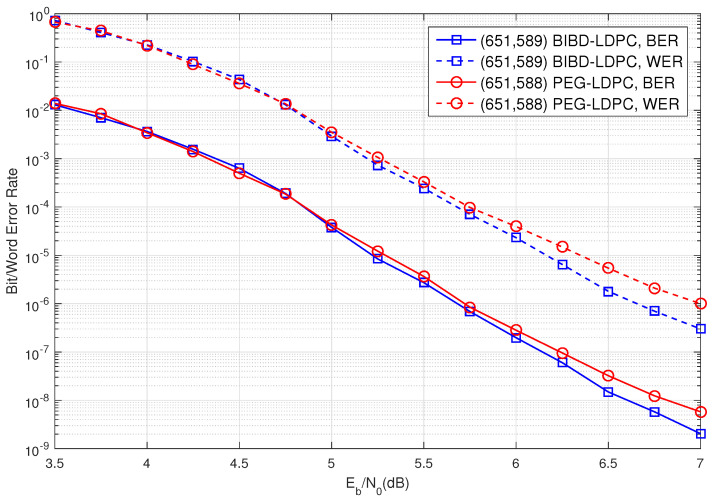 Figure 1
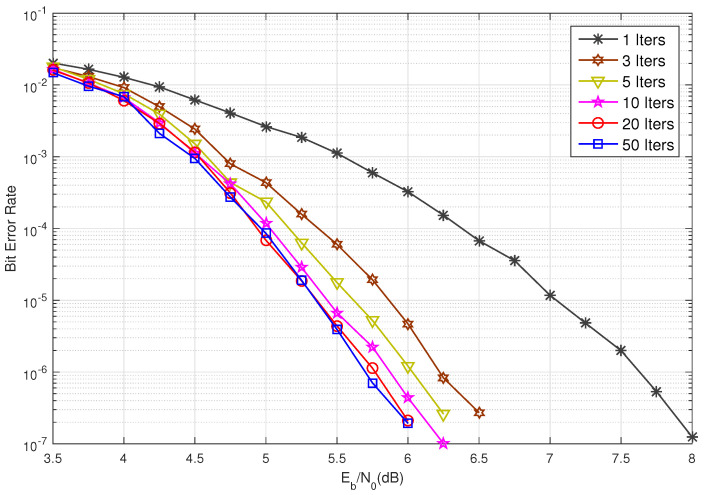 Figure 2
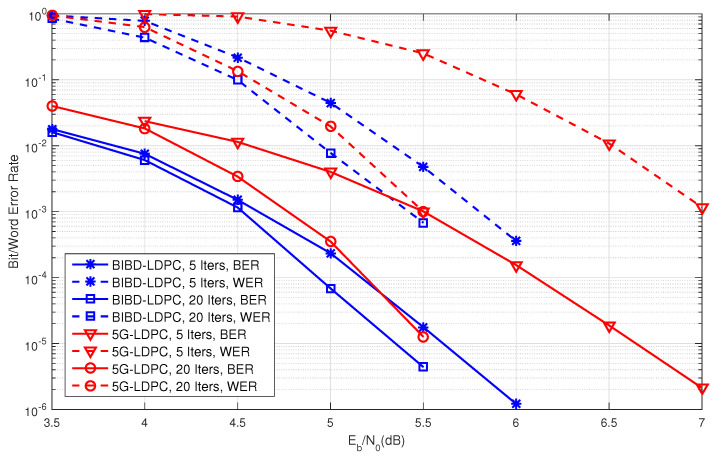 Figure 3
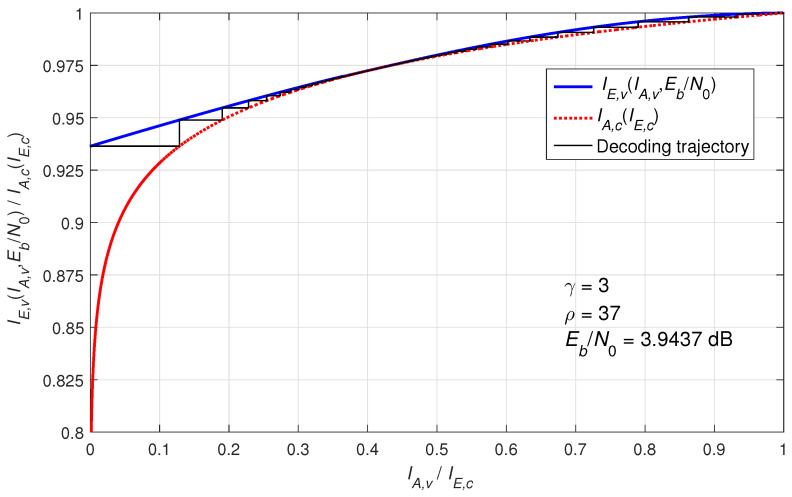 Figure 4
- —National Natural Science Foundation of China
- —TianYuan Special Funds of the National Natural Science Foundation of China
- —Development Project of Henan Provincial Department of Science and Technology
- —Key Scientific Research Project in Colleges and Universities of Henan Province
Peer Reviews
No public reviews on file for this paper yet. If you reviewed it on a platform where reviews are public (OpenReview, ICLR, NeurIPS, ICML), you can paste yours below so the community can read it here.
Videos
No videos yet. Explain this paper in a talk, walkthrough, or lecture? Add one.
Taxonomy
TopicsError Correcting Code Techniques · DNA and Biological Computing · Advanced Wireless Communication Techniques
1. Introduction
Low-density parity-check (LDPC) codes exhibit remarkable performance within the framework of iterative decoding. Several structural properties of LDPC codes significantly influence their iterative decoding performance, including their minimum distance, row redundancy, and degree distribution of their parity-check matrices, as well as the girth and cycle distribution of their Tanner graphs [1], among others. For an LDPC code, the iterative decoder, which operates based on belief propagation, functions on its Tanner graph. The presence of cycles causes the decoder to operate locally until a solution is found or the termination condition is met. In other words, the decoding solution is derived primarily around cycles, particularly short cycles, which prevents the decoder from achieving globally optimal solutions. Consequently, iterative decoders operating on Tanner graphs with short cycles are unable to identify maximum-likelihood (ML) code words [2]. As a result, cycles, especially short ones, adversely affect the decoding performance of LDPC codes when decoded using iterative algorithms. This makes the study of cycle distribution in LDPC codes a topic of significant interest [3].
Numerous effective algorithms have been developed for the counting of cycles in LDPC codes (or their Tanner graphs). In bipartite graphs, cycles of lengths and were enumerated in [4], where g represents the girth of the graph. However, the computational complexity of these methods increases rapidly with the number of variable nodes. Several alternative approaches have been proposed based on graph properties such as eigenvalues, degree distribution, and spectrum [5,6,7,8]. Additionally, leveraging message-passing algorithms, two competitive methods were presented in [9,10]. Nevertheless, for the methods described in [5,6,7,8,9,10], the lengths of the counted cycles do not exceed , where g is the girth of the LDPC code. Furthermore, necessary and sufficient conditions for the existence of cycles in quasi-cyclic LDPC (QC-LDPC) codes have been established in [11,12,13,14], along with corresponding cycle-counting algorithms. Determining the number of cycles in the Tanner graphs of well-designed LDPC codes based on design rules or structural properties remains a topic of significant interest.
Complementary to these, random-like constructions with carefully designed cycle-avoidance rules have also been developed [15,16,17]. A unifying framework emerges through partial geometries, which provides a geometric perspective for the analysis of code structures [18]. This approach has proven particularly valuable, as partial geometry-based LDPC codes demonstrate exceptional iterative decoding performance [19,20]. Notably, balanced incomplete block designs (BIBDs) constitute an important subclass of partial geometries [21], making them particularly attractive for code construction.
The design of LDPC codes with large girth and a minimal number of short cycles has been approached through various mathematical frameworks. Algebraic constructions utilizing finite fields [22], finite geometries [23], Sidon sequences [24], protographs [25], and transversal designs [26] have shown promising results. Additionally, random-like LDPC codes designed under specific rules (e.g., avoiding or eliminating short cycles) have also been proposed [15,16,17]. Connections among algebraically constructed LDPC codes were explored in [27]. Notably, a well-known general framework called partial geometries was introduced, under which many existing LDPC code constructions can be unified [18]. By leveraging the concept of partial geometries, key structural properties of LDPC codes and their parity-check matrices can be analyzed from a geometric perspective. Research has demonstrated that LDPC codes constructed based on partial geometries exhibit excellent performance under iterative decoding [19,20]. Notably, BIBDs constitute an important subclass of partial geometries [21], making them particularly attractive for code construction. Consequently, the use of BIBDs to construct high-performance LDPC codes has become a topic of significant interest in coding theory [28,29,30,31,32,33]. It is worth noting that the construction methods for some BIBDs were detailed in [34].
In this paper, we investigate LDPC codes constructed based on balanced incomplete block designs (BIBDs). By analyzing the cycle structure, we aim to understand how the design parameters of BIBDs, such as block size and the number of points, affect the presence and distribution of short cycles, which are critical factors in determining the performance of LDPC codes under belief propagation decoding. Unlike previous works reported in [28,29,30,31,32,33], we utilize the complete structure of a BIBD to design LDPC codes. Specifically, given a BIBD, the constructed LDPC code exhibits well-defined parameters, such as code length, row weight, and column weight the parity-check matrix. Moreover, we establish the incidence relationship between points and blocks in a BIBD and analyze the cycle structure within the Tanner graphs of the resulting LDPC codes. Based on this analysis, we propose a systematic method for counting cycles and determine the exact number of cycles of lengths 6 and 8 in the Tanner graphs. Finally, we provide numerical simulation results to demonstrate the performance of the constructed LDPC codes based on BIBDs.
The main contributions of this paper are outlined as follows.
- Novel structured construction: We present a systematic framework for constructing LDPC codes using complete BIBDs. The proposed method generates parity-check matrices with guaranteed structural properties that satisfy the row–column (RC) constraints, extending the partial geometry approach established in [18]. The construction method provides a mathematically rigorous yet practically viable coding solution that bridges the gap between theoretical design and communication requirements. This makes it particularly attractive for applications demanding both excellent error correction capability and implementation feasibility.
- Girth guarantees and performance analysis: We provide a rigorous proof that the BIBD-LDPC codes achieve a minimum girth of 6, effectively eliminating detrimental short cycles that impair iterative decoding. The inherent properties of BIBDs, including balanced connectivity and optimized cycle structure, naturally prevent small trapping sets and low-weight code words, thereby enhancing both waterfall-region performance and error-floor characteristics.
- Comprehensive cycle analysis: We develop a systematic methodology for analyzing the cycle structure of the constructed codes. The proposed technique enables precise enumeration of cycles (particularly lengths 6 and 8) in the Tanner graphs, with a generalizable framework that can be extended to count longer cycles (e.g., 10, 12, etc.). This analysis provides valuable insights into the code’s graphical properties and decoding behavior.
2. LDPC Codes Constructed from BIBDs and Their Tanner Graphs
2.1. LDPC Codes and Tanner Graphs
An LDPC code is defined by the null space of a sparse matrix ( ), known as a parity-check matrix. If every row of contains nonzero elements and every column of contains nonzero elements, the resulting LDPC code is referred to as -regular. The Tanner graph of an LDPC code is a bipartite graph, where the two types of vertices correspond to the row indices and column indices of , respectively. An edge connects the row index (i) and the column index (j) if and only if element of is nonzero. A cycle in the Tanner graph is a closed path of interconnected edges that starts and ends at the same edge, traversing no other edge more than once. The length of the shortest cycles in the Tanner graph of an LDPC code is known as its girth.
2.2. Balanced Incomplete Block Designs (BIBDs)
Let be a finite set of points and be a collection of subsets of , where the elements of are referred to as blocks. The number of elements in is denoted by , i.e., . Let the number of blocks in be m, and let K denote the set of possible sizes for the blocks. Specifically, each block in contains a number of elements that belong to K. This means that the size of any block in is one of the values in set K, i.e., for . A BIBD is an incidence structure defined by pair , which satisfies the following properties:
- (1)Each block in contains exactly points for .
- (2)Every pair of distinct points in is contained in exactly blocks.
This incidence structure is denoted by BIBD . For , BIBD is denoted by BIBD for short. In combinatorial design theory, BIBD is also referred to as the Steiner 2 design. These properties ensure a balanced and structured relationship between the points and blocks, making balanced incomplete block designs (BIBDs) a cornerstone of combinatorial design theory. Their well-defined and symmetric structure is particularly valuable in the construction of LDPC codes, where BIBDs are employed to achieve desirable properties such as large girth and controlled cycle distributions in Tanner graphs. This makes BIBDs a powerful tool for designing LDPC codes with enhanced iterative decoding performance.
2.3. LDPC Codes Constructed Based on BIBDs
Consider a BIBD , where the number of blocks in is m. The points and blocks in BIBD are represented as and , respectively, that is, and . Algebraically, BIBD can be represented by an incidence matrix ( ) of size , whose elements are either 0 or 1. The rows of correspond to the points of the BIBD, labeled from 1 to (or, equivalently, ), and the columns correspond to the blocks, labeled from 1 to m (or, equivalently, ). Element equals 1 (i.e., = 1) if and only if the i-th point ( ) is contained in the j-th block ( ); otherwise, . In this paper, the incidence matrix of a BIBD is used as the parity-check matrix, and its null space defines an LDPC code, referred to as the BIBD-LDPC code. This approach leverages the combinatorial properties of BIBDs to construct LDPC codes with desirable structural characteristics.
To facilitate the understanding of BIBDs, an example is provided. Consider a BIBD . Here, the number of elements in each block is 3, and the cardinality of point set is 7. Without loss of generality, let the point set be and the block set be . A straightforward counting argument confirms that the incidence structure satisfies the properties of a BIBD . Consequently, the incidence matrix ( ) of size is constructed as follows:
where each row corresponds to a point in and each column corresponds to a block in . Element is 1 if the i-th point is included in the j-th block; otherwise, it is 0. It can be observed that the rank of the incidence matrix ( ) is 4. Consequently, the null space of defines a -regular LDPC code. This code is characterized by a code length of 7, a dimension of 3, and a parity-check matrix with uniform row and column weights of 3.
To avoid generating cycles of length 4, a well-known row–column (RC) constraint can be applied to the parity-check matrix. Specifically, no two rows (or two columns) in the parity-check matrix should have more than one position in common. Therefore, for BIBD-LDPC codes to be free of cycles of length 4, it is necessary to ensure that any two points do not appear together in more than one block or, equivalently, any two blocks share, at most, one common point. This condition requires that the parameter equal 1. Additionally, the column weights of the parity-check matrix take values from set K. To ensure that the BIBD-LDPC code has a fixed column weight, we set . Consequently, in the remainder of this paper, the discussed BIBD-LDPC codes are constructed from BIBD .
According to the structural properties of BIBD , the code length of the constructed BIBD-LDPC code is given by
The incidence matrix of BIBD has a column weight of and a row weight of . The rank of the incidence matrix depends on the specific structure of the BIBD. Numerical results show that the parity-check matrices of BIBD-LDPC codes typically have full (or nearly full) rank. Therefore, the code rate (R) of a BIBD-LDPC code constructed from BIBD is at least
3. Girth and Cycle Structure Analysis of BIBD-LDPC Codes
We now consider a BIBD-LDPC code whose parity-check matrix is the incidence matrix ( ) of a given BIBD . In this section, we analyze the cycle structure of BIBD-LDPC codes, determine their girth, and present a method for counting cycles in their Tanner graphs. Specifically, We investigate how the combinatorial properties of BIBDs influence the cycle distribution in the Tanner graphs of these codes, potentially providing valuable insights into their iterative decoding performance.
3.1. Cycle Structure of BIBD-LDPC Codes
According to the definition of cycles in the Tanner graph [1,11], a cycle in the BIBD-LDPC code can be represented as an ordered sequence of positions of alternate nonzero elements in the parity-check matrix. Based on the structure of the incidence matrix of BIBD , a cycle of length in the Tanner graph of the BIBD-LDPC code can be expressed as the following sequence:
where for and . are distinct points in , and are distinct blocks in . Each consecutive pair ( and , where = and = ) corresponds to a nonzero entry in the incidence matrix ( ), ensuring the cycle is closed. This sequence represents a closed path in the Tanner graph, where each point ( ) is connected to block and each block ( ) is connected to the next point ( ), forming a cycle of length .
In other words, the adjacent points (or blocks) in the sequence (1) are distinct from one another. Additionally, each block in (1) contains its two adjacent points, and each point in (1) is included in its two adjacent blocks. For a BIBD , any pair of points in is contained in exactly one block. Consequently, for two points adjacent to the same block in (1), no other block contains both of them. Therefore, the point-and-block sequence (1) can be simplified and represented by the following point sequence:
where for , that is, a cycle of length can be fully represented by the point sequence (2), making it unnecessary to explicitly consider the blocks in the cycle. Therefore, a cycle of length corresponds uniquely to an ordered point sequence of the following form:
where are distinct points in and each consecutive pair ( , where ) is contained in exactly one block ( ). This representation simplifies the analysis of cycles by focusing solely on the point sequence, leveraging the property of BIBD according to which each pair of points appears in exactly one block. As a result, the cycle structure is entirely determined by the arrangement of points, eliminating the need to explicitly track the blocks in the cycle.
3.2. Girth of BIBD-LDPC Codes
Based on the above analysis, we observe that BIBD-LDPC codes are constructed from the BIBD incidence structure, which is , that is, . Hence, the parity-check matrices of these BIBD-LDPC codes satisfy the row–column (RC) constraint. This ensures that the constructed BIBD-LDPC codes are free of cycles of length 4 and, consequently, have a girth of at least 6. In fact, the girth of these BIBD-LDPC codes is exactly 6. To further determine the girth of BIBD-LDPC codes, we aim to identify a cycle of length 6 in the Tanner graph of a BIBD-LDPC code, and such a cycle corresponds to the point-and-block sequence described in (1). This sequence represents a closed path of length 6 in the Tanner graph, confirming the presence of cycles of length 6 in the BIBD-LDPC code.
Consider two distinct points ( ). According to the definition of BIBD , there exists a unique block ( ) that contains both and . Since is a proper subset of , there exists a point ( ) such that . Consequently, is distinct from and . According to the properties of BIBD , there exists a unique block ( ) that contains both and . It is clear that and are distinct blocks because but . Similarly, based on points and , there exists a unique block ( ) that contains both and . Since (while ) and (while ), is distinct from both and . Thus, blocks , and are all distinct. This leads to the following point-and-block sequence:
which forms a cycle of length 6 in the Tanner graph of the BIBD-LDPC code. This sequence satisfies the conditions for a cycle, as each consecutive pair of points and blocks corresponds to a nonzero entry in the incidence matrix, and the sequence is closed. Hence, this point-and-block sequence represents a closed path of length 6 in the Tanner graph, confirming the presence of cycles of length 6 in the BIBD-LDPC code. In the following, we explore methods to systematically identify and count such cycles.
It is evident that the point-and-block sequence described above can be simplified to the point sequence expressed as . Without loss of generality, any three distinct points selected from the point set ( ) can form a similar point-and-block sequence as in (1). Consequently, there exist numerous cycles of length 6 in the Tanner graphs of BIBD-LDPC codes. This confirms that the girth of BIBD-LDPC codes constructed from BIBD is 6.
3.3. A Method for Counting Short Cycles of BIBD-LDPC Codes
Since the girth of BIBD-LDPC codes is 6, we focus on analyzing cycles of length in the Tanner graph of a BIBD-LDPC code for . Based on the cycle analysis in the preceding subsections, it is clear that the existence of cycles of length is closely tied to the point-and-block sequence described in (1) or, equivalently, the point sequence in (2). These sequences provide a systematic way to identify and characterize cycles in the Tanner graph, enabling a deeper understanding of the cycle structure and its impact on the performance of BIBD-LDPC codes.
According to the theory of quasi-cyclic LDPC (QC-LDPC) codes with a girth of g, Equation (4) in [11] provides the necessary and sufficient condition for the existence of cycles of length for [35]. Therefore, for the constructed BIBD-LDPC codes, the sequence (2) precisely represents cycles of length for . From (2), it follows that identifying cycles of length is equivalent to finding i points in such that any t adjacent points in these i points do not lie in the same block for . Consequently, determining the number of cycles of length can be formulated as a combinatorial problem. It is important to note that for , the existence of cycles of length depends on the presence of cycles of length j for , such as cycles of length 6. The analysis of these longer cycles involves more complex sequences derived from (2). In the following, we focus on cycles of length in the Tanner graph of BIBD-LDPC codes, which can be divided into three parts:
- Selection of i points from : The number of ways to choose i distinct points from the points in is given by the combination formula expressed as
This quantity is denoted by .
- Exclusion of invalid cases: Among the chosen i points, some cases must be excluded where any t adjacent points (for ) lie in the same block. These cases require a detailed combinatorial analysis, and the number of such invalid cases is denoted by .
- Counting valid cycles of length : For the remaining valid selections of i points, the number of cycles of length that can be formed is denoted by . This involves determining how many distinct cycles of length exist for each valid set of i points. This is analogous to the circle permutation problem but without considering the order of permutation. A simple counting argument shows that
This formula accounts for the number of distinct cycles that can be formed from i points, treating rotations and reflections as identical.
Based on the above analysis, the total number of cycles of length in the Tanner graph of a BIBD-LDPC code is given by
Since and can be directly calculated using the corresponding formulas based on the parameters of the BIBD, our focus shifts to determining , which represents the number of invalid cases where t adjacent points (for ) lie in the same block. Once is computed, the number of cycles of length can be determined for specific values of i. In the following, we apply the proposed cycle-counting method to calculate the number of cycles of lengths 6 and 8 in the Tanner graph of the BIBD-LDPC code constructed from BIBD . It is noted that parameters and are consistently used in the following two subsections to maintain a unified framework for counting cycles of different lengths in the Tanner graphs of BIBD-LDPC codes.
3.3.1. Number of Cycles of Length 6
In this case, we only consider , and parameter t takes only one value, namely 3. Therefore, for the cases of , the only scenario to consider is when three points chosen from lie in the same block. In other words, we calculate the number of cases where any three points of are contained within a single block. For any block in with , the number of ways to choose three points from the block is given by
Since the total number of blocks in the BIBD is
the total number of invalid cases ( ) is
Additionally, the values of and are calculated as follows:
and
Combining and , the exact number of cycles of length 6 ( ) is
After a simple verification, it can be observed that even for , the number of cycles of length 6 remains consistent with the expression for in (3). Specifically, substituting into the formula expressed as
yields
This result aligns with the combinatorial interpretation, as the case of inherently prevents the formation of cycles of length 6 due to the inability to have three points in a single block. Thus, the formula remains valid for , confirming its generality.
3.3.2. Number of Cycles of Length 8
In this case, , and we first assume . The t parameter takes two values: 3 and 4. Therefore, cases of can be partitioned into two distinct categories: (a) all four points in the same block ( ) and (b) three points in the same block and one point in a different block ( ).
The first class of cases of is that all four points are in the same block ( ). This corresponds to the scenario where any four points of lie in the same block. The number of such cases, denoted by , is calculated as follows:
- (1)For each block, the number of ways to choose four points is expressed as
- (2)The total number of blocks in the BIBD is expressed as
- (3)Thus, the total number of cases where four points lie in the same block is expressed as
The second class of cases of is occurs when three points lie in the same block and one point is in a different block ( ). This corresponds to the scenario where any three of the four points lie in the same block and the fourth point lies in a different block. The number of such cases, denoted by , is calculated as follows:
- (1)For each block, the number of ways to choose three points is expressed as
- (2)The fourth point must be chosen from the remaining points (since it cannot be in the same block as the first three points).
- (3)The total number of blocks in the BIBD is
- (4)Thus, the total number of cases where three points lie in the same block and the fourth point lies in a different block is expressed as
Combining these two cases, the total number of invalid cases ( ) is
Since
and
the number of cycles of length 8 is expressed as
where .
When , it is evident that the cases of (where all four points lie in the same block) cannot occur, since each block contains only three points. Therefore, . For , the number of cycles of length is determined solely by the second cases of , where three points lie in the same block and the fourth point lies in a different block. Substituting into the expression for , we have
Since , the total number of invalid cases ( ) is
Hence, the number of cycles of length 8 ( ) for is
When , the block size is too small to accommodate the conditions required for two classes of cases of . Specifically, the first class of cases requires four points to lie in the same block, which is impossible, since , and the second class of cases requires three points to lie in the same block, which is also impossible, since . Thus, both and are zero, and the total number of invalid cases ( ) is
Hence, the number of cycles of length 8 for is
Based on the above analysis, it can be observed that for and , the number of cycles of length 8 is consistent with the expression for derived in (4) with . Thus, the general expression for in (4) remains valid for and , demonstrating its generality across different block sizes. This confirms that the cycle-counting method is robust and applicable to a wide range of BIBD-LDPC codes.
4. Short Cycles of Specific BIBD-LDPC Codes
In this section, we provide specific examples of BIBD-LDPC codes and determine their short-cycle distributions. By applying the cycle-counting method developed in the previous sections, we calculate the number of cycles of lengths 6 and 8 for these codes. This analysis highlights the relationship between the parameters of the BIBD (e.g., ) and the cycle structure of the resulting LDPC codes.
First, we provide some important parameters of BIBD-LDPC codes. Based on a BIBD , we can construct a BIBD-LDPC code of length , the parity-check matrix of which has a column weight of and a row weight of . The code rate is about . The detailed parameters of the BIBD-LDPC codes are presented in Table 1. Second, we provide some existing BIBDs. For convenience, we do not introduce the construction of the existing BIBDs and only provide their existence conditions. We summarize some existing BIBDs in Theorem 1.
Theorem 1. A BIBD exists for κ = 3, 4, 5, 6, and 7 if one of the following conditions is satisfied.
- (1) If or , there exists a BIBD .
- (2) If or , there exists a BIBD .
- (3) If or , there exists a BIBD .
- (4) If or for 16, 21, 36, 46, 51, 61, 81, 166, 226, 231, 256, 261, 286, 316, 321, 346, 351, 376, 406, 411, 436, 441, 471, 501, 561, 591, 616, 646, 651, 676, 771, 796, and 801, there exists a BIBD .
- (5) If for 1, 2, 3, 5, 6, 12, 14, 17, 19, 22, 27, 33, 37, 39, 42, 47, 59, and 62 or for 3, 19, 34, and 39, there exists a BIBD .
Based on the cycle-number equations derived in Section 3.3, we can directly determine the number of short cycles in BIBD-LDPC codes constructed from a BIBD . By applying Theorem 1, we can obtain a BIBD and subsequently construct a BIBD-LDPC code. Using this approach, the number of short cycles in the Tanner graphs of the constructed BIBD-LDPC codes can be accurately counted. These results are recorded in Table 2.
Notably, the proposed cycle-counting method achieves complexity, as the enumeration of cycles of lengths 6 and 8 reduces to closed-form expressions parameterized by . This contrasts sharply with existing approaches that require greater computational complexity. For instance, counting cycles with a length of 6 in a BIBD-LDPC code constructed from BIBD using the competitive message-passing algorithm proposed in [10] incurs complexity of , whereas our method requires only two subtractions, three multiplications, and one division operation.
5. Simulation Results
In the following simulations, we assume an additive white Gaussian noise (AWGN) channel, binary phase-shift keying (BPSK) modulation, and the sum-product algorithm (SPA) with 50 iterations for decoding.
Consider BIBD . This design consists of 63 points and 651 blocks. Using its incidence matrix, we construct a (3,31)-regular (651,589) BIBD-LDPC code. The bit-error rate (BER) and word-error rate (WER) of this code, decoded using the sum-product algorithm (SPA), are illustrated in Figure 1. For comparison, we also construct a (3,31)-regular (651,588) LDPC code based on the progressive edge-growth (PEG) algorithm [16], referred to as the PEG-LDPC code. The BER/WER performance of this PEG-LDPC code is also included in Figure 1. From Figure 1, it is evident that the (651,589) BIBD-LDPC code outperforms the (651,588) PEG-LDPC code by approximately 0.3 dB at a WER of . Additionally, the BIBD-LDPC code exhibits no error floor down to a BER of . Notably, the (3,31)-regular (651,589) BIBD-LDPC code contains 39,060 cycles of length 6 and 1,669,815 cycles of length 8.
Consider BIBD . This design consists of 75 points and 925 blocks. The null space of the incidence matrix of this BIBD yields a (3,37)-regular (925,851) BIBD-LDPC code. The BER performance of this code under iterative decoding using the sum-product algorithm (SPA) with 1, 3, 5, 10, 20, and 50 iterations is depicted in Figure 2. As shown in Figure 2, the iterative decoding of this code converges very quickly. The BER performance curves for 20 and 50 iterations are nearly identical, indicating convergence. At a BER of , the performance gap between 5 and 50 iterations is only 0.25 dB, while the gap between 10 and 50 iterations is approximately 0.1 dB. Furthermore, this BIBD-LDPC code exhibits a low error floor, as demonstrated in Figure 2. For the (3,37)-regular (925,851) BIBD-LDPC code, the numbers of cycles of lengths 6 and 8 are 66,600 and 3,446,550, respectively. For performance benchmarking, we compare the constructed (3,37)-regular (925,851) BIBD-LDPC code against the standard (651,589) 5G-LDPC code specified in [36]. Figure 3 presents the BER/WER performance under SPA decoding with both 5 and 20 iterations. It can be seen from Figure 3 that the constructed BIBD-LDPC code achieves approximately 0.2 dB coding gain at a BER of with 20 decoding iterations compared to the 5G-LDPC code, and the performance advantage becomes more pronounced (about 1 dB gain at BER ) when using only 5 iterations. These comparative results validate that the proposed BIBD construction maintains performance with competitive with modern 5G standards while offering faster convergence, a critical advantage for latency-sensitive applications.
To evaluate the performance of our proposed BIBD-LDPC codes, we employ extrinsic information transfer (EXIT) chart analysis to examine their convergence behavior [37]. Figure 4 illustrates a typical EXIT chart for regular LDPC codes operating over a binary-input AWGN channel with parameters of and . The EXIT chart utilizes extrinsic mutual information as its key metric, comprising two characteristic curves: (1) The upper solid blue curve ( vs. ) represents the variable-node processors (VNPs), showing the output extrinsic mutual information ( ) as a function of input a priori information ( ). (2) The lower dashed red curve ( vs. ) characterizes the check-node processors (CNPs), depicting output extrinsic mutual information ( ) versus input a priori information ( ). (Note that this curve is conventionally plotted with reversed axes for EXIT chart representation.) The iterative decoding process manifests as a trajectory bouncing between these curves, where extrinsic information from VNPs becomes a priori information for CNPs and vice-versa. Beginning at the (0,0) point (complete uncertainty), successful decoding is achieved when the trajectory converges to (1,1) (perfect information transfer and error-free decoding). This graphical representation vividly demonstrates the information exchange dynamics between VNPs and CNPs. The widening “tunnel” between the curves at higher SNR values accelerates decoder convergence. The shown SNR (slightly above 3.9437 dB) represents the decoding threshold for the (3,37) code ensemble. Below this critical threshold, the tunnel closes, preventing the trajectory from reaching the (1,1) point and resulting in nonzero error rates.
6. Conclusions
In this paper, we proposed a method for constructing LDPC codes based on a BIBD . We analyzed the cycle structure of the constructed LDPC codes and determined their girth. Numerical results show that the constructed LDPC codes exhibit excellent performance under iterative decoding. Furthermore, we presented a method for counting cycles in the Tanner graphs of these codes, specifically enumerating cycles of lengths 6 and 8. This method can be extended to systematically count cycles of lengths greater than 8 (e.g., 10, 12, etc.). However, the complexity of the analysis increases significantly with the cycle length, primarily due to the need to account for the presence of existing shorter cycles (such as those of lengths 6 and 8) and their interactions within the Tanner graph.
The reference list from the paper itself. Each links out to its DOI / PubMed record.
- 1Tanner R.M. A recursive approach to low complexity codes IEEE Trans. Inf. Theory 19812753354710.1109/TIT.1981.1056404 · doi ↗
- 2Li J. Lin S. Abdel-Ghaffar K. Ryan W.E. Costello D.J.Jr. LDPC Code Designs, Constructions, and Unification Cambridge University Press New York, NY, USA 2017
- 3Blake I.F. Lin S. On short cycle enumeration in biregular bipartite graphs IEEE Trans. Inf. Theory 2018646526653510.1109/TIT.2017.2784839 · doi ↗
- 4Halford T. Chugg K. An algorithm for counting short cycles in bipartite graphs IEEE Trans. Inf. Theory 20065228729210.1109/TIT.2005.860472 · doi ↗
- 5Karimi M. Banihashemi A.H. Counting Short Cycles of Quasi Cyclic Protograph LDPC Codes IEEE Commun. Lett.20121640040310.1109/LCOMM.2012.020212.112311 · doi ↗
- 6Dehghan A. Banihashemi A.H. On Computing the Multiplicity of Cycles in Bipartite Graphs Using the Degree Distribution and the Spectrum of the Graph IEEE Trans. Inf. Theory 2019653778378910.1109/TIT.2019.2895356 · doi ↗
- 7Dehghan A. Banihashemi A.H. Counting Short Cycles in Bipartite Graphs: A Fast Technique/Algorithm and a Hardness Result IEEE Trans. Commun.2020681378139010.1109/TCOMM.2019.2962397 · doi ↗
- 8Dehghan A. Banihashemi A.H. On Computing the Number of Short Cycles in Bipartite Graphs Using the Spectrum of the Directed Edge Matrix IEEE Trans. Inf. Theory 2020666037604710.1109/TIT.2020.3011556 · doi ↗