Successful preoperative esophageal cleansing for achalasia with esophageal dilatation using the drainage method and gel immersion
Satoshi Abiko, Haruhiro Inoue, Kei Ushikubo, Kazuki Yamamoto, Yohei Nishikawa, Ippei Tanaka, Naoya Sakamoto

Abstract
Genes, proteins, chemicals, diseases, species, mutations and cell lines named across the full text — each resolved to its canonical identifier and authoritative record.
Click any figure to enlarge with its caption.
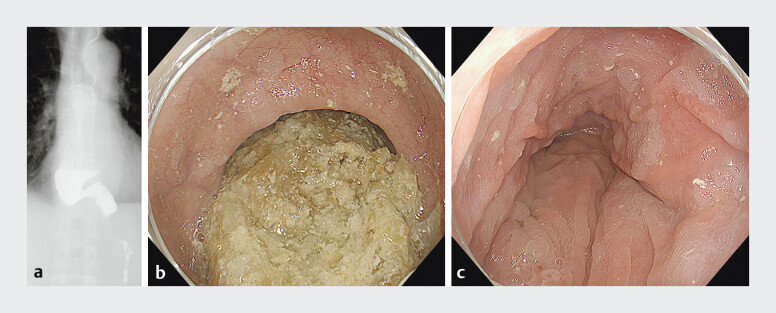 Fig. 1
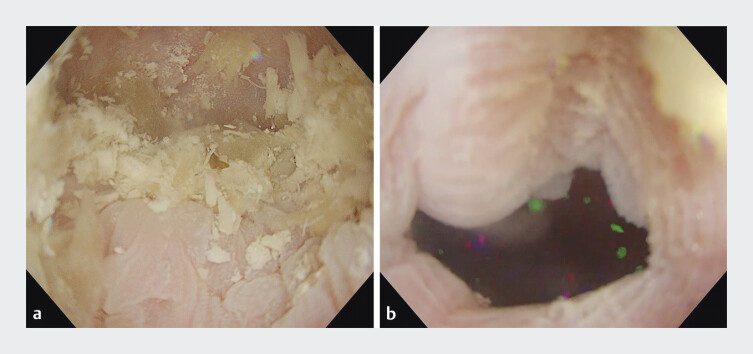 Fig. 2
Peer Reviews
No public reviews on file for this paper yet. If you reviewed it on a platform where reviews are public (OpenReview, ICLR, NeurIPS, ICML), you can paste yours below so the community can read it here.
Videos
No videos yet. Explain this paper in a talk, walkthrough, or lecture? Add one.
Taxonomy
TopicsEsophageal and GI Pathology · Gastroesophageal reflux and treatments · Esophageal Cancer Research and Treatment
During preoperative esophageal cleansing for achalasia with esophageal dilatation, passing through the esophagogastric junction (EGJ) and maintaining the lower esophageal sphincter in an open position is a critical step to facilitate the drainage of large amounts of food residue into the stomach. This residue is often too voluminous to be aspirated directly. We have named this technique the drainage method. However, the presence of a large amount of food residue may obscure the endoscopic field, making EGJ passage difficult and increasing the risk of serious complications such as esophageal perforation or aspiration pneumonia.
Gel immersion using a transparent gel (VISCOCLEAR; Otsuka Pharmaceutical Factory, Inc., Tokushima, Japan) has been proposed as an effective approach to enhance endoscopic visualization 1 2 3 . We describe a case of successful preoperative esophageal cleansing for achalasia with esophageal dilatation using a combination of the drainage method and gel immersion ( Video 1 ).
Demonstration of preoperative esophageal cleansing for achalasia with esophageal dilatation using the drainage method combined with gel immersion in a 72-year-old man.Video 1
The procedure was performed in a 72-year-old man with achalasia and marked esophageal dilatation ( Fig. 1 a ). To prevent aspiration pneumonia, the procedure began with the patient’s head elevated at approximately 70°. Initial suctioning of the food residue was attempted but proved unsuccessful due to the amount of the material. As a result, the drainage method was attempted ( Fig. 1 b ). Efforts to reach the EGJ while maintaining visibility using water were hindered by the large volume of food residue. To improve visualization, gel was introduced, which successfully clarified the endoscopic view ( Fig. 2 a ) and allowed identification of the EGJ ( Fig. 2 b ). After traversing the EGJ, the lower esophageal sphincter was dilated, and the procedure was continued in the esophagus. A combination of water and CO₂ insufflation was then used to promote further drainage of the food residue into the stomach. The esophageal cleansing procedure was successfully completed ( Fig. 1 c ).
Barium examination performed before and after preoperative esophageal cleansing for achalasia with esophageal dilatation using the drainage method and gel immersion. a Barium examination in a patient with achalasia and esophageal dilation. b Suctioning of food residue was attempted but proved unsuccessful due to the large volume and size of the residue; the drainage method was therefore employed. c Preoperative esophageal cleansing for achalasia with esophageal dilatation was successfully completed.
Drainage method with gel immersion. a Gel was used to achieve a clear endoscopic view. b The gastroesophageal junction was successfully identified.
Preoperative esophageal cleansing for achalasia with esophageal dilatation using the drainage method in conjunction with gel immersion may be an effective technique that may reduce the risk of severe complications.
Endoscopy_UCTN_Code_TTT_1AO_2AD
The reference list from the paper itself. Each links out to its DOI / PubMed record.
- 1Yano T Takezawa T Hashimoto K Gel immersion endoscopy: Innovation in securing the visual field – Clinical experience with 265 consecutive procedures Endosc Int Open 20219 E 1123 E 112734222638 10.1055/a-1400-8289 PMC 8216780 · doi ↗ · pubmed ↗
- 2Abiko S Hirata K Suzuki K Successful direct clipping of the bleeding source of a colonic diverticular hemorrhage using the “long-hood gel-filling” method Endoscopy 202355 E 606E 60737040887 10.1055/a-2048-6071 PMC 10089795 · doi ↗ · pubmed ↗
- 3Muramatsu T Fukuzawa M Mizumachi M Low-pressure self-expandable metal stent insertion for obstructive colon cancer using water and gel immersion Endoscopy 202456 E 888E 88910.1055/a-2433-057639414240 PMC 11485730 · doi ↗ · pubmed ↗