Successful bridging disconnected pancreatic duct syndrome complicated by plastic stent-induced bowel perforation
Guoming Zhang, Miaomiao Ma, Yi-Fan Wang, Ruiguang Ma, Haiou Li, Zhen Li, Ning Zhong

Abstract
Genes, proteins, chemicals, diseases, species, mutations and cell lines named across the full text — each resolved to its canonical identifier and authoritative record.
Click any figure to enlarge with its caption.
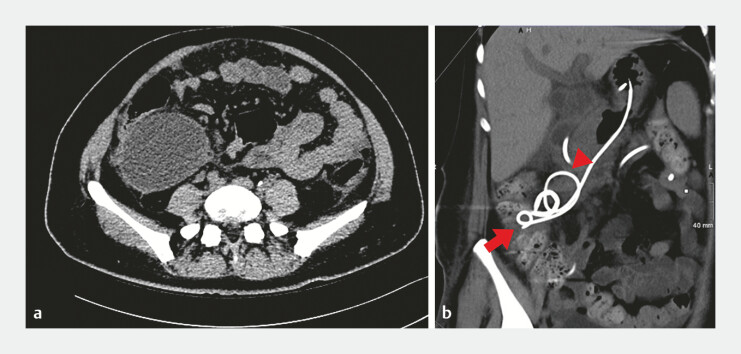 Fig. 1
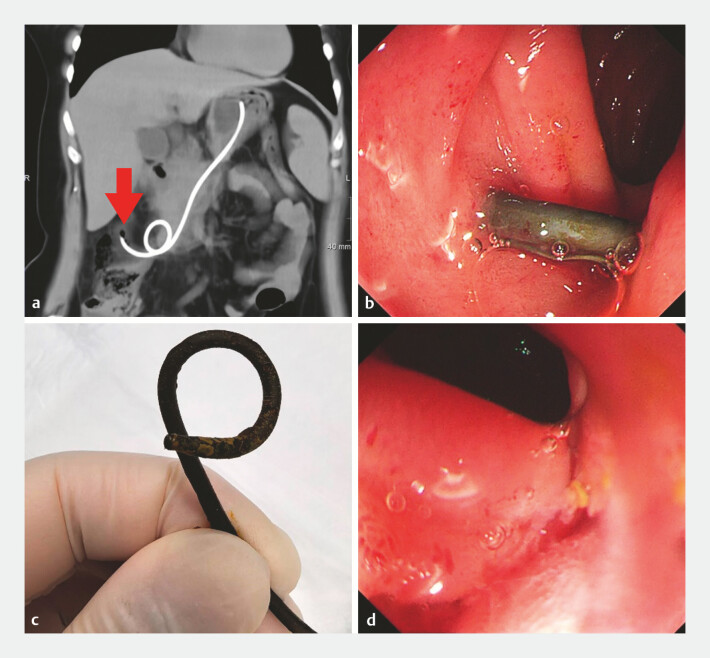 Fig. 2
- —The Shandong Provincial Key Research and Development Program
- —The Taishan Scholars Program of Shandong Province
Peer Reviews
No public reviews on file for this paper yet. If you reviewed it on a platform where reviews are public (OpenReview, ICLR, NeurIPS, ICML), you can paste yours below so the community can read it here.
Videos
No videos yet. Explain this paper in a talk, walkthrough, or lecture? Add one.
Taxonomy
TopicsPancreatitis Pathology and Treatment · Gastrointestinal disorders and treatments · Pediatric Hepatobiliary Diseases and Treatments
A 40-year-old woman with recurrent pancreatitis presented to our institution. She underwent seven endoscopic debridements of a pancreatic pseudocyst with necrosis after an EUS-guided drainage procedure. Since the infiltrates have migrated and encapsulated around the right para-colonic groove, a transnasal tube was inserted for drainage, and subsequently cut by endoscopic scissors to convert to internal gastric drainage, after which she was discharged without symptoms ( Fig. 1 ).
a Pancreatitis with pancreatic pseudocyst extension to the right lower pelvic cavity. b 3D reconstruction of the internal gastric drainage tube pigtail is intimately connected to the right hemicolon (arrow), and the retroflex segment is adjacent to the duodenum (Triangle).
Following an 8-month gap, she returned with recurrent abdominal pain. Computed tomography (CT) revealed that the stent's distal curved end had entered the colonic cavity. Furthermore, gastroscopy showed that part of the tube had perforated the duodenal wall. We extracted the tube successfully with foreign body forceps, noting its distal end was feces-adhered. Luckily, the duodenal mucosa only showed congestion without bleeding ( Fig. 2 ). Her symptoms were resolved, confirming the tube as the cause rather than suspected recurrent pancreatitis, and the colonic fistula healed spontaneously.
a 3D reconstruction of CT revealed the stent's distal curved end had entered the colonic cavity (arrow). b The drainage tube was seen to pass through the descending part of the duodenum. c Yellowish fecal attachment is seen at the distal end of the drainage tube (Pigtail end). d The duodenum showed mucosal congestion without bleeding. Abbreviation: CT, computed tomography.
Another 10 months later, she returned with abdominal pain again. EUS and endoscopic retrograde cholangiopancreatography (ERCP) confirmed disconnected pancreatic duct syndrome (DPDS). However, the guidewire could not pass through the disconnected pancreatic duct (DPD) even with the guidance of pancreatoscopy. Thus, we immediately performed EUS-guided pancreatic duct drainage (EUS-PD) and tried to maneuver the guidewire toward the duodenal side. Unfortunately, the guidewire kept rolling over and failed to bridge the two ends of the DPD. So, we left a 7Fr plastic drainage tube between the cyst and the gastric cavity. After 2 weeks, the cyst almost disappeared, and we successfully bridged the DPD via ERCP ( Video 1 ).
Long-term stent in place can cause duodenal perforations with colonic fistulas. Integrating EUS-guided pancreatic duct drainage before endoscopic retrograde cholangiopancreatography (ERCP) successfully bridged the disconnected pancreatic duct.Video 1
Previous data showed that long-term use of plastic stents effectively managed DPDS without severe adverse events 1 2 . However, this case alerts the potential risk of GI fistula and recurrence of DPDS-related symptoms. We provided a simple way to address such complications and ultimately successfully bridged the DPD.
Endoscopy_UCTN_Code_CPL_1AL_2AD
The reference list from the paper itself. Each links out to its DOI / PubMed record.
- 1Gkolfakis P Bourguignon A Arvanitakis M Indwelling double-pigtail plastic stents for treating disconnected pancreatic duct syndrome-associated peripancreatic fluid collections: long-term safety and efficacy Endoscopy 2021531141114910.1055/a-1319-509333225428 · doi ↗ · pubmed ↗
- 2Bang JY Wilcox CM Navaneethan U Impact of Disconnected Pancreatic Duct Syndrome on the Endoscopic Management of Pancreatic Fluid Collections Ann Surg 201826756156810.1097/sla.000000000000208227849658 · doi ↗ · pubmed ↗