Functional Microendoscopy Reveals Calcium Responses of Single Cells in Tracheal Tuft Cells and Kidney Podocytes
Tobias A. Dancker, Mohamed Ibrahem Elhawy, Ramona Rittershauß, Qinghai Tian, Yvonne Schwarz, Markus D. A. Hoffmann, Christopher Carlein, Amanda Wyatt, Vanessa Wahl, Daniel Speyerer, Alaa Kandah, Ulrich Boehm, Leticia Prates Roma, Dieter Bruns, Peter Lipp

TL;DR
A new microendoscope allows detailed imaging of single cells in hard-to-reach areas like the trachea and kidneys, capturing calcium and redox signals.
Contribution
A cost-effective, thin multicore-fiber microendoscope enables in vivo and in situ functional imaging of single cells with high resolution.
Findings
The microendoscope successfully captured calcium dynamics in murine tracheal tuft cells and kidney podocytes.
Ratiometric redox reactions were recorded in various biological settings, including explanted organs and pancreatic islet cultures.
The system achieved an effective resolution of 4.6 µm, resolving subcellular structures.
Abstract
Microendoscopy, a crucial technology for minimally invasive investigations of organs, facilitates studies within confined cavities. However, conventional microendoscopy is often limited by probe size and the constraint of using a single excitation wavelength. In response to these constraints, a multichannel microendoscope with a slender profile of only 360 µm is engineered. Functional signals both in situ and in vivo are successfully captured from individual single cells, employing a specially developed software suite for image processing, and exhibiting an effective resolution of 4.6 µm, allowing for the resolution of subcellular neuronal structures. This system enabled the first examination of calcium dynamics in vivo in murine tracheal tuft cells (formerly named brush cells) and in situ in kidney podocytes. Additionally, it recorded ratiometric redox reactions in various biological…
Genes, proteins, chemicals, diseases, species, mutations and cell lines named across the full text — each resolved to its canonical identifier and authoritative record.
Click any figure to enlarge with its caption.
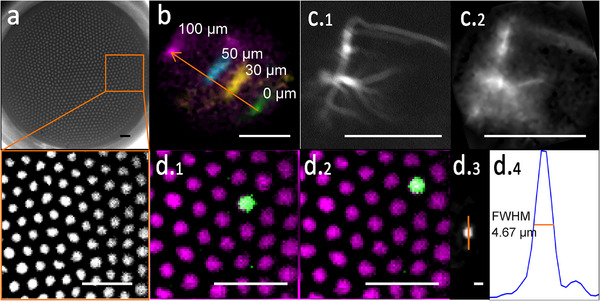 Figure 1
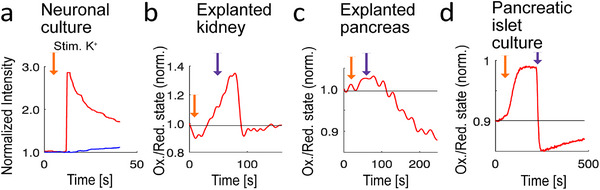 Figure 2
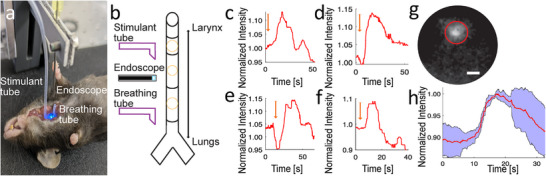 Figure 3
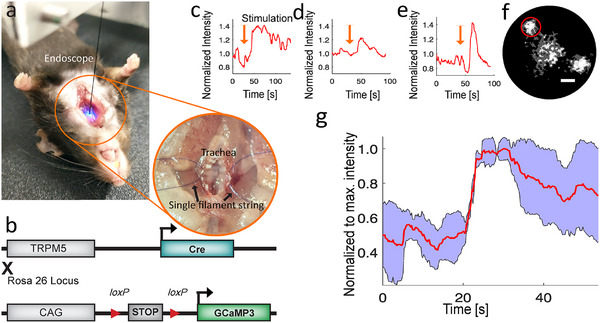 Figure 4
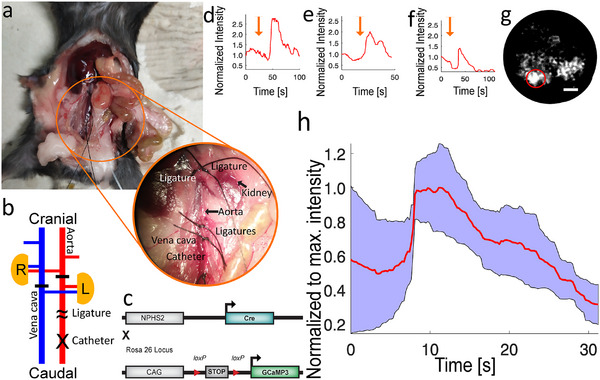 Figure 5
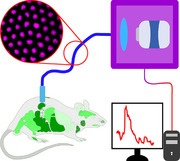 Figure 6
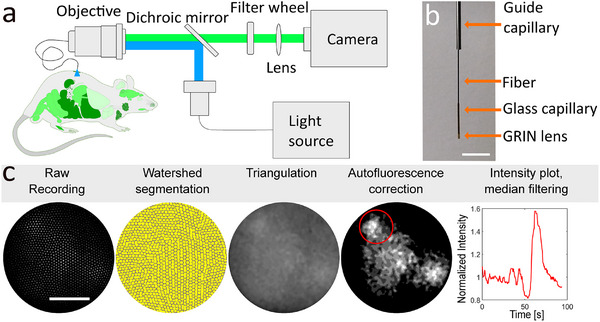 Figure 7
Peer Reviews
No public reviews on file for this paper yet. If you reviewed it on a platform where reviews are public (OpenReview, ICLR, NeurIPS, ICML), you can paste yours below so the community can read it here.
Videos
No videos yet. Explain this paper in a talk, walkthrough, or lecture? Add one.
Taxonomy
TopicsIon Transport and Channel Regulation · Pancreatic function and diabetes