Cost-effectiveness of massed versus spaced trauma-focused treatment as first-line treatment for post-traumatic stress disorder in adults with multiple trauma exposure: protocol for a single-blind non-inferiority randomised controlled trial
Bram Kemmere, Ytje T van Pelt, Miriam J J Lommen, Rafaele J C Huntjens, Miranda Olff, Mayaris Zepeda Méndez, Suzy Matthijssen, Leona Hakkaart-van Roijen, Mirjam J Nijdam, Foske Jackie June ter Heide

TL;DR
This study compares the effectiveness and cost of two PTSD treatments: one with frequent sessions and one with weekly sessions, focusing on patients with multiple traumas.
Contribution
The study introduces a novel protocol to evaluate massed trauma-focused treatment as a potential first-line alternative to spaced treatment for PTSD.
Findings
The study will assess clinical effectiveness and cost-effectiveness of massed versus spaced trauma-focused treatment.
Predictive and moderating factors related to treatment response will be identified.
Results will be shared with clinicians and the public to inform PTSD treatment practices.
Abstract
Post-traumatic stress disorder (PTSD) is a serious disorder that burdens individuals and society. The current standard of first-line treatment for PTSD is spaced trauma-focused treatment (S-TFT), involving weekly sessions. While effective, S-TFT may take relatively long to complete, especially in patients exposed to multiple potentially traumatic events (PTEs). Massed trauma-focused treatment (M-TFT), involving increased session frequency, potentially results in faster symptom reduction and restoration of quality of life, as well as in a reduction of societal costs. However, M-TFT is not recommended as first-line treatment. This paper describes the research protocol of a single-blind, multicentre randomised controlled trial (RCT) aimed at investigating: (1) the clinical and cost-effectiveness of M-TFT versus S-TFT in employed, multiply traumatised patients who seek first-line treatment…
Genes, proteins, chemicals, diseases, species, mutations and cell lines named across the full text — each resolved to its canonical identifier and authoritative record.
Click any figure to enlarge with its caption.
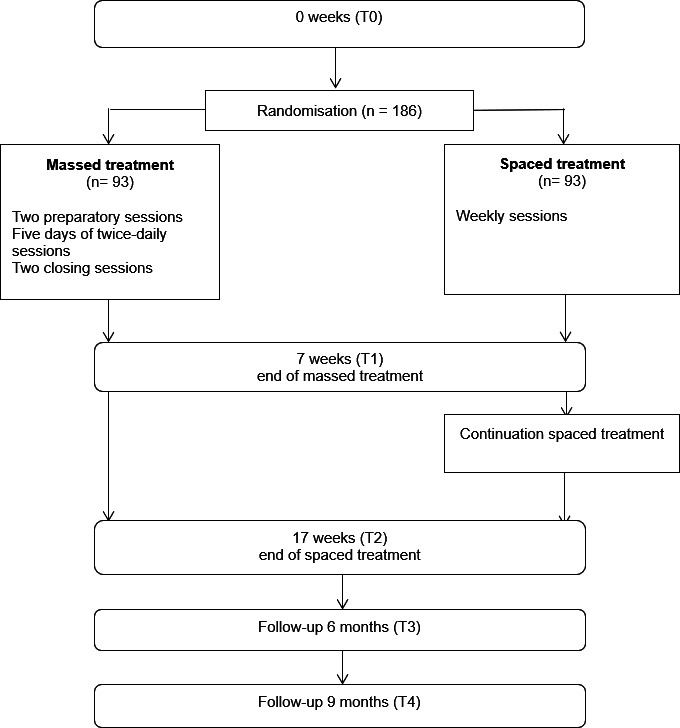 Figure 1
Peer Reviews
No public reviews on file for this paper yet. If you reviewed it on a platform where reviews are public (OpenReview, ICLR, NeurIPS, ICML), you can paste yours below so the community can read it here.
Videos
No videos yet. Explain this paper in a talk, walkthrough, or lecture? Add one.
Taxonomy
TopicsPosttraumatic Stress Disorder Research · Child Abuse and Trauma · Migration, Health and Trauma