Higher bone cement volume in total knee arthroplasty lowers the risk of postoperative radiolucent lines
Maximilian Keintzel, Maria A. Smolle, Kevin Staats, Christoph Böhler, Reinhard Windhager, Amir Koutp, Andreas Leithner, Stefanie Donner, Carsten Perka, Tobias Reiner, Tobias Renkawitz, Alexandra Leica, Manuel Sava, Michael Hirschmann, Patrick Sadoghi

TL;DR
Using more bone cement during knee replacement surgery reduces the risk of postoperative radiolucent lines, which can indicate implant issues.
Contribution
This study shows that higher cement volume, not demographics, is linked to fewer radiolucent lines in knee arthroplasty.
Findings
37.4% of patients developed radiolucent lines after TKA, with tibial components more affected than femoral.
Higher cement volume was independently associated with a lower risk of radiolucent lines.
Demographic factors like age, BMI, and smoking had no significant impact on radiolucent line occurrence.
Abstract
The aim of this multicenter study was to analyze the potential impact of patient demographics and cementation technique towards the development of radiolucent lines (RLLs) in primary total knee arthroplasty (TKA). It was hypothesized that cementation techniques, including higher cement volume, double‐layer cementation technique and hardening in full extension, reduce RLL incidence by improving stability, whereas demographic factors such as age, BMI and smoking may increase RLL risk by affecting bone quality and mechanical loading. Altogether, 776 patients (median age: 70.7 years; 39.2% males) underwent TKA at five tertiary orthopaedic centres between 11/2013 and 04/2023. X‐rays were analyzed retrospectively for the evaluation of RLLs taken between 6 and 36 months from surgery. RLLs on anterior–posterior and lateral X‐rays taken at a median of 14 months (range: 6–36) from primary…
Genes, proteins, chemicals, diseases, species, mutations and cell lines named across the full text — each resolved to its canonical identifier and authoritative record.
Click any figure to enlarge with its caption.
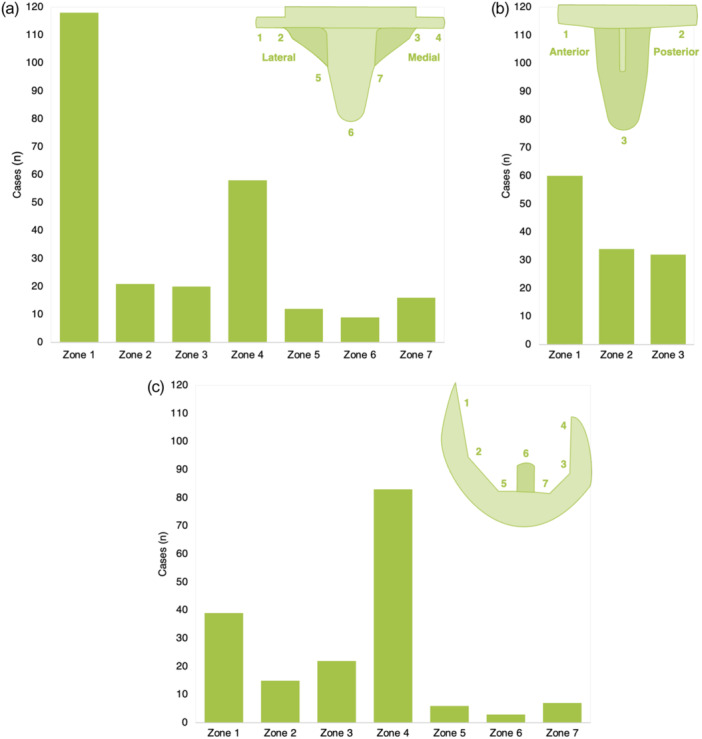 Figure 1
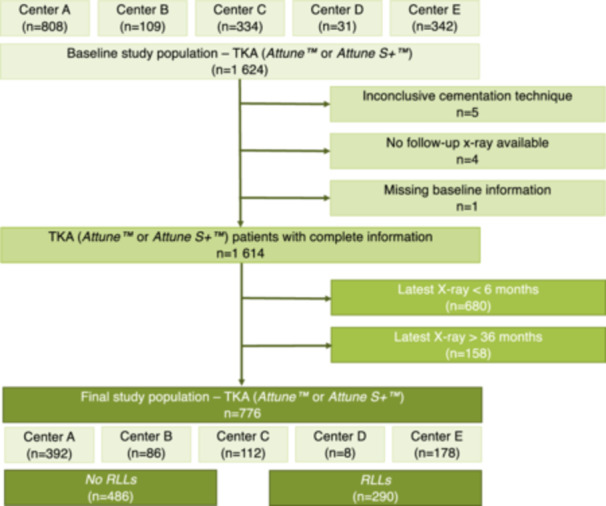 Figure 2
Peer Reviews
No public reviews on file for this paper yet. If you reviewed it on a platform where reviews are public (OpenReview, ICLR, NeurIPS, ICML), you can paste yours below so the community can read it here.
Videos
No videos yet. Explain this paper in a talk, walkthrough, or lecture? Add one.
Taxonomy
TopicsTotal Knee Arthroplasty Outcomes · Orthopaedic implants and arthroplasty · Orthopedic Infections and Treatments