Outcomes in Patients With Resectable Stage III NSCLC Who Did Not Have Definitive Surgery After Neoadjuvant Treatment—A Retrospective Analysis of the SAKK Trials 16/96, 16/00, 16/01, 16/08, and 16/14: A Brief Report
Sabine Raimann, Sämi Schär, Stefanie Hayoz, Matthias Guckenberger, Tobias Finazzi, Isabelle Opitz, Sabine Schmid, Michael Mark, Alfredo Addeo, Laetitia A. Mauti, Daniel C. Betticher, Hans-Beat Ris, Roger Stupp, Alessandra Curioni-Fontecedro, Solange Peters, Martin Früh

TL;DR
This study examines outcomes for lung cancer patients who did not undergo surgery after initial treatment, finding that those who had surgery had much better survival rates.
Contribution
The study provides new insights into survival outcomes for resectable stage III NSCLC patients who did not receive definitive surgery after neoadjuvant treatment.
Findings
Three-year overall survival was significantly higher in patients who had definitive surgery compared to those who did not.
Prognosis for patients without surgery improved in the era of immune checkpoint inhibitors.
Disease progression was the most common reason for not undergoing surgery in both ICI and non-ICI trials.
Abstract
Neoadjuvant or perioperative treatment, including an immune checkpoint inhibitor (ICI), has emerged as a new standard for patients with resectable stage III NSCLC. Nevertheless, approximately 20% of patients who start neoadjuvant chemo-immunotherapy will not undergo definitive surgery. Little is known about these patients. We analyzed outcomes of patients without definitive surgery from five Swiss Group for Clinical Cancer Research (SAKK) trials that investigated different neoadjuvant treatment modalities in patients with resectable stage III-N2 NSCLC. Study treatment included neoadjuvant cisplatin-docetaxel chemotherapy (with or without radiotherapy), either combined with peri-operative durvalumab in the SAKK 16/14 trial (n = 68) or without an ICI (non-ICI trials, n = 431). Of the 499 patients, 102 (20%) did not have definitive surgery. Cancellation of surgery occurred in a similar…
Genes, proteins, chemicals, diseases, species, mutations and cell lines named across the full text — each resolved to its canonical identifier and authoritative record.
Click any figure to enlarge with its caption.
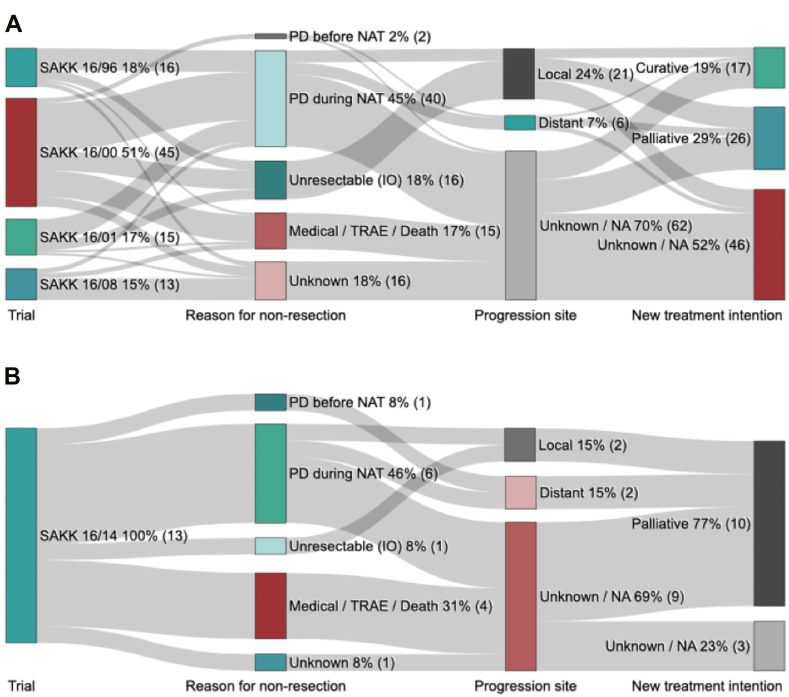 Figure 1
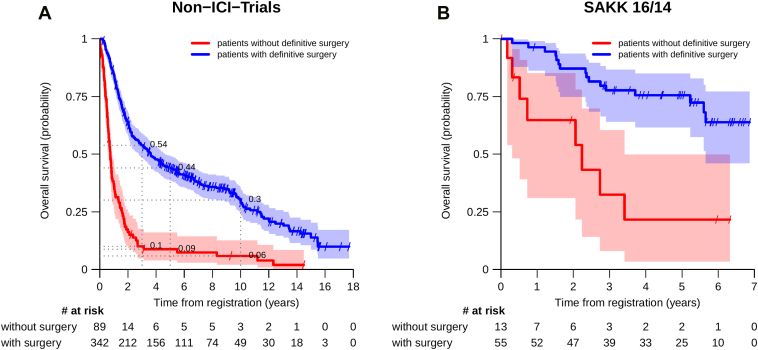 Figure 2
Peer Reviews
No public reviews on file for this paper yet. If you reviewed it on a platform where reviews are public (OpenReview, ICLR, NeurIPS, ICML), you can paste yours below so the community can read it here.
Videos
No videos yet. Explain this paper in a talk, walkthrough, or lecture? Add one.
Taxonomy
TopicsGastric Cancer Management and Outcomes · Ovarian cancer diagnosis and treatment · Hepatocellular Carcinoma Treatment and Prognosis