Adult head circumference and the risk of cancer: a retrospective cohort study
Suhas Krishnamoorthy, Jonathan K. L. Mak, Kathryn C. B. Tan, Gloria H. Y. Li, Ching-Lung Cheung

TL;DR
This study found that larger adult head circumference is linked to a higher risk of cancer, especially colorectal and prostate cancer, even after adjusting for other factors like height and weight.
Contribution
The study identifies a novel independent association between head circumference and cancer risk, beyond traditional risk factors.
Findings
A larger head circumference was associated with increased risk of any cancer (HR per cm: 1.17).
The strongest associations were observed for colorectal cancer (HR per cm: 1.81) and prostate cancer (HR per cm: 1.58).
The association remained significant after adjusting for weight, waist-to-hip ratio, and serum levels of calcium and phosphorus.
Abstract
Cancer-related genes and pathways have recently been implicated in a genome-wide meta-analysis of head size. In the current study, we aimed to evaluate the association between adult head circumference and the risk of cancer. This is a cohort study using data from the Hong Kong Osteoporosis Study, where 1,301 participants aged 27–96 years with head circumference measured between 2015 and 2019, and without a history of cancer, were followed up to 15 January 2024. Incident cancers were identified using electronic medical records from a territory-wide database. Hazard ratios (HR) and 95% confidence intervals (CI) were estimated using Cox proportional hazards regression, adjusting for age, sex, height, weight, education, smoking, alcohol drinking, physical activity, and family history of cancer, as well as accounting for familial clustering. The median head circumference was 53 cm…
Genes, proteins, chemicals, diseases, species, mutations and cell lines named across the full text — each resolved to its canonical identifier and authoritative record.
Click any figure to enlarge with its caption.
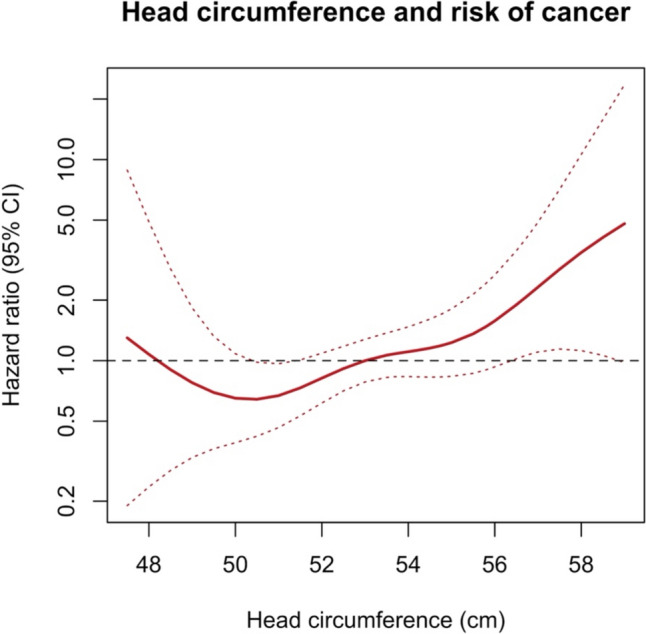 Figure 1
Peer Reviews
No public reviews on file for this paper yet. If you reviewed it on a platform where reviews are public (OpenReview, ICLR, NeurIPS, ICML), you can paste yours below so the community can read it here.
Videos
No videos yet. Explain this paper in a talk, walkthrough, or lecture? Add one.
Taxonomy
TopicsEpigenetics and DNA Methylation · Genetic factors in colorectal cancer · BRCA gene mutations in cancer