Correction: Microglial activation contributes to cognitive impairments in rotenone-induced mouse Parkinson’s disease model
Dongdong Zhang, Sheng Li, Liyan Hou, Lu Jing, Zhengzheng Ruan, Bingjie Peng, Xiaomeng Zhang, Jau-Shyong Hong, Jie Zhao, Qingshan Wang

Abstract
Genes, proteins, chemicals, diseases, species, mutations and cell lines named across the full text — each resolved to its canonical identifier and authoritative record.
Click any figure to enlarge with its caption.
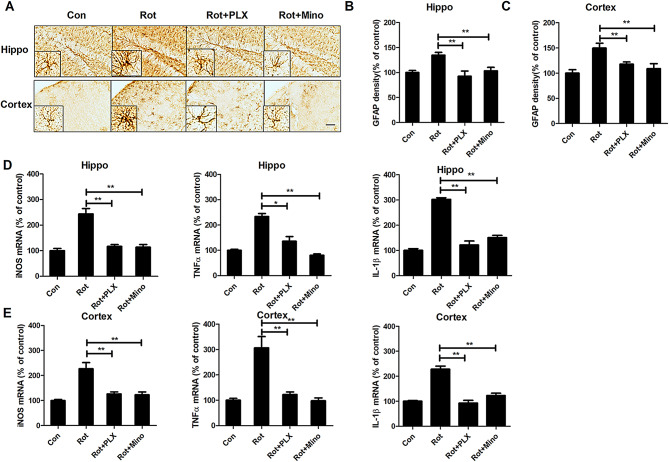 Figure 1
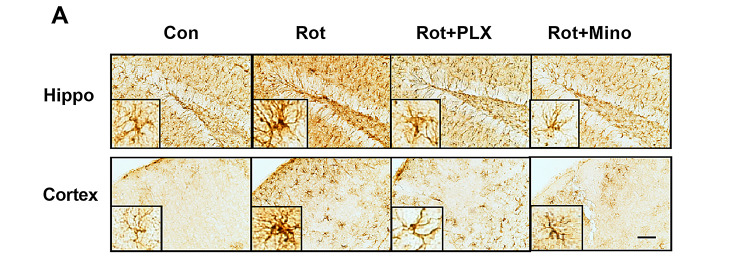 Figure 2
Peer Reviews
No public reviews on file for this paper yet. If you reviewed it on a platform where reviews are public (OpenReview, ICLR, NeurIPS, ICML), you can paste yours below so the community can read it here.
Videos
No videos yet. Explain this paper in a talk, walkthrough, or lecture? Add one.
Taxonomy
TopicsNeuroinflammation and Neurodegeneration Mechanisms · Neurological Disease Mechanisms and Treatments · Nuclear Receptors and Signaling
Correction: Journal of Neuroinflammation (2021) 18:4
10.1186/s12974-020-02065-z
In this article [1], there was an error in Fig. 6A. For completeness and transparency, the old incorrect Fig. 6 and the correct Fig. 6 are displayed below.
Incorrect Fig. 6
Fig. 6PLX3397 and minocycline attenuate rotenone-induced astroglial activation and gene expression of proinflammatory factors in mice. a The representative images of astroglial marker, GFAP immunostaining were shown. b, c Quantitative analysis of GFAP immunostaining density. d, e The gene expression levels of iNOS, TNFα, and IL-1β in the hippocampus (d) and cortex (e) of mice were detected. n = 5–6. *p < 0.05, **p < 0.01; Scale bar = 200 μm
Correct Fig. 6A
Fig. 6PLX3397 and minocycline attenuate rotenone-induced astroglial activation and gene expression of proinflammatory factors in mice. a The representative images of astroglial marker, GFAP immunostaining were shown