Diversity and host plant utilization of leaf-mining beetles of Chrysomeloidea (Coleoptera) in Japan

Abstract
Genes, proteins, chemicals, diseases, species, mutations and cell lines named across the full text — each resolved to its canonical identifier and authoritative record.
Click any figure to enlarge with its caption.
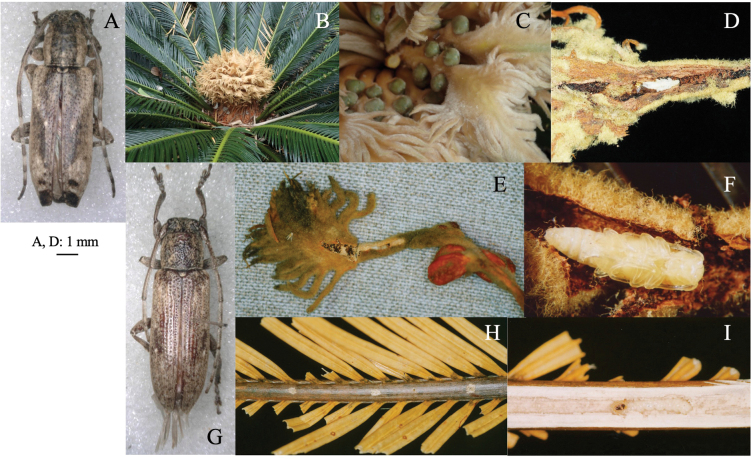 Figure 1
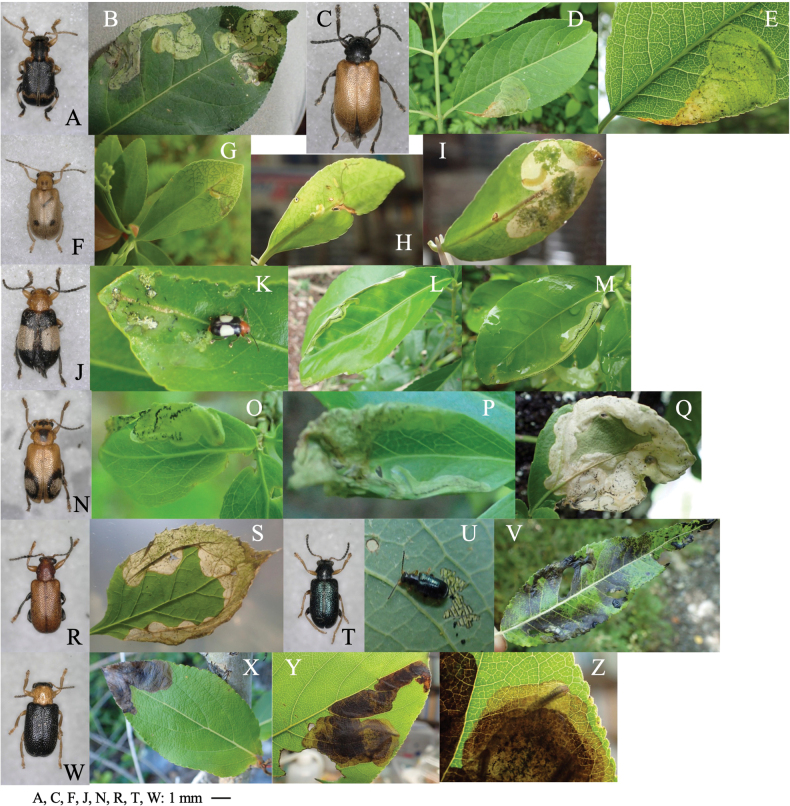 Figure 2
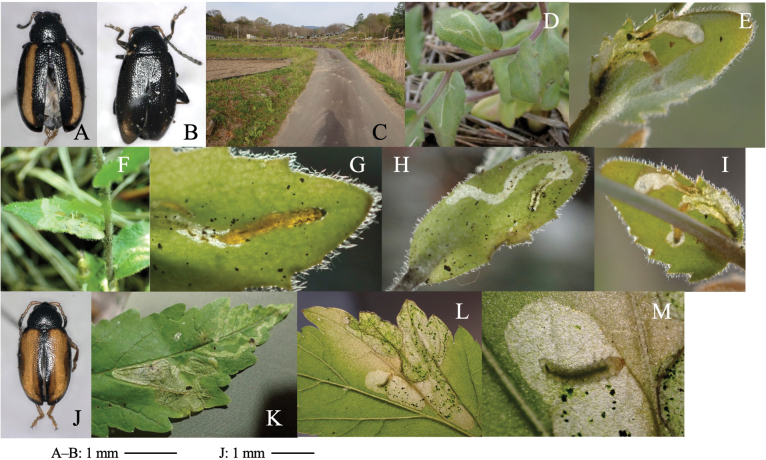 Figure 3
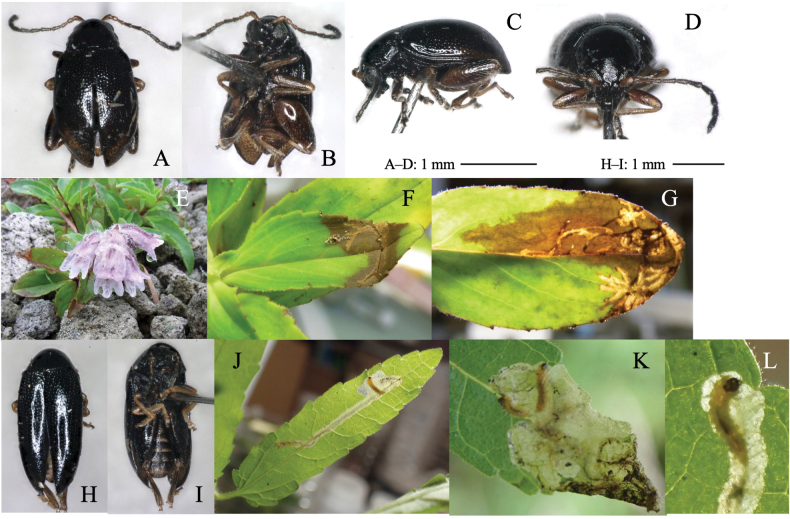 Figure 4
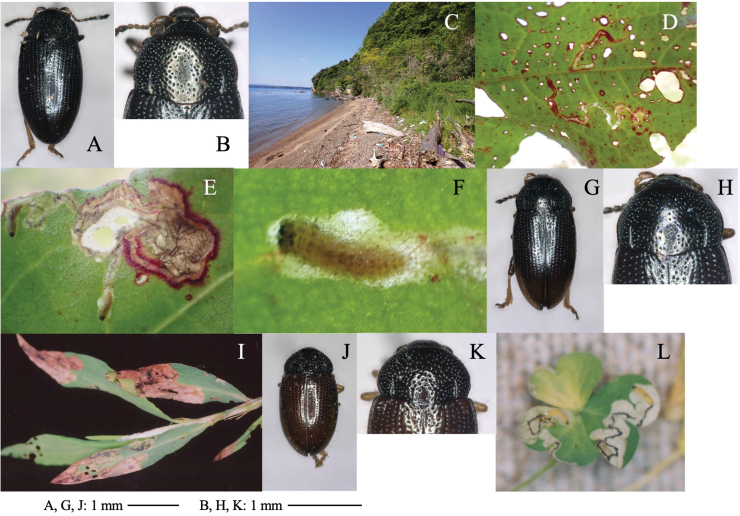 Figure 5
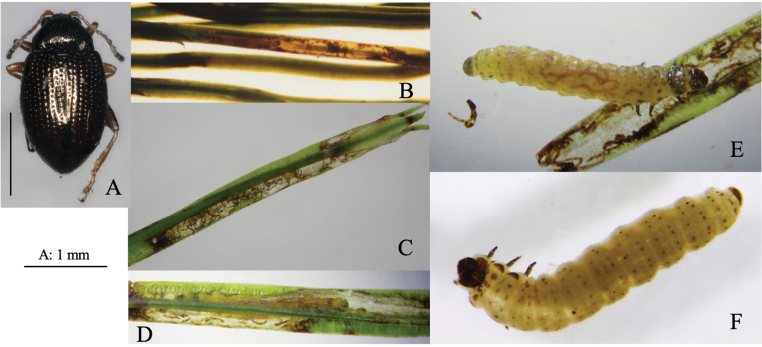 Figure 6
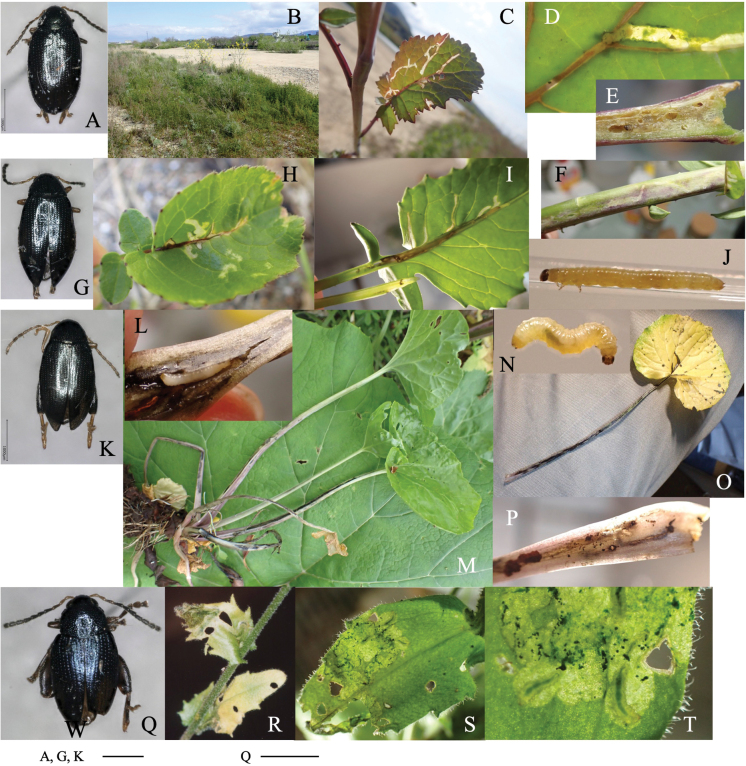 Figure 7
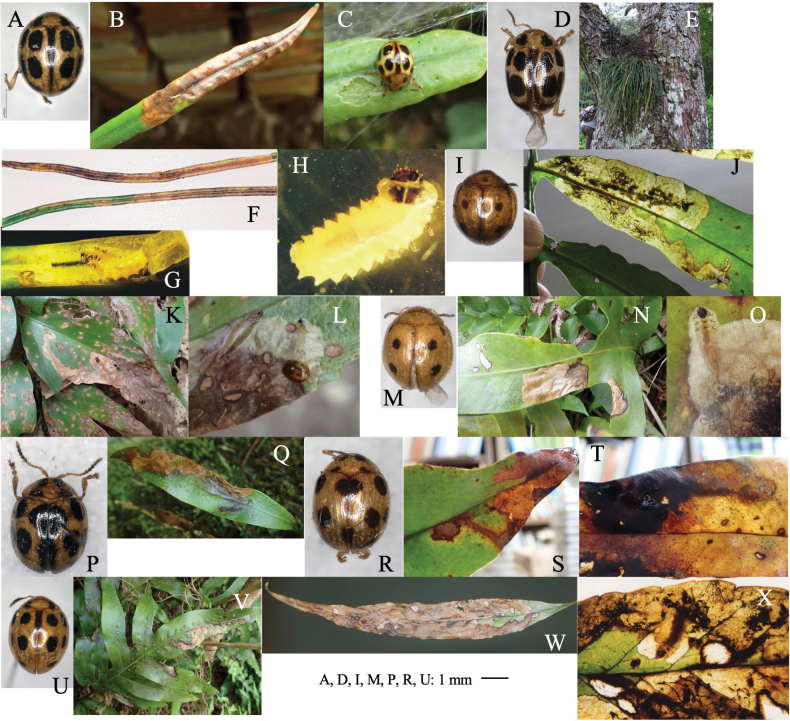 Figure 8
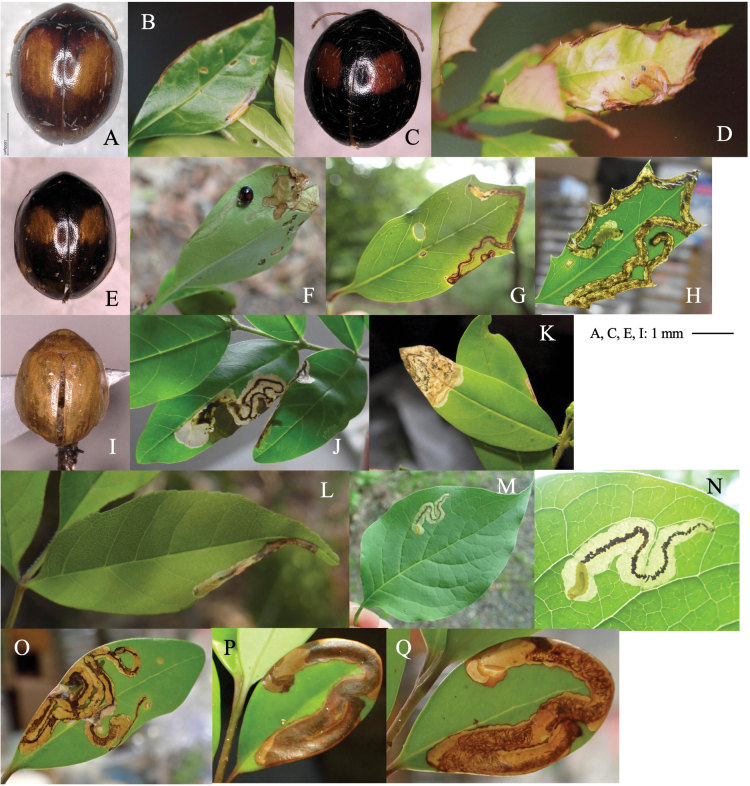 Figure 9
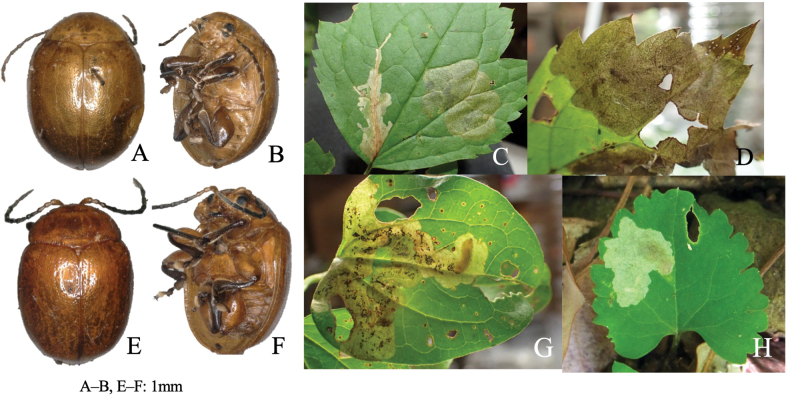 Figure 10
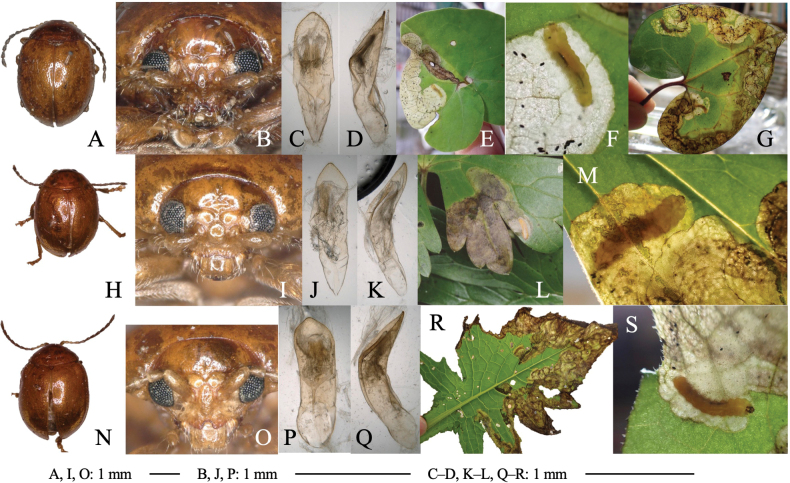 Figure 11
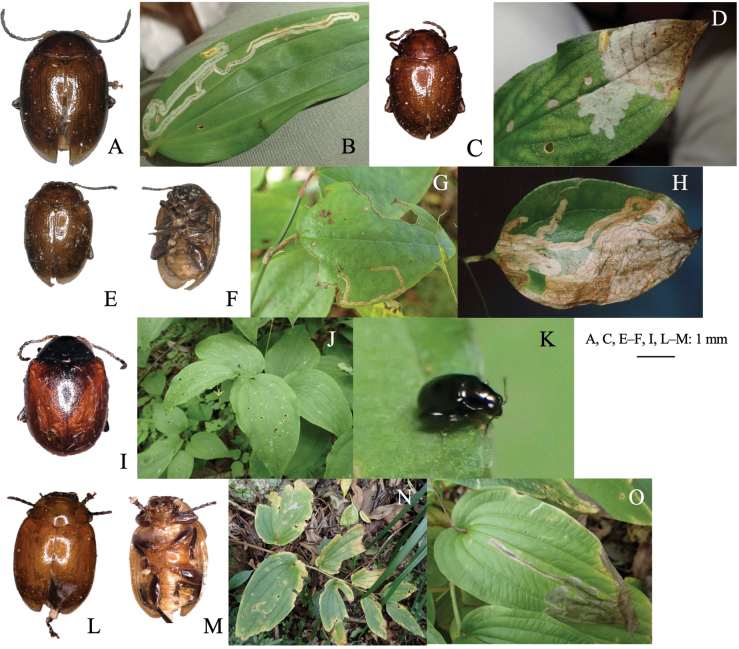 Figure 12
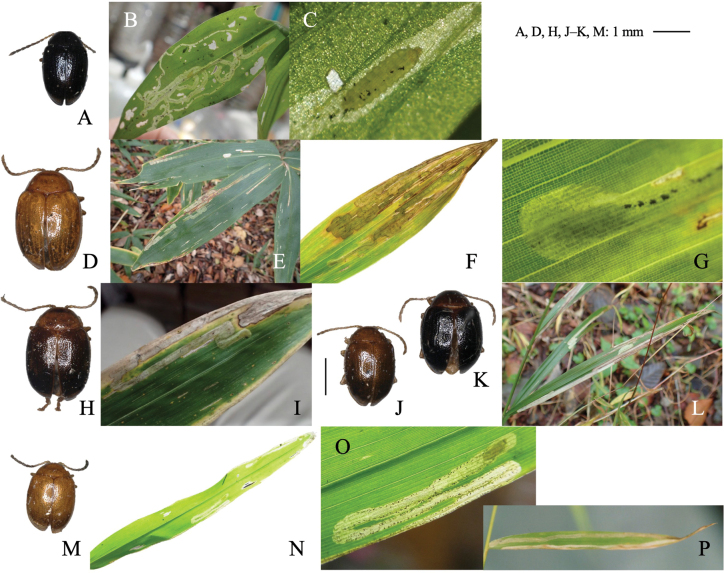 Figure 13
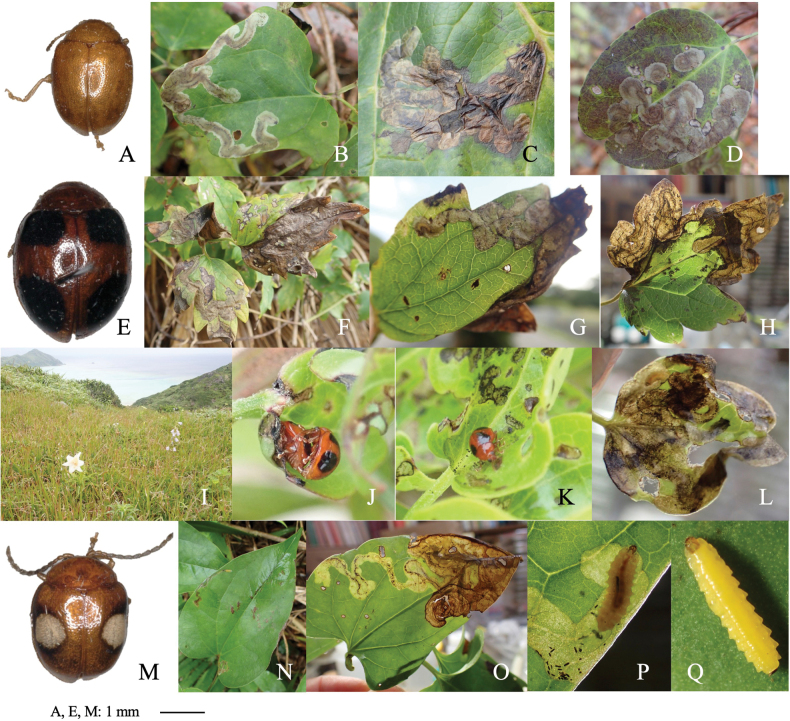 Figure 14
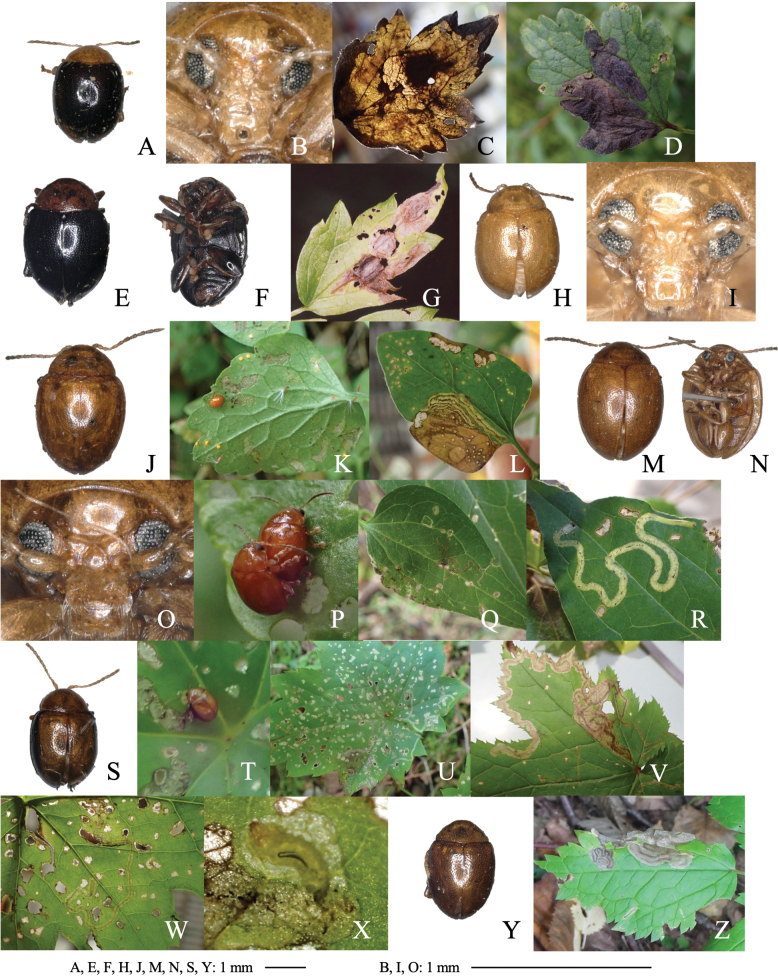 Figure 15
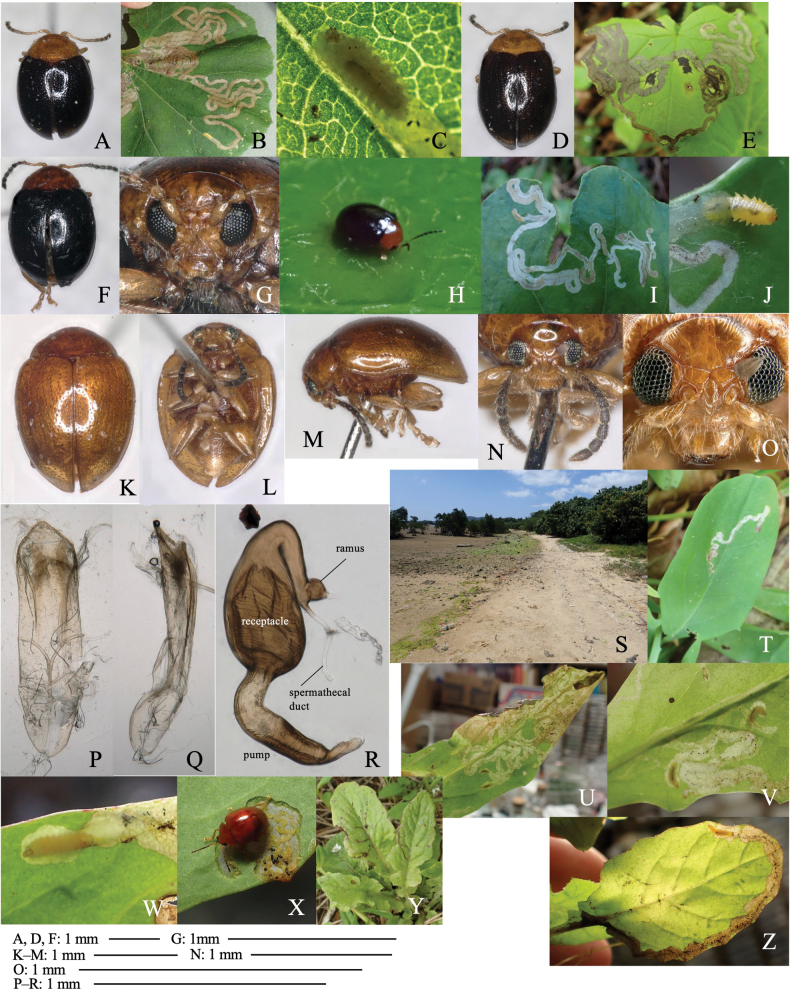 Figure 16
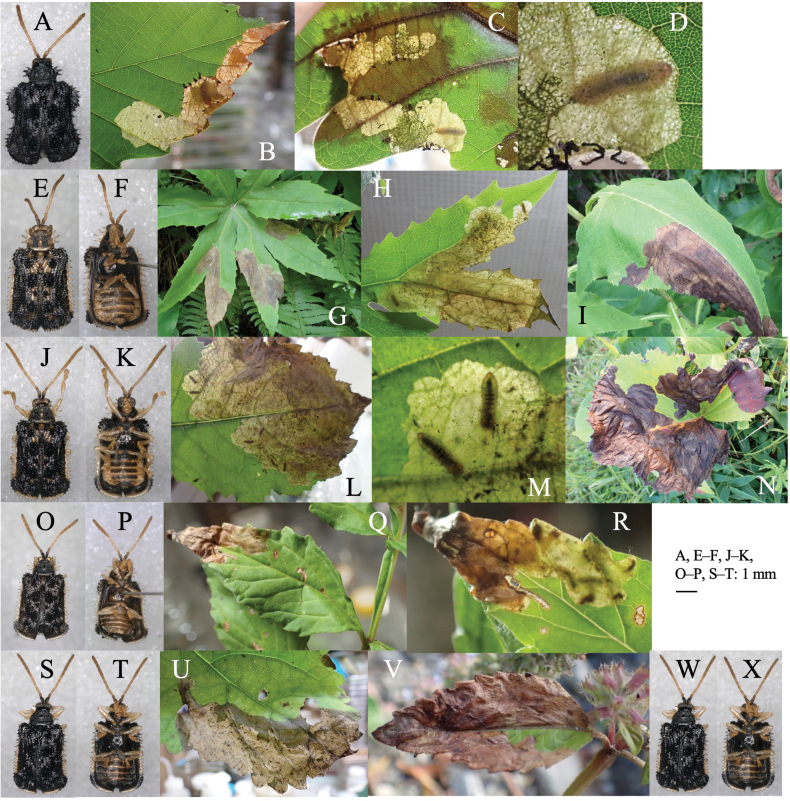 Figure 17
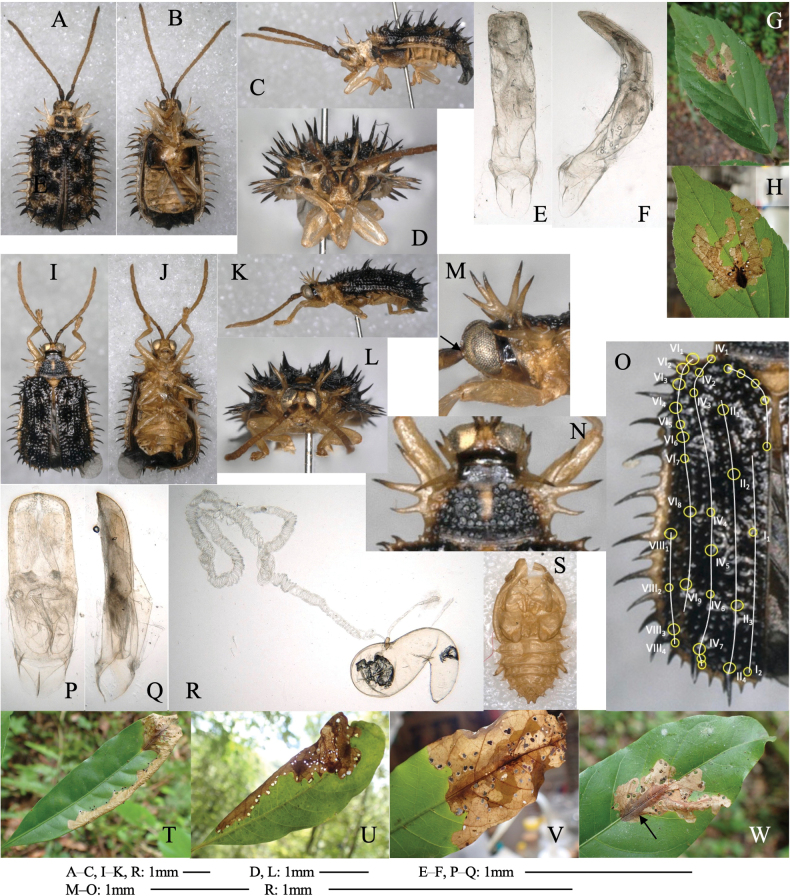 Figure 18
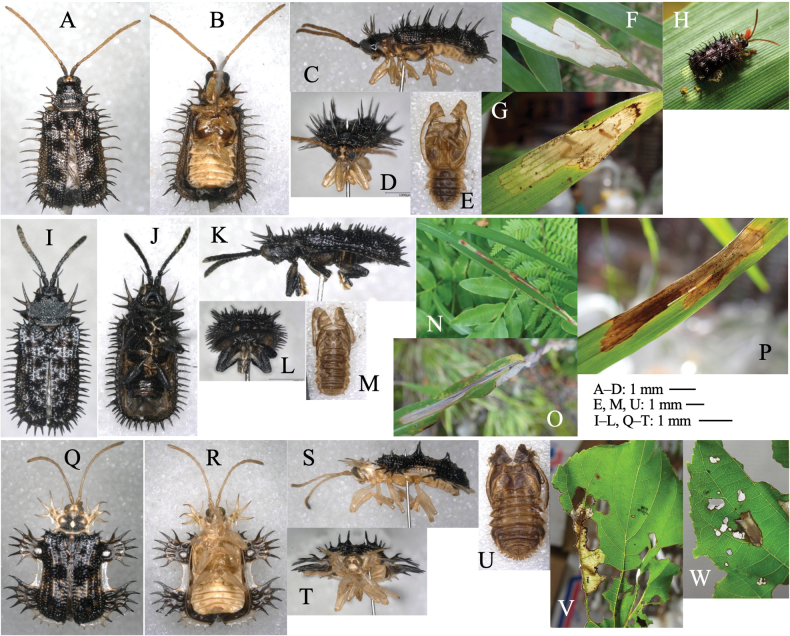 Figure 19
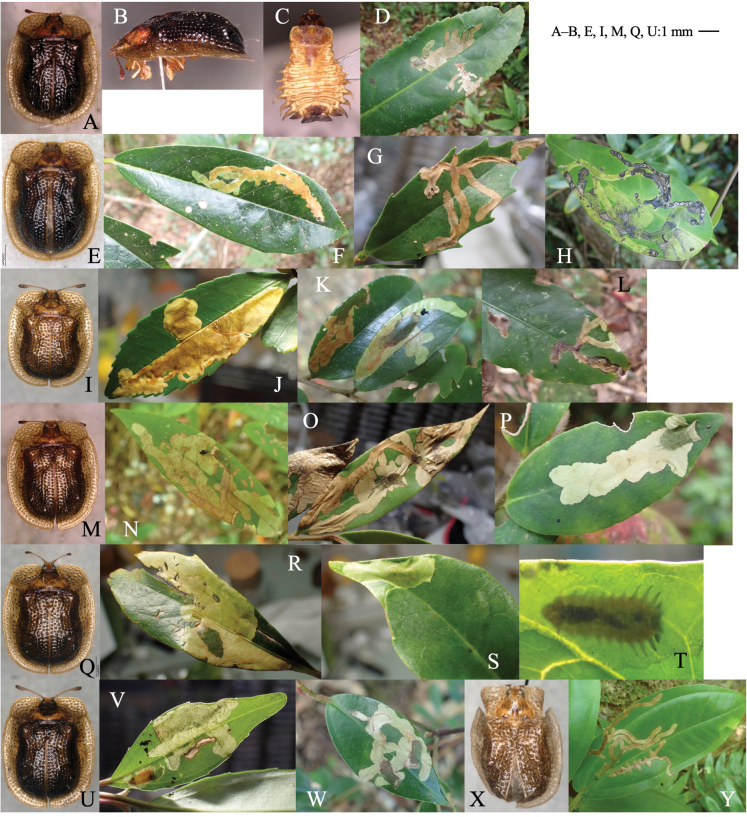 Figure 20
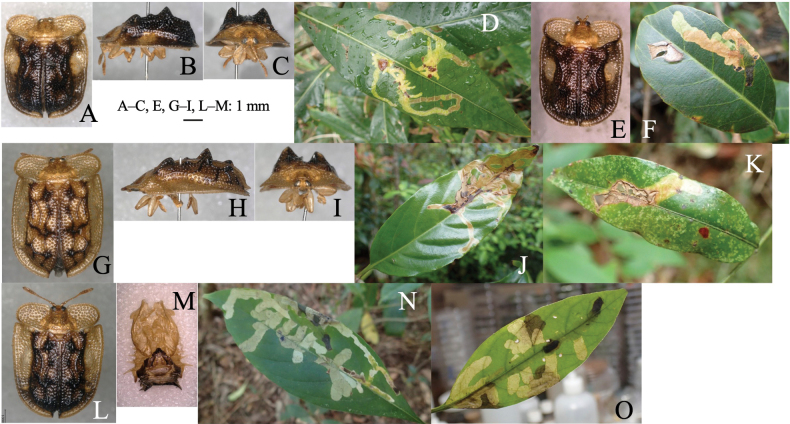 Figure 21
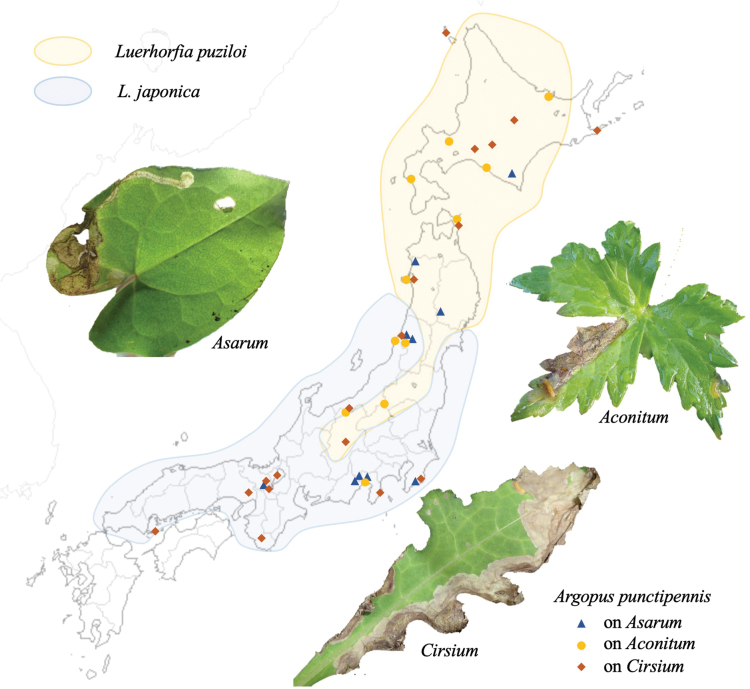 Figure 22
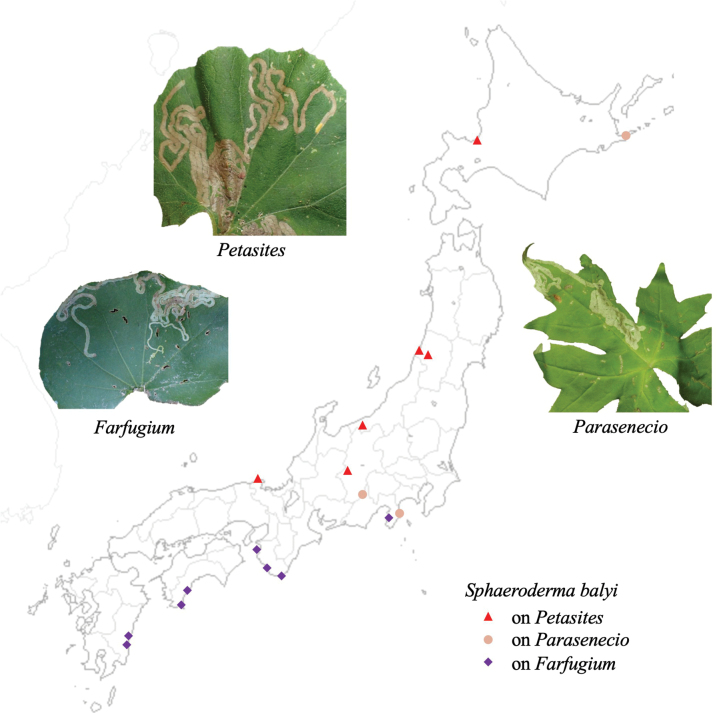 Figure 23
| Family | Subfamily | Tribe | Genus | Species | Host plants | No. utilized plant taxa | Mining pattern* | Ps** | |||
|---|---|---|---|---|---|---|---|---|---|---|---|
| order | family | genur | species | ||||||||
|
|
|
|
| 1 | 1 | 1 |
|
| in | ||
|
|
| 1 | 1 | 1 |
|
| in | ||||
|
|
|
|
| 1 |
| 3 | 10 |
| ex | ||
|
| 1 | 1 | 1 |
| ex | ||||||
|
| 1 | 1 |
| 2 |
| ex | |||||
|
| 1 | 1 | 1 |
|
| ex | |||||
|
| 1 | 1 | 1 |
|
| ex | |||||
|
| 1 | 1 |
| 2 |
| ex | |||||
|
| 1 | 1 | 1 |
|
| ex | |||||
|
| 1 | 1 | 1 |
|
| ex | |||||
|
| 1 | 1 | 1 |
| ? | ex | |||||
|
| ? | ? | ? | ||||||||
|
|
|
|
|
| 1 | 1 | 1 |
| ex | ||
|
| 1 | 1 | 1 |
|
| ex | |||||
|
|
| 1 | 1 | 1 |
|
| ex | ||||
|
|
| 1 | 1 | 1 |
|
| ex | ||||
|
|
| 1 |
| 2 | 3 |
| ex | ||||
|
| 1 | 1 | 1 |
|
| ex | |||||
|
| ? | ? | ? | ||||||||
|
|
| 1 | 1 |
| 2 |
| ex | ||||
|
|
| 1 |
| 4 | 6 | ex | |||||
|
| 1 | 1 | 1 |
| ex | ||||||
|
|
| 1 | 1 |
| 3 |
| ex | ||||
|
|
| 3 | 6 | 6 |
| ex | |||||
|
|
| 3 | 6 | 6 |
| ex | |||||
|
| 1 |
| 2 | 2 |
| ex | |||||
|
|
| 1 |
| 2 | 6 |
| ex | ||||
|
| 1 |
| 2 | 3 |
| ex | |||||
|
| 1 | 1 | 1 |
|
| ex | |||||
|
| 1 | 1 | 1 |
|
| ex | |||||
|
| 1 |
| 3 | 3 |
| ex | |||||
|
|
| 1 | 1 |
| 2 |
| ex | ||||
|
| 1 | 1 |
| 2 |
| ex | |||||
|
|
| 3 | 3 | 25 |
| ex | |||||
|
| ? | ? | ? | ||||||||
|
| ? | ? | ? | ||||||||
|
| ? | ? | ? | ||||||||
|
|
|
| 3 | 6 | 11 |
| ex | ||||
|
| 1 | 1 | 1 |
|
| ex | |||||
|
| 1 |
| 6 | 9 |
| ex | |||||
|
| 1 | 1 | 1 |
|
| ex | |||||
|
| 1 | 1 | 1 |
|
| ex | |||||
|
| ? | ? | ? | ||||||||
|
| 1 | 1 |
| 2 |
| ex | |||||
|
| 1 | 1 |
| 2 |
| ex | |||||
|
| 1 | 1 | 1 |
|
| ex | |||||
|
| 1 | 1 | 1 |
|
| ex | |||||
|
| 1 | 1 | 1 |
|
| ex | |||||
|
| 1 | 1 |
| 2 |
| ex | |||||
|
| 1 | 1 |
| 2 |
| ex | |||||
|
| 1 | 1 |
| 3 |
| ex | |||||
|
| 1 | 1 | 1 |
|
| ex | |||||
|
| 1 |
| 3 | 5 |
| ex | |||||
| 1 |
| 3 | 3 |
| ex | ||||||
|
| ? | ? | ? | ||||||||
|
| ? | ? | ? | ||||||||
|
| ? | ? | ? | ||||||||
|
| ? | ? | ? | ||||||||
|
| ? | ? | ? | ||||||||
|
|
|
|
| 1 | 1 | 1 |
|
| in | ||
|
| 1 |
| 2 | 2 |
| in | |||||
|
|
| 1 |
| 2 | 2 |
| in | ||||
|
|
| 1 |
| 3 | 7 |
| in | ||||
|
| 1 |
| 8 | 21 |
| in | |||||
|
|
| 2 | 5 | 10 |
| in | |||||
|
| 1 | 1 | 1 |
|
| in | |||||
| 1 | 1 | 1 |
|
| in | ||||||
|
| 1 | 1 |
| 2 |
| in | |||||
|
|
| 1 | 1 | 1 |
|
| in | ||||
|
|
| 1 |
| 2 | 5 |
| in | ||||
|
|
| 1 | 1 | 1 |
|
| in | ||||
|
|
| 1 | 1 | 1 |
|
| in | ||||
|
| |||||||||||
|
|
| 4 | 7 | 8 | 10 |
| in | ||||
|
| 2 | 2 | 2 | 2 |
| in | |||||
|
| 1 |
| 4 | 4 |
| in | |||||
| Beetle family | Genus | Species | Plant order | ||||||||||||||||||||||||||
|---|---|---|---|---|---|---|---|---|---|---|---|---|---|---|---|---|---|---|---|---|---|---|---|---|---|---|---|---|---|
|
|
|
|
|
|
|
|
|
|
|
|
|
|
|
|
|
|
|
|
|
|
|
|
|
|
| Total no. orders | |||
|
|
|
| 1 | 1 | |||||||||||||||||||||||||
|
|
| 1 | 1 | ||||||||||||||||||||||||||
|
|
|
| 1 | 1 | |||||||||||||||||||||||||
|
| 1 | 1 | |||||||||||||||||||||||||||
|
| 1 | 1 | |||||||||||||||||||||||||||
|
| 1 | 1 | |||||||||||||||||||||||||||
|
| 1 | 1 | |||||||||||||||||||||||||||
|
| 1 | 1 | |||||||||||||||||||||||||||
|
| 1 | 1 | |||||||||||||||||||||||||||
|
| 1 | 1 | |||||||||||||||||||||||||||
|
| 1 | 1 | |||||||||||||||||||||||||||
|
|
|
| 1 | 1 | |||||||||||||||||||||||||
|
| 1 | 1 | |||||||||||||||||||||||||||
|
|
| 1 | 1 | ||||||||||||||||||||||||||
|
|
| 1 | 1 | ||||||||||||||||||||||||||
|
|
| 1 | 1 | ||||||||||||||||||||||||||
|
| 1 | 1 | |||||||||||||||||||||||||||
|
|
| 1 | 1 | ||||||||||||||||||||||||||
|
|
| 1 | 1 | ||||||||||||||||||||||||||
|
| 1 | 1 | |||||||||||||||||||||||||||
|
|
| 1 | 1 | ||||||||||||||||||||||||||
|
| 1 | 1 | |||||||||||||||||||||||||||
|
| 1 | 1 | |||||||||||||||||||||||||||
|
| 1 | 1 | |||||||||||||||||||||||||||
|
|
| 1 | 1 | ||||||||||||||||||||||||||
|
| 1 | 1 | |||||||||||||||||||||||||||
|
| 1 | 1 | |||||||||||||||||||||||||||
|
| 1 | 1 | |||||||||||||||||||||||||||
|
| 1 | 1 | |||||||||||||||||||||||||||
|
|
| 1 | 1 | ||||||||||||||||||||||||||
|
| 1 | 1 | |||||||||||||||||||||||||||
| 1 | 1 | 1 | 3 | ||||||||||||||||||||||||||
|
| 1 | 1 | 1 | 3 | |||||||||||||||||||||||||
|
| 1 | 1 | |||||||||||||||||||||||||||
|
| 1 | 1 | |||||||||||||||||||||||||||
|
| 1 | 1 | |||||||||||||||||||||||||||
|
| 1 | 1 | |||||||||||||||||||||||||||
|
| 1 | 1 | |||||||||||||||||||||||||||
|
| 1 | 1 | |||||||||||||||||||||||||||
|
| 1 | 1 | |||||||||||||||||||||||||||
|
| 1 | 1 | |||||||||||||||||||||||||||
|
| 1 | 1 | |||||||||||||||||||||||||||
|
| 1 | 1 | |||||||||||||||||||||||||||
|
| 1 | 1 | |||||||||||||||||||||||||||
|
| 1 | 1 | |||||||||||||||||||||||||||
|
| 1 | 1 | |||||||||||||||||||||||||||
|
| 1 | 1 | |||||||||||||||||||||||||||
| 1 | 1 | ||||||||||||||||||||||||||||
|
|
| 1 | 1 | ||||||||||||||||||||||||||
|
| 1 | 1 | |||||||||||||||||||||||||||
|
|
| 1 | 1 | ||||||||||||||||||||||||||
|
|
| 1 | 1 | ||||||||||||||||||||||||||
|
| 1 | 1 | |||||||||||||||||||||||||||
| 1 | 1 | 2 | |||||||||||||||||||||||||||
|
| 1 | 1 | |||||||||||||||||||||||||||
| 1 | 1 | ||||||||||||||||||||||||||||
|
| 1 | 1 | |||||||||||||||||||||||||||
|
|
| 1 | 1 | ||||||||||||||||||||||||||
|
|
| 1 | 1 | ||||||||||||||||||||||||||
|
|
| 1 | 1 | ||||||||||||||||||||||||||
|
|
| 1 | 1 | ||||||||||||||||||||||||||
|
| 1 | 1 | 1 | 1 | 4 | ||||||||||||||||||||||||
| 1 | 1 | 2 | |||||||||||||||||||||||||||
| 1 | 1 | ||||||||||||||||||||||||||||
| Total number of beetle species | 4 | 2 | 1 | 1 | 1 | 1 | 10 | 1 | 12 | 1 | 1 | 5 | 1 | 3 | 1 | 1 | 1 | 1 | 5 | 1 | 2 | 3 | 2 | 7 | 4 | 72 | |||
Peer Reviews
No public reviews on file for this paper yet. If you reviewed it on a platform where reviews are public (OpenReview, ICLR, NeurIPS, ICML), you can paste yours below so the community can read it here.
Videos
No videos yet. Explain this paper in a talk, walkthrough, or lecture? Add one.
Taxonomy
TopicsColeoptera Taxonomy and Distribution · Forest Insect Ecology and Management · Insect-Plant Interactions and Control
Introduction
Leaf mining refers to the lifestyle of phytophagous insect larvae that live, feed, and develop within the internal tissues of plant leaves. This behavior occurs in four holometabolous insect orders: Coleoptera, Hymenoptera, Diptera, and Lepidoptera (Hering 1951). The earliest credible fossil records of leaf mines date back to the Late Triassic period (Imada et al. 2022) and even to the Late Carboniferous period (Knecht et al. 2023). Leaf-mining insects typically exhibit dorso-ventrally flattened bodies and well-developed mouthparts adaptations for living within the confined spaces of leaves and consuming fibrous plant tissues (Hering 1951). While the plant tissue offers internal leaf miners protection from insect and vertebrate predators, as well as environmental stress, these larvae are still vulnerable to parasitoid attacks. This ecological niche has been adopted by diverse insect leaf-miners.
Leaf-mining species are represented in several coleopteran families, including the Buprestidae, Nitidulidae, Mordellidae, Megalopodidae, Chrysomelidae, Attelabiidae, Brachyceridae, and Curculionidae (Hering 1951; Tooker and Giron 2020; Eiseman 2022). The latter five are part of the clade Phytophaga, which spans two superfamilies, Chrysomeloidea and Curculionoidea, and evolved from the fungus-feeding beetle superfamily Cucujoidea (Hunt et al. 2007; Zhang et al. 2018-. These superfamilies, comprising 59,000 and 53,000 species, respectively, have diversified enormously as angiosperm plants radiated since the Cretaceous period (Farrell 1998; Hunt et al. 2007). The Chrysomeloidea comprises three families: Cerambycidae, Megalopodidae, and Chrysomelidae. Cerambycids are typically wood or shoot borers during their larval stage, while megalopodid and chrysomelid larvae feed on leaves or roots, either internally or externally, of both terrestrial and aquatic plants. The oldest known Chrysomeloidea fossil, attributed to the Cerambycidae, was found in the Lower Cretaceous Yixian Formation of China (Wang et al. 2014).
Chrysomeloidea contains diverse leaf-mining species across more than 40 genera (Jolivet and Hawkeswood 1995; Santiago-Blay 2004; Eiseman 2022; Frost 1924). Within Megalopodidae, at least a few Zeugophora species are leaf miners (Takemoto 2019). The Chrysomelidae family exhibits larval habits that vary from leaf mining and root boring to external leaf feeding. Among its ten subfamilies (Reid 1995), both Galerucinae and Cassidinae harbor leaf-mining species (Cai et al. 2022). Within Galerucinae in Japan, leaf-mining species have been identified in several genera, including Phyllotreta Chevrolat, 1837, Mantura Stephens, 1831, Halticorcus Lea, 1917 (= Schenklingia), Argopistes Motschulsky, 1860, Argopus Fischer von Waldheim, 1824, and Sphaeroderma Stephens, 1831 (Yano 1954, 1958, 1965; Kato 1991; Kimoto and Takizawa 1993). The Hispini tribe within Cassidinae span tropical and subtropical regions and exhibit several leaf-mining species (Chaboo 2007). Japanese Hispini leaf-mining species are found in the genera Leptispa Baly, 1858, Asamangulia Maulik, 1915, Dactylispa Weise, 1897, Hispellinus Weise, 1897, Rhadiosa Weise, 1905, Platypria Guérin-Méneville, 1840, and Dicladispa Gestro, 1897 (Kimoto and Takizawa 1993). Additionally, in the Notosacanthini within the subfamily Cassidinae, Notosacantha Chevrolat, 1837 also includes leaf-mining species (Rane et al. 2000; Monteith et al. 2021). Despite the abundance of taxonomic studies of chrysomelids in these genera (Kimoto and Takizawa 1993; Takizawa 2005, 2007, 2015, 2021), reports on their larval biology remain limited. Leaf mines of chrysomelids have been documented in just 15 species in Japan, as reported by Yano (1954, 1965) and Kato (1991). A more comprehensive understanding of the association between leaf-mining chrysomelids and their host plants could provide insights into the diversification processes within the Chrysomeloidea.
During the last 40 years, we have conducted extensive collections of Japanese leaf miners, reared them, and collected data on their diversity, host plants, and larval biology. In this article, we present a detailed account of this leaf-mining beetle diversity, including the identification of two new chrysomelid species within the genera Sphaeroderma and Dactylispa. Additionally, we explore the host plants and host specificity of these leaf-mining species, with insights into leaf mines and their larval biology, and discuss the association between leaf-mining beetles and their host plants.
Our study reveals the presence of 64 leaf-mining species within Japanese Chrysomeloidea, each intricately associated with specific host plants. While most of these beetle species exhibit host specificity at the genus or species level, we have observed instances where certain species are associated with multiple genera belonging to phylogenetically distant plant families. By investigating whether these species demonstrate specialist or generalist tendencies, we have categorized the pattern of host selection as exhibiting extended host specificity.
Materials and methods
Since the 1980s, MK has conducted extensive sampling of chrysomelid leaf mines across the Japanese Archipelago and all specimens were collected by MK, with specific exceptions noted. To rear the leaf-mining chrysomelid larvae, mined leaves were placed in plastic cases with a layer of vermiculite at the bottom. This setup was kept moderately moist to create an optimal environment for the pupation and hibernation phases usually in incubators. Approximately 400 adult chrysomelid beetles were obtained by rearing the leaf-mining larvae. Leaves with leaf mines were dried as herbarium specimens and deposited in the Kyoto University Museum, Japan (KUM). Plant species were identified according to their scientific names, in line with Ohashi et al. (2015). The insect specimens were also deposited in the KUM, with the type specimens deposited in National Museum of Nature and Science, Tokyo (NSMT). All material with a registration number is mentioned in the listing of the designated material type.
For morphological examination, adult specimens were examined under a microscope (VHS-7000; Keyence, Osaka, Japan). This analysis was augmented by synthesizing virtual images from a series of depth-focused photographs to capture detailed images of the specimens. For identification we referred to Hayashi et al. (1984), Kimoto and Takizawa (1993, 1997). To observe male and female genitalia, the abdomens were macerated in in a 10% KOH solution for ~ 12 h at room temperature, rinsed in water, and dissected under a microscope.
Results
From the Japanese Archipelago, we confirmed 64 species of Chrysomeloidea as leaf miners, including two cerambycids, nine megalopodids, and 53 chrysomelids (Table 1). We provide a summary of host plants and leaf mines of these species and describe two new species belonging to Sphaeroderma and Dactylispa. The following list also includes ten beetle species that are unknown for their larval habits but are suspected to be leaf-miners in light of the habits of morphologically related species. In the following descriptions, families, subfamilies, tribes, and genera are arranged in a phylogenetic order suggested by Hayashi et al. (1984), and species in each genus are arranged in a taxonomic order of their host plants. In the genus Dactylispa, species are arranged by their species groups as suggested by Zhang et al. (2021).
Cerambycidae Latreille, 1802
Lamiinae Latreille, 1825
Mimectatina (Matsushita, 1933)
Mimectatina
meridiana ohirai
Taxon classificationAnimaliaColeopteraCerambycidae
Breuning & Villiers, 1973
3BCEB7F9-77B7-5ED0-B9A4-56E58F390465
Host plant.
Cycadaceae: Cycasrevoluta Thunb. (Fig. 1B–F) (Kato 2001). The wood tissues of Toddaliaasiatica (L.) and Aucubajaponica Thunb. are used as hosts (Coleopterological Society of Japan 1984).
Two cerambycid species associated with Cycas revouta: Mimectatinameridianaohirai (A–F) and Sybraflavostriataflavostriata (G–I). A, G adult habitus B flowering cycad C flowering megasporophyll D cross section of mined megasporophyll E mine of megasporophyll F pupa in the mine H oviposition scars on leaf stalk I larva mining the leaf stalk.
Leaf mine.
Linear or linear-blotch mines in the megasporophyll of female cycad plants (Fig. 1E). The larva sometimes penetrates the testa of the cycad seed. Pupation occurs within the mine on the leaf stalk of the megasporophyll (Fig. 1D, F). Frass is granular and deposited within the mine.
Material examined.
• 25 adults, Hedo, Kunigami, Okinawa Is., Okinawa Pref., 1-II-1998 (collected as larva on Cycasrevoluta), emerged on 3-III–20-VI-1998; • 7 adults, Hedo, Kunigami, Okinawa Is., Okinawa Pref., 10-III-1997 (as larva on C.revoluta), emerged on 25-IV–20-VI-1997; 2 adults, Hedo, Kunigami, Okinawa Is., Okinawa Pref., 19-IV-2000 (as larva on C.revoluta), emerged on ?-V-2000; • 8 adults, Angyaba, Kakeroma Is., Setouchi, Kagoshima Pref., 10-V-2001 (as larva on C.revoluta), emerged on 12–28-VI-2001.
Sybra Pascoe, 1865
Sybra
ordinata
Taxon classificationAnimaliaColeopteraCerambycidae
Bates, 1873
1815AF37-60B1-5689-BB69-0C3626FB9ED5
Host plant.
Cycadaceae: Cycasrevoluta (Fig. 1H, I) (Kato 2001). Wood of Ficussuperba (Miq.), Ficuserecta Thunb., Pittosporumtobira (Thunb.), and Boehmeriabiloba Wedd. are also used as larval hosts (Coleopterological Society of Japan 1984).
Leaf mines.
Linear mine in a leaf stalk. The adult female bites the lower surface of the leaf stalk and inserts eggs into the scar (Fig. 1H). The larva mines the woody leaf stalk linearly, but does not enter leaflets. The fully grown larva pupates in the mine (Fig. 1I).
Material examined.
• 5 adults, Haneji, Nago, Okinawa Is., Okinawa Pref., 1-II-1998 (as larva on Cycasrevoluta), emerged on ?-V-1998; 2 adults, Hedo, Kunigami, Okinawa Is., Okinawa Pref., 1-II-1998 (as larva on Cycasrevoluta), emerged on 20-III-1998.
Megalopodidae Latreille, 1802
Zeugophorinae Böving & Craighead, 1931
Zeugophora Kunze, 1818
Zeugophora
annulata
Taxon classificationAnimaliaColeopteraMegalopodidae
(Baly, 1873)
0D5C15D5-09E7-5E75-8312-0BB791EBA2AD
Host plant.
Celastraceae: Celastrusorbiculatus Thunb., Euonymusalatus (Thunb.), E.fortunei (Turcz.), E.japonicus Thunb., E.macropterus Rupr., E.melananthus (Thunb.), E.oxyphyllus Miq., E.tricarpus Koidz., E.sieboldianus Blume. Tripterygiumregelii is also recorded as a host by Takemoto (2019).
Leaf mine.
Full-depth linear-blotch mine on newly-opened leaf (Fig. 2O–Q). The mine often covers the whole area of the leaf causing deformation of the leaf, and the larva moves to another unmined leaf. Frass is thread-like and meandering, deposited along the center of the mine. The fully grown larva exits the mined leaf, falls to the ground, and pupates underground.
Habitus and feeding scars of adult beetles and leaf mines of eight Zeugophora species A, BZ.nigricolisC–EZ.unifasciataF–IZ.chujoiJ–MZ.flavonotataN–QZ.annulataR, SZ.varipesT–VZ.hozumiiW–ZZ.japonica. Host plants A, BEuonymussieboldianus at Hirayu, Gifu Pref. C–EE.sieboldianus at Sugadaira, Nagano Pref. F–IE.fortunei at Nagao-toge, Shizuoka Pref. J–LE.tanakae at Yutsun, Iriomote Is., Okinawa Pref. ME.japonicus at Hoshidate, Iriomote Is., Okinawa Pref. N, OE.alatus at Kiyosato, Yamanashi Pref. PE.melananthus at Mt. Tara, Nagasaki Pref. QE.fortunei at Mt. Myôjô, Niigata Pref. R, SSymplocossawafutagi at Iyari, Nagano Pref. T–VSalixcardiophyllavar.urbaniana at Kitazawa-toge, Nagano Pref. W–ZPopulussuaveolens at Sôunkyô, Hokkaido.
Material examined.
• 4 adults, Iyari, Ômachi, Nagano Pref., 5-V-2016 (as larva on Euonymusalatus), emerged on 27-V-2016 (Fig. 2N, O); 5 adults, Saroma Lake, Yûbetsu, Hokkaidô, 5-VI-2016 (as larva on E.sieboldianus), emerged on 29–30-VI-2016; 3 adults, Mt. Tara, Isahaya, Nagasaki Pref., 19-IX-2017 (as larva on E.melananthus), emerged on 23-V-2017 (Fig. 2P); • 2 adults, Mt. Myôjô, Niigata Pref., Aoi-ku, Shizuoka Pref., 9-V-2018 (as larva on E.fortunei), emerged on 10-VI-2018 (Fig. 2Q); • 1 adult, Mt. Teine, Sapporo, Hokkaido, 6-VI-2016 (as larva on E.tricarpus), emerged on 25-VI-2016; • 2 adults, Ashiu, Nantan, Kyoto Pref., 5-V-1992 (as larva on E.oxyphyllus), emerged on ?-V-1992; • 1 adult, Hidakatsu, Tsushima Is., Nagasaki Pref., 19-IV-2009 (as larva on E.japonicus), emerged on 18-V-2009; • 1 adult and many leaf mines, Mt. Byôbu, Kizukuri, Aomori Pref., 14-V-1993 on E.macropterus; • 3 adults, Misakubo Dam, Hamamatsu, Shizuoka Pref., 10-V-2000 (as larva on Celastrusorbiculatus collected by T. Kato), emerged on 7-VI-2000.
Zeugophora
chujoi
Taxon classificationAnimaliaColeopteraMegalopodidae
Ohno, 1961
19F7DD9E-BC34-5900-9C1C-EF331BE3772B
Host plant.
Celastraceae: Euonymusfortunei (Turcz.).
Leaf mine.
Full-depth linear-blotch mine on the leaf blade and the midrib of a newly-opened leaf (Fig. 2G–I). The egg is laid in the midrib and the hatched larva enters the midrib and bores into the petiole, leading to leaf abscission from the shoot at the petiole base. Following the leaf fall, the mine diverges from the midrib and expands in the leaf blade, forming a blotch mine. Frass is granular and scattered throughout the mine. The fully grown larva exits the mined leaf, falls to the ground, and pupates underground.
Material examined.
• 4 adults, Nagao-tôge, Gotenba, Shizuoka Pref., 15-V-2018 (as larva on Euonymusfortunei), emerged on 18-VI-2018 (Fig. 2F–I).
Zeugophora
flavonotata
Taxon classificationAnimaliaColeopteraMegalopodidae
(Chûjô, 1935)
BDE06BAD-F2C6-51C5-8BF1-A386EF1984F9
Host plant.
Celastraceae: Euonymuscarnosus Maxim., E.japonicus Thunb.
Leaf mine.
Full-depth linear mine on the newly-opened leaf (Fig. 2K–M). The egg is laid near the leaf margin and the hatched larva mines along the leaf margin, slowly expanding the mine. Frass is thread-like, deposited somewhat to one side of the center. The fully grown larva exits the mined leaf, falls to the ground, and pupates underground.
Material examined.
• 2 adults, Yutsun, Iriomote Is., Yaeyama, Okinawa Pref., 24-III-2022 (as larva on Euonymuscarnosus), emerged on 16–18-IV-2022 (Fig. 2J–L); 3 adults, Todomari, Iriomote Is., Yaeyama, Okinawa Pref., 27-III-2018 (as larva on E.carnosus), emerged on 16–18-IV-2018; 14 adults, Hoshidate, Iriomote Is., Yaeyama, Okinawa Pref., 6-III-2019 (as larva on E.japonicus), emerged on 3–6-IV-2019 (Fig. 2M).
Zeugophora
nigricolis
Taxon classificationAnimaliaColeopteraMegalopodidae
(Jacoby, 1885)
B6C5DBBD-BD75-5272-B54E-55022F53A3E2
Host plant.
Celastraceae: Euonymussieboldianus Blume.
Leaf mine.
Upper-layer ophiogenous blotch mine on the mature leaf (Fig. 2D, E). Within the blotch, the larval trajectory itself is linear and meandering compactly. The egg is laid along the basal margin of the leaf and the hatched larva mines along the leaf margin, abruptly expanding the mine. Within the blotch, the larval trajectory itself is linear and meandering compactly. Frass is granular and deposited along the meandering trajectory. The fully grown larva exits the mined leaf, falls to the ground, and pupates underground.
Material examined.
• 2 adults, Sugadaira, Ueda, Nagano Pref., 18-VI-2017 (as larva on Euonymussieboldianus), emerged on 20–28-VII-2017 (Fig. 2C–E).
Zeugophora
unifasciata
Taxon classificationAnimaliaColeopteraMegalopodidae
(Jacoby, 1885)
0A80E343-CF8C-5414-A746-8F66C9AB7B5C
Host plant.
Celastraceae: Euonymussieboldianus.
Leaf mine.
Upper-layer linear mine on mature leaf (Fig. 2B). The egg is laid in the leaf blade and the hatched larva construct slightly meandering mine. Width of the mine is slightly wider than the width of the larva. Frass is thread-like, deposited along the meandering trajectory. The fully grown larva exits the mined leaf, falls to the ground, and pupates underground.
Material examined.
• 5 adults, Hirayu-tôge, Takayama, Gifu Pref., 6-IX-2019 (as larva on Euonymussieboldianus), emerged on 6–7-X-2019 (Fig. 2A, B); • 1 adult, Toyohara, Nasu, Tochigi Pref., 2-VII-2022 (as larva on E.sieboldianus), emerged on 3-VIII-2022.
Zeugophora
varipes
Taxon classificationAnimaliaColeopteraMegalopodidae
(Jacoby, 1885)
B21F7B41-4516-5A72-8F23-4E163359BA0E
Host plant.
Symplocaceae: Symplocoscoreana (H. Lev.), S.sawafutagi Nagam.
Leaf mine.
Full-depth linear-blotch mine on young leaf (Fig. 2S). The egg is laid in the leaf blade, and the hatched larva constructs linear mine along the leaf margin, then gradually expands the mine. The mine is wider than the width of the larva. Frass is granular, scattered throughout the mine. The fully grown larva exits the mined leaf, falls to the ground, and pupates underground.
Material examined.
• 1 adult and 5 leaf mines, Iyari, Ômachi, Nagano Pref., 5-V-2016 on Symplocossawafutagi (Fig. 2R, S); 6 adults, Omotsubo, Okayama Pref., 27-V-1993 (as larva on Symplocoscoreana), emerged on 20–24-VI-1993.
Zeugophora
hozumii
Taxon classificationAnimaliaColeopteraMegalopodidae
Chûjô, 1953
DBE888AD-23FD-5D62-AF7F-6C5C2F140703
Host plant.
Salicaceae: Salixcardiophylla Trautv. et C. A. Mey. Although Takemoto (2019) lists Salixcaprea L. as a host plant, this record is not confirmed.
Leaf mine.
Black upper-layer linear-blotch mine on mature leaf (Fig. 2V). The egg is laid in the leaf blade, and the hatched larva constructs a linear-blotch mine, the upper surface of which turns black. Frass is granular, scattered throughout the mine. The fully grown larva exits the mined leaf, falls to the ground, pupates underground, and hibernates as a pupa.
Material examined.
• 8 adults and many leaf mines, Kitazawa Tôge, Ina, Nagano Pref., 30-VII-2016, feeding lower surface of leaf of Salixcardiophylla (Fig. 2T–V); • 1 adult, Azusa-gawa, Matsumoto, Nagano Pref., 24-X-2020 (as larva on Salixcardiophylla), emerged on 22-III-2021.
Zeugophora
japonica
Taxon classificationAnimaliaColeopteraMegalopodidae
Chûjô, 1951
9861A8A9-1048-5893-BF21-C99E21F2DF55
Host plant.
Salicaceae: Populussuaveolens Fisch.
Leaf mine.
Black upper-layer blotch mine on mature leaf, sometimes gregarious (Fig. 2X–Z). The egg is laid along the leaf margin, and the hatched larva constructs a blotch mine, the upper surface of which turns black. Frass is granular, scattered throughout the mine. The fully grown larva exits the mined leaf, falls to the ground, pupates underground.
Material examined.
• 1 adult, Rekifune Nakanokawa, Taiki, Tokachi, Hokkaidô, 23-VI-2017 (as larva on Populussuaveolens), emerged on 21-VIII-2017 (Fig. 2W–Z); • 2 adults, Rubeshibe, Kitami, Hokkaidô, 25-VI-2017 (as larva on P.suaveolens), emerged on 21-VIII-2017.
Zeugophora
cupka
Taxon classificationAnimaliaColeopteraMegalopodidae
Takemoto, 2019
487307BF-F38B-5D06-B184-3170E1E7811F
Host plant.
Salicaceae: Populussuaveolens (Takemoto 2019). Leaf mine has not yet been reported.
Zeugophora
gracilis
Taxon classificationAnimaliaColeopteraMegalopodidae
Chûjô, 1958
B9548D24-2A9A-57CC-A40D-D5481FEFE7B0
Note.
There is no recent collection of this species, and its host plant and mine are not known (Takemoto 2019).
Chrysomelidae Latreille, 1802
Galerucinae Latreille, 1802
Alticini Newman, 1834
Phyllotreta Chevrolat, 1836
Phyllotreta
ezoensis
Taxon classificationAnimaliaColeopteraChrysomelidae
Kimoto, 1993
57C3B260-E46B-5028-A2D6-9C919A668008
Host plant.
Brassicaceae: Drabanemorosa L. The host plant grows on levee of traditional rice fields and upland fields in Central Honshu (Fig. 3C).
Habitus of adults and leaf mines of two Phyllotreta species A–IP.ezoensisJ–MP.shirahatai. Host plants A–IDrabanemorosa at Kiyosato, Yamanashi Pref. J–MCardamineappendiculata at Eniwa (J, K) and Tobai (L, M), Hokkaido.
Leaf mine.
Full-depth linear mine of leaf blade, midrib, petiole, and shoot (Fig. 3D–I). The egg is laid on the leaf, and the hatched larva mines toward the midrib, and reenters midrib/leaf blade. Larvae repeats mining leaf and mining midrib, petiole, and/or shoot, often by exiting its mine and establishing a new mine. Frass is granular, deposited linearly along midline of the mine. The fully grown larva exits the mined leaf, falls to the ground, and pupates underground. The adult emerges ~ 2 weeks after pupation, and varies in elytral pattern (Fig. 3A, B).
Material examined.
• 6 adults, Matsubara-Lake, Koumi, Nagano Pref. 21-V-2021 (as larva on Drabanemorosa), emerged on 4-VI-2021 (Fig. 3A–E); • 15 adults, Kiyosato, Hokuto, Yamanashi Pref., 4-V-2022 (as larva on D.nemorosa), emerged on 17–20-V-2022 (Fig. 3F–I).
Phyllotreta
shirahatai
Taxon classificationAnimaliaColeopteraChrysomelidae
Madar, 1959
E47EC518-EAA5-5834-B80B-A48FB3EDF243
Host plant.
Brassicaceae: Cardamineleucantha (Tausch.).
Leaf mine.
Full-depth linear-blotch mine on mature leaf (Fig. 3K–M). Frass is granular, scattered throughout the mine. The fully grown larva exits the mined leaf, falls to the ground, and pupates underground.
Material examined.
• 1 adult and several leaf mines on Cardamineleucantha, Eniwa Park, Eniwa, Hokkaidô, 21-VII-2020 (Fig. 3J, K); several leaf mines, Tôbai, Nemuro, Hokkaidô, 2-VIII-2023 on C.leucantha (Fig. 3L, M).
Longitarsus Latreille, 1829
Longitarsus
aff. holsaticus
Taxon classificationAnimaliaColeopteraChrysomelidae
(Linnaeus, 1758)
3803BDD8-6D85-5A85-BC88-5C1EBEF24EEB
Note.
Whereas six collected specimens were tentatively identified as this species, more specimens and further taxonomic studies are necessary.
Host plant.
Plantaginaceae: Pennellianthusfrutescens (Lamb.). Host plants of Longitarsusholsaticus are reported to be Veronica spp. by Kimoto and Takizawa (1993).
Leaf mine.
Full-depth linear or radiate mine in young leaf (Fig. 4F–G). Frass is deposited compactly in a few parts of the mine, and sometimes discharged from the mine through holes perforated along the mine edge. The fully grown larva exits the mined leaf, falls to the ground, and pupates underground.
Habitus of adults and leaf mines of two species belonging to two Alticini genera, Longitausus and DiboliaA–GLongitarsusholsaticusH–LDiboliajaponica. Host plants A–GPennellianthusfrutescens at Mt. Tarumae, Hokkaido H–LStachysasperavar.hispidula at Lake Shoji-ko, Yamanashi Pref.
Material examined.
• 6 adults, Mt. Tarumai, Chitose, Hokkaidô, 4-VII-2010 (as larva on Pennellianthusfrutescens), emerged on 17-VIII-2010 (Fig. 4A–G).
Dibolia Latreille, 1829
Dibolia
japonica
Taxon classificationAnimaliaColeopteraChrysomelidae
S.-H. Chen, 1933
B7DDF71D-D6CA-5577-A75E-E8481A7DCDE3
Host plant.
Lamiaceae: Stachysaspera Michx.
Leaf mine.
Full-depth linear-blotch mine on mature leaf (Fig. 4J–L). Frass is thread-like, deposited along trajectory in the mine. The fully grown larva exits the mined leaf, falls to the ground, pupates underground.
Material examined.
• 1 adult, Shôji-ko Lake, Fuji-kawaguchiko, Yamanashi Pref., 4-VII-2010 (as larva on Stachysaspera), emerged on 3-VIII-2010 (Fig. 4H–L).
Mantura Stephens, 1831
Mantura
clavareaui
Taxon classificationAnimaliaColeopteraChrysomelidae
Heikertinger, 1912
C74E1ADF-C922-5B71-9A3D-0EC1B2443B1F
Host plant.
Polygonaceae: Rumexjaponicus Houtt., Polygonumaviculare L. Rumexacetosa L. is also recorded as a host plant (Kimoto and Takizawa 1993).
Leaf mine.
Full-depth linear mine occurs on mature leaf (Fig. 5D–F, I). The larva alternates mining the leaf blade and mining the midrib, the petiole, and the shoot, and often relocates its mine. Frass is granular, deposited linearly along middle line of the mine. The fully grown larva exits the mined leaf, falls to the ground, and pupates underground.
Habitus of adults, habitat, and leaf mines of two Mantura species A–IM.clavareauiJ–LM.fulvipes. Host plants A–FRumexjaponicus at Notojima Island, Ishikawa Pref. G–IPolygonumaviculare at Mihogaseki, Shimane Pref. J–LOxaliscorniculata at Tamanoura, Fukue Is., Nagasaki Pref.
Material examined.
• 3 adults, Kôda, Notojima Is., Nanao, Ishikawa Pref. 2-V-2023 (as larva on Rumexjaponicus), emerged on 22-V-2023 (Fig. 5A–F); • 21 adults, Kamematsu, Shivani, Kumamoto Pref., 28-IV-2017 (as larva on R.japonicus), emerged on 13–14-V-2017; • 14 adults, Mihonoseki, Matsue, Shimane Pref., 15-V-2006 (as larva on Polygonumaviculare), emerged on 31-V–3-VI-2006 (Fig. 5G–I).
Mantura
fulvipes
Taxon classificationAnimaliaColeopteraChrysomelidae
Jacoby, 1885
66926E35-CC8A-5B9C-A0A5-C113DFDD4DCA
Host plant.
Oxalidaceae: Oxaliscorniculata L.
Leaf mine.
Full-depth linear mine on mature leaf (Fig. 5L). The egg is laid along the leaf margin, and hatched larva mines along the leaf margin, gradually expanding the mine. Width of the mine is wider than that of larva. Frass is thread-like, deposited along middle line of the mine. The fully grown larva exits the mined leaf, falls to the ground, pupates underground.
Material examined.
• 19 adults, Tamanoura, Fukue Is. Goto, Nagasaki Pref. 9-X-1998 (as larva on Oxaliscorniculata), emerged on 22–26-X-1998 (Fig. 5J–L).
Mantura
japonica
Taxon classificationAnimaliaColeopteraChrysomelidae
Jacoby, 1885
649F7497-9C60-5B89-8415-7320420F487C
Note.
Host plant has not been reported (Hayashi et al. 1984; Kimoto and Takizawa 1993).
Hippuriphila Foudras, 1859
Hippuriphila
babai
Taxon classificationAnimaliaColeopteraChrysomelidae
(Chûjô, 1959)
2A706F2C-7988-5682-A69F-00361CF737C2
Host plant.
Equisetaceae: Equisetumarvense L., E.fluviatile L.
Leaf mine.
Full-depth or internal linear mine on leaf-like branch and the green stem (Fig. 6B–E). The larva is cylindrical (Fig. 6F) and sometimes exits its mine and moves to the other shoot. Frass is thread-like, deposited in the mine.
Habitus of adults, leaf mine, and larva of Hippuriphilababai on EquisetumarvenseA habitus of adults B, C leaf-mine at Mt. Teine D–F larva at Yubari, Hokkaido.
Material examined.
• 2 adults, Mt. Teine, Sapporo, Hokkaidô, 9-X-1998 (as larva on Equisetumarvense), emerged on 25-VII–3-VIII-1998 (Fig. 6A–C); • 2 adults, Rebun Is., Hokkaidô, 9-VII-1995 (as larva on E.arvense), emerged on 25–27-VII-1995; • 5 adults, Bibi, Chitose, Hokkaidô, 30-VI-2023 (as larva on E.fluviatile), emerged on 17–20-VII-2023.
Psylliodes Latreille, 1829
Psylliodes
punctifrons
Taxon classificationAnimaliaColeopteraChrysomelidae
Baly, 1874
1871083B-ACA4-5D32-9BB6-12C3A7B3024A
Host plant.
Brassicaceae: Brassicajuncea (L.), RaphanussativusL.var.raphanistroides (Makino), Rorippapalustris (L.), Eutremajaponicum (Miq.). Cardamineanemonoides, Brassicachinensis and B.napus are also recorded as host plants (Takizawa 2005).
Leaf mine.
Full-depth linear mine occurs on leaf blade, midrib, petiole, and shoot (Fig. 7C–E, H, I, L–P). The egg is laid on the leaf, and the hatched larva mines toward midrib, and reenters leaf blade. Larvae alternates mining the leaf and mining the midrib/petiole/shoot, and often relocates its mine. Frass is deposited compactly in a few parts of the mine, and sometimes discharged from the mine through the perforated holes. The fully grown larva exits the mined leaf, falls to the ground, pupates underground. Adult emerges ~ 1 month after pupation. On Eutremajaponicum with long petiole, linear mine of petiole and midrib of mature leaf (Fig. 7L–P). The mined petiole turns blackish. Frass is deposited compactly in a few parts of the mine, and sometimes discharged from the mine through perforated holes.
Habitus of adults and larvae, habitat, and leaf mines of three Psylliodes species A–JP.punctifronsK–PP.sasakiiQ–TP.subrugosa. Host plants A–FBrassicajuncea at Kizu-gawa, Kyôto G–IRaphanussativusvar.hortensis at Notojima Is., Ishikawa Pref. K–MEutremajaponicum at Futamata, Oshamanbe, Hokkaido N–PEutremajaponicum at Nyûkawa, Takayama, Gifu Pref. Q–TArabishirsuta at Shimo-suwa, Nagano Pref.
Material examined.
• 23 adults, Kusauchi, Kizu-gawa, Kyôtanabe, Kyoto Pref. 11-III-2020 (as larva on Brassicajuncea), emerged on 1–15-V-2020 (Fig. 7A–E); • 1 adult, Kôda, Notojima Is., Nanao, Ishikawa Pref., 2-V-2023 (as larva on Raphanussativusvar.raphanistroides), emerged on 4-VI-2023 (Fig. 7G–J); • 2 adults, Watarase, Fujioka, Tochigi Pref., 25-V-2020 (as larva on Rorippapalustris), emerged on 8–14-VI-2020; • 19 adults, Futamata, Oshamanbe, Hokkaidô, 20-V-2023 (as larva on Eutremajaponicum), emerged on 14–25-VI-2023 (Fig. 7K–M); • 2 adults, Nyû-kawa, Takayama, Gifu Pref., 1-V-2023 (as larva on Eutremajaponicum), emerged on 29-V–5-VI-2023 (Fig. 7N–P).
Psylliodes
aff. subrugosa
Taxon classificationAnimaliaColeopteraChrysomelidae
Jacoby, 1885
979B4F41-63E7-5873-A503-C4D9A3674176
Note.
Two female specimens were reared and tentatively identified as related to this species, but there is a possibility that this is an undescribed species.
Host plant.
Brassicaceae: Arabishirsuta (L.). Crucifers are known as host plants (Kimoto and Takizawa 1993), while its biology has not been reported.
Leaf mine.
Linear mine in the midrib and the petiole of mature leaf (Fig. 7R–T). The egg is laid on the petiole, and the hatched larva mines the petiole, and sometimes enter the midrib. The mined petiole becomes blackish. Frass is deposited compactly in a few parts of the mine, and sometimes discharged from the mine through perforated holes. The fully grown larva (Fig. 7N) exits the mined leaf, falls to the ground, and pupates underground. The adult emerges ~ 1 month after pupation.
Material examined.
• 2 adults, Higashimata, Shimosuwa, Suwa-gun, Nagano Pref., 28-VI-2020 (as larva on Arabishirsuta), emerged on 9-VIII-2020 (Fig. 7Q, S, T): several leaf mines on Arabishirsuta, Sanjiro, Matsumoto, Nagano Pref., 28-VII-1995 (Fig. 7R).
Halticorcus Lea, 1917
Halticorcus
kasuga
Taxon classificationAnimaliaColeopteraChrysomelidae
(Nakane, 1963)
C3DA3799-AADD-5FA7-9FA2-27B85AC4132A
Host plant.
Polypodiaceae: Lepisorusmiyoshianus (Makino)., L.onoei (Franch. et Sav.), L.thunbergianus (Kaulf.), Pyrrosialinearifotia (Hook.) and Lemmaphyllummicrophyllum C. Presl. are reported as adult’s host plants by Suzuki et al. (2008).
Leaf mine.
Upper-layer linear-blotch mine on mature leaf (Fig. 8B, F, G). The fully grown larva (Fig. 8H) exits the mined leaf, falls to the ground, and pupates underground.
Habitus of adults and leaf mines of four Halticorcus species A–HH.kasugaI–LH.sauteriM–TH.hiranoiU–XH.duodecimmaculata. Host plants A, BLepisorusthunbergianus at Mt. Shizuhata, Shizuoka Pref. CLepisorusonoei at Shôjiko Lake, Yamanashi Pref. D–HL.miyoshianus at Kiso-fukushima, Nagano Pref. I–JLeptochilusneopothifolius at Kanyû, Kakeroma Is., Kagoshima Pref. K–LCyrtomiumfalcatum at Imasato, Amami-ôshima Is., Kagoshima Pref. M–OPhymatosorusscolopendria at Tonaki Is., Okinawa Pref. P, QLoxogrammesalicifolia at Inohae, Kitago, Miyazaki Pref. R–TPyrrosialingua at Mt. Yuwan, Amami-ôshima Is., Kagoshima Pref. U, VPhymatosorusscolopendria at Iriomote Is., Okinawa Pref. W, XCrypsinusyakushimensis at Iriomote Is., Okinawa Pref.
Material examined.
• 3 adults, Mt. Shizuhata, Aoi-ku, Shizuoka Pref., 27-VII-2017 (as larva on Lepisorusthunbergianus), emerged on 12–18-IX-2017 (Fig. 8A, B); • 1 adult on L.onoei, Shôji-ko Lake, Fuji-kawaguchi-ko, Yamanashi Pref., 8-IX-2019 (Fig. 7C); • 2 adults, Shimo-shimizu, Kiso-fukushima, Nagano Pref., 7-VIII-2011 (as larva on L.miyoshianus), emerged on 4-IX-2011 (Fig. 7D–H).
Halticorcus
sauteri
Taxon classificationAnimaliaColeopteraChrysomelidae
(S.-H. Chen, 1934)
FF28D892-41BB-52E4-8F74-5A0090CD7F51
Host plant.
Dryopteridaceae: Cyrtomiumfalcatum (L. f.); Oleandraceae: Nephrolepiscordifolia (L.); Polypodiaceae: Colysiselliptica (Thunb.), Loxogrammesalicifolia (Makino), Leptochilusneopothifolius Nakaike, Lemmaphyllummicrophyllum Presl., Microsorumbuergerianum (Miq.), Phymatosorusscolopendria (Burm. f.). Thelypterisacuminata (Houtt.) is also reported as adult’s host plants by Suzuki et al. (2008).
Leaf mine.
Upper-layer linear-blotch mine on mature leaf (Fig. 8J–L, N, O). Frass is thread-like, thin, and often intermittent, and deposited along the meandering larval trajectory. The fully grown larva exits the mined leaf, falls to the ground, and pupates underground.
Material examined.
• 1 adult and several leaf mines, Imasato, Uken, Amami-ôshima Is. Kagoshima Pref., 4-IX-2011 on Cyrtomiumfalcatum (Fig. 8K, L); • 2 adults, Angyaba, Tatsugô, Amami-ôshima Is. Kagoshima Pref., 8-V-1997 (as larva on Cyrtomiumfalcatum), emerged on 22-VI-1997; • 22 adults, Kinsakubaru, Naze, Amami-ôshima Is. Kagoshima Pref., 3-VI-1996 (as larva on Nephrolepiscordifolia), emerged on 2-VII-1996; • 1 adult, Naon, Yamato, Amami-ôshima Is. Kagoshima Pref., 11-V-2002 (as larva on Colysiselliptica), emerged on 11-VI-2002; • 10 adults, Segiri, Nagata, Yaku Is., Kumage-gun, Kagoshima Pref., 27-V-1990 (as larva on Leptochilusneopothifolius), emerged on ?-VII-1990; • 3 adults, Higashinamaka, Amami-ôshima Is. Kagoshima Pref., 20-V-2015 (as larva on Leptochilusneopothifolius), emerged on 17–18-VI-2015 (Fig. 8I–J); • 2 adults, Mt. Yuwan, Uken, Amami-ôshima Is., Kagoshima Pref., 30-VI-1992 (as larva on Microsorumbuergerianum), emerged on 25-VII-1992; • 1 adult and several leaf mines, Tonaki Is., Shimajiri-gun, Okinawa Pref., 18-III-2020 (as larva on on Phymatosorusscolopendria), emerged on 20-V-2020 (Fig. 8M–O).
Halticorcus
hiranoi
Taxon classificationAnimaliaColeopteraChrysomelidae
(Takizawa, 1982)
2C950025-D8EA-50DC-BE00-2B8553F881BB
Host plant.
Aspleniaceae: Aspleniumantiquum Makino; Polypodiaceae: Pyrrosialingua, Lemmaphyllummicrophyllum, Lepisorusthunbergianus, Leptochilusneopothifolius, Loxogrammesalicifolia; Vittariaceae: Vittariaflexuosa Fee.
Leaf mine.
Upper-layer linear-blotch mine on mature leaf (Fig. 8Q, S, T). Frass is thread-like, thin, and often intermittent, and deposited along meandering larval trajectory. The fully grown larva exits the mined leaf, falls to the ground, and pupates underground.
Material examined.
• 1 adult and several leaf mines, Inohae, Nichinan, Miyazaki Pref., 20-V-2015 on Loxogrammesalicifolia (Fig. 8P, Q); • 3 adults, Mt. Yuwan, Uken, Amami-ôshima Is., Kagoshima Pref., 8-III-2000 (as larva on Pyrrosialingua), emerged on 14–18-V-2000 (Fig. 8R–T); • 1 adults, Mt. Yuwan, Uken, Amami-ôshima Is., Kagoshima Pref., 16-II-1999 (as larva on Lepisorusthunbergianus), emerged on 22-IV-1999; • 4 adult, Mt. Yuwan, Uken, Amami-ôshima Is., Kagoshima Pref., 7-III-2004 (as larva on Aspleniumantiquum), emerged on 25-V–5-VI-2004; • 2 adults, Mt. Katsuu-dake, Nago, Okinawa Pref., 23-XII-1989 (as larva on Lemmaphyllummicrophyllum), emerged on ?-III-1990; • 1 adult, Inokawa-dake, Tokunoshima Is., Kagoshima Pref., 12-III-2001 (as larva on Vittariaflexuosa), emerged on 25-VI-2001; 8 adults, Kuroshima Is., Mishima-mura, Kagoshima Pref., 11-III-1995 (as larva on Vittariaflexuosa), emerged on 21–25-V-1995.
Halticorcus
duodecimmaculata
Taxon classificationAnimaliaColeopteraChrysomelidae
(S.-H. Chen, 1934)
3CF83FF4-F430-5FB9-BE2F-36897A39878B
Host plant.
Polypodiaceae: Phymatosorusscolopendria, Selligueayakushimensis (Makino).
Leaf mine.
Full-depth linear-blotch mine on mature leaf (Fig. 8V–X). Frass is thread-like, thin, and often intermittent, and deposited along meandering larval trajectory. The fully grown larva exits the mined leaf, falls to the ground, and pupates underground.
Material examined.
• 5 adults, Ômija, Iriomote Is., Yaeyama, Okinawa Pref., 27-III-2018 (as larva on Phymatosorusscolopendria), emerged on 25-V–7-VI-2018 (Fig. 8U, V); • 9 adults, Urauchi, Iriomote Is., Yaeyama, Okinawa Pref., 11-V-1999 (as larva on Selligueayakushimensis collected by Shirô Kobayashi), emerged on ?-VI-1999 (Fig. 8W, X).
Argopistes Motschulsky, 1860
Argopistes
coccinelliformis
Taxon classificationAnimaliaColeopteraChrysomelidae
Csiki, 1940
B1A3FFE3-60C2-5789-816F-FB4478FC02C1
Host plant.
Oleaceae: Ligustrummicranthum Zucc., L.ovalifolium Hassk. Ligustrumjaponicum Thunb., Osmanthusheterophyllus (G. Don), O.insularis Koidz., O.×fortunei Carr. are also recorded as adult hosts (Kimoto and Takizawa 1993). In Ogasawara Islands, this is the only leaf-mining chrysomelid species.
Leaf mine.
Full-depth linear mine on young leaf (Fig. 9B). The egg is laid on leaf margin, and the hatched larva mines adjoining along the leaf margin or its mine. Frass is thread-like, deposited along the middle line of the mine. The fully grown larva exits the mined leaf, falls to the ground, and pupates underground.
Habitus of adults and leaf mines of four Argopistes species A, BA.coccinelliformisC–HA.biplagiataI–NA.tsekooniO–QA.ryukyuensis. Host plants A, BLigustrumovalifolium at Shirahama, Wakayama Pref. C, DOsmanthus×fortunei at Mizorogaike Lake, Kyôto Pref. E–HOsmanthusheterophyllus at Iwakura, Kyôto Pref. I–KLigustrumobtusifolium at Mt Nabejiri, Shiga Pref. LFraxinussieboldiana at Uri-tôge, Hamamatsu, Shizuoka Pref. M, NSyringareticulata at Tôro Lake, Kushiro, Hokkaido O–QLigustrumjaponicum at Abu, Okinawa Is., Okinawa Pref.
Material examined.
• 3 adults, Rinkai, Shirahama, Nishimuro-gun, Wakayama Pref., 13-V-1998 (as larva on Ligustrumovalifolium), emerged on 2-VI-1998 (Fig. 9A, B); • 1 adult, Mukô-jima Is. Ogasawara, Tokyo Pref. on Ligustrummicranthum.
Argopistes
biplagiata
Taxon classificationAnimaliaColeopteraChrysomelidae
Motschulsky, 1860
87504AD5-384F-5E30-B65F-0D33A3F4A28E
Host plant.
Oleaceae: Ligustrumjaponicum, Osmanthusheterophyllus, O.insularis, O.×fortunei.
Leaf mine.
Full-depth linear mine on young leaf (Fig. 9D, G, H). The egg is laid on the leaf margin, and the hatched larva mines adjoining along the leaf margin or its mine. Frass is thread-like, deposited along the middle line of the mine in young instars, but in old instars along meandering larval trajectory, scattered throughout the mine. The fully grown larva exits the mined leaf, falls to the ground, and pupates underground.
Material examined.
• 15 adults and many leaf mines, Mizorogaike Lake, Sakyo, Kyoto Pref., 13-V-1998 on Osmanthus×fortunei (Fig. 9C, D); • 7 adults, Iwakura, Sakyo, Kyoto Pref., 13-V-2016 (as larva on Osmanthusheterophyllus), emerged on 4–8-VI-2016 (Fig. 9E–H).
Argopistes
tsekooni
Taxon classificationAnimaliaColeopteraChrysomelidae
Chen, 1934
CF44E66C-F77E-5DDE-8B10-9B9166E8AB2A
Host plant.
Oleaceae: Ligustrumobtusifolium Sieb. et Zucc., Fraxinussieboldiana Blume, Syringareticulata (Blume).
Leaf mine.
Full-depth wide linear mine on mature leaf in young instars and full-depth ophiogenous blotch mine in old instars (Fig. 9J–N). The mine is wider than the larval width, and frass is thick thread-like, deposited linearly along the middle line of the mine. The fully grown larva exits the mined leaf, falls to the ground, and pupates underground.
Material examined.
• 3 adults, Mt. Nabejiri, Taga, Shiga Pref., 23-V-2015 (as larva on Ligustrumobtusifolium), emerged on ?-VII-2015 (Fig. 9I–K); • 7 adults, Iwakura, Sakyo, Kyoto Pref., 22-IV-2013 (as larva on Fraxinussieboldiana), emerged on 3-VI-2013 (Fig. 9L); • 7 adults, Tôro Lake, Shibecha, Kawakami-gun, Kushiro, Hokkaido, 25-VI-2017 (as larva on Syringareticulata), emerged on 8-VIII-2017 (Fig. 9M, N).
Argopistes
ryukyuensis
Taxon classificationAnimaliaColeopteraChrysomelidae
Shigetoh & Suenaga, 2022
C88F0506-6577-5F36-952D-6743E62AD719
Host plant.
Oleaceae: Ligustrumjaponicum.
Leaf mine.
Full-depth wide linear mine on mature leaf in young instars and full-depth ophiogenous blotch mine in old instars (Fig. 9O–Q). Frass is thread-like, deposited along the middle line of the mine in young instars, but in old instars along meandering larval trajectory, scattered throughout the mine. The fully grown larva exits the mined leaf, falls to the ground, and pupates underground.
Material examined.
Several leaf mines, Abu, Nago, Okinawa Is., Okinawa, Pref., 18-V-2017 (Fig. 9O–Q).
Argopistes
unicolor
Taxon classificationAnimaliaColeopteraChrysomelidae
Jacoby, 1885
4F5A951A-720D-5ECF-A2A7-99E900CBA7D9
Host plant.
Oleaceae: Osmanthusheterophyllus (Hayashi et al. 1984; Kimoto and Takizawa 1993).
Leaf mine.
Unknown.
Argopus Fischer von Waldheim, 1824
Argopus
balyi
Taxon classificationAnimaliaColeopteraChrysomelidae
Harold, 1878
C4A7B25B-00AC-56B1-9C75-F9056A205276
Host plant.
Ranunculaceae: Clematisstans Sieb. et Zucc. C.apiifolia DC. and Clematisterniflora DC. are recorded as adult hosts (Hayashi et al. 1984; Kimoto and Takizawa 1993).
Leaf mine.
Upper-layer radiate mine along primary leaf vein in young instars (Fig. 10C) and full-depth blotch mine in old instars (Fig. 10D) occur on the mature leaves. Frass is thin threadlike, deposited along meandering larval trajectory in the mine. The fully grown larva exits the mine, falls to the ground, and pupates underground.
Habitus of adults and leaf mines of four Argopus species A–DA.balyiE–HA.clypeatus. Host plants A–DClematisstans at Fukuji-onsen, Gifu Pref. E–HClematisterniflora (E–G at Tsushima Nagasaki Pref., H at Uri-tôge, Shizuoka Pref.).
Material examined.
• 1 adult, Fukuji-onsen, Takayama, Gifu Pref., 3-X-2018 (as larva on Clematisstans), emerged on 9-V-2018 (Fig. 10A–D); • 1 adult, Iwakura, Sakyo, Kyoto Pref., 12-X-2009 (as larva on C.stans), emerged on 10-V-2009.
Argopus
clarki
Taxon classificationAnimaliaColeopteraChrysomelidae
Jacoby, 1885
9C7557E6-F2C9-5208-93F6-D576CAF736CA
Host plant.
Ranunculaceae: Clematisterniflora is recorded as larval and adult hosts (Kimoto and Takizawa 1993).
Argopus
clypeatus
Taxon classificationAnimaliaColeopteraChrysomelidae
Baly, 1874
2213D4CC-F511-5003-B3B1-BF5BD107650F
Host plant.
Ranunculaceae: Clematisterniflora, C.apiifolia (Hayashi et al. 1984; Kimoto and Takizawa 1993).
Leaf mine.
Whitish full-depth blotch mine on mature leaf (Fig. 10G, H). Frass is granular, deposited along the larval trajectory in the mine. The fully grown larva exits the mined leaf, falls to the ground, and pupates underground.
Material examined.
• 3 adults, Mine, Kami-tsusima Is., Nagasaki Pref., 19-VI-2016 (as larva on Clematisterniflora), emerged on 18–29-VIII-2016 (Fig. 10E–G); • 6 adults, Uri-tôge, Mikkabi, Hamamatsu, Shizuoka Pref., 22-IV-2013 (as larva on C.terniflora), emerged on 28-V–7-VI-2013 (Fig. 10H); • 5 adults, Nekata, Hamakita, Shizuoka Pref.
Argopus
punctipennis
Taxon classificationAnimaliaColeopteraChrysomelidae
(Motschulsky, 1866)
60A8DB87-45D9-5D18-BB59-CC4E033F9804
Note.
Leaf-mining larvae of this species have been found from 26 plant species belonging to three taxonomically isolated plant families: Aristolochiaceae (Fig. 11A–G), Ranunculaceae (Fig. 11H–M) and Asteraceae (Fig. 11N–T). The morphology of the adult beetle (Fig. 11A, B, G–H, N–P) and its male genitalia (Fig. 11C, D, J, K, P, Q) suggest that all these specimens belong to this species.
Adult morphology and leaf mines of ArgopuspunctipennisA–H on AsarumI–N on AconitumO–S on Cirsium. Host plants A–FAsarumheterotropoides at Samani, Hidaka, Hokkaido G–HAsarummegacalyx at Mt. Haguro, Tsuruoka, Yamagata Pref. I–MAconitumjaponicumsubsp.subcuneatum at Shiriya, Aomori Pref. NAconitumsachalinense at Hinoemata, Fukushima Pref. O–RCirsiumkamtschaticum at Aibetsu, Kamikawa, Hokkaido, SCirsiumjaponicum at Mt. Mikusa, Hyogo Pref. A, I, O Habitus B, J, P frontal head C, D, K, L, Q, R male genitalia in ventral and lateral views E–G, L, M, R, S leaf mines.
Host plant.
Aristolochiaceae: Asarumasperum F. Maek., A.blumei Duch., A.caulescens Maxim., A.curvistigma F. Maekawa, A.heterotropoides Miq., A.megacalyx (F. Maek.), A.nipponicum F. Maek., A.sieboldii Miq., A.tohokuense Yamaji et Ter. Nakam; Ranunculaceae: Aconitumgigas H. Lév. et Vaniot, A.japonicum Thunb., A.okuyamae Nakai, A.pterocaule Koidz., A.sachalinense F. Schmidt; Asteraceae: Cirsiumaustrohidakaense Kadota, C.iito-kojianum Kadota, C.japonicum Fisch. ex DC., C.kamtschaticum Ledeb, C.kiotoense (Kitam.), C.makinoi Kadota, C.microspicatum Nakai, C.oligophyllum (Franch. et Sav.), C.otayae Kitam., C.taishakuense Kadota, C.ugoense Nakai, C.yoshinoi Nakai.
Leaf mine.
Upper-layer linear-blotch mine in young instars, and full-depth blotch mine in old instars occur on mature leaves (Fig. 11E–G, L, M, R, S). Frass is thin thread-like, deposited along meandering larval trajectory in the mine. The fully grown larva exits the mined leaf, falls to the ground, and pupates underground. The mining pattern is largely similar among leaves of the different plant species/families.
Material examined.
Aristolochiaceae: • 1 adult, Samani, Hidaka, Hokkaidô, 31-V-2020 on Asarumheterotropoides (Fig. 11A, B); • 4 adults, Samani, Hidaka, Hokkaidô, 31-V-2020 (as larva on Asarumheterotropoides), emerged on 13–14-VII-2020 (Fig. 11C–E); • 1 adult, Hachimori, Happô, Yamamoto-gun, Akita Pref., 15-VI-2015 (as larva on Asarumsieboldii), emerged on ?-VII-2015; • 4 adults, Mt. Haguro, Tsuruoka, Yamagata Pref., 9-VII-2018 (as larva on Asarummegacalyx), emerged on 19-VIII–4-IX-2018 (Fig. 11G, H); • 6 adults, Mt. Yakeishi, Ôshû, Iwate Pref., 15-VII-2019 (as larva on Asarumtohokuense), emerged on 30-VIII-2018; • 1 adult, Mt. Kiyosumi, Kamogawa, Chiba Pref., 14-V-2008 (as larva on Asarumnipponicum), emerged on 20-VII-2008; • 1 adult, Warabino, Aoi-ku, Shizuoka, Shizuoka Pref., 11-V-2004 (as larva on Asarumcurvistigma), emerged on 21-VII-2004; • 1 adult, Mt. Gassan, Tsuruoka, Yamagata Pref., 12-VI-2019 (as larva on Asarumsieboldii), emerged on 16-V-2019; • 1 adult, Inogashira, Fujinomiya, Shizuoka Pref., 26-V-2002 (as larva on Asarumcaulescens), emerged on 4-VII-2002; • 1 adult, Iwakura, Sakyo, Kyoto Pref., 24-V-1991 (as larva on Asarumasperum), emerged on ?-VII-1991.
Ranunculaceae: • 2 adults, Shiriya, Higashidôri, Shimokita, Aomori Pref., 16-VI-1995 (as larva on Aconitumjaponicum), emerged on 13–14-VII-1995 (Fig. 11I–M); • 6 adults, Mt. Teine, Sapporo, Hokkaidô, 10-VII-1995 (as larva on Aconitumyezoense), emerged on 5-VIII-1995; • 4 adults, Monbetsu, Hidaka, Saru-gun, Hokkaidô, 5-VI-1993 on Aconitumyezoense; 3 adults, Mt. Obira, Shimamaki, Hokkaidô, 6-VII-2011 (as larva on Aconitumpterocaule, emerged on 28-VII-2011; • 5 adults, Hinoemata, Aizu-gun, Fukushima Pref., 16-VII-2023 (as larva on Aconitumjaponicum, emerged on 17–21-VIII-2023; 5 adults, Mt. Hiuchi, Myôkô, Niigata Pref., 16-VII-2023 (as larva on Aconitumjaponicum), emerged on 17–21-VIII-2023 (Fig. 11N); 12 adults, Funakawa, Oga, Akita Pref., 2-VI-2017 (as larva on Aconitumjaponicum), emerged on 24–28-VII-2017; • 3 adults, Atsumi, Tsuruoka, Yamagata Pref., 2-VI-2017 (as larva on Aconitumokuyamae), emerged on 20-VII-2017; • 4 adults, Tokoro, Abashiri, Hokkaidô, 24-VII-2017 (as larva on Aconitumgigas), emerged on 3–15-IX-2017; • 1 adult, Mt. Yudono, Tsuruoka, Yamagata Pref., 28-VIII-2017 (as larva on Aconitumpterocaule), emerged on 15-X-2017; • 1 adult, Donden, Sado Is., Niigata Pref., 13-VII-2019 (as larva on Aconitumjaponicum), emerged on ?-XI-2019; • 2 adults, Mt. Fuji, Fujinomiya, Shizuoka Pref., 27-VI-2001 (as larva on Aconitumjaponicum), emerged on 9–12-VIII-2001.
Asteraceae: 14 adults, Aibetsu, Kamikawa, Hokkaidô, 26-VI-2016 (as larva on Cirsiumkamtschaticum), emerged on 5–21-VIII-1995 (Fig. 11O–S); 4 adults, Kashiwadai, Chitose, Hokkaidô, 26-VI-2017 (as larva on C.kamtschaticum), emerged on 8–15-VIII-2017; 3 adults, Rebun Is., Hokkaidô, 9-VII-1995 (as larva on C.kamtschaticum), emerged on 10-VIII-1995; 1 adult, Tôbai, Nemuro, Hokkaidô, 23-VII-2018 (as larva on C.iito-kojianum), emerged on 28-VIII-2018; 2 adults, Mt. Yûbari, Yubari, Hokkaidô, 20-VII-2020 (as larva on C.austrohidakaense), emerged on 5–9-IX-2020; 1 adult, Shiriya, Higashidôri, Shimokita, Aomori Pref., 16-VI-2017 (as larva on C.aomorense), emerged on 13-VII-2017; 1 adult, Funakawa, Oga, Akita Pref., 2-VI-2017 (as larva on C.makinoi), emerged on ?-VII-2017; 4 adults, Mt. Haguro, Tsuruoka, Yamagata Pref., 9-VII-2018 (as larva on C.ugoense), emerged on 10-VIII--2018; 1 adult, Mt. Hiuchi, Myôkô, Niigata Pref., 14-VIII-2023 (as larva on C.otayae), emerged on 10–11-IX-2023; 1 adult, Mt. Hiuchi, Myoko, Niigata Pref., 4-V-2002 (as larva on C.oligophyllum), emerged on 10-VI-2002; 2 adults, Iwakura, Sakyo, Kyoto Pref., 1-V-1999 (as larva on C.kiotoense), emerged on 4-VI-1999; 1 adult, Mt. Kiyosumi, Chiba Pref., 14-V-2008 (as larva on C.japonicum), emerged on 20-VII-2008; 2 adults, Tochiu, Takashima, Shiga Pref., 6-V-1998 (as larva on C.yoshinoi), emerged on 7-VI-2017; 1 adult, Ippekiko Lake, Ito, Shizuoka Pref., 15-V-1999 (as larva on C.microspicatum), emerged on 14-VI-1999; 2 adults, Mt. Mikusa, Katô, Hyôgo Pref., 20-V-2018 (as larva on C.japonicum), emerged on 27–28-VI-2018; 1 adult, Yasukawa-keikoku, Tanabe, Wakayama Pref., 15-IV-2007 (as larva on C.yoshinoi), emerged on 16-V-2007; 8 adults, Hashirajima Is. Iwakuni, Yamaguchi Pref., 8-V-1993 (as larva on C.japonicum), emerged on 14–17-VI-1993.
Argopus
nigripennis
Taxon classificationAnimaliaColeopteraChrysomelidae
(Gebler, 1823)
14D48865-94EC-5568-A57B-656FC7F3C347
Note.
A host plant has not been reported (Hayashi et al. 1984; Kimoto and Takizawa 1993).
Argopus
unicolor
Taxon classificationAnimaliaColeopteraChrysomelidae
Motschulsky, 1860
8D694144-8AE0-5F85-A942-512701F68B15
Note.
A host plant has not been reported (Hayashi et al. 1984; Kimoto and Takizawa 1993).
Sphaeroderma Stephens, 1831
Sphaeroderma
nigricolle
Taxon classificationAnimaliaColeopteraChrysomelidae
Jacoby, 1885
E3542A3C-C800-51BF-BD26-8046AC0F4712
Host plant.
Liliaceae: Cardiocrinumcordatum (Thunb.), Liliumauratum Lindley, Tricyrtisflava Maxim, T.macropoda Miq.; Smilacaceae: Smilaxchina L., S.nipponica Miq., S.riparia A. DC., S.stans Maxim., Heterosmilaxjaponica Kunth; Stemonaceae: Croomiaheterosepala (Baker), C.japonica Miq. Note: this species was collected on 11 host plants (six genera and three families of monocots, and the emerged adults varied in color and size among their host plants).
Leaf mine.
Full-depth long linear mine on mature leaf, often adjoining its own previous trajectory (Fig. 12B, D, G, H, J, N. O). Frass is thread-like, deposited along the middle line of the mine. The fully grown larva exits the mined leaf, falls to the ground, and pupates underground. The mine on Tricyrtis is unique in that the mine in young instars is not linear but radiate (Fig. 12D).
Habitus of adults and leaf mines of host races of Sphaerodermanigricolle. Host plants A, BLiliumauratum at Mt. Haguro-san, Yamagata Pref. C, DTricyrtismacropoda at Tengu-kogen, Kôchi Pref. E–GSmilaxstans at Mt. Torigata, Kôchi Pref. HSmilaxstans at Mt. Ôtaki, Kagawa Pref. I–KCroomiaheterosepala at Kikuchi-keikoku, Kumamoto Pref. L–OCroomiajaponica at Naon, Amami-ôshima Is., Kagoshima Pref.
Material examined.
• 5 adults, Mt. Haguro, Tsuruoka, Yamagata Pref., 8-VII-2018 (as larva on Liliumauratum), emerged on 31-VIII–7-IX-2018 (Fig. 12A, B); • 1 adult, Iwakura, Sakyo, Kyoto Pref., 8-IX-2008 (as larva on Tricyrtismacropoda), emerged on 16-XI-2008 (Fig. 12C, D); • 1 adult, Mt. Torigata, Niyodogawa, Agawa-gun, Kôchi Pref., 6-X-2020 (as larva on Smilaxstans), emerged on 4-III-2021 (Fig. 9E–G); • 2 adults, Mt. Haguro, Tsuruoka, Yamagata Pref., 12-VI-2019 (as larva on Smilaxnipponica), emerged on 16-VIII-2019; several leaf mines, Mt. Ôtaki, Kagawa, Pref., 7-IX-1998 on Smilaxstans (Fig. 12H); • 1 adult, Kikuchi-keikoku, Kumamoto Pref., 2-V-2018 on Croomiajaponica (Fig. 12I–K); • 1 adult, Naon, Amami-ôshima Is., Kagoshima Pref., 12-XII-2014 (as larva on Croomiaheterosepala), emerged on 29-VI-2015 (Fig. 12L–O).
Sphaeroderma
japanum
Taxon classificationAnimaliaColeopteraChrysomelidae
Baly, 1874
93A02546-038B-5996-B8CD-D597C5387176
Host plant.
Commelinaceae: Commelinacommunis L.
Leaf mine.
Full-depth long linear mine on mature leaf (Fig. 13B, C). Frass is thread-like, deposited along the middle line of the mine. The fully grown larva exits the mined leaf, falls to the ground, and pupates underground.
Habitus of adults and leaf mines of monocot-associated Sphaeroderma species A–CS.japanumD–LS.tarsatumM–PS.seriatum. Host plants A–CCommelinacommunis at Makidô, Niimi, Okayama Pref. E–GSasanipponica at Akiu, Sendai, Miyagi Pref. H, ISasasenanensis at Kamikôchi, Nagano Pref. J–LStipacoreanavar.japonica at Mt. Fuji, Shizuoka M–PPanicumbisulcatum at Yogo Lake, Shiga Pref. (M–O) and at Seryo, Kyôto Pref. (P).
Material examined.
• 5 adults, Maki-dô, Niimi, Okayama Pref., 22-VI-2020 (as larva on Commelinacommunis), emerged on 16-III-2021 (Fig. 13A–C).
Sphaeroderma
tarsatum
Taxon classificationAnimaliaColeopteraChrysomelidae
Baly, 1874
2043D58A-4285-579F-BDE8-A53696A667CE
Host plant.
Poaceae: Phyllostachysbambusoides Sieb. et Zucc., Pleioblastuschino(Franch. et Savat.)var.viridis (Makino), Sasakurilensis (Ruprecht), S.nipponica M. et S., S.senanensis (Franch et Savat.), Sasamorphaborealis (Hack.), Shibataeakumasaca Makino, StipacoreanaHondavar.kengii Ohwi).
Leaf mine.
Upper-layer long linear mine on mature leaf, often adjoining its own trajectory (Fig. 13E–G, I, L). The egg is laid in leaf blade, hatched larva mines usually toward leaf apex along leaf vein, and sometimes turns adjoining its past mine. Frass is granular, deposited linearly along the middle line of the mine. The mining larva is found in autumn from October to December. The fully grown larva exits the mined leaf from late autumn to early winter, falls to the ground, and pupates underground. Pupa hibernates under the ground, and the adult emerges the next spring.
Material examined.
• 2 adults, Akiu, Taihaku-ku, Sendai, Miyagi Pref., 14-XI-2014 (as larva on Sasanipponica), emerged on 7-V-2015 (Fig. 13D–G); • 1 adult, Azusagawa, Matsumoto, Nagano Pref., 24-X-2020 (as larva on Sasasenanensis), emerged on 2-III-2021 (Fig. 13H, I); • 1 adult, Ashiu, Nantan, Kyoto Pref., 9-XI-1999 (as larva on Sasakurilensis), emerged on 28-III-2000; 1 adult, Kuchisakamoto, Aoi-ku, Shizuoka, Shizuoka Pref., 27-XII-2005 (as larva on Sasamorphaborealis), emerged on 1-III-2006; • 1 adult, Inogashira, Fujinomiya, Shizuoka Pref., 11-XI-2001 (as larva on Phyllostachysbambusoides), emerged on 14-V-2002; • 3 adult, Usuzuka, Mt. Fuji, Fujinomiya, Shizuoka Pref., 24-X-2019 (as larva on Stipacoreanavar.kengii), emerged on 7–10-IV-2020 (Fig. 13J–L).
Sphaeroderma
seriatum
Taxon classificationAnimaliaColeopteraChrysomelidae
Baly, 1874
C6A481CE-3560-52CF-92CB-38D28E7F7745
Host plant.
Poaceae: Panicumbisulcatum Thunb.
Leaf mine.
Full-depth linear mine on mature leaf (Fig. 13N–P). The egg is laid along the leaf margin, and the hatched larva mines usually toward leaf apex along leaf margin, and sometimes turns adjoining its mine. Frass is intermittent thread-like, deposited linearly in two rows along both sides of the mine. Mining larva is found in October. The fully grown larva exits the mined leaf from late autumn to early winter, falls to the ground, pupates underground, and the adult emerges in late autumn.
Material examined.
• 3 adults, Yogo Lake, Nagahama, Shiga Pref., 12-IX-2015 (as larva on Panicumbisulcatum), emerged on 7-X-2015 (Fig. 13M–O); • 4 adults, Seryô, Sakyô, Kyoto, Kyoto Pref., 11-IX-1998 (as larva on Panicumbisulcatum), emerged on 28-IX–1-X-1998 (Fig. 13P).
Sphaeroderma
apicale
Taxon classificationAnimaliaColeopteraChrysomelidae
Baly, 1874
86AEF7ED-D0D2-552C-B3DD-C12315A26B89
Host plant.
Poaceae: Miscanthussinensis (Hayashi et al. 1984; Kimoto and Takizawa 1993).
Leaf mine.
Unknown.
Sphaeroderma
akebia
Taxon classificationAnimaliaColeopteraChrysomelidae
Ohno, 1964
7CB09DD1-636E-5BB4-A6D1-913F0AD888F0
Host plant.
Lardizabalaceae: Akebiatrifoliata (Thunb.), A.quinata Decne.
Leaf mine.
Upper-layer linear mine on mature leaf (Fig. 14B, C). The mine is wider than the larval width, having dead ends and branches. Frass is granular and minute, deposited linearly in two rows along both sides of the mine, and inner space between the frass lines is colored darker against the outer space. The mining larva is found from late autumn to early winter. The fully grown larva exits the mined leaf in early winter, falls to the ground, and pupates underground. The pupa hibernates underground, and the adult emerges the next spring.
Habitus of adults, habitats, and leaf mines of Akebia-associated and Clematis-associated Sphaeroderma species A–CS.akebiaDS.inaizumiiE–LS.quadrimaculatumM–QS.flavonotatumR–VS.separatum. Host plants A–CAkebiatrifoliata at Tsuruoka, Yamagata Pref. DAkebiatrifoliata at Shôji Lake, Yamanashi Pref. E–GClematistaiwanianavar.ryukiuensis at Hedo, Okinawa Is., Okinawa Pref. J–LClematistaiwanianavar.ryukiuensis at Tonaki Is., Okinawa Pref. M–PClematistashiroi at Iriomote Is. Okinawa Pref. S–VClematisjaponica at Shirakawa-gô, Gifu Pref.
Material examined.
• 3 adults, Shimoike Lake, Tsuruoka, Yamagata Pref., 15-XI-2014 (as larva on Akebiatrifoliata), emerged on 7-V-2015 (Fig. 14A–C); • 2 adults, Aibano, Takashima, Shiga Pref., 13-XII-1998 (as larva on Akebiatrifoliata), emerged on 8-IV-1999.
Sphaeroderma
inaizumii
Taxon classificationAnimaliaColeopteraChrysomelidae
Takizawa, 2015
D46F349D-3261-5568-8F15-8275E18C838F
Host plant.
Lardizabalaceae: Akebiatrifoliata, A.quinata.
Leaf mine.
Upper-layer blotch mine on mature leaf (Fig. 14D). The mine is orbicular, and the larva often relocates its mine. Frass is minute and often liquid, deposited as dark band in the mine. The mining larva is found from late autumn to early winter. The fully grown larva exits the mined leaf in early winter, falls to the ground, and pupates underground.
Material examined.
Many leaf mines, Shoji Lake, Kawaguchiko, Yamanashi Pref., 24-XI-2018 on Akebiatrifoliata (Fig. 14D).
Sphaeroderma
quadrimaculatum
Taxon classificationAnimaliaColeopteraChrysomelidae
Chûjô, 1935
0A2B5252-B029-52B8-AC5E-F3DDBD44C4A8
Host plant.
Ranunculaceae: ClematistaiwanianaHayatavar.ryukiuensis Tamura.
Leaf mine.
Full-depth linear mine on mature leaf (Fig. 14F–H, L). Frass is granular and minute, deposited linearly in two rows along both sides of the mine. The fully grown larva exits the mined leaf in early winter, falls to the ground, and pupates underground.
Material examined.
• 2 adults, Hedo, Kunigami, Okinawa Pref., 10-XI-2021 on Clematistaiwanianavar.ryukiuensis (Fig. 14E); • 3 adults, Hedo, Kunigami, Okinawa Pref., 14-X-2000 (as larva on C.taiwanianavar.ryukiuensis), emerged on 21-XI–10-XII-2000 (Fig. 14F–H); • 2 adults, Tonaki Is., Shimajiri-gun, Okinawa Pref., 18-III-2020 (as larva on C.taiwanianavar.ryukiuensis), emerged on 10-V-2020 (Fig. 14I–L).
Sphaeroderma
flavonotatum
Taxon classificationAnimaliaColeopteraChrysomelidae
Chûjô, 1937
D7143DFD-E8E2-5947-B5F7-A94FFA847433
Host plant.
Ranunculaceae: Clematistashiroi Maxim. The host plant record of Smilax spp. by Takizawa (2021) is uncertain.
Leaf mine.
Full-depth linear mine on mature leaf (Fig. 14N–P). Frass is granular, deposited as a band along middle line of the mine. The fully grown larva (Fig. 14Q) exits the mined leaf in early winter, falls to the ground, and pupates underground.
Material examined.
• 6 adults, Funaura, Iriomote Is., Yaeyama, Okinawa Pref., 6-III-2019 (as larva on Clematistashiroi), emerged on 20-IV-2019 (Fig. 14M–Q).
Sphaeroderma
separatum
Taxon classificationAnimaliaColeopteraChrysomelidae
Baly, 1874
B91FA7A4-9F9E-5B8F-9F75-9E8DE1B58AD9
Host plant.
Ranunculaceae: Clematisjaponica. Takizawa (2021) lists up three host plants: C.apiifolia DC., C.pierotti Miq. and Chelidoniummajus L. (Papaveraceae).
Leaf mine.
Full-depth radiate mine along leaf vein on mature leaf (Fig. 14T–V). Frass is liquefied, deposited near the center of the mine.
Material examined.
• 2 adults copulating on a leaf of Clematisjaponica at Shirakawa-gô, Shirakawa, Ôno-gun, Gifu Pref., 12-VIII-2024 (Fig. 14R, S), and many leaf mines on the plant species at the same locality 29-IX-2023 (Fig. 14T–V).
Sphaeroderma
placidum
Taxon classificationAnimaliaColeopteraChrysomelidae
Harold, 1877
CC7B707B-EFDD-5CFD-9639-76061E7E27E4
Host plant.
Ranunculaceae: Clematisapiifolia.
Leaf mine.
Black upper-layer blotch mine on mature leaf. Frass is granular scattered along larval trajectory at young instars, and accumulated in a discoid area in a center of the mine in old instars. The mining larva is found from late autumn to early winter. The fully grown larva exits the mined leaf in early winter, falls to the ground, and pupates underground. The pupa hibernates under the ground, and the adult emerges the next spring.
Material examined.
• 3 adults, Shoji Lake, Kawaguchiko, Yamanashi Pref., 24-XI-2018 (as larva on Clematisapiifolia), emerged on 10-V-2019 (Fig. 15A–D); • 2 adults, Kisofukushima, Kiso, Nagano Pref., 24-X-1999 (as larva on Clematisapiifolia), emerged on 22-V-2000; 11 adults and several leaf mines, Fukasawa, Gotenba, Shizuoka Pref., 29-VI-2014 on Clematisapiifolia; • 1 adult and several leaf mines on Clematisapiifolia, Ashiu, Nantan, Kyôto Pref., 13-IX-1993 (Fig. 15E–G).
Adult morphology, behavior, and leaf mines of Clematis-associated and Cimicifuga-associated Sphaeroderma species A–GS.placidumH–LS.unicolorM–RS.uenoiS–ZS.ohkuboiA, E, H, J, M, S, Y adult habitus in dorsal view F, N ventral view B, F, I, O Frontal view of head K, P, T adult feeding behavior C, D, G, L, Q, R, U–X, Z leaf mines. Host plants A–DClematisapiifolia at Shyôji Lake, Yamanashi Pref. E–GClematisapiifolia at Ashiu, Kyôto Pref. H, IClematisterniflora at Obama, Fukui Prefecture J–LClematisterniflora at Iya, Tokushima Prefecture M–QClematisterniflora at Kizu-gawa, Kyôto Pref. RClematisterniflora at Iwakura, Kyôto Pref. S–XCimicifugajaponica at Mt. Nakatsu-myôjin, Kôchi Pref. Y, ZCimicifugasimplex at Shirahone-onsen, Nagano Pref.
Sphaeroderma
unicolor
Taxon classificationAnimaliaColeopteraChrysomelidae
Kimoto, 1965
E8BC6C9E-138E-585C-8D5C-1EF1359589DA
Host plant.
Ranunculaceae: Clematisterniflora DC., C.apiifolia DC.
Leaf mine.
Full-depth linear mine on mature leaf, often adjoining its own trajectory (Fig. 15L). Frass is linear thread-like, deposited along a side line of the mine. Mining larva is found from late autumn to early winter. The fully grown larva exits the mined leaf in early winter, falls to the ground, and pupates underground. The pupa hibernates under the ground, and the adult emerges the next spring.
Material examined.
• 1 adult and several leaf mines, Iya, Miyoshi, Tokushima Pref., 13-VI-2017 on Clematisapiifolia (Fig. 15J–L); • 5 adults, Aidani, Iwade, Wakayama Pref., 19-I-2002 (as larva on Clematisterniflora), emerged on 28-III–1-IV-2002; • 1 adult, Inogashira, Fujinomiya, Shizuoka Pref., 11-XI-1999 (as larva on Clematisterniflora collected by T. Kato), emerged on 14-V-2000; • 4 adults, Obama, Fukui Pref., 13-XII-1998 (as larva on Clematisterniflora) emerged on 4–8-IV-1998 (Fig. 15H, I).
Sphaeroderma
uenoi
Taxon classificationAnimaliaColeopteraChrysomelidae
Takizawa, 2021
6C1FB0F6-B295-5518-A89C-C7168BC8900D
Host plant.
Ranunculaceae: Clematisapiifolia, Clematisterniflora.
Leaf mine.
Full-depth linear mine on mature leaf (Fig. 15R). Frass is linear thread-like but intermittent. The fully grown larva exits the mined leaf in early winter, falls to the ground, and pupates underground. The pupa hibernates under the ground, and the adult emerges the next spring.
Material examined.
• 2 adults and several leaf mines on Clematisterniflora, Kizu-gawa, Kusauchi, Kyôtanabe, Kyoto Pref., 11-X-2022 (Fig. 15M–Q); many leaf mines on Clematisterniflora, Iwakura, Sakyo, Kyoto Pref., 20-XII-2023 (Fig. 15R).
Sphaeroderma
ohkuboi
Taxon classificationAnimaliaColeopteraChrysomelidae
Chûjô, 1940
5580FCC1-C832-58DA-BB2B-0B6D2D19DD2F
Host plant.
Ranunculaceae: Cimicifugajaponica (Thunb.), C.biternata (Siebold et Zucc.), C.simplex Wormsk.
Leaf mine.
Full-depth linear mine on the mature leaf (Fig. 15V–X, Z). Frass is dark pasty, deposited as a wide band along middle line of the mine. The fully grown larva exits the mined leaf in autumn, falls to the ground, and pupates underground. The pupa hibernates under the ground, and the adult emerges the next spring.
Material examined.
• 1 adult and several leaf mines, Mt. Nakatsu-myôjin, Niyodogawa, Kôchi Pref., 6-X-2020 on Cimicifugajaponica (Fig. 15S–X); 1 adult, Shirahone, Matsumoto, Nagano Pref., 15-X-2013 (as larva on C.simplex), emerged on ?-V-2014 (Fig. 15Y, Z); • 1 adult, Toyohara, Nasu, Tochigi Pref., 14-IX-2003 (as larva on C.simplex), emerged on 3-V-2004.
Sphaeroderma
balyi
Taxon classificationAnimaliaColeopteraChrysomelidae
Jacoby, 1885
F90151A6-EA30-5851-A57A-E69B16CE0006
Host plant.
Asteraceae: Farfugiumjaponicum (L.), Paraseneciokamtschaticus (Maxim.), P.amagiensis (Kitam.), P.yatabei (Matsum. et Koidz.), Petasitesjaponicus (Siebold et Zucc.).
Leaf mine.
Upper-layer linear mine on the mature leaf, with trajectories usually adjoining each other (Fig. 16B, E, I, J). Frass is minute granular, deposited linearly along either side of the mine. The fully grown larva exits the mined leaf in autumn, falls to the ground, and pupates underground.
Adult morphology, behavior, and leaf mines of Asteraceae-associated Sphaeroderma species A–JS.balyiK–ZS.komiana sp. nov. A, D, F adult habitus in dorsal view G, O frontal view of head H, X adult feeding behavior L–N ventral, lateral, frontal view P–Q male genitalia R female spermatheca S landscape of the habitat at type locality B, C, E, I, J, T–W, Y, Z leaf mines. Host plants A–CPetasitesjaponicus at Ukawa, Kyôtango, Kyôto Pref. D, EParaseneciokamtschaticus at Tôbai, Nemuro, Hokkaido F–JFarfugiumjaponicum at Kobukei, Nichinan, Miyazaki Pref. T–XIxerisjaponica at Komi, Iriomote Island, Okinawa Pref. Y–ZYoungiajaponica at Hoshidate, Iriomote Is., Okinawa Pref.
Material examined.
• 2 adults, Mt. Teine, Sapporo, Hokkaidô, 10-VII-1995 (as larva on Petasitesjaponicus), emerged on 10-VIII-1995; • 1 adult, Shimoike, Tsuruoka, Yamagata Pref., 12-VI-2019 (as larva on Petasitesjaponicus), emerged on 10-VII-2019; • 1 adult, Mt. Haguro, Tsuruoka, Yamagata Pref., 8-VII-2018 (as larva on Petasitesjaponicus), emerged on ?-IV-2019; 1 adult, Renge-onsen, Itoigawa, Niigata Pref., 1-VII-2013 (as larva on Petasitesjaponicus), emerged on 10-VIII-2013; • 4 adults, Ukawa, Kyôtango, Kyoto Pref., 17-IX-2019 (as larva on Petasitesjaponicus), emerged on 15–20-X-2019 (Fig. 16A–C); • 1 adult, Nagawado, Matsumoto, Nagano Pref., 12-VII-2003 (as larva on Petasitesjaponicus), emerged on 1-IX-2003; • 2 adults, Tôbai, Nemuro, Hokkaidô, 23-VII-2018 (as larva on Paraseneciokamtschaticus), emerged on 30-VII–4-VIII-2018 (Fig. 16D, E); • 1 adult, Torikura-rindo, Ôshika, Nagano Pref., 30-VI-2013 (as larva on Parasenecioyatabei), emerged on 28-VIII-2013; • 1 adult, Yawatano, Izu, Shizuoka Pref., 12-V-2002 (as larva on Parasenecioamagiensis collected by T. Kato), emerged on 26-VI-2002; • 3 adults, Amatsu-kominato, Kamogawa, Chiba Pref., 14-V-2008 (as larva on Farfugiumjaponicum), emerged on 27-V-2008; 3 Dôgashima, Nishiizu, Shizuoka Pref., 9-V-2004 (as larva on Farfugiumjaponicum), emerged on 23-VI-2004; 3 Ena, Yura, Hidaka-gun, Wakayama Pref., 19-V-2002 (as larva on Farfugiumjaponicum), emerged on 12–15-VI-2002; • 2 adults, Ashizuri-misaki, Tosashimizu, Kochi Pref., 23-IV-2018 (as larva on Farfugiumjaponicum), emerged on 7-VI-2018; • 1 adult and manly leaf mines, Kobukei, Nichinan, Miyazaki Pref., 23-X-2022 on Farfugiumjaponicum (Fig. 16F–J).
Sphaeroderma
fulvoapicale
Taxon classificationAnimaliaColeopteraChrysomelidae
Kimoto & Gressitt, 1966
1F853C6B-AEB5-5C94-BE52-BA058DC058BB
Host plant.
Asteraceae: Farfugiumjaponicum (L.) (Takizawa, 2021).
Leaf mine.
Unknown.
Sphaeroderma
komiana
Taxon classificationAnimaliaColeopteraChrysomelidae
Kato sp. nov.
F579D9DA-E514-5EA1-86C7-552BCB3E8B73
https://zoobank.org/390A08F4-3F79-4548-8F94-409EA1A23E5A
Type locality.
Japan: Okinawa Pref., Iriomote Is., Komi.
Type material.
Holotype: • ♂, Komi, Iriomote Is., Yaeyama, Okinawa Pref. (24.319°N, 123.910°E, 4 m above sea level), 16-III-2018 (collected as larva on Ixerisjaponica by M. Kato), emerged on 15-V-2018 (NSMT-I-C- 200350). Paratypes: • 3 ♂ 1 ♀, same data with holotype, emerged on 11–15-V-2018 (NSMT-I-C- 200351–200354); • 3 ♂ 2 ♀, Shirahama, Iriomote Is., Yaeyama, Okinawa Pref., 16-III-1999 (as larva on Lactucaindica), emerged on 21–25-IV-1999 (NSMT-I-C-200355– 200359).
Diagnosis.
The species is a small oblong-oval, strongly convex beetle (length 1.8–1.9 mm) with a shiny, completely reddish brown body, elytra, and legs. The head features a pair of distinctly delimited frontal tubercles that contact each other at postero-inner angles. The inter-antennal area is raised and fusiform. The male genitalia exhibit a laterally uncurved aedeagus. The larva mines the leaves of Asteraceae plants including Ixerisjaponica, Lactucaindica, and Youngiajaponica.
Description.
Adult male (Fig. 16K–Q). Habitus. The body is oblong-oval and strongly convex on the dorsal side, measuring 1.8–1.9 mm in length (Fig. 16K, N). It is reddish brown, with black eyes. The antennae are dark brown, and the four basal segments, pronotum, and elytra are reddish brown (Fig. 16N).
Head. The head has a smooth, shiny, impunctate vertex. The frontal tubercles are transverse and posteriorly delimited by a nearly straight, deep, sharp sulcus, with antero-inner and antero-outer angles produced below, well-delimited behind by a sharp furrow, almost contacting each other at postero-inner angles (Fig. 16O). The inter-antennal area is raised and fusiform, with the diameter of the raised area narrower than that of the antennal socket. The eyes are strongly convex, with their transverse diameter in frontal view being 0.8-fold wider than the inter-ocular distance. The clypeus has an entire anterior fringe. The antennae are half as long as the body. The proportional lengths of antennomeres 1–11 are as follows: 1:0.50:0.38:0.51:0.65:0.65:0.65:0.65:0.69:0.69:0.91.
Thorax. The pronotum is transverse, 1.7-fold as wide as long, with the widest point located slightly before basal angles, and broadly arched at the posterior margin, with roundly produced anterior angles. The disc is evenly convex, sparsely covered with small punctures and interspaced with smooth and shining areas. The scutellum is rounded and triangular in shape, flat, impunctate, and as long as wide. The elytra are oblong and strongly convex, each measuring 2.1-fold as long as wide, widest at the basal one-fourth area and then rounded and narrowed toward the apex (Fig. 16K). The disc is densely covered with 11 partially irregular, longitudinal striae of small punctures. The epipleura are wide at the base, with gradual narrowing and disappearance before the apex. The epipleural disc is impunctate and smooth. The prosternum is narrow with a stout longitudinal carina as wide as the length of the 10^th^ antennal segment (Fig. 16L).
Abdomen. The fifth visible abdominal sternite is densely covered with punctures bearing long hairs and is weakly concave apically, with a dark median longitudinal line. The legs are stout, with the first tarsal segments being moderately enlarged but distinctly narrower than the third segment. The hind legs have significantly enlarged femora.
Genitalia. (Fig. 16P, Q) The aedeagus is lanceolate in dorsal view, 3.6-fold longer than its width, almost parallel-sided, and narrowed to a rounded triangular apex. Slightly curved in lateral view, with the ventral surface almost flat. The ostium is membranous, containing an inverted V-shaped sclerotized area.
Female. The body is slightly enlarged, ~ 2.0–2.2 mm in length.
Genitalia. (Fig. 16R) The spermatheca is brown and sclerotized, consisting of a proximal swollen receptacle and a distal strongly curved slender pump, with the apex attenuated and curved inward. The receptacle and pump exhibit many transverse wrinkles. The spermathecal duct is proximally sclerotized, connecting to a thin transparent duct. The distal portion of the sclerotized spermathecal duct carries a globular ramus.
Distribution.
The only known distribution is on Iriomote Island, Japan.
Host plant.
Asteraceae: Ixerisjaponica (Burm. f.) (Fig. 16T–X), Lactucaindica L., Youngiajaponica (L.) (Fig. 16Y, Z). Ixerisjaponica grows on sandy beaches along coral reefs and mangroves (Fig. 16S). Lactucaindica and Y.japonica grow along margins of rice field paddies.
Leaf mine.
Full depth linear mines on mature leaf, without crossing, backtracking, or branching (Fig. 16T–W, Y, Z). Typically, the mine is initiated near the midrib, seldom adjoining other mines. Minute granular frass is linearly deposited along the subcentral line of the mine. Upon reaching maturity, the larva exits the mined leaf in autumn and drops to the ground, where it pupates beneath the soil surface.
Etymology.
The species name refers to the village name of the type locality, which is also the original name of Iriomote Island (Komi).
Japanese name.
Komi-tamanomi-hamushi.
Remarks.
This newly identified species resembles asterid-associated S.balyi in terms of size, habitus, punctuation of elytra, and frontal tubercles of the head. However, it is distinctly differentiated from the latter by the reddish-brown color of the elytra (black in S.balyi), parallel-sided and dorso-ventrally flattened aedeagus (aedeagus in the latter having lateral constriction in the middle and strongly curved in lateral view; Kimoto and Takizawa 1993: pl. 84, fig. 9), host plant genera (Ixeris, Lactuca, and Youngia vs Farfugium, Parasenecio, and Petasites), and mining pattern without adjoining trajectories (the mine of the latter is characterized by adjoining meandering trajectories; Fig. 16B, E, I).
This new species also resembles Clematis-associated Sphaeroderma species (C.unicolor and yellow form of C.uenoi) in terms of habitus and body color. However, it is distinguished from the latter by the darker color of elytra compared to their yellowish color in C.unicolor and yellow color in C.uenoi, a pair of frontal tubercles contacting each other compared to distinct tubercles in the latter (Takizawa 2021: figs 7, 10), and laterally almost uncurved aedeagus of the male genitalia compared to the significantly aedeagus in the latter (Takizawa 2021: figs 12, 15).
Fifteen species of Sphaeroderma have been recorded from Taiwan, 13 of which are endemic to the region (Kimoto and Takizawa 1997; Lee 2023). The newly identified species resembles Sphaerodermahsui Lee, 2023, a Taiwanese species, in terms of its habitus and small size. However, it can be differentiated from the latter based on its dark brown antennae compared to the yellowish-brown antennae in the latter, transverse frontal tubercle compared to the rounded or subsquare frontal tubercle in the latter, laterally uncurved aedeagus of male genitalia compared to the laterally moderately curved aedeagus in the latter, and a slender spermathecal pump with an apical tubular appendage compared to a short pump without apical appendage in the latter.
Among 21 Sphaeroderma species recorded from Japan (Takizawa 2021), the following five species have no known host plants (Hayashi et al. 1984; Kimoto and Takizawa 1993):
Sphaerodermaatrum Jacoby, 1885
Sphaerodermakuroashi Kimoto, 2000
Sphaerodermamorimotoi Chûjô & Ohno, 1964
Sphaerodermaobscurum Ohno, 1964
Sphaerodermarubidum (Graells, 1858)
Cassidinae Gyllenhal, 1813
Hispini Gyllenhal, 1813
Leptispa Baly, 1858
Leptispa
taguchii
Taxon classificationAnimaliaColeopteraChrysomelidae
Chûjô, 1956
80FEE769-2FBF-5F1D-90C2-B749BE88FF79
Host plant.
Poaceae: Miscanthussinensis Andersson (Hayashi et al. 1984; Kimoto and Takizawa 1993).
Leaf mine.
Unknown.
Leptispa
miyamotoi
Taxon classificationAnimaliaColeopteraChrysomelidae
Kimoto, 1957
5BC1ADE9-62A5-58D7-B623-D9995E5EA9B7
Host plant.
Poaceae: Miscanthussinensis, Saccharumofficinarum L. (Hayashi et al. 1984; Kimoto and Takizawa 1993).
Leaf mine.
Unknown.
Asamangulia Maulik, 1915
Asamangulia
yonakuni
Taxon classificationAnimaliaColeopteraChrysomelidae
(Kimoto & Gressitt, 1966)
2613D0F4-B430-592D-9501-F49EA1966413
Host plant.
Poaceae: Oryzasativa L., Miscanthussinensis (Hayashi et al. 1984; Kimoto and Takizawa 1993).
Leaf mine.
Unknown.
Dactylispa Weise, 1897
Dactylispa
subquadrata
Taxon classificationAnimaliaColeopteraChrysomelidae
(Baly, 1874)
F54BE6A9-D214-5229-AB89-EF02AC07ECEC
Host plant.
Fagaceae: Castaneacrenata Sieb. et Zucc., Castanopsissieboldii (Makino), Quercusdentata Thunb., Q.aliena Blume, Q.serrata Thunb., Q.variabilis Blume, Q.glauca (Thunb.).
Leaf mine.
Full-depth linear-blotch mine on mature leaf (Fig. 17B–D). The mine has many holes perforated by larva on each side of the mine, and frass is excreted outside through the holes. The fully grown larva pupates in the mine. The upper layer tissue around the pupation site is often kept intact, so that the pupa is hidden by the green tissue and kept less conspicuous.
Habitus of adults and leaf mines of three Dactylispa species A–DD.subquadrataE–ND.masoniiO–XD.angulosa. Host plants A, BQuercusserrata at Yashiro, Hyôgo Pref. C, DQuercusdentata at Nasu, Tochigi Pref. E–HSyneilesispalmata at Kawazu, Izu, Shizuoka Pref. N–SParaseneciohastatussubsp.orientalis at Aikappu, Akkeshi, Hokkaido J–MCirsiumsuzukaense at Mt. Ibuki, Shiga Pref. NLigulariahodgsonii at Aikappu, Akkeshi, Hokkaido O–RSalviaranzaniana at Sabushi-gawa, Niimi, Okayama Pref. S–USalvianipponica at Nasu, Tochigi Pref. VClinopodiummicranthum at Nagawado, Nagano Pref. W–XLithospermumzollingeri at Taishaku-kyô, Okayama Pref.
Material examined.
• 11 adults, Yashiro, Katô, Hyôgo Pref., 25-VI-2019 (as larva on Quercusserrata), emerged on 19–23-VII-2019 (Fig. 17A–C); Several leaf mines, Toyohara, Nasu, Tochigi Pref., 2-VII-2022 on Quercusdentata (Fig. 17D); • 1 adult, Hami, Miyazu, Kyoto Pref., 3-VIII-2008 (as larva on Quercusvariabilis), emerged on 4-VIII-2008; • 1 adult, Hami, Miyazu, Kyoto Pref., 16-VII-2012 (as larva on Q.glauca), emerged on 1-VIII-2012; • 1 adult, Kushimoto-ôshima, Higashimuro-gun, Wakayama Pref., 2-VIII-1999 (as larva on Castanopsissieboldii), emerged on 3-VIII-1999; • 1 adult, Hami, Miyazu, Kyoto Pref., 3-VIII-2008 (as larva on Castaneacrenata), emerged on 5-VIII-2008.
Dactylispa
masonii
Taxon classificationAnimaliaColeopteraChrysomelidae
Gestro, 1923
C1B6D22C-E9F2-56E5-BA36-AD3583FB7124
Host plant.
Asteraceae: Ainsliaeaacerifolia Sch. Bip., Asteryomena (Kitam.), CacaliaauriculataDC.var.kamtschatica (Kitam.), Cirsiumashiuense S. Yokoy. et T. Shimizu, C.confertissimum Nakai, C.inundatum Makino, C.kiotoense, C.longepedunculatum Kitam., C.microspicatum Nakai, C.okamotoi Kitam., C.olygophyllum (Franch. et Sav.), C.sieboldii Miq., C.suzukaense Kitam., C.tashiroiKitam.var.hidaense (Kitam.), C.tonense Nakai, Ligulariafischeri (Ledeb.), L.hodgsonii Hook., Paraseneciohastatus(L.)ssp.orientalis (Kitam.), P.farfarifolius(Siebold et Zucc.)var.bulbiferus (Maxim.), Petasitesjaponicus, Syneilesispalmata (Thunb.).
Leaf mine.
Dark upper-layer aggregate blotch mine on mature leaf (Fig. 17G–I, L–N). Frass is granular, deposited along meandering larval trajectory. Often several larvae aggregately mine in a leaf, and the mined area is large and turns blackish. The fully grown larvae pupate together in the mine.
Material examined.
• 20 adults, Kawazu, Kamo-gun, Shizuoka Pref., 7-VI-2015 (as larva on Syneilesispalmata), emerged on 15–20-VI-2015 (Fig. 17E–H); • 2 adults, Aikappu, Akkeshi, Hokkaidô, 4-VIII-2023 (as larva on Paraseneciohastatusssp.orientalis), emerged on 19-VIII-2023 (Fig. 17I); • 4 adults, Hotokegaura, Sai-mura, Shimokita, Aomori Pref., 27-VII-2009 (as larva on Paraseneciofarfarifoliusvar.bulbiferus), emerged on 24–28-VIII-2009; 1 adult, Renge-onsen, Itoigawa, Niigata Pref., 4-IX-1999 (as larva on Ainsliaeaacerifolia), emerged on 15-IX-1999; • 2 adults, Suehiro, Akkeshi, Hokkaidô, 4-VIII-2023 (as larva on Ligulariahodgsonii), emerged on 19-VIII-2023 (Fig. 17N); • 5 adults, Hiruzen, Maniwa, Okayama Pref., 30-VII-2018 (as larva on Ligulariafischeri), emerged on 2–30-VII-2018; • 1 adult, Ashiu, Nantan, Kyoto Pref., 7-VIII-1991 (as larva on Cirsiumashiuense), emerged on 20-VIII-1991; 8 adults, Daigonji-kôgen, Matsunoyama, Tôkamachi, Niigata Pref., 19-VIII-2008 (as larva on Cirsiuminundatum), emerged on 21–29-VIII-2008; • 5 adults, Aburazaka, Ôno, Fukui Pref., 6-IX-2019 (as larva on Cirsiumtashiroivar.hidaense), emerged on 4–7-X-2019; • 5 adults, Koigakubo, Tessai, Niimi, Okayama Pref., 9-X-2017 (as larva on Cirsiumtashiroivar.hidaense), emerged on 17-X-2017; • 5 adults, Niken-chaya, Shizuichi, Sakyô, Kyoto Pref., 10-VI-2015 (as larva on Cirsiumkiotoense), emerged on 30-VI-2015; 1 adult, Mt. Hakusan, Shiramine, Hakusan, Ishikawa Pref., 27-VII-1998 (as larva on Cirsiummatsumurae), emerged on 20-VIII-1998; • 1 adult, Kaida-kôgen, Kiso, Nagano Pref., 7-VIII-2016 (as larva on Cirsiumoligophyllum), emerged on 30-VIII-2016; • 1 adult, Toyohara, Nasu, Tochigi Pref., 30-VII-2018 (as larva on Cirsiummakinoi), emerged on 3–20-VIII-2018; • 2 adults, Doai, Minakami, Tone-gun, Gunma Pref., 30-VII-2018 (as larva on Cirsiummicrospicatum), emerged on 3–20-VIII-2018; • 16 adults, Bibi, Chitose, Hokkaidô, 30-VI-2023 (as larva on Petasitesjaponicus), emerged on 24–26-VII-2023; 20 adults, Beppo, Nemuro, Hokkaidô, 23-VII-2018 (as larva on Petasitesjaponicus), emerged on 2–27-VIII-2018; • 6 adults, Kisofukushima, Kio Nagano Pref., 19-VII-1999 (as larva on Petasitesjaponicus), emerged on 2–11-VIII-1999;
Dactylispa
angulosa
Taxon classificationAnimaliaColeopteraChrysomelidae
(Solsky, 1872)
1578AC17-D146-50A3-AF89-DBF1AA12F4EB
Host plant.
Lamiaceae: Clinopodiumchinense(Benth.)var.parviflorum (Kudo), C.gracile (Benth.), C.micranthum(Regel)var.sachalinense (F.Schmidt), Isodoninflexa Kudo, Glechomahederacea (A.Gray), Prunellavulgaris L., Salviaglabrescens (Franch. et Sav.), S.japonica Thunb., S.ranzaniana Makino; Boraginaceae: Lithospermumzollingeri (A. DC.).
Leaf mine.
Upper-layer aggregate blotch mine on mature leaf (Fig. 17Q, R, U, V). Frass is granular, deposited throughout the mine. The fully grown larva pupates in the mine.
Material examined.
Lamiaceae: • 2 adults, Sabushi-gawa, Niimi, Okayama Pref., 20-VI-2020 (as larva on Salviaranzaniana), emerged on 19–24-VII-2020 (Fig. 17O–R); • 4 adults, Toyohara, Nasu, Tochigi Pref., 2-VII-2022 (as larva on Salviaglabrescens), emerged on 19–25-VII-2022 (Fig. 17S–U); • 1 adult, Omotsubo, Tetta, Niimi, Okayama Pref., 19-VII-1991 (as larva on Salviajaponica), emerged on 21-VII-1991; • 3 adult, Kaida-kôgen, Kiso, Nagano Pref., 3-VIII-2002 (as larva on Prunellavulgaris), emerged on 21–28-VIII-2002; • 9 adults, Chigonosawa, Kisofukushima, Kiso, Nagano Pref., 20-VII-1997 (as larva on Clinopodiumchinensevar.parviflorum), emerged on 28-VII–1-VIII-1997; • 1 adult, Aburazaka, Ôno, Fukui Pref., 11-VII-2003 (as larva on Clinopodiummicranthumvar.sachalinense), emerged on 1-VIII-2003; • 1 adult, Nagawado, Matsumoto, Nagano Pref., 10-VIII-2016 (as larva on Clinopodiummicranthum), emerged on 27-VIII-2016 (Fig. 17V); 1 adult, Chigonosawa, Kisofukushima, Kiso, Nagano Pref., 20-VII-1995 (as larva on Isodoninflexus), emerged on 5-VIII-2016; • 1 adult, Chigonosawa, Kisofukushima, Kiso, Nagano Pref., 20-VII-1995 (as larva on Glechomahederacea), emerged on 10-VIII-1995; • 1 adult, Mumyôdani, Tetta, Niimi, Okayama Pref., 9-VII-1991 (as larva on Meehaniaurticifolia), emerged on ?-VIII-1991.
Boraginaceae: • 1 adult, Taishaku-kyô, Shôbara, Hiroshima Pref., 8-VII-1991 (as larva on Lithospermumzollingeri), emerged on ?-VIII-1991 (Fig. 17W–X).
Dactylispa
higoniae
Taxon classificationAnimaliaColeopteraChrysomelidae
(Lewis, 1896)
CA68E110-3279-5747-91EA-37A251D65E30
Host plant.
Boraginaceae: Callicarpamollis Siebold et Zucc.
Leaf mine.
Upper-layer radiate mine on mature leaf, usually mining at the central part of the leaf (Fig. 18G, H). The mine has many holes perforated by larva along the margin of the mine, and frass is excreted outside through the holes. The fully grown larva pupates at central area just on midrib in the mine.
Adult morphology, male genitalia, and leaf mines of two Dactylispa species A–HD.higoniaeI–WD.adinae sp. nov. A–L dorsal (A, I), ventral (B, J), lateral (C, K), frontal (D, L) views of adults M lateral view of prothorax N dorsal view of prothorax O arrangement of spines on interstices I–VIII of left elytra (yellow circles denote spines on interstices, size of circle indicates length of spine) E, F, P–Q aedeagus in male genitalia (E, P ventral, F, Q lateral) R spermatheca and ductus spermatheca in female genitalia S ventral view of pupal exuvia G, H, T–W leaf mines. Host plants G, HCallicarpamollisT–WAdinapilulifera at Inohae, Nichinan, Miyazaki Pref. An arrow in W indicates pupation chamber.
Material examined.
Lamiaceae: • 2 adults, Inohae, Nichinan, Miyazaki Pref., 24-VII-2021 (as larva on Callicarpamollis), emerged on 31-VII–1-VIII-2021 (Fig. 18A–H).
Dactylispa
adinae
Taxon classificationAnimaliaColeopteraChrysomelidae
Kato sp. nov.
C7C0D40A-3420-5B64-AD54-F122E904E9B0
https://zoobank.org/299A7AE8-FE0C-4B87-8B81-133D498C38D1
Type locality.
Japan: Miyazaki Pref., Nichinan, Inohae.
Type material.
Holotype: • ♂, Inohae, Nichinan, Miyazaki Pref. (31.728°N, 131.369°E, 85 m above sea level), 18-VII-2018 (as larva on Adinapilulifera collected by M. Kato), emerged on 1-VIII-2018 (NSMT-I-C-200360). Paratypes: • 1 ♂ 2 ♀ same as holotype, emerged on 31-VII–6-VIII-2018 (NSMT-I-C-200361–200363); 1 ♀ Kaeda-keikoku, Miyazaki, Miyazaki Pref., 11-IV-2021 (as larva on Adinapilulifera by M. Kato), emerged on 26-V-2021 (NSMT-I-C-200365).
Additional material examined.
• 1 ♂ 1 ♀ same as holotype, emerged on 3–14-VIII-2021; • 1 ♂ Kaeda-keikoku, Miyazaki, Miyazaki Pref., 11-IV-2021 (as larva on Adinapilulifera), emerged on 31-V-2021.
Diagnosis.
This newly identified species exhibits a rectangular, flattened morphology (length: 4.6–4.7 mm), characterized by black, spiny pronotum and elytra, as well as a dull yellow ventral surface. The pronotum bears a pair of dull yellow trifurcate anterior spines and three pairs of dull yellow long spines oriented horizontally. Similarly, the elytron exhibits numerous long and short spines along margins and interstices I, II, IV, VI, and VIII. The male genitalia feature an aedeagus resembling a spatula in dorsal view, appearing almost parallel-sided and uncurved in lateral view. The larvae mine the leaves of Rubiaceae, particularly Adinapilulifera. This species resembles Dactylispanigrodiscalis Gressitt, 1938, a Chinese species. However, it is differentiated from the latter by the widely separated anterior trifurcate spines of the prothorax and the basally separated first and second lateral spines on the prothorax.
Description.
Male (Fig. 18I–Q). Habitus. The body is 4.6–4.7 mm in length (excluding spines) and is mostly black on the dorsal surface and dull yellow on the ventral surface and head (Fig. 18I, J). The pronotum is black except for dull yellow margins, spines, and a medial linear area before the posterior margin. The elytra are largely black except for dull yellow margins in the middle.
Head. The head is broader than the anterior margin of the prothorax, narrowing behind the eyes and with a black, smooth, and shining occiput. The frons is yellowish-brown and rugose, with a small projection between antennal insertions (Fig. 18M, arrow). The antennae are moderately long, approximately three-quarters of the body length. The segments do not feature spines and are covered with fine short hairs. Segment 1 is the longest among the 11 segments and is slightly curved outward. Segments 1 and 2 are dark brown, whereas segments 3–11 are yellowish brown. Segments 5–11 are slightly thicker than segments 3–4 (Fig. 18I). The proportional lengths of antennomeres 1–11 are as follows: 1:0.3:0.5:0.5:0.6:0.6:0.6:0.6:0.6:0.6:0.9.
Thorax. The pronotum is transverse, measuring 1.6-fold as wide as long, with rounded sides that are prominently produced and flattened medially (Fig. 18I). A pair of dull yellow trifurcate spines appears at the anterior margin of the pronotum (Fig. 18K, M). The two anterior projections share a long common stem and point upward, whereas the posterior projection points diagonally upward and backward, with black apexes. The lateral margin of the pronotum features three long, dull yellow spines pointed horizontally, with the anterior two being longer than the posterior one and located basally on a common stem. The apexes of the anterior two projections are black (Fig. 18N). The base of the disc features a transverse impression. The disc is granulated and covered with large punctures between the lateral spines, with a dull yellow, impunctate, longitudinal linear depression before the posterior margin along the median line.
The scutellum is finely granulose and broad but narrow and subangulate posteriorly. The elytra are largely parallel-sided and broadly rounded posteriorly, with distinct rounded punctures on the surface (Fig. 18I) that are largely black. However, the lateral margins in the middle and apical regions (including spines) are dull yellow. The base of the elytron is wider than the pronotum, with the sides and disc bearing numerous long spines. The lateral margin of the elytron is flattened on each side, featuring 15 or 16 compressed spines, with alternating long and short spines. Each long spine is as long as the first segment of the antenna and slightly curved backward. The apical margin is covered with seven or eight short spines. The elytral interstices are covered with long and short spines (Fig. 18K, O): interspace I with two short spines, interspace II with four long spines, interspace IV with nine spines of which the fifth and seventh are long, interspace VI with nine spines of which the fifth and seventh are short, and interspace VIII with four spines of which the first and third are long. Punctuation is regular and coarse, with the distance between punctures being smaller than the puncture diameter. The legs are dull yellow and slender.
Abdomen. The abdomen is dull yellow.
Genitalia. The aedeagus has a spatula-like appearance in dorsal view, with a poorly sclerotized basal region (Fig. 18P, Q). It measures 3-fold longer than its width, appearing almost parallel-sided and narrowed to a rounded apex. It is almost uncurved in lateral view. There are V-shaped phallobase apodeme rings around and keeling the median lobe.
Female. The body of females is larger than that of males, measuring 4.7–5.1 mm in length.
Genitalia. The spermatheca is J-shaped and swollen (Fig. 18R). The cornu is gradually narrowed toward the blunt apex. The ductus spermatheca is thin, exceedingly elongated, and regularly and tightly coiled.
Pupa. The body is pale brown, elongated, and flattened dorsoventrally (Fig. 18S). Abdominal segments I–IV feature acuminate bifurcated lateral processes at the apical region, with the ventral process smaller than the dorsal process. The processes of segment IV are significantly enlarged, and the ventral process is particularly thick and projecting diagonally backward, with a hooked tip. Segments V–VII feature bifurcated processes, with greater bifurcation of the ventral processes. Segments VIII and IX are fused, exhibiting two blunt processes apically.
Distribution.
Around Obi, Southern Miyazaki Prefecture, Japan.
Host plants.
Rubiaceae: Adinapilulifera (Lam.).
Leaf mine.
Full-depth, linear-blotch mine on mature leaf, often transitioning into a radiate mine (Fig. 18T–W). The larvae create holes that penetrate the upper and lower layers of the leaf, with frass being discharged outside through the holes. Holes form intermittent lines along the sides of the mine. Larvae sometimes exit the mine and move to another leaf to construct a new mine. Fully grown larvae pupate in the pupation chamber located nearly at the center of the mine, typically on the midrib. The upper layer of the leaf around the chamber remains undamaged and green.
Etymology.
The species name refers to the genus name of the host plant, Adina.
Japanese name.
Obi-togehamushi.
Remarks.
Dactylispa exhibits considerable diversity in China (Chen et al. 1961; Chen and Tan 1964). This newly discovered species resembles Dactylispanigrodiscalis, a Chinese species, in terms of its habitus, presence of trifurcate anterior spines on the prothorax, arrangement of spines on the elytra (Gressitt 1938), and association with the host plant family (Rubiaceae). However, it is differentiated from the latter by the presence of a pair of anterior trifurcate spines of the prothorax that are widely separated from each other, with the distance between spines being subequal to the width of the occiput but less than three-quarters of the width in the latter. The first and second lateral spines on the prothorax of the newly identified species branch basally, whereas in D.nigrodiscalis, the first and second lateral spines on the prothorax share common stems. Moreover, the former is associated with Adinapilulifera as the host plant species, whereas the latter is associated with Metadinatrichotoma, Mussaendapubescens, and Uncariarhynchophylla (Yang et al. 2023). Given that D.nigrodiscalis belongs to the subgenus Triplispa (Zhang et al. 2021), this new species is considered a member of Triplispa.
This newly discovered species resembles Dactylispaissikii Chûjô, 1938 in terms of the presence of trifurcate anterior spines on the prothorax. However, it is distinguished from the latter by the presence of yellow spines on the prothorax compared to black in the latter, the presence of a yellow area on the pronotum and elytron compared to a black pronotum and elytron in the latter, completely yellow sternum compared to a dark brown sternum in the latter, more and shorter lateral spines on the elytron, and association with the host plant family Rubiaceae compared to Poaceae in the latter.
Although the new species is similar to Dactylispahigoniae in terms of habitus, it is distinguished from the latter by the presence of trifurcate anterior spines on the prothorax compared to bifurcate spines in the latter, yellow propleuron and sternum compared to their dark brown color in the latter except along the longitudinal suture, and association with the host plant family Rubiaceae compared to Lamiaceae for the latter.
Dactylispa
issikii
Taxon classificationAnimaliaColeopteraChrysomelidae
Chûjô, 1938
5EAA5601-2199-5B82-AC89-A7E0F92C760F
Host plant.
Poaceae: Pleioblastuschinovar.viridis (Makino), P.simonii (Carrière).
Leaf mine.
White full-depth linear-blotch mine on mature leaf, usually situated around the leaf tip (Fig. 19F, G). Frass is granular, deposited linearly along either side of the mine, or discharged outside from a slit made along mine margin. The mine contains one or a few larvae, and the fully grown larva pupates in the mine.
Adult morphology and leaf mines of three Hispini species A–HDactylispaissikiiI–PRhadinosanigrocyaneaQ–WPlatypriamelliA, I, Q dorsal B, J, R ventral C, K, S lateral D, L, T frontal views of adults E, M, U exuviae F, G, N–P, V, W leaf mines. Host plants G, HPleioblastuschino at Tsuge, Kuma, Kumamoto Pref. B–OMiscanthustinctorius at Hatabe, Kumamoto Pref. PMiscanthustinctorius at Fukube-dani, Hakusan, Ishikawa Pref. V, WHoveniadulcis at Kin, Tsushima Is., Nagasaki Pref.
Material examined.
• 8 adults, Tsuge, Ashikita, Ashikita-gun, Kumamoto Pref., 16-VII-2018 (as larva on Pleioblastuschinovar.viridis), emerged on 20-VII–6-VIII-2018 (Fig. 19A–H); • 1 adult, Kyoto University, Yoshida, Sakyo, Kyoto Pref., 11-X-2015 (as larva on P.chinovar.viridis), emerged on 15-XI-2015; • 6 adults, Fushimi-inari, Fushimi-ku, Kyoto Pref., 12-VII-2019 (as larva on P.chinovar.viridis), emerged on 16–30-VII-2019; • 5 adults, Inohae, Nichinan, Miyazaki Pref., 14-VII-2021 (as larva on P.simonii), emerged on 19-VII–8-VIII-2021;
Hispellinus Weise, 1897
Hispellinus
moerens
Taxon classificationAnimaliaColeopteraChrysomelidae
(Baly, 1874)
D53BC85E-5D51-569F-A6CD-1E283423C068
Host plant.
Poaceae: Miscanthussinensis Anderss. (Hayashi et al. 1984; Kimoto and Takizawa 1993).
Leaf mine.
Unknown.
Rhadinosa Weise, 1905
Rhadinosa
nigrocyanea
Taxon classificationAnimaliaColeopteraChrysomelidae
(Motschulsky, 1860)
9A15B03B-5D6D-55ED-8A79-25D0A42B0CE5
Host plant.
Poaceae: Miscanthuscondensatus Hack., M.sinensis, M.oligostachyus Stapf, M.tinctorius (Steud.), Pleioblastuschinovar.viridis.
Leaf mine.
Upper-layer linear-blotch mine on mature leaf (Fig. 19N–P). Frass is granular, deposited along larval trajectory in the mine. The fully grown larva pupates in the mine.
Material examined.
• 1 adult, Hatabe-gen’ya, Aso, Kumamoto Pref., 16-VII-2018 (as larva on Miscanthussinensis), emerged on 21-VII-2018 (Fig. 19I–O); • 1 adult, Fukube-dani, Hakusan, Ishikawa Pref., 1-X-2019 (as larva on M.tinctorius), emerged on 14-X-2019 (Fig. 19P); • 2 adults, Mt. Kujû, Kokonoe, Kusu-gun, Ôita Pref., 27-IX-2019 (as larva on M.oligostachyus), emerged on 7–11-X-2019; • 1 adult, Mt. Yufu, Beppu, Ôita Pref., 23-VII-2017 (as larva on Pleioblastuschinovar.viridis), emerged on 26-IX-2017.
Platypria Guérin-Méneville, 1840
Platypria
melli
Taxon classificationAnimaliaColeopteraChrysomelidae
Uhmann, 1955
6D753692-D1AC-5482-99C2-319D014B8B4B
Host plant.
Rhamnaceae: Hoveniadulcis Thunb.
Leaf mine.
Full-depth blotch mine on the mature leaf (Fig. 19V). Frass is granular deposited in the mine. The larva sometimes relocates its mine. The fully grown larva pupates in the mine, sometimes in a mine newly constructed for pupation (Fig. 19W).
Material examined.
• 1 adult, Kin, Kamitsushima Is., Tsushima, Nagasaki Pref., 3-VII-2015 (as larva on Hoveniadulcis collected by T. Kato), emerged on 9–16-VIII-2015 (Fig. 19Q–W).
Dicladispa Gestro, 1897
Dicladispa
boutani
Taxon classificationAnimaliaColeopteraChrysomelidae
(Weise, 1905)
7845BEF8-7B14-5F3D-B21D-A55B9966B13E
Host plant.
Poaceae: Oryzasativa (Kimoto and Takizawa 1987).
Leaf mine.
Unknown.
Notosacanthini Gressitt, 1952
Notosacantha Chevrolat, 1837
Notosacantha
ihai
Taxon classificationAnimaliaColeopteraChrysomelidae
Chûjô, 1958
AE67ED2B-9289-5B4C-BA64-EC2901FC6073
Host plant.
Proteaceae: Heliciacochinchinensis Lour.; Pentaphylacaceae: Adinandraryukyuensis Masam., Euryajaponica Thunb.; Theaceae: Schimaliukiuensis Nakai; Staphyleaceae: Turpiniaternata Nakai; Melastomataceae: Brediaokinawensis (Matsum.), B.yaeyamensis (Matsum.); Symplocaceae: Symplocosglauca (Thunb.), S.sonoharae Koidz.; Loganiaceae: Gardnerialiukiuensis Hatus. All these plants are woody plants having coriaceous evergreen leaves.
Leaf mine.
Upper-layer linear-blotch, often radiate mine on mature leaf (Fig. 20D, F–H, J–L, N–P, R–T, V–W, Y). The mine often has blind ends and branches, and the outline of the mine is often undulated. The larva sometimes relocates its mine. Frass is granular, often discharged outside from slit made by the larva. The fully grown larva pupates in the mine, especially in the mine newly constructed for pupation.
Adult habitus and leaf mines of Notosacanthaihai on various host plants A–DTurpiniaternata at Mt. Yuwan, Amami-ôshima, Kagoshima Pref. E, FSymplocosglauca at Yona, Kunigami, Okinawa Pref. GSymplocossonoharae at Mt. Yuwan, Amami-ôshima, Kagoshima Pref. HGardnerianutans at Mt. Nishime, Kunigami, Okinawa Pref. I, JEuryajaponica at Mt. Nishime, Kunigami, Okinawa Pref. KEuryajaponica at Yona, Kunigami, Okinawa Pref. LSchimawallichii at Mt. Yuwan, Amami-ôhsima, Kagoshima Pref. M–PAdinandraryukyuensis at Yona, Kunigami, Okinawa Pref. Q–THeliciacochinchinensis at Yona, Kunigami, Okinawa Pref. U–WBrediaokinawensis at Mt. Nishime, Kunigami, Okinawa X, YBrediayaeyamensis at Komi, Iriomote Is., Okinawa Pref.
Material examined.
• 1 adult, Mt. Yuwan, Uken, Amami-ôshima Is., Kagoshima Pref., 25-V-2017 (as larva on Turpiniaternata), emerged on 15–18-VI-2017 (Fig. 20A–D); • 1 adult, Yona, Kunigami, Okinawa Is., Okinawa Pref., 19-V-2011 (as larva on Symplocosglauca), emerged on 13-VI-2011 (Fig. 20E, F); • 2 adults, Mt. Yuwan, Uken, Amami-ôshima Is., Kagoshima Pref., 29-IV-2005 (as larva on Symplocossonoharae), emerged on 25-V-2005 (Fig. 20G); • 2 leaf mines, Mt. Nishime, Kunigami, Okinawa Pref., 17-III-2020 on Gardnerialiukiuensis (Fig. 20H); • 1 adult, Mt. Nishime, Kunigami, Okinawa Is., Okinawa Pref., 17-III-2020 (as larva on Euryajaponicavar.japonica), emerged on 9-V-2020 (Fig. 20I–K); • 2 leaf mines, Mt. Yuwan, Uken, Amami-ôshima Is., Kagoshima Pref., 23-XI-2023 on Schimaliukiuensis (Fig. 20L); • 2 adults, Yona, Kunigami, Okinawa Is., Okinawa Pref., 29-III-2018 (as larva on Adinandraryukyuensis), emerged on 4–9-V-2018 (Fig. 20M–P); • 3 adults, Yona, Kunigami, Okinawa Is., Okinawa Pref., 28-III-2018 (as larva on Heliciacochinchinensis), emerged on 30-IV–5-V-2018 (Fig. 20Q–T); • 1 adult, Mt. Nishime, Kunigami, Okinawa Is., Okinawa Pref., 17-III-2020 (as larva on Brediaokinawensis), emerged on 1-V-2020 (Fig. 20U–W); • 1 adult, Komi, Iriomote Is., Yaeyama, Okinawa Pref., 28-III-2018 (as larva on Adinandraryukyuensis), emerged on 4-IV-2018 (Fig. 20X, Y).
Notosacantha
loochooana
Taxon classificationAnimaliaColeopteraChrysomelidae
Chûjô, 1961
55255663-A5AC-558E-89B7-3AB096CC8A56
Host plant.
Iteaceae: Iteaoldhamii Schneider; Rubiaceae: Gardeniajasminoides Ellis.
Leaf mine.
The upper-layer linear-blotch, often radiate mine occurs on the mature leaf (Fig. 21D, F). The mine often has blind ends and branches. The larva sometimes relocates its mine. Frass is granular, often discharged outside from slit made by the larva. The fully grown larva pupates in the mine, often in a mine newly constructed for pupation.
Habitus and leaf mines of two Notosacantha species A–FNotosacanthaloochooanaG–ON.nishiyamaiA, G, L dorsal B, H lateral C, I frontal view of adults M exuvia D, F, J, K, N, O leaf mines. Host plants A–DGardeniajasminoides at Nagakumo-toge, Amami-ôshima, Kagoshima Pref. E, FIteaoldhamii at Higashinakama, Amami-ôshima Is., Kagoshima Pref. G–JTarennagracilipes at Nekumachiji, Ôgimi, Okinawa Pref. KCoptosapeltadiffusa at Yona, Kunigami, Okinawa Pref. L–ORandiacanthioides at Yona, Kunigami, Okinawa Pref.
Material examined.
• 9 adults, Nagakumo-tôge, Amami-ôshima Is., Kagoshima Pref., 22-II-2015 (as larva on Gardeniajasminoides), emerged on 30-IV–1-V-2015 (Fig. 21A–D); 2 adults, Mt. Yui, Setouchi, Amami-ôshima Is., Kagoshima Pref., 19-III-1997 (as larva on Gardeniajasminoides), emerged on 1-V-1997; • 1 adult, Higashinakama, Sumiyo, Amami-ôshima, Kagoshima Pref., 21-II-2015 (as larva on Iteaoldhamii), emerged on 4-V-2015 (Fig. 21E, F).
Notosacantha
nishiyamai
Taxon classificationAnimaliaColeopteraChrysomelidae
Komiya, 2002
D62CE543-7F55-5EAC-A2A6-DA5944D53884
Host plant.
Rubiaceae: Coptosapeltadiffusa (Champ. ex Benth.), Gardeniajasminoides, Randiacanthioides Champ. ex Benth, Tarennagracilipes Ohwi.
Leaf mine.
Upper-layer linear-blotch, often radiate mine on mature leaf (Fig. 21J–K, N–O). The mine often has blind ends and branches. The larva sometimes relocates its mine. Frass is granular, often discharged outside from slit made by the larva. The fully grown larva pupates in a pupation site in the mine along the midrib, where upper layer of the leaf is kept intact and green (Fig. 21O).
Material examined.
• 1 adult, Mt. Nekumachiji, Ôgimi, Okinawa Is. Okinawa Pref., 30-III-2018 (as larva on Tarennagracilipes), emerged on 2-V-2018 (Fig. 21G–J); • 1 adult, Mt. Nishime, Kunigami, Okinawa Is., Okinawa Pref., 22-XII-1989 (as larva on Gardeniajasminoides), emerged on ?-IV-1990; • 2 leaf mines, Yona, Kunigami, Okinawa Is., Okinawa Pref., 29-III-2019 on Coptosapeltadiffusa (Fig. 21K); • 2 adults, Yona, Kunigami, Okinawa Is., Okinawa Pref., 29-III-2018 (as larva on Randiacanthioides), emerged on 3-V-2018 (Fig. 21L–O).
Discussion
Pattern of host plant utilization
Our study reviews the 64 leaf-mining beetle species of Chrysomeloidea within the Japanese Archipelago (Table 1), including the first description of leaf mines for 30 species. These species exhibit varied associations, including larvae found on pteridophytes (one species on Equisetales and four on Polypodiales), cycads (two species on Cycadales), and diverse angiosperms (66 species with 24 orders of angiosperms) (Table 2). Host plants are documented for the first time for six species: Longitarsusholsaticus, Diboliajaponica, Psylliodessubrugosa, Halticorcusduodecimmaculata, Sphaerodermakomiana, and Dactylispaadinae (Table 1). Host plant records are analyzed with the Chrysomelidae phylogeny of Nie et al. (2020), and suggest that host shifts from angiosperms to pteridophytes have likely occurred once or twice, in Hippuriphila and Halticorcus (Table 2). The mined part of Equisetum by Hippuriphila is a functional leaf but a botanical shoot. The larva of Hippuriphila do not exhibit the typical larval body flattering characteristic observed in most leaf miners. Similar non-flattened leaf-mining larvae are found in the cerambycid larvae mining megasporophyll and leaf stalk of cycads.
All four Halticorcus species are associated with epiphytic or terrestrial evergreen ferns characterized by simple or unipinnate compound leaves, most of which are large, coriaceous, and sometimes fleshy. Each species uses multiple fern species, with H.sauteri utilizing specimens from six genera belonging to three families. While some Halticorcus species share host plant genera and species, sympatric species (e.g., H.hiranoi and H.sauteri) do not typically share the same host plant species, suggesting that host plant segregation likely played a role in speciation of Halticorcus.
Within the beetle clades associated with angiosperms, diversification has been noted in Polypodiales (Halticorcus), Rununculaceae (Argopus and Sphaeroderma), Celastraceae (Zeugophora), and Oleaceae in Lamiales (Argopistes) (Table 2). This suggests that diversification may have occurred through host shifts among different plant species and genera within the same genus or family. However, within each beetle genus, multiple species can share the same plant species. Rearing records suggest that diversification can also occur through the variations in the larval active seasons on the same host plants, without necessitating host shifts among plant species. For example, among the three Zeugophora species (Z.annulata, Z.nigricolis, and Z.unifasciata) associated with Euonymussieboldianus (Fig. 2A–D, N–Q), Z.annulata exclusively mines newly opened leaves in early spring, Z.nigricolis targets fully opened leaves in June, and Z.unifasciata mines mature leaves between July and September.
Extended host specificity
Among the 64 species for which host plants were identified, 29 were specific to particular host species, 12 to host genera, 16 to host families, two to host orders, and five species were non-specific even to order level (Tables 1, 2). In species associated with multiple plant orders or families, each beetle species utilizes only a small number of plant genera or species, suggesting that they are far from generalists. This pattern of host selection can be referred to as extended host specificity, where species are restricted to host plant genera or species belonging to distinct plant orders and families.
Argopuspunctipennis is a large red leaf-beetle commonly found on thistle. Our study revealed that this species is associated with 24 plant species distributed among three phylogenetically isolated genera (Asarum, Aconitum, and Cirsium) belonging to different families (Aristolochiaceae, Ranunculaceae, and Asteraceae) and orders (Piperales, Ranunculales, and Asterales) (Fig. 11A–S), illustrating extended host specificity. The combination of these three plant genera is intriguing, particularly because Aconitum contains diverse highly toxic metabolites (Ali et al. 2021) and is rarely infested by herbivores. Given that the other two Argopus species are associated with Clematis (Ranunculaceae), we hypothesize that an intra-familial host shift from Clematis to Aconitum occurred initially in A.punctipennis. Subsequently, inter-familial host shifts occurred, from Aconitum to Asarum and Cirsium. These beetles reared from various plant genera cannot be distinguished, even in terms of male genital morphology, suggesting that host races have not yet been differentiated.
The distribution of Argopuspunctipennis (Fig. 22) suggests that the two or three plant genera are sympatric and simultaneously utilized at several sites, with no geographical patterns of host utilization. To explain why these three phylogenetically isolated genera are utilized by beetles, chemical analysis of secondary metabolites among host plant genera, bioassays of the beetles against these chemicals, genetic analysis of beetle populations, and phylogenetic analyses of individuals associated with different plant species or genera would be necessary.
Map showing collection sites of Argopuspunctipennis in the Japanese Archipelago with each recorded host plant genus (Asarum, Aconitum and Cirsium) indicated by different symbols. The distributions of two Asarum-associated butterfly species, Luerhdorfiapuziloi and L.japonica, are presented (Suzuki et al. 2023).
In Japan, the host plant genus Asarum (Aristolochiaceae) comprises locally restricted diverse species belonging to three sections: deciduous Asarum and Asiasarum and evergreen Heterotropa (Okuyama et al. 2020). Species from the Asiasarum section and several species from Heterotropa are utilized by two butterfly species, Luerhdorfiapuziloi Leech, 1889 and Luerhdorfiajaponica Leech, 1889 (Papilionidae), which utilize Asiasarum and Heterotropa, respectively. A recent molecular study revealed that the differential adaptation to various Asarum sections between the two Luehdorfia species and the reproductive interference between these species have influenced the formation of their current parapatric distribution (Suzuki et al. 2023). In contrast to Luehdorfia, A.punctipennis utilizes all three groups of Asarum, i.e., section Asiasarum in the L.puziloi range and sections Heterotropa and Asarum in the L.japonica range (Fig. 22). The difference in geographical host utilization patterns between Luerhdorfia and A.punctipennis may be attributable to variation in the time spent associating with Asarum. The association between Luerhdorfia and Asarum species is ancient, with divergence occurring approximately 17 million years ago (Suzuki et al. 2023). Conversely, the association between A.punctipennis and Asarum is of more recent origin, involving a host switch to Asarum.
The host genus Cirsium (Asteraceae) has undergone significant radiation in the Japanese archipelago (Ohashi et al. 2015), with most of the 150 recorded species being newly endemic. Diverse Cirsium species are utilized by A.punctipennis from Hokkaidô to Honshû. Additionally, Cirsium is utilized by two endemic phytophagous coccinellid beetle species, Epilachnapustulosa Kôno, 1937 and Epilachnaniponica Lewis, 1896, in Hokkaidô and Honshû, respectively (Katakura, 1997). Recent phylogenetic analyses have revealed that the Cirsium-associated Epilachna species derived from a Solanaceae-associated clade, which diverged from Cucurbitaceae-associated Asian clades (Katoh et al. 2014). These results suggest that the routes and timing of host shifts to Cirsium differ between Argopus and Epilachna; the host shift in the former occurred more recently from Ranunculaceae, without differentiation between populations on different host plants. Conversely, in the case of Epilachna, the host shift from Solanaceae occurred earlier, resulting in the differentiation of Cirsium-associated species and subsequent differentiation of the two allopatric species.
Leaf-mining beetle species often utilize distinct host plant species at different sites within their range of distribution. Sphaerodermabalyi utilizes three genera of the tribe Senecioneae within the Asteraceae family, most of which are perennials with large, round leaves (Fig. 16A–J) that are widely distributed in various climatic zones. These host plant genera vary among climatic zones. In cool temperate forests, the beetle species utilize deciduous perennials belonging to Parasenecio and Petasites, whereas in warm temperate forests, they utilize evergreen perennials belonging to Farfugium, with no overlap in their ranges (Fig. 23). Although the leaves of these host plant genera differ in terms of deciduousness, thickness, toughness, shape, and surface coating, their mining patterns are similar, suggesting that the expansion of the host range of S.balyi has occurred recently and is ongoing.
Map showing collection sites of Sphaerodermabalyi in the Japanese Archipelago with each recorded host plant genus (Petasites, Parasenecio and Farfugium) indicated by different symbols.
In Cassidinae, leaf-mining habit has evolved in two tribes Notosacanthini and Hispini, which respectively comprises 254 and 611 species in the world (Chaboo 2007). In Notosacanthini, extended host specificity was observed for all Japanese species of Notosacantha (Cassidinae: Notosacanthini), which construct radiate mines on coriaceous leaves of evergreen woody plants (Figs 20, 21). For example, N.ihai utilizes seven restricted genera belonging to seven phylogenetically isolated plant families as host plants. Similar pattern of host association is reported in several tropical Notosacantha species (Monteith et al. 2021). Cassidine leaf beetles, including Notosacantha, harbor host-specific gammaproteobacterial symbionts in gut-associated symbiotic organs, which help the host to digest food plants by producing pectin-degrading enzymes (Fukumori et al. 2022). In contrast with Notosacanthini, beetles in Hispini do not harbor gammaproteobacterial symbionts and show higher host specificity, suggesting that gammaproteobacterial symbionts may contribute to the extended host specificity of Notosacantha.
Mining patterns
Characteristic mining patterns described by Frost (1924) as being common to chrysomeloidean leaf miners was not found universally. Instead, their leaf mines are linear, linear-blotch, blotch, or radiate mines (Table 1). Larvae of Megalopodidae and Galerucinae are slightly flattened but still thick, and typically construct full-depth leaf mines, whereas larvae of Cassidinae are sufficiently flattened to construct upper-layer leaf mines. The pupation site is internal in Cerambycidae and Cassidinae but external (i.e., underground) in Megalopodidae and Galerucinae. Frass is typically left behind within its mine in a granular, linear, or meandering linear fashion in most groups except for several species of Hispini in Cassidinae, where frass is discharged outside through perforated holes. Abandoning and reconstructing mines (i.e., mine moving) are observed in various genera in Chrysomelidae, particularly on small leaves and those that wilt easily.
Unique midrib mining behavior was observed in Zeugophorachujoi, whose young instar larvae enter the midrib and cause the fall of newly opened leaves of E.fortunei (Fig. 2G–I). Similar midrib/petiole mining behaviors in young instars have been observed in a few buprestid species associated with Symplocaceae (Kato and Kawakita 2023). Another petiole/midrib miner is Psylliodespunctifrons, whose larvae mine the petiole/midrib of mature leaves of crucifer but do not cause leaf fall or wilting (Fig. 7C–E, H–J, L–P). The larva is not flattened but elongated, and its mine is not sufficiently thick to cause profound leaf damage. This slender larval morphology suggests that the leaf-mining habit has recently evolved from stem or root-mining habits, as Psylliodes species associated with the Brassicaceae are internal feeders in stems or roots (Gikonyo et al. 2019). Among the nine Psylliodes species in Japan, three (P.punctifrons, P.subrugosa, and Psylliodessasakii) are associated with the Brassicaceae (Takizawa 2005, 2015), and at least two are confirmed to be leaf miners.
Similar to Psylliodes, Phyllotreta is also associated with Brassicaceae and comprises leaf-mining, stem-boring, and root-boring species (de Jong et al. 2009; Ellis 2020). There are five Phyllotreta species in Japan, and their identification is difficult due to the polymorphism of elytral patterns (Takizawa 2007). Our rearing records suggest that at least two Phyllotreta species have leaf-mining habits (Fig. 3A–M), and P.ezoensis exhibits elytral polymorphism (Fig. 3A, B).
Evolution of leaf-mining habits
In Chrysomeloidea, cerambycid and megalopodid larvae are respectively wood borers and leaf-miners, while chrysomelid larvae live external or internal life on plants. Our results revealed that there are at least three leaf-mining clades in Japanese Chrysomelidae: a part of the tribe Alticini in Galerucinae (10 genera), and all members of the tribe Hispini (7 genera) and the tribe Notosacanthini (1 genus) both in Cassidinae (Table 1). Because phylogenetic tree of Chrysomeloidean families is (Chrysomelidae (Megalopodidae, Cerambycidae)) (Cai et al. 2022), and because extant basal clades of Chrysomelidae are external feeders (Nie et al. 2020), leaf-mining life in Chrysomelidae is thought to have evolved from external life in several clades in Alticini and at the base of the two tribes Hispini and Notosacanthini. Further phylogenetic study on Alticini will reveal history of evolutionary shifts between internal and external life in Chrysomelidae.
Supplementary Material
XML Treatment for Mimectatina meridiana ohirai
XML Treatment for Sybra ordinata
XML Treatment for Zeugophora annulata
XML Treatment for Zeugophora chujoi
XML Treatment for Zeugophora flavonotata
XML Treatment for Zeugophora nigricolis
XML Treatment for Zeugophora unifasciata
XML Treatment for Zeugophora varipes
XML Treatment for Zeugophora hozumii
XML Treatment for Zeugophora japonica
XML Treatment for Zeugophora cupka
XML Treatment for Zeugophora gracilis
XML Treatment for Phyllotreta ezoensis
XML Treatment for Phyllotreta shirahatai
XML Treatment for Longitarsus aff. holsaticus
XML Treatment for Dibolia japonica
XML Treatment for Mantura clavareaui
XML Treatment for Mantura fulvipes
XML Treatment for Mantura japonica
XML Treatment for Hippuriphila babai
XML Treatment for Psylliodes punctifrons
XML Treatment for Psylliodes aff. subrugosa
XML Treatment for Halticorcus kasuga
XML Treatment for Halticorcus sauteri
XML Treatment for Halticorcus hiranoi
XML Treatment for Halticorcus duodecimmaculata
XML Treatment for Argopistes coccinelliformis
XML Treatment for Argopistes biplagiata
XML Treatment for Argopistes tsekooni
XML Treatment for Argopistes ryukyuensis
XML Treatment for Argopistes unicolor
XML Treatment for Argopus balyi
XML Treatment for Argopus clarki
XML Treatment for Argopus clypeatus
XML Treatment for Argopus punctipennis
XML Treatment for Argopus nigripennis
XML Treatment for Argopus unicolor
XML Treatment for Sphaeroderma nigricolle
XML Treatment for Sphaeroderma japanum
XML Treatment for Sphaeroderma tarsatum
XML Treatment for Sphaeroderma seriatum
XML Treatment for Sphaeroderma apicale
XML Treatment for Sphaeroderma akebia
XML Treatment for Sphaeroderma inaizumii
XML Treatment for Sphaeroderma quadrimaculatum
XML Treatment for Sphaeroderma flavonotatum
XML Treatment for Sphaeroderma separatum
XML Treatment for Sphaeroderma placidum
XML Treatment for Sphaeroderma unicolor
XML Treatment for Sphaeroderma uenoi
XML Treatment for Sphaeroderma ohkuboi
XML Treatment for Sphaeroderma balyi
XML Treatment for Sphaeroderma fulvoapicale
XML Treatment for Sphaeroderma komiana
XML Treatment for Leptispa taguchii
XML Treatment for Leptispa miyamotoi
XML Treatment for Asamangulia yonakuni
XML Treatment for Dactylispa subquadrata
XML Treatment for Dactylispa masonii
XML Treatment for Dactylispa angulosa
XML Treatment for Dactylispa higoniae
XML Treatment for Dactylispa adinae
XML Treatment for Dactylispa issikii
XML Treatment for Hispellinus moerens
XML Treatment for Rhadinosa nigrocyanea
XML Treatment for Platypria melli
XML Treatment for Dicladispa boutani
XML Treatment for Notosacantha ihai
XML Treatment for Notosacantha loochooana
XML Treatment for Notosacantha nishiyamai
The reference list from the paper itself. Each links out to its DOI / PubMed record.
- 1Ali S Chouhan R Sultan P Hassan QP Gandhi SG (2023) A comprehensive review of phytochemistry, pharmacology and toxicology of the genus Aconitum L.Advances in Traditional Medicine 23: 299–320. 10.1007/s 13596-021-00565-8 · doi ↗
- 2Angiosperm Phylogeny Group (2016) An update of the Angiosperm Phylogeny Group classification for the orders and families of flowering plants: APG IV.Botanical journal of the Linnean Society 181(1): 1–20. 10.1111/boj.12385 · doi ↗
- 3Cai C Tihelka E Giacomelli M Lawrence JFŚlipiński A Kundrata R Yamamoto S Thayer MK Newton AF Leschen RAB Gimmel MLLüL Engel MS Bouchard P Huang D Pisani D Donoghue PC (2022) Integrated phylogenomics and fossil data illuminate the evolution of beetles.Royal Society Open Science 9(3): 211771. 10.1098/rsos.21177135345430 PMC 8941382 · doi ↗ · pubmed ↗
- 4Chaboo CS (2007) Biology and phylogeny of the Cassidinae Gyllenhall sensu lato (tortoise and leaf-mining beetles) (Coleoptera: Chrysomelidae). Bulletin of the American Museum of Natural History 305: 1–250. 10.1206/0003-0090(2007)305[1:BAPOTC]2.0.CO;2 · doi ↗
- 5Chen SH Tan CC (1964) New species of Dactylispa from China (Coleoptera, Hispinae).Acta Entomologica Sinica 13: 414–427.
- 6Chen SH Tan CC Yu PT (1961) Results of the zoological-botanical expedition to southwest China 1955–57 (Coleoptera, Hispinae I).Acta Entomologica Sinica 10: 457–481.
- 7Coleopterological Society of Japan (1984) The longicorn-beetles of Japan in color.Kôdansha, Tokyo, 565 pp.
- 8de Jong PW Breuker C Jde Vos H Vermeer KM Oku K Verbaarschot P Nielsen JK Brakefield PM (2009) Genetic differentiation between resistance phenotypes in the phytophagous flea beetle, Phyllotretanemorum.Journal of Insect Science 9(69): 1–8. 10.1673/031.009.6901 PMC 301196720053124 · doi ↗ · pubmed ↗