Does the need for refinement sets of orthodontic clear aligners correlate with professional experience?
Victor de Miranda LADEWIG, Kamila de Oliveira Novais MACHADO, Thaís Maria Freire FERNANDES, Renata Rodrigues de ALMEIDA-PEDRIN, Paula Vanessa Pedron OLTRAMARI, Márcio Rodrigues de ALMEIDA, Ana Cláudia de Castro Ferreira CONTI

TL;DR
This study examines whether the need for additional orthodontic aligners is linked to the experience level of orthodontists.
Contribution
The study reveals that more experienced orthodontists request additional aligners more frequently, challenging assumptions about experience and technique mastery.
Findings
Refinements were requested in 70.31% of cases, with more experienced professionals requesting them more often.
A second refinement was needed in 21.95% of cases, mainly by less experienced orthodontists.
Mild and moderate crowding were the most common indications for aligners, while extractions and presurgical treatments were least indicated.
Abstract
To assess how often orthodontists request additional aligners and correlate this need with professional’s experience. A questionnaire was sent by instant messaging app (WhatsApp) to 188 orthodontists who answered it voluntarily. Respondents were grouped by experience, including time of orthodontic training (OT), training with aligners (TA) and number of cases treated with aligners (TC). They were also surveyed about the cases in which they recommend aligners. Chi-square tests were used to analyze associations between experience categories and the need for 1 or 2+ refinements, with a significance level set at 5%. At least one refinement was requested in 70.31% of cases. More experienced specialists and those with longer use of aligners requested refinements more often. A second refinement was required in 21.95% of cases, primarily requested by professionals with less experience as…
Genes, proteins, chemicals, diseases, species, mutations and cell lines named across the full text — each resolved to its canonical identifier and authoritative record.
Click any figure to enlarge with its caption.
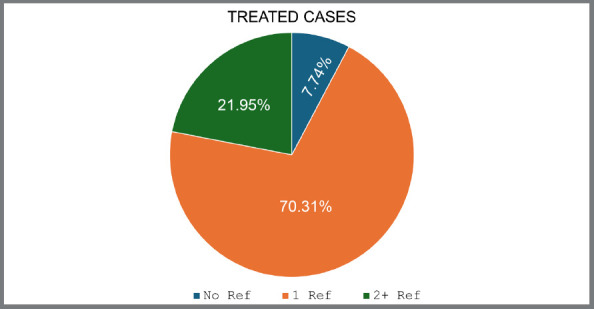 Figure 1
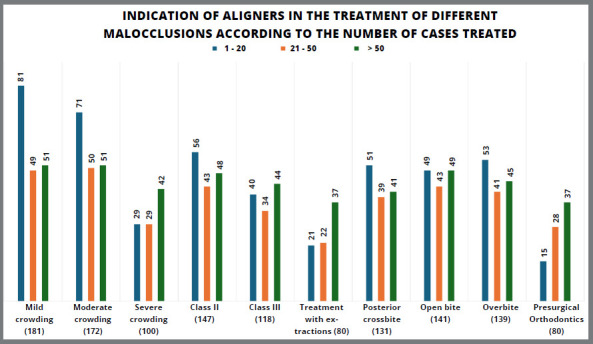 Figure 2
Peer Reviews
No public reviews on file for this paper yet. If you reviewed it on a platform where reviews are public (OpenReview, ICLR, NeurIPS, ICML), you can paste yours below so the community can read it here.
Videos
No videos yet. Explain this paper in a talk, walkthrough, or lecture? Add one.
Taxonomy
TopicsOrthodontics and Dentofacial Orthopedics · dental development and anomalies · Dental Implant Techniques and Outcomes
INTRODUCTION
Current technological advancements are changing not only how people interact with each other, but also their self-perception.1 ^,^ 2 Aesthetic appliances, once mainly a need for adult patients, are now sought by individuals of all ages.3 ^,^ 4 The rise in demand has driven both technical and technological innovations, which can now be digitally supported and fully programmed virtually.5 ^-^ 10
Aligners were initially indicated for aligning and leveling teeth, limited to small corrections4. However, technological advancements and the development of materials with increasingly favorable properties have gradually expanded the range of options for which aligners can be indicated.11 ^-^ 14
Despite a similar biological response, the mechanics of aligners differ from traditional fixed appliances, as they primarily “push” the tooth through elastic deformation.15 These unique characteristics, along with the need for patient cooperation, specific tooth movements (e.g., space closure, rotations, intrusions), and finishing/detailing, raise questions about the effectiveness of removable devices for treatment of different malocclusions.3 ^,^ 7 ^,^ 11 ^,^ 14 ^-^ 22
The impact of these limitations is evident in clinical practice, where only 50% of movements occur as planned.15 ^,^ 21 ^,^ 23 Based on the challenges of achieving specific tooth movements and the high cost of this treatment protocol, it is important to assess the need for additional aligners and identify the professional factors that contribute to this.
While some studies20 ^-^ 22 ^,^ 24 ^,^ 25 have explored clear aligner therapy (CAT) practices among orthodontists, data on the relationship between professional’s experience and the number of refinements requests remains limited. Surveys offer valuable insights,26 and previous studies21 ^,^ 22 using the same evaluation method (e-surveys) suggested the need for further researchers to investigate the challenges to achieve effective treatments with aligners.
Thus, the present research aimed to determine the frequency in which orthodontists need to request additional aligners during orthodontic treatment, and to correlate this need with the professional’s experience, both in terms of time and number of cases treated.
METHODS
The research was approved by the Research Institutional Board of University of North Paraná (UNOPAR) under protocol number 42471320.4.0000.0108.
A 14-question survey, specifically designed by the authors for this study, was created using Google Forms (Google, CA, USA). Potential evaluators were digitally invited via an instant messaging app (WhatsApp, Facebook Inc, CA, USA), in groups of orthodontists from all regions of Brazil. The instrument followed the CHERRIES checklist.27 The first section included an explanation of the study, and participants provided consent before proceeding. The second section covered questions regarding professional location, years as an orthodontic specialist, experience with aligners, number of cases treated and refinements requested, and the types of malocclusion most commonly treated with aligners. A pilot questionnaire was conducted releasing the survey to 10 orthodontists, to ensure the instrument’s validity and reliability.
Eligible respondents included orthodontists of both genders, performing their professional activity in Brazil, who had completed at least one treatment case using esthetic aligners. The respondents were categorized based on the following criteria:
- » Time of orthodontic training (OT) - years since obtaining the orthodontics specialty degree, categorized as: up to 10 years, 11 to 20 years, and over 20 years.
- » Working time with aligners (TA) - years of professional experience using aligners, categorized as: up to 5 years, 6 to 10 years, and over 10 years.
- » Number of treated cases (TC) - total cases treated with orthodontic aligners, categorized as: 1 to 20 cases, 21 to 50 cases, and more than 50 cases.
For evaluation purposes, professionals were instructed to consider only cases treated within the last 24 months, given the rapid technological advancements in the field in recent years that have significantly improved the clinical performance of aligners.
SAMPLE SIZE
The sample size calculation was based on an initial analysis of the first 100 cases, in which 76% required 1 refinement. Adopting a significance level of 5% and a statistical power of 80% to detect a difference of 10% between the groups, a minimum total sample of 321 cases per group was required. Therefore, a total of 963 cases would be necessary.
STATISTICAL ANALYSIS
The Statistical Package for the Social Science software (SPSS, version 27.0, IBM Inc., Armonk, NY, USA) was used for data analysis. Data are presented by absolute (n) and relative (%) frequencies.
To analyze the association between the categories of orthodontists with the use of 1 refinement or 2+ refinements, the chi-square test was used. When the result was statistically significant, the comparison between the three categories was made using the proportion test, to indicate between which categories there was a statistically significant difference. The significance level in all tests was set at 5%.
RESULTS
The survey was sent out to 350 orthodontists, and it was answered by 192. Four incomplete responses were excluded, resulting in a final sample of 188 professionals, evenly distributed by gender (96 females and 92 males).
The survey reported 2,937 aligner treatments completed in the last 24 months. Of these, 70.31% required additional aligners, and 21.95% needed two or more refinements (Fig. 1).
Figure 1:Proportion of the number of treated cases with and without refinements.
Table 1 shows the relationship between specialization experience and the frequency of additional aligner needed over the last 24 months. Professionals with up to 10 years or 11-20 years of specialization required refinements in 72.7% and 72.9% of cases, respectively, showing no significant difference. However, those with over 20 years of experience requested refinements in 82.3% of cases. For cases requiring more than one refinement, the highest prevalence was observed among the least experienced group (27.3%), followed by those with 11-20 years (27.1%) and those with over 20 years of specialization (17.7%).
Table 1:Association between orthodontic training time and the use of one or more refinements.Orthodontic training timeParticipantsCasesRef1 Ref 2+ Ref pnnnn%n% Up to 10 years^a^ 5447041830472.711427.3<0.00111 - 20 years^a^ 901225125291372.933927.1More than 20 years^b^ 441242121299882.321417.7Statistically significant at p<0.05. Categories with the same superscript letters have no statistically significant difference between them. Ref = Refinement.
When considering the length of experience using aligners (Table 2), professionals with 5 years or less of experience requested refinement in 76.8% of cases, and a rate similar to 80.2% was observed in those with over 10 years of experience, with no statistically significant difference. In contrast, the group with 6-10 years of experience had the lowest refinement rate, of 71%.
Table 2:Association between training time with aligners and the use of one or more refinements.Training time with alignersParticipantsCasesWith Ref1 Ref 2+ Ref pnnnn%n% Up to 5 years^a^ 11092885765876.819923.2<0.0016 - 10 years^b^ 4064972551571.021029.0More than 10 years^a^ 3813601300104280.225819.8Statistically significant at P<0.05. Categories with the same superscript letters have no statistically significant difference between them. Ref = Refinement.
Table 2 reveals that the group with 6-10 years of experience had the highest need for more than 1 refinement, of 29.0%. In comparison, professionals with over 10 years of experience using aligners requested, on average, more than one refinement in only 19.8% of cases. Those with up to 5 years of experience requested more than one refinement in 23.2% of treatments.
Table 3 shows a relationship between the number of cases treated with aligners and the need for refinement. The group that treated up to 20 cases showed the lowest refinement rate (72.4%), followed by those with more than 50 cases (76.5%) and those who treated 20-50 cases (81.0%). For cases requiring 2 or more refinements, the group with 20-50 cases had the lowest rate (19%), followed by those with more than 50 cases (23.5%) and those with 20 or fewer cases (27.6%).
Table 3:Association between the number of cases treated with aligners and the use of one or more refinements.Number of casesParticipantsCasesWith Ref1 Ref 2+ Ref pnnnn%n%1 - 20^a^ 8535733724472.49327.60.01220 - 50^b^ 5257352042181.09919.0More than 50^ab^ 5120272025155076.547523.5Statistically significant at P<0.05. Categories with the same superscript letters have no statistically significant difference between them. Ref=Refinement.
Figure 2 illustrates the type of malocclusions for which professionals from different groups indicated aligners as a treatment option, with mild crowding being the most common. All three groups chose aligners: 81 professionals (95.29%) in the group with up to 20 cases, 49 (94.23%) in the 21-50 cases group, and 51 (100%) in the group with over 50 cases. In contrast, presurgical orthodontics was the least commonly recommended for the up-to-20 cases group, with only 15 professionals (17.65%) selecting it. For the 21-50 cases group, aligners were least indicated for malocclusions requiring extractions, chosen by 22 professionals (42.30%). Among those with more than 50 treatments, aligners were least recommended for cases involving extractions and presurgical orthodontics, selected by 37 professionals (72.55%) in each group.
Figure 2:Indication of aligners in the treatment of different malocclusions according to the number of cases treated.
DISCUSSION
Aligners emerge in orthodontics as highly esthetic, hygienic option, and have been increasingly requested by patients.20 ^,^ 21 ^,^ 24 ^,^ 28 However, the predictability of digitally planned tooth movements is often low, leading to the need for additional aligners, which can increase both costs and treatment duration.7 ^,^ 17 ^,^ 23 ^,^ 29 ^-^ 31 To assess the need for refinement sets, professionals answered a questionnaire regarding the aligner’s cases treated in the last 24 months.
Table 1 reveals that the group of professionals with over 20 years of experience in Orthodontics had the highest need for refinements (82.3%), yet also the lowest need for a second or additional refinements (17.7%). These findings align with other e-survey-based studies,20 ^,^ 22 which report that over 80% of orthodontists require refinements. Additionally, a 2019 systematic review highlighted that professional experience positively impacts the selection of appropriate techniques and the quality of treatment outcomes.32 A similar study comparing orthodontists and general practitioners found that specialists, being more experienced, not only take longer with virtual treatment, but are also more likely to use additional aligners to achieve the desired result.6
These findings may reflect the fact that more experienced professionals are more critical of treatment outcomes and strive for optimal refinement. Additionally, their advanced understanding of biomechanics and tooth movement likely explains the lower need for second refinement.
Table 2 shows that just over half of the respondents (58%) have been using aligners for less than 5 years, a finding consistent with a recent study31 in which 50% of respondents reported using esthetic aligners for 5 years or less. The authors noted that less experienced professionals tend to show greater interest in esthetic aligners, as the technique is commonly taught in graduate courses. In contrast, only 20.2% of respondents have used aligners for over 10 years, yet this group accounted for the highest request for additional aligners (80.2%). However, they had the lowest need for second refinements (19.8%).
As professionals are more experienced with aligners, their confidence in treating complex cases rises,33 leading to longer, less predictable treatments that require more refinements. This is reflected in Table 3, in which the group with the fewest cases treated had the lowest need for additional aligners (72.4%). The next group, with 20-50 cases, despite having greater experience with aligners, required refinements in 81.0% of cases. As professionals treat more cases, they progress through the learning curve, better understanding the technique’s strengths and weaknesses. Although aligners are being indicated for increasingly complex cases, greater familiarity with the mechanics reduces the need for refinements. The group with over 50 treated cases showed a refinement rate of 76.5%, an intermediate value, compared to the two previous groups.
Mild and moderate crowding are the most commonly indicated malocclusions (Fig. 2), a finding consistent with a survey of 188 European professionals, in which crowding was the leading indication (86%).31 The present study shows that as crowding complexity increases, so does the number of professionals who indicate aligners. The prevalence of professionals recommending aligners for mild and moderate crowding remains similar across experience levels. However, for severe crowding, the prevalence rises with experience: 34.12% for those treating up to 20 patients, 55.77% for 21-50 cases, and 82.35% for those with over 50 cases. In other words, more experienced professionals tend to handle more complex cases.
A similar trend is seen in the malocclusions for which professionals least recommend aligners (Fig. 2). Among those with up to 20 cases, only 17.65% use aligners for pre-surgical orthodontics. For professionals with 21-50 cases, 42.30% avoid aligners for cases requiring extractions. Interestingly, while professionals with over 50 cases still use aligners less for these complex cases, their prevalence of recommendation (72.55%) is higher than that of the less experienced groups. This highlights that even for more challenging cases, experienced professionals are more likely to recommend aligners. They are better prepared to select suitable cases for aligner treatment and determine the appropriate auxiliary mechanics for each case.6 ^,^ 31
This study has limitations that must be considered. The use of aligners from different companies introduces potential bias, as variations in plastics, strength, and thickness that could affect treatment outcomes.34 Professional experience (years of training, number of cases, and time spent working with aligners) represents only one factor in requesting refinement sets. Other factors, including case complexity, patient compliance, and the aligner brand, also contribute to the need for refinements. Future studies should examine the impact of these variables on refinement needs.
CONCLUSION
- » Additional aligners were required in 70.31% of cases, with 21.95% needing a second refinement.
- » Professionals with more specialization time requested additional aligners more often (82.3%), but had the lowest need for second refinements (17.7%).
- » Orthodontists with more experience using aligners requested more refinements (80.2%) than others.
- » Professionals with fewer treated cases requested the least refinements (72.4%).
- » Aligners were most commonly indicated for mild and moderate crowding.
The reference list from the paper itself. Each links out to its DOI / PubMed record.
- 1Pithon MM Nascimento CC Barbosa GC Coqueiro RS Do dental esthetics have any influence on finding a job Am J Orthod Dentofacial Orthop 201414644234292526314410.1016/j.ajodo.2014.07.001 · doi ↗ · pubmed ↗
- 2Pithon MM Santos CR Santos NL Lima SOAS Coqueiro RS Santos RL Impact of malocclusion on affective/romantic relationships among young adults Angle Orthod 20168646386432636731210.2319/030915-146.1PMC 8601477 · doi ↗ · pubmed ↗
- 3Fialho T Freitas KMS Ohira ETB Souza JEP Oliveira RCG Oliveira RCG Comparison of the efficiency of initial dental alignment with Invisalign(r) aligners changed every 7 or 14 days in mature adults randomized clinical trial Orthod Craniofac Res 20242745445513832181510.1111/ocr.12766 · doi ↗ · pubmed ↗
- 4Paim J Souza LFD Fialho T Borba DBM Freitas KMS Cotrin P Assessment of patients' knowledge and preferences for the use of orthodontic aligners J Orthod 20245132512573832341510.1177/14653125241229456 · doi ↗ · pubmed ↗
- 5Azaripour A Weusmann J Mahmoodi B Peppas D Gerhold-Ay A Van Noorden CJ Braces versus Invisalign(r) gingival parameters and patients' satisfaction during treatment: a cross-sectional study BMC Oral Health 20151569692610438710.1186/s 12903-015-0060-4PMC 4478712 · doi ↗ · pubmed ↗
- 6Best AD Shroff B Carrico CK Lindauer SJ Treatment management between orthodontists and general practitioners performing clear aligner therapy Angle Orthod 20178734324392787428210.2319/062616-500.1PMC 8381984 · doi ↗ · pubmed ↗
- 7Djeu G Shelton C Maganzini A Outcome assessment of Invisalign and traditional orthodontic treatment compared with the American Board of Orthodontics objective grading system Am J Orthod Dentofacial Orthop 200512832922981616832510.1016/j.ajodo.2005.06.002 · doi ↗ · pubmed ↗
- 8Mandall NA Vine S Hulland R Worthington HV The impact of fixed orthodontic appliances on daily life Community Dent Health 2006232697416800360 · pubmed ↗