Design and development of primers for detection of Streptococcus pneumoniae, Haemophilus influenzae, and Neisseria meningitidis
Leila Azimi, Fatemeh Shirkavand, Shahnaz Armin, Fereshteh Karbasian, Hannan Khodaei

TL;DR
This paper designs highly sensitive primers for detecting bacteria that cause meningitis, improving diagnostic accuracy and speed.
Contribution
The study introduces novel primers with 10 times higher sensitivity than current commercial kits for detecting meningitis-causing bacteria.
Findings
The primers CtrA and hpd2 detected 400 copy numbers/ml of Haemophilus influenzae.
LytA2 detected 40 copy numbers/ml of Streptococcus pneumoniae.
All primers showed 100% sensitivity and specificity in detection.
Abstract
The mortality rate of meningitis is still alarmingly high in certain regions across the globe. The objective of this research is to identify the most effective primers for detecting Streptococcus (S.) pneumoniae, Haemophilus (H.) influenzae, and Neisseria (N.) meningitidis using Real-Time PCR technology. Two sets of primers were developed for detecting S. pneumoniae, H. influenzae, and N. meningitidis using the Primer Biosoft Allele ID 7.6 application. The study examined the minimum bacterial copy numbers detectable by each primer, as well as their specificity. CtrA and hpd2 could detect the 400 copy numbers/ml of H. influenzae, and N. meningitidis and LytA2 could detect the 40 copy numbers/ml of S. pneumoniae. The sensitivity and specificity of all primers was 100% (CI: 95%). Using more sensitive primers to detect the bacterial agent responsible for causing bacterial meningitis…
Genes, proteins, chemicals, diseases, species, mutations and cell lines named across the full text — each resolved to its canonical identifier and authoritative record.
Click any figure to enlarge with its caption.
 Figure 1
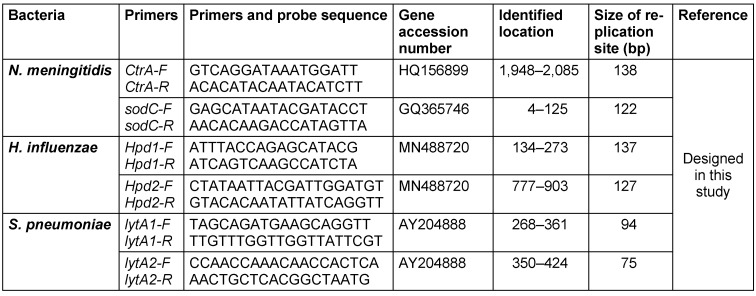 Figure 2
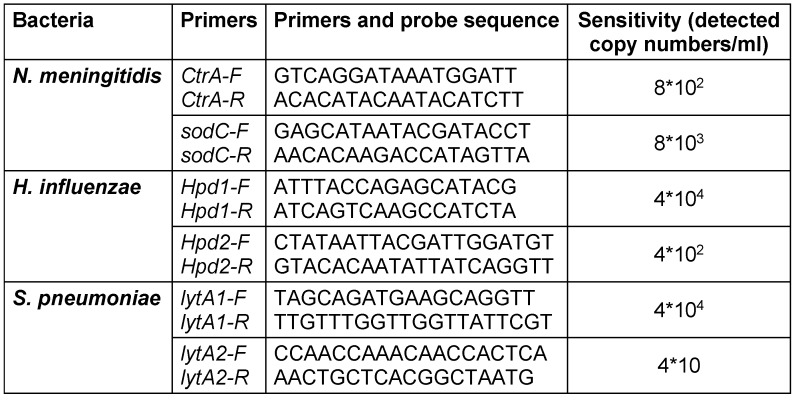 Figure 3
Peer Reviews
No public reviews on file for this paper yet. If you reviewed it on a platform where reviews are public (OpenReview, ICLR, NeurIPS, ICML), you can paste yours below so the community can read it here.
Videos
No videos yet. Explain this paper in a talk, walkthrough, or lecture? Add one.
Taxonomy
TopicsBacterial Infections and Vaccines · Pneumonia and Respiratory Infections · vaccines and immunoinformatics approaches
Introduction
H. influenzae, N. meningitidis, and S. pneumoniae can cause infection in important tissues such as blood and cerebrospinal fluid (CSF), requiring rapid intervention and healing [1], [2], [3], [4], [5]. Fast and early diagnosis of these bacteria is necessary for quick treatment and appropriate antibiotic therapy. Blood and CSF cultures (conventional culture or BACTEC) are traditional methods used to identify bacteria [6]. However, these methods are time-consuming and, in some cases, bacteria cannot grow in the culture medium due to the use of antibiotics and despite the clinical symptoms, bacterial growth is not observed. Molecular methods can be helpful in overcoming these disadvantages.
Real-time PCR, a molecular method, can be used for early diagnosis and fast treatment of the patient. Many commercial diagnosis kits with different levels of sensitivity are used worldwide to identify the cause of infections. The sensitivity and minimum detectable copy numbers of bacteria are related to the primers of the kits. As such, the primers play a key role in these diagnosis kits. In this regard, the aim of this study was to design a diagnostic panel using real-time PCR to identify H. influenzae, N. meningitidis, and S. pneumoniae.
Materials and methods
Samples and setting
H. influenzae, N. meningitidis, and S. pneumoniae, which were isolated from bacterial meningitides and had their identity confirmed by real-time PCR in the last study by our group [7], were selected. These strains were used to evaluate the designed primers.
Primer design
Two different pairs of primers were designed by Allele ID 7.6 for different genes or different parts of genes to detect H. influenzae (hpd gene), N. meningitidis (CtrA and SodC), and S. pneumoniae (lytA) (Table 1 (Tab. 1)).
DNA extraction
Bacterial genome extraction was performed using a DNA extraction kit (Qiagen Cat No./ID: 51304). The DNA concentration was read by Qubit. 10 dilutions were prepared by a factor of 101 for each bacterium, and the DNA concentration of all dilutions was determined by the Qbit instrument to determine the sensitivity and the cut-off point of these primers.
Real-time PCR assay
Real time-PCR assay was performed for the identification of bacteria using differently designed primers. Cyber green master mix and ABI step-one, in addition to the real-time PCR instrument, were used in this setup.
The DNA copy number calculator works according to the following equation:
where Amount (ng) is the amount of DNA in nanograms (ng) in the tube, 6.022x1.023 is Avogadro’s constant and represents the number of molecules per mole, Length (bp) is the length of DNA, in base pairs (bp), in the template (H. influenzae 1.830.137 bp, N. meningitidis 2.184.406 bp and S. pneumoniae 2.160.837 bp), 1x10^9^ is the factor used to convert to ng, Mass of DNA bp stands for the average mass of a DNA bp, which is either 660 (dsDNA) or 330 (ssDNA) g/mole. This value depends on what is selected as the type of DNA in the calculator (https://toptipbio.com/dna-copy-number-calculator/).
The genomes of *Acinetobacter baumannii, Pseudomonsa (P.) aeruginosa, Escherichia (E.) coli, Klebsiella (K.) pneumoniae, Enterobacter spp., Staphylococcus (S.) aureus and Enterococcus *spp. were used as a negative control to evaluate the specificity of these primers.
Results
The results of real-time PCR showing the sensitivity of these primers to detect the included bacteria are presented in Table 2 (Tab. 2).
None of the duplication observed with the genomes of A. baumannii, P. aeruginosa, E. coli, K. pneumoniae, Enterobacter spp., S. aureus and Enterococcus spp. confirmed the 100% (CI: 95%) specificity of these primers.
Discussion
Bacterial meningitis occurs most often in childhood and the etiological pathogens can be diverse in different age groups of children [4], [8], [9]. Based on previous studies, the incidence of bacterial meningitis can vary depending on factors such as time, geographical location, and patient age [4], [8], [9].
A systematic review and meta-analysis on the worldwide etiology of bacterial meningitis showed that the most prevalent causative pathogens were N. meningitidis and S. pneumoniae in all age groups, while S. pneumoniae was most prevalent in children [4]. An accurate method to identify these bacteria can be helpful in saving human lives and prevent them from becoming disabled in the future due to meningitis. The results of this study showed higher sensitivity of CtrA primer than SodC for the detection of N. meningitidis. On the other hand, different genome regions of hpd and LytA genes in H. influenzae and S. pneumoniae, respectively, were selected to design primers. The different results when various genes are selected to identify the bacteria, showing that the primer selected for nucleotide sequence between 777–903 has greater sensitivity for detecting H. influenzae. Also, primer design for nucleotide sequences between 350–424 is more sensitive for detecting S. pneumoniae.
In the study by Haddad-Boubaker et al. the results showed that Real-time PCR could detect up to 67.10^–4^ ng/µL DNA for S. pneumoniae, 38.10^–6^ ng/µL and 38.10^–3^ ng/µL for N. meningitidis ctrA gene and sodC gene, respectively, and 97.10^–4^ ng/µL for H. influenzae [10]. In the current study, the primers used were ctrA, hpd.2, and LytA.2. These results are near to ours.
Cyber green was used in the current study and is more affordable in comparison to using the probe of the Haddad-Boubaker et al. study [10]. One of the commercial molecular-diagnosis kits for the detection of these three bacteria is being used (Sacace™ NHS Meningitidis Real-TM) in Iran. The analytical sensitivity, genome equivalents/ml of this kit is 110^3^ (genome of bacteria/ml) [11], but the primers we designed have a minimum detectable bacterial genome 410*^2^* for N. meningitidis and H. influenzae and 4*10 for S. pneumoniae. These results showed that the primers designed in the current study detected bacteria with at least 10 times greater sensitivity. This is an important advantage of molecular diagnosis kits, especially when patients used antibiotics before the test.
Conclusions
The detection of the causative bacteria of meningitis can be helpful to choose the best therapeutic process as soon as possible. In this regard, selecting the most accurate and rapid method with the greatest possible sensitivity to identify relevant agents is necessary. It is important to know the exact cause of meningitis, because the choice of treatment depends on it.
Notes
Competing interests
The authors declare that they have no competing interests.
Ethical approval
Ethical approval No. IR.SBMU.RICH.REC.1399.061 was granted by the Pediatric Infections Research Center, Shahid Beheshti University of Medical Sciences, Tehran, Iran.
Funding
The research reported in this publication was supported by the Researcher Grant Committee under grant number [20326] from the Pediatric Infections Research Center, Shahid Beheshti University of Medical Sciences, Tehran, Iran.
Authors’ ORCID
- Azimi L: https://orcid.org/0000-0002-7216-2530
- Shirkavand F: https://orcid.org/0009-0001-5207-4883
- Armin S: https://orcid.org/0000-0002-4993-482X
- Karbasian F: https://orcid.org/0000-0003-2494-6231
- Khodaei H: https://orcid.org/0000-0002-2297-4733
The reference list from the paper itself. Each links out to its DOI / PubMed record.
- 1Pouladfar G Sanaei Dashti A Kadivar MR Jafari M Pourabbas B Jamalidoust M Evaluation of multiplex real-time PCR and WHO criteria for diagnosing childhood bacterial meningitis in a tertiary referral hospital in Iran Arch Pediatr Infect Dis 2022103 e 10182210.5812/pedinfect.101822 · doi ↗
- 2Tsang RSWA Narrative Review of the Molecular Epidemiology and Laboratory Surveillance of Vaccine Preventable Bacterial Meningitis Agents: Streptococcus pneumoniae, Neisseria meningitidis, Haemophilus influenzae and Streptococcus agalactiae Microorganisms 22Feb 20219244910.3390/microorganisms 902044933671611 PMC 7926440 · doi ↗ · pubmed ↗
- 3Ranjbar R Afshar D Isothermal and sensitive identification of Streptococcus pneumoniae using loop mediated isothermal amplification assay Arch Pediatr Infect Dis 201861 e 6160410.5812/pedinfect.61604 · doi ↗
- 4Oordt-Speets AM Bolijn Rvan Hoorn RC Bhavsar A Kyaw MH Global etiology of bacterial meningitis: A systematic review and meta-analysis P Lo S One 2018136 e 019877210.1371/journal.pone.019877229889859 PMC 5995389 · doi ↗ · pubmed ↗
- 5Corless CE Guiver M Borrow R Edwards-Jones V Fox AJ Kaczmarski EB Simultaneous detection of Neisseria meningitidis, Haemophilus influenzae, and Streptococcus pneumoniae in suspected cases of meningitis and septicemia using real-time PCRJ Clin Microbiol Apr 20013941553155810.1128/JCM.39.4.1553-1558.200111283086 PMC 87969 · doi ↗ · pubmed ↗
- 6Bahr NC Boulware DR Methods of rapid diagnosis for the etiology of meningitis in adults Biomark Med 2014891085110310.2217/bmm.14.6725402579 PMC 4239990 · doi ↗ · pubmed ↗
- 7Karimi A Rafiei Tabatabaei S Azimi L Almasian Tehrani N Fallah F Faghihian I Tracing the Negative Results of Multiplex Real-Time PCR Assay for Diagnosis of Bacterial Pediatrics Meningitis Can J Infect Dis Med Microbiol 20232023350266610.1155/2023/350266636698729 PMC 9870701 · doi ↗ · pubmed ↗
- 8WHO Health topics – Meningitis Geneva WHO Available from: https://www.who.int/health-topics/meningitis#tab=tab_1