A new species and updates on Paravelia Breddin, 1898 (Hemiptera, Heteroptera, Veliidae) in Brazil

Abstract
Genes, proteins, chemicals, diseases, species, mutations and cell lines named across the full text — each resolved to its canonical identifier and authoritative record.
Click any figure to enlarge with its caption.
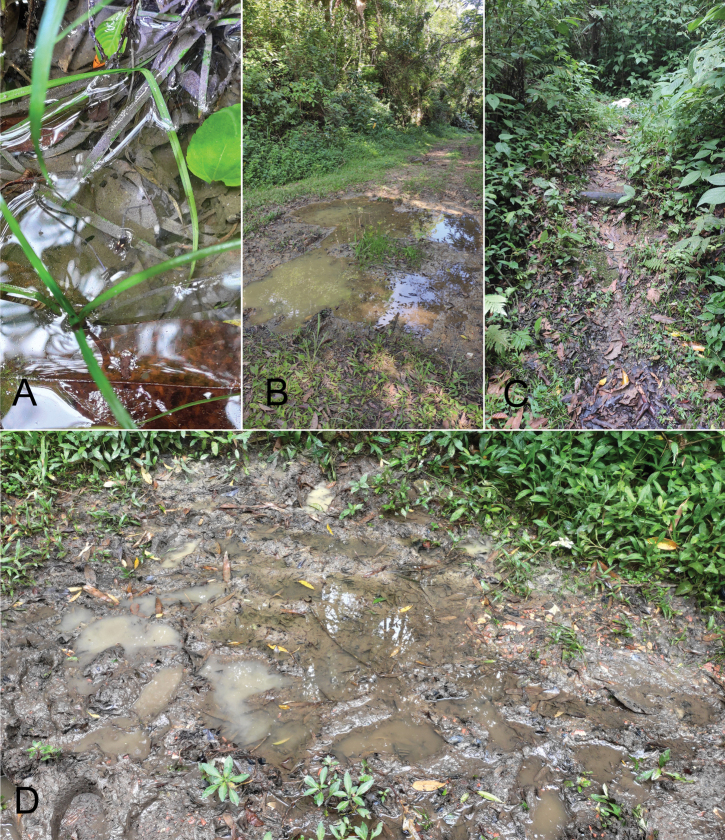 Figure 1
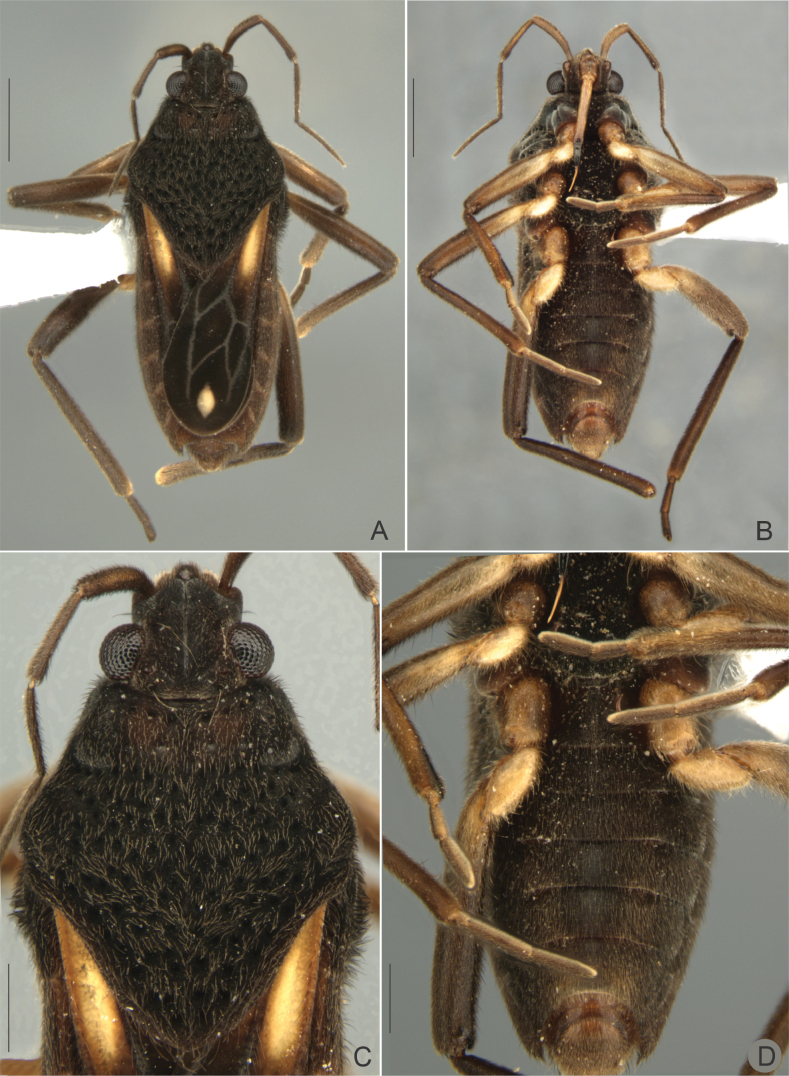 Figure 2
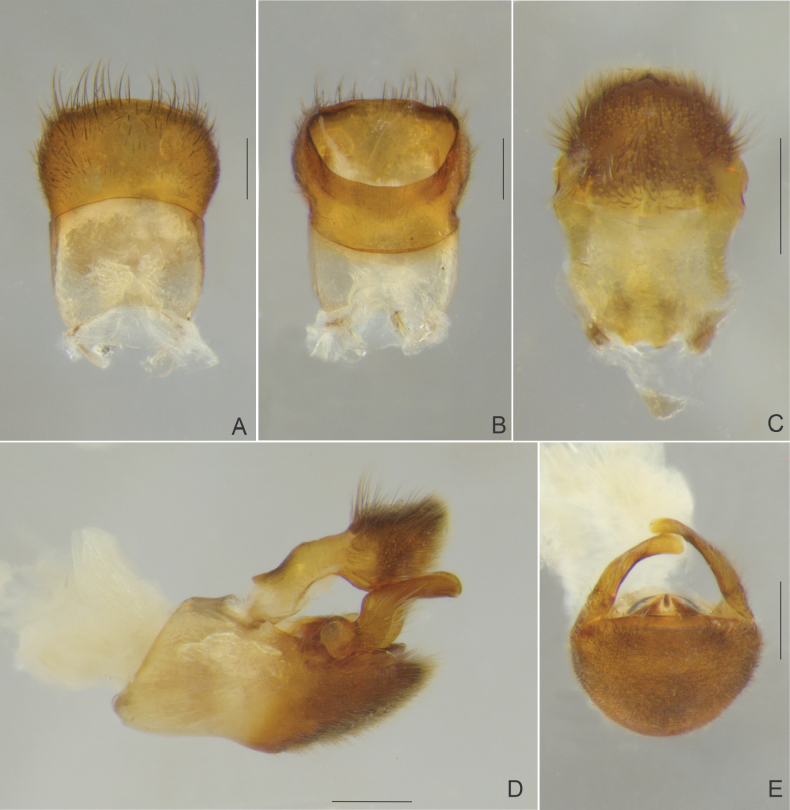 Figure 3
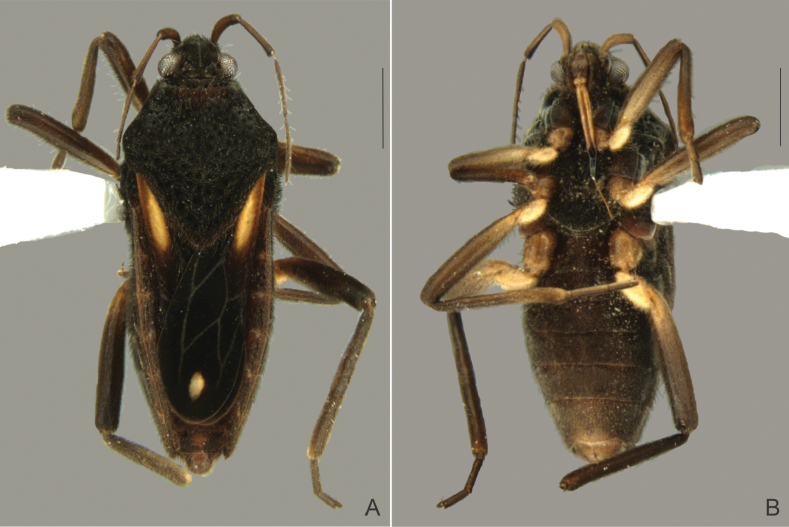 Figure 4
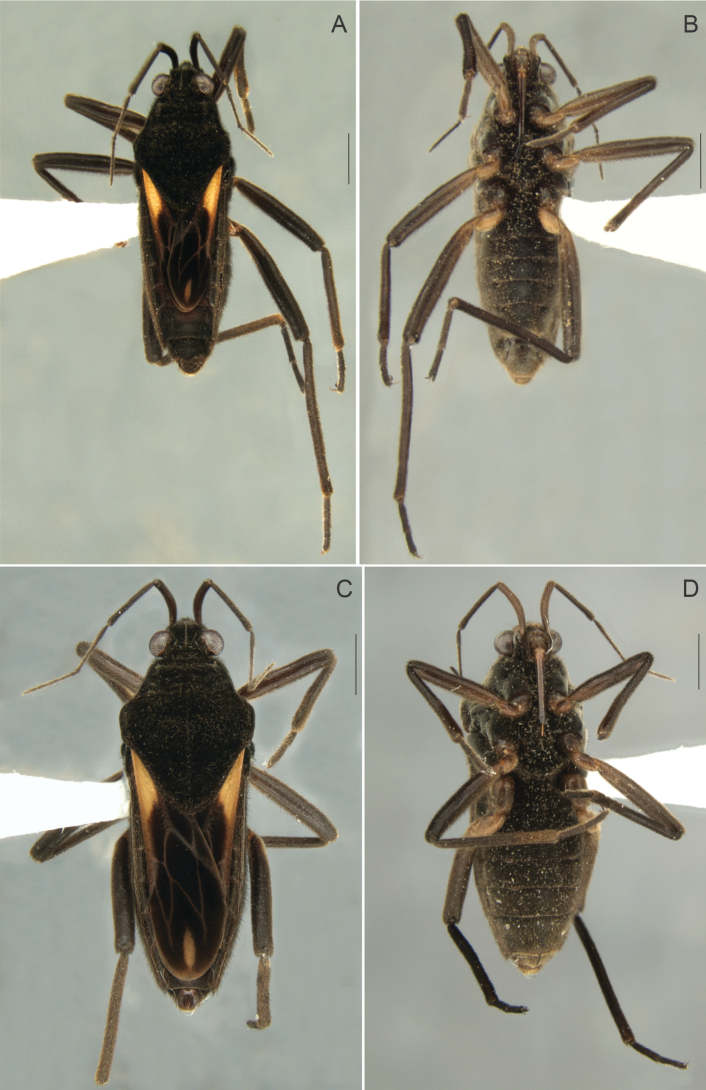 Figure 5
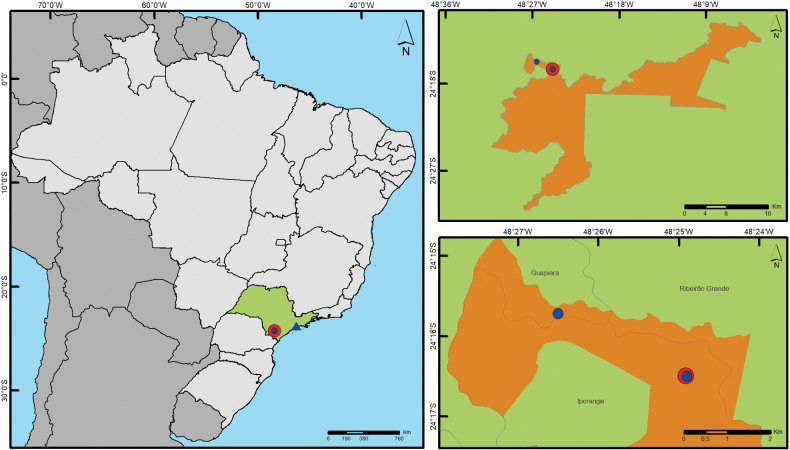 Figure 6
| 1 | Body shorter than 3.40 mm |
|
| – | Body at least 3.40 mm long |
|
| 2 | Head, pronotum, legs, and abdomen covered by small black denticles ( | |
| – | Body and legs without black denticles, covered by very long setae ( | |
| 3 | Forewings with bubble-like structures at basal region near humeral angles ( | |
| – | Forewings without bubble-like structures |
|
| 4 | Venter of abdomen covered by rounded or oval punctations ( | |
| – | Venter of abdomen not covered by rounded or oval punctations |
|
| 5 | Forewing with an elongated macula basally and a pair of laterally placed rounded maculae apically; all maculae whitish (as in |
|
| – | Forewing maculae not as above |
|
| 6 | Body length 3.60–4.20 mm; legs brown, lighter towards base, unarmed; forewing with basal macula long, starting close to humeral angle of pronotum | |
| – | Body length 4.55–4.95 mm; legs annulate, with black spinules on femora and tibiae; forewing with basal macula short, starting after apex of pronotum | |
| 7 | Forewing with basal and apical maculae small, of similar size, and rounded ( | |
| – | Forewing with basal and apical maculae of different sizes and/or shapes |
|
| 8 | Pronotal humeral angle with or without spinose projection ( | |
| – | Pronotal humeral angle never with spinose projection; forewing maculae not as above |
|
| 9 | Head, thorax, and abdominal laterotergites covered by small black denticles; pronotum orange or yellowish orange; forewing with an additional white stripe in front of the basal macula; one macula present on cubital vein and a whitish line surrounding the wing; at apex, another white macula (as in |
|
| – | Black denticles, if covering body, not distributed as above; pronotum with variable coloration; forewing at most with basal and apical maculae |
|
| 10 | General body color yellowish orange; body length approximately 5.00 mm; male abdominal sternum VII with a pair of distinct projections ( | |
| – | General body color orange to orange-brown; body length 3.80–4.25 mm; male abdominal sternum VII without projections (as in |
|
| 11 | Antennomere IV whitish, with small brown areas on base and apex ( | |
| – | Antennomere IV entirely orange-brown ( | |
| 12 | Forewing with basal macula distinctly yellow (as in Figs |
|
| – | Forewing with basal macula white or yellowish white |
|
| 13 | Male abdominal sternum VII with a pair of large projections ( |
|
| – | Male abdominal sternum VII without projections or lobes |
|
| 14 | Thorax and abdomen dark brown to black; basal macula of forewing starting from humeral angle; apical macula of forewings, when present, narrow and elongated ( | |
| – | Thorax dark-brown, abdomen ventrally light brown to brown; basal macula of forewing starting close to humeral angle; apical macula of forewings rounded ( | |
| 15 | Apical macula of forewing elongate-oval, almost reaching apex of wing (Figs | |
| – | Apical macula of forewing rounded to oval or diamond-shaped, located far from apex of wing (Figs |
|
| 16 | Legs and venter of abdomen with extensive yellowish areas ( | |
| – | Legs and venter of abdomen predominantly dark (Figs | |
| 17 | Body with small black denticles, which can be restricted to male abdominal segment VIII (in |
|
| – | Small black denticles completely absent from body |
|
| 18 | Posterior angle of pronotum ending in a robust, finger-like, upward directed process ( | |
| – | Posterior angle of pronotum without upward directed process; small black denticles with different disposition; male abdominal sternum VII without nodules on posterior region |
|
| 19 | Posterior angle of pronotum acuminated (as in |
|
| – | Posterior angle of pronotum rounded (as in |
|
| 20 | Pronotum orange, with anterior lobe, humeral angles, and wide median stripe brownish; base of paramere with dorsal surface slightly widened ( | |
| – | Pronotum dark brown to black, with margins of posterior lobe orange ( | |
| 21 | Small black denticles present on abdominal laterotergites; body length 3.54–4.00 mm |
|
| – | Small black denticles absent from abdominal laterotergites; body length 4.42–5.52 mm |
|
| 22 | Body length 3.54 mm; abdominal segment VIII of male without small black denticles; paramere curved mesally, becoming darker and narrower towards apex | |
| – | Body length 4.00 mm; abdominal segment VIII of male with small black denticles laterally; paramere not as above |
|
| 23 | Paramere curved, constricted near base and after middle, with wide apex | |
| – | Paramere with apex strongly curved and acute | |
| 24 | Anterior lobe of pronotum laterally with a pair of silvery pubescent areas ( | |
| – | Anterior lobe of pronotum without silvery pubescence (as in |
|
| 25 | Body length approximately 5.50 mm; forewing with a white, tear-like, basal macula starting from below humeral angle and surpassing posterior margin of pronotum ( |
|
| – | Body length 4.42–5.15 mm; forewing with a white, oval, basal macula not reaching humeral angle and ending adjacent to posterior margin of pronotum or slightly beyond ( |
|
| 26 | Grasping comb occupying 1/5 of fore tibial length; hind femur with a row of spines ( | |
| – | Grasping comb occupying 1/3 of fore tibial length; hind femur without spines; abdominal sterna II–VI with black denticles | |
| 27 | Body at least 4.90 mm long; non-bromelicolous species |
|
| – | Body shorter than 4.90 mm; bromelicolous species |
|
| 28 | Posterior angle of pronotum ending in a digitiform process ( |
|
| – | Posterior angle of pronotum rounded (as in |
|
| 29 | Body at most 6.00 mm long; forewing with apical macula projected laterally in the distal region ( | |
| – | Body longer than 6.00 mm; forewing with apical macula evenly ovate, not projected laterally ( | |
| 30 | Body length 5.80–6.00 mm; femora yellowish at basal half, rest of legs brownish ( | |
| – | Body length approximately 5.00 mm; legs dark brown ( | |
| 31 | Anterior lobe of pronotum without pubescence laterally ( | |
| – | Anterior lobe of pronotum with a pair of lateral, white, pubescent areas ( |
|
| 32 | Pubescence on anterior lobe of pronotum narrow, elongate, slightly curved laterally ( | |
| – | Pubescence on anterior lobe of pronotum subtriangular ( |
|
| 33 | Body black ( | |
| – | Body brown, reddish brown, or orange-brown ( |
|
| 34 | Apical macula of forewing usually rounded or oval, shorter than basal macula ( | |
| – | Apical macula of forewing narrow, elongate, at least as long as basal macula ( |
|
| 35 | Male proctiger only with a weak elevation at base ( | |
| – | Male proctiger with a weak elevation plus a small acute process at base ( |
- —Conselho Nacional de Desenvolvimento Científico e Tecnológico 501100003593 https://ror.org/03swz6y49 http://doi.org/10.13039/501100003593
- —Fundação Carlos Chagas Filho de Amparo à Pesquisa do Estado do Rio de Janeiro 501100004586 https://ror.org/03kk0s825 http://doi.org/10.13039/501100004586
- —Coordenação de Aperfeiçoamento de Pessoal de Nível Superior 501100002322 https://ror.org/00x0ma614 http://doi.org/10.13039/501100002322
Peer Reviews
No public reviews on file for this paper yet. If you reviewed it on a platform where reviews are public (OpenReview, ICLR, NeurIPS, ICML), you can paste yours below so the community can read it here.
Videos
No videos yet. Explain this paper in a talk, walkthrough, or lecture? Add one.
Taxonomy
TopicsHemiptera Insect Studies · Insect and Arachnid Ecology and Behavior · Forest Insect Ecology and Management
Introduction
Paravelia Breddin, 1898 is the most speciose genus of the subfamily Veliinae (Hemiptera, Heteroptera, Gerromorpha, Veliidae). It contains 46 species distributed from Mexico to Argentina, 35 of which occur in Brazil (Moreira 2024; Rodrigues and Moreira 2024). These semiaquatic bugs inhabit a wide range of lentic and lotic freshwater habitats, including emergent vegetation, surfaces of large rocks, logs, and roots in the water, as well as humid terrestrial environments (Mazzucconi et al. 2009). Alongside Microvelia Westwood, 1834, they are also the only gerromorphans inhabiting phytotelmata (Polhemus and Polhemus 1991).
Paravelia has gone through revisions since the 199’s, with several species being transferred to other genera (Polhemus and Polhemus 1993; Polhemus et al. 2019; Polhemus 2021; Rodrigues and Moreira 2024). Currently, it is characterized by following combination of features: mesoacetabulum and metasternum lacking lateral tubercles; tarsomere II of the middle leg usually 4–5 times longer than tarsomere I; pretarsus of the middle and hind legs with setae-shaped arolia and two falcate claws; and the macropterous form usually exhibiting two maculae on each forewing, one basally and the other apically (Rodrigues and Moreira 2016a, 2022, 2024).
In this study, we describe a new species of Paravelia from the state of São Paulo, Brazil. We also present new distribution records of P.luederwaldti Rodrigues & Moreira, 2016 and provide an updated key to the Paravelia recorded from Brazil.
Methods
Study area
Parque Estadual Intervales (PEI) is a conservation unit (CU) in the state of São Paulo, southeastern Brazil, that was established in 1995. It forms an ecological corridor together with five other contiguous CUs, representing one of the largest remnants of Atlantic Forest (Furlan and Leite 2008; Ribeiro et al. 2009). Currently, PEI encompasses an area of 41,704 ha in the Serra do Paranapiacaba mountain range, spreading through the municipalities of Eldorado Paulista, Guapiara, Iporanga, Ribeirão Grande, and Sete Barras. Elevations range from 60 to 1,100 m, which, combined with the humid climate, generates a wide range of environments. Two major hydrographic basins originate from the highest areas within PEI: Ribeira de Iguape river basin, which flows towards the coast, and Paranapanema river basin, which flows inland (Furlan and Leite 2008).
Sampling and taxonomy
We conducted two expeditions to PEI in November and December 2023 under permit from the Sistema Integrado de Gestão Ambiental of the state of São Paulo (#5695/2023). We obtained geographic coordinates of the collecting localities with a GPS receiver: (GPS Status and Toolbox, MobiWIA Ltd, Budapest, Hungary). We collected specimens using small sieves in temporary rain pools formed along trails (Fig. 1). Specimens are deposited in the Coleção Entomológica do Instituto Oswaldo Cruz, Rio de Janeiro, Brazil (CEIOC).
Photographs of the collecting localities in the Parque Estadual Intervales, São Paulo state, Brazil. A, D Puddles where P.intervalensis sp. nov. was collected B, C puddles where P.luederwaldti Rodrigues & Moreira, 2016 was collected.
Terminology, description, and measurements follow the standards established in the latest revision of the genus (Rodrigues et al. 2014). We obtained photographs using a Leica M205 C stereomicroscope coupled with a digital camera and the Leica LAS imaging system. We produced maps using QGIS version 3.34.11. The distribution of each species is according to Moreira (2024) and abbreviations of Brazilian states are according to the official standard (IBGE 2024).
Abbreviations used for measurements are as follows: body length (BL), head length (HL), head width through eyes (HW), length of antennomeres I–IV [without intersegmental pieces] (ANT I, ANT II, ANT III, ANT IV), maximum eye width (EYE), pronotum length on midline (PL), pronotum width (PW), length of foreleg segments (FORELEG), length of midleg segments (MIDLEG), length of hindleg segments (HINDLEG), femoral length (FEM), tibial length (TIB), length of tarsomeres I–III (TAR I, TAR II, TAR III). All measurements are given in millimeters.
Results and discussion
New species
Paravelia
intervalensis
sp. nov.
Taxon classificationAnimaliaHemipteraVeliidae
58C5CB9D-E9A4-57E6-B0E2-E289CDD09BCB
https://zoobank.org/F19F5762-5779-4E91-AC7B-37AE0E65AFFC
Type material.
Holotype. Brazil – São Paulo • Iporanga, Parque Estadual Intervales, poça de chuva na trilha; 24°16'29.6"S, 48°24'54.4"W; 23.XI.2023; L.L. Dumas, J.M.S. Rodrigues & R.P.R. Canejo leg.; macropterous ♂, CEIOC 83571. Paratypes. Same data as holotype; 17 macropterous ♂, 12 macropterous ♀, CEIOC 83572.
Macropterous male.
(Figs 2, 3) BL 5.12–5.18; HL 0.50–0.57; HW 0.95–1.00; ANT I 0.59–0.60; ANT II 0.59–0.60; ANT III 0.65–0.68; ANT IV 0.74–0.77; EYE 0.20–0.23; PL 1.80–1.85; PW 1.85–1.90; FORELEG, FEM 1.28–1.34; TIB 1.25–1.31; TAR I 0.07–0.10; TAR II 0.24–0.26; TAR III 0.38–0.41; MIDLEG, FEM 1.55–1.68; TIB 1.55–1.60; TAR I 0.08–0.12; TAR II 0.58; TAR III 0.52–0.56; HINDLEG, FEM 1.96–2.03; TIB 2.28–2.36; TAR I 0.08–0.15; TAR II 0.38–0.45; TAR III 0.45–0.55.
Paraveliaintervalensis sp. nov., holotype, macropterous male. A Dorsal view B ventral view C head, pronotum and part of the anterior wing, dorsal view D abdomen and part of the legs, ventral view. Scale bars: 0.5 mm (C, D); 1 mm (A, B).
Paraveliaintervalensis sp. nov., male terminalia. A, B Abdominal segment VIII A dorsal view B ventral view C proctiger, dorsal view D, E genital capsule D lateral view E anterior view. Scale bars: 0.2 mm.
General color dark brown to black. Head black. Antenna brown to dark brown; antennomeres I–II brown, with base and apex dark brown. Labium with two basal articles brown; article III yellow laterally, brown medially; distal segment blackish. Pronotum black. Thoracic sterna black. Acetabula dark brown laterally; yellowish-brown mesally. Forewing black, with an elongated yellow macula reaching humeral angle and slightly surpassing posterior margin of pronotum; at apex, a small diamond-shaped white macula, smaller than basal macula (Fig. 2A); veins whitish. Coxae brown, with yellow marks. Trochanters yellow. Femora dark brown, with yellow mark at base of ventral surface; fore femur with yellowish mark at middle of dorsal surface. Tibiae brown, with yellow mark at apex. Tarsi dark brown. Abdominal laterotergites light brown mesally, dark brown laterally; intersegmental areas with yellowish marks. Venter of abdomen, dark brown; terminalia lighter.
Head covered by fine golden pubescence intermixed with elongate black and golden setae; dorsal midline impressed, shiny, posteriorly with pair of oblique, impressed, shiny lines and pair of indentations near mesal eye margins. Buccula and jugum without black denticles. Ocular setae present. Antenniferous tubercle developed, shiny. Antenna covered by golden pubescence and elongate golden setae scattered on segments II–IV; antennomere I robust, curved laterally; II thicker than III–IV.
Pronotum subpentagonal, covered by fine golden pubescence intermixed with elongate black setae; anterior lobe with row of rounded punctations adjacent to anterior margin; posterior lobe covered by rounded punctations, these larger towards apex; humeral angle slightly elevated; posterior angle slightly tapered, apex rounded (Fig. 2C, D). Forewings leaving apex of abdominal segment VII exposed, with four closed cells; veins on basal half with small golden setae. Proepimeron with rounded punctations. Meso- and metapleura with scattered rounded punctations. Prosternum with a row of four rounded punctations anteriorly. Meso- and metasterna with two pairs of small tubercles meeting centrally at intersegmental region. Legs densely covered by short, appressed, pale setae and elongate, brownish setae. Hind femur without spines.
Abdominal laterotergites covered by golden pubescence; elevated, without black denticles; last produced posteriorly. Abdominal sterna covered by fine golden pubescence and elongate dark brown setae; the latter concentrated on lateral margins; II compressed laterally and bearing weak longitudinal carina anteriorly; VII without projections or nodules (Fig. 2C); posterior margin evenly concave, with robust black denticles posterolaterally. Abdominal segment VIII with fine, golden pubescence on apical 2/3 intermixed with elongate, dark-brown setae dorsolaterally (Fig. 3A, B). Proctiger with elongate golden setae on apical half, without spines (Fig. 3C). Paramere (Fig. 3D, E), in lateral view, notched on dorsal surface, sinuous, with elongate golden setae and rounded apex (Fig. 3D).
Macropterous female.
(Fig. 4) BL 5.37–5.44; HL 0.60–0.66; HW 1.08–1.15; ANT I 0.54–0.60; ANT II 0.60–0.66; ANT III 0.72–0.80; ANT IV 0.80–0.86; EYE 0.20–0.28; PL 1.85–2.00; PW 1.87–1.94; FORELEG, FEM 1.25–1.28; TIB 1.25–1,29; TAR I 0.07–0.10; TAR II 0.20–0.25; TAR III 0.38–0.42; MIDLEG, FEM 1.60–1.68; TIB 1.76–1.80; TAR I 0.07–0.10; TAR II 0.48–0.56; TAR III 0.48–0.50; HINDLEG, FEM 1.80–1.85; TIB 2.26–2.30; TAR I 0.06–0.08; TAR II 0.50–0.54; TAR III 0.48–0.52.
Paraveliaintervalensis sp. nov., paratype, macropterous female. A Dorsal view B ventral view. Scale bars: 1 mm.
General color and structure as in brachypterous male. Body longer; forewings leaving posterior margin of abdominal mediotergite VI exposed; abdomen more robust, with laterotergites more elevated.
Etymology.
The new species is named after Parque Estadual Intervales, the type locality.
Discussion.
Paraveliaintervalensis sp. nov. can be distinguished from the other species of the genus by the following combination of features: BL ~5.1–5.5; head, thorax, and abdomen (except posterior margin of sternum VII) not covered by small black denticles; humeral angle not spinose (Figs 2A, C, 4A); forewings without bubble-like structures, with a pair of elongated yellow maculae basally and a small diamond-shaped white macula apically (Figs 2A, C, 4A); yellow maculae reaching humeral angles and white macula far from apex of forewings (Figs 2A, C, 4A); venter of abdomen not covered by punctations (Figs 2B, D, 4B); male abdominal sternum VII without projections or lobes (Fig. 2D); male proctiger without conical process at base, without lateral projections approximately at middle of length (Fig. 3C); and male paramere with a dorsal notch in lateral view (Fig. 3D).
This species runs to couplet P.luederwaldti vs P.luisi Rodrigues & Moreira, 2022 in the key provided by Rodrigues and Moreira (2022). In P.luederwaldti, however, the apical macula of the forewings is elongate-oval and almost reaches the wing apex (Fig. 5A), the male proctiger bears a conical process at base (Rodrigues and Moreira 2016a: fig. 21), and the paramere is not notched at the dorsal surface (Rodrigues and Moreira 2016a: fig. 21). In turn, P.luisi is lighter and more yellowish than the other two species (Rodrigues and Moreira 2022: figs 1, 2); has shorter, more rounded, basal forewing maculae that do not surpass the apex of the pronotum (Rodrigues and Moreira 2022: figs 1A, 2A, C); and bears lateral projections on the male proctiger (Rodrigues and Moreira 2022: fig 3C).
Paravelialuederwaldti Moreira & Rodrigues, 2016. A, B Brachypterous male A dorsal view B ventral view C, D submacropterous female C dorsal view D ventral view. Scale bars: 1 mm.
Geographic distribution of Paraveliaintervalensis sp. nov. and P.luederwaldti Rodrigues & Moreira, 2016 in São Paulo state (highlighted in green). Parque Estadual Intervales is highlighted in orange. P.intervalensis sp. nov. record is indicated by a red circle. P.luederwaldti records are indicated by blue circles (new) and triangle (previous).
New record
Paravelia
luederwaldti
Taxon classificationAnimaliaHemipteraVeliidae
Rodrigues & Moreira, 2016
5CDA3421-CAFE-5567-8919-7F42C11C4CAD
Material examined.
Brazil – São Paulo • Iporanga, Parque Estadual Intervales, poças na trilha; 24°16'30"S, 48°24'54"W; 814 m alt.; 23.XI.2023; L.L. Dumas, J.M.S. Rodrigues & R.P.R. Canejo leg.; 2 ♂, 2 ♀, CEIOC 83573 • Guapiara, Parque Estadual Intervales, poças na lama, em estrada de terra; 24°15'43"S, 48°26'30"W; 924 m alt.; 03.XII.2023; L.L. Dumas, J.M.S. Rodrigues, L. Nery & L. Hoehne leg.; 7 ♂, 2 ♀, CEIOC 83574.
This is the first record of this species since its original description by Rodrigues and Moreira (2016a). The type series was also collected in the Serra do Paranapiacaba mountain range, about 220 km north of the new records.
Key to the species of Paravelia recorded from Brazil
(modified from Rodrigues and Moreira 2022)
**: **
Supplementary Material
XML Treatment for Paravelia intervalensis
XML Treatment for Paravelia luederwaldti
The reference list from the paper itself. Each links out to its DOI / PubMed record.
- 1Furlan SA Leite SA (2008) Plano de manejo do Parque Estadual de Intervales. https://fflorestal.sp.gov.br/planos-de-manejo/planos-de-manejo-planos-concluidos/plano-de-manejo-pe-intervales/ [Accessed on 19.X.2024]
- 2Hungerford HB (1930) Three new Velia from South America.Journal of the Kansas Entomological Society 3: 23–27. 10.1093/aesa/23.1.120 · doi ↗
- 3IBGE (2024) Cidades e Estados. https://www.ibge.gov.br/cidades-e-estados [Accessed on 19.X.2024]
- 4Mazzucconi SLópez-Ruf M Bachmann AO (2009) Hemiptera – Heteroptera: Gerromorpha y Nepomorpha. In: Dominguez E Fernández HR (Eds) Macroinvertebrados bentónicos sudamericanos.Sistemática y Biología. Fundación Miguel Lillo, Tucumán, 167–231.
- 5Moreira FFF (2024) Veliidae in Catálogo Taxonômico da Fauna do Brasil. http://fauna.jbrj.gov.br/fauna/faunadobrasil/9453 [Accessed on 09.XI.2024]
- 6Moreira FFF Barbosa JF (2012) Two new species of Paravelia Breddin, 1898 and distributional notes concerning the Veliidae from Minas Gerais State, Brazil (Insecta: Hemiptera: Heteroptera: Gerromorpha).Zootaxa 3354: 58–68. 10.11646/zootaxa.3354.1.2 · doi ↗
- 7Polhemus DA (2021) Callivelia, a new genus for certain Neotropical Veliinae (Heteroptera: Veliidae), including description of a new species.Zootaxa 4950(2): 345–360. 10.11646/zootaxa.4950.2.633903441 · doi ↗ · pubmed ↗
- 8Polhemus JT Polhemus DA (1984) Notes on Neotropical Veliidae (Hemiptera) IX: additional new species of Paravelia from South America.Amazoniana 8: 497–504.