Organ-preserving endoscopic resection of a large colorectal lesion causing McKittrick–Wheelock syndrome
Shi Jie Looi, Omer Ahmad, Edward Seward, Roser Vega

Abstract
Genes, proteins, chemicals, diseases, species, mutations and cell lines named across the full text — each resolved to its canonical identifier and authoritative record.
Click any figure to enlarge with its caption.
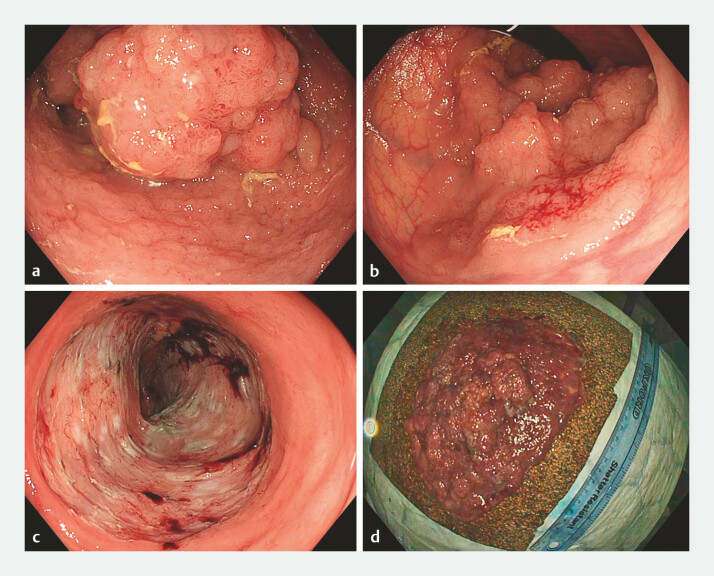 Fig. 1
Peer Reviews
No public reviews on file for this paper yet. If you reviewed it on a platform where reviews are public (OpenReview, ICLR, NeurIPS, ICML), you can paste yours below so the community can read it here.
Videos
No videos yet. Explain this paper in a talk, walkthrough, or lecture? Add one.
Taxonomy
TopicsBiliary and Gastrointestinal Fistulas · Gastrointestinal disorders and treatments · Esophageal and GI Pathology
McKittrick–Wheelock syndrome is a rare but life-threatening condition characterised by severe diarrhoea, electrolyte disturbances, and kidney injury caused by colorectal tumours 1 . The majority of reported cases have been managed by surgical resection 2 . We demonstrate a case of McKittrick–Wheelock syndrome managed endoscopically by speedboat-assisted endoscopic submucosal dissection (S-ESD). S-ESD involves the use of a novel endoscopic electrosurgical device combining advanced bipolar radiofrequency for dissection and microwave energy for coagulation ( Video 1 ). This technique was selected to enable en-bloc resection with the potential for organ preservation, while minimising the risks associated with surgery below the peritoneal reflection, particularly in an elderly patient with multiple co-morbidities.
Speedboat-assisted endoscopic submucosal dissection (S-ESD) of a large colorectal lesion causing McKittrick–Wheelock syndrome.Video 1
The lesion was removed en-bloc completely by S-ESD ( Fig. 1 ). Our patient had an uneventful recovery without any immediate or delayed complications. Histology confirmed R0 resection of a tubulovillous adenoma with low-grade dysplasia and focal high-grade dysplasia. S-ESD using Speedboat is a safe alternative to surgery for the management of McKittrick–Wheelock syndrome especially with lesions below the peritoneal reflection to minimise complications associated with surgery.
Endoscopic resection of a large colorectal lesion causing McKittrick–Wheelock syndrome. a, b , Laterally spreading tumour extending from the rectum beyond the rectosigmoid junction. c Resection bed following Speedboat-assisted endoscopic submucosal dissection. d Final specimen measuring over 17 cm.
Endoscopy_UCTN_Code_TTT_1AQ_2AD_3AD
The reference list from the paper itself. Each links out to its DOI / PubMed record.
- 1Hashash JG Holder-Murray J Aoun E The Mc Kittrick-Wheelock syndrome: a rare cause of chronic diarrhoea BMJ Case Rep 201310.1136/bcr-2013-009208 PMC 364565123592821 · doi ↗ · pubmed ↗
- 2Orchard MR Hooper J Wright JAA systematic review of Mc Kittrick-Wheelock syndrome Ann R Coll Surg Engl 20181001710.1308/rcsann.2018.0184 PMC 620450530322287 · doi ↗ · pubmed ↗