Hysterectomy rates per resident in final year of training in teaching hospitals: an ecologic study
Luiza Nestori Chiozzotto, Nino José Wilson Moterani, Laura Bresciani Bento Gonçalves Moterani, Vinicius César Moterani, Francisco José Candido dos Reis

TL;DR
This study examines how the number of hysterectomies performed per resident in their final training year changed in teaching hospitals in São Paulo, Brazil, from 2009 to 2019.
Contribution
The study provides new insights into the relationship between resident training and surgical trends in hysterectomy rates and techniques.
Findings
Hysterectomy rates per resident dropped by 24.1% between 2009 and 2019.
The decline was most significant for vaginal (46.4%) and abdominal (23.3%) routes.
Laparoscopic hysterectomies increased 264% but remained a small proportion of surgeries in 2019.
Abstract
Analyze the hysterectomy rates per resident in graduation year in teaching hospitals in the state of São Paulo (Brazil). We selected teaching hospitals in the state of São Paulo and gathered information from two public databases to estimate the hysterectomy rates per resident in their final year of training between 2009 and 2019. Between 2009 and 2019, there was a 37.5% increase in the number of residents in their final year of training, a 4.31% increase in the number of hysterectomies, and a drop in the hysterectomy rates per resident of 24.1%. The reduction of the rate of hysterectomy per resident was more pronounced for vaginal route (46.4%) followed by abdominal route (23.3%). The ratio of laparoscopic hysterectomy per resident increased 264% during the period, however, this route was used in only 7% of the surgeries in 2019. The hysterectomy rates per resident in their final…
Genes, proteins, chemicals, diseases, species, mutations and cell lines named across the full text — each resolved to its canonical identifier and authoritative record.
Click any figure to enlarge with its caption.
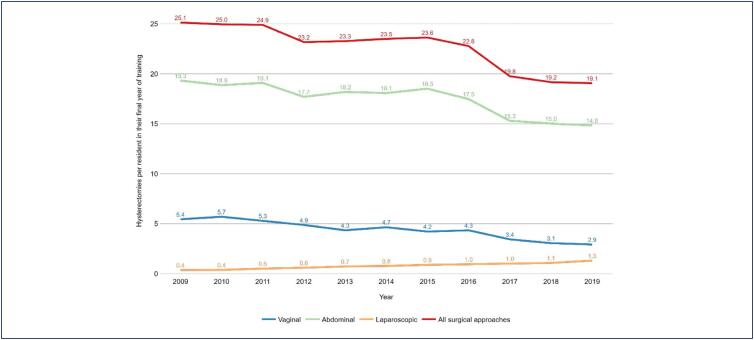 Figure 1
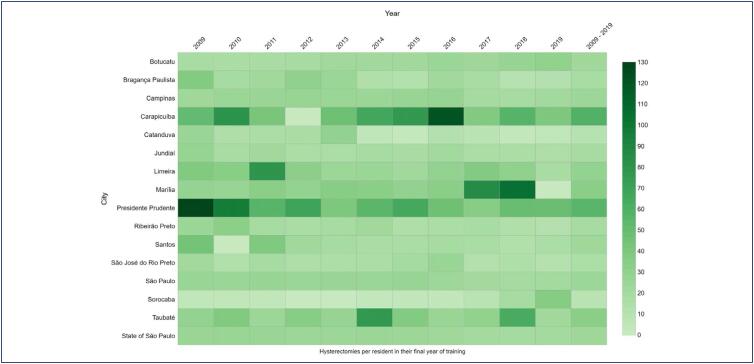 Figure 2
| City | Teaching hospital |
|---|---|
| Botucatu |
|
| Bragança Paulista |
|
| Campinas |
|
|
| |
| Carapicuíba |
|
| Catanduva |
|
| Jundiaí |
|
| Limeira |
|
| Marília | |
| Presidente Prudente |
|
| Ribeirão Preto |
|
|
| |
| Santos |
|
|
| |
| São José do Rio Preto |
|
| São Paulo (metropolitan area) |
|
|
| |
|
| |
|
| |
|
| |
|
| |
|
| |
|
| |
|
| |
|
| |
|
| |
|
| |
|
| |
|
| |
| Sorocaba |
|
| Taubaté |
|
| Year | Residents in final year | Hysterectomies | Abdominal hysterectomies | Vaginal hysterectomies | Laparoscopic hysterectomies |
|---|---|---|---|---|---|
| 2009 | 192 | 4,825 | 3,710 | 1,046 | 69 |
| 2010 | 197 | 4,916 | 3,718 | 1,123 | 75 |
| 2011 | 194 | 4,830 | 3,704 | 1,026 | 100 |
| 2012 | 197 | 4,565 | 3,486 | 961 | 118 |
| 2013 | 207 | 4,817 | 3,765 | 900 | 152 |
| 2014 | 215 | 5,052 | 3,886 | 1,000 | 166 |
| 2015 | 225 | 5,316 | 4,166 | 950 | 200 |
| 2016 | 223 | 5,079 | 3,896 | 969 | 214 |
| 2017 | 254 | 5,019 | 3,886 | 874 | 259 |
| 2018 | 258 | 4,945 | 3,876 | 790 | 279 |
| 2019 | 264 | 5,033 | 3,915 | 772 | 346 |
| 2009 - 2019 | 2426 | 54,397 | 42,008 | 10,411 | 1,978 |
Peer Reviews
No public reviews on file for this paper yet. If you reviewed it on a platform where reviews are public (OpenReview, ICLR, NeurIPS, ICML), you can paste yours below so the community can read it here.
Videos
No videos yet. Explain this paper in a talk, walkthrough, or lecture? Add one.
Taxonomy
TopicsSurgical Simulation and Training · Hospital Admissions and Outcomes · Cardiac, Anesthesia and Surgical Outcomes
Introduction
Hysterectomy is the most commonly performed gynecological surgery in several countries, consisting of uterus removal for treatment of various gynecological diseases.^(1,2)^ The possible routes are abdominal, vaginal, and laparoscopic.^(1,3)^ Each has its advantages and disadvantages, with the choice depending on the diagnosis, health conditions and anatomy of the patient, hospital technical availability, and the surgeon's preference and experience.^(3)^ Although the vaginal and laparoscopic routes have less impact on the patient's recovery, the most used route is the abdominal.
The medical residency program in Obstetrics and Gynecology aims to specialize and capacitate physicians in clinical and surgical interventions related to women's health.^(4)^ Currently, the milestones designed by the Brazilian Federation of Obstetrics and Gynecology Associations (FEBRASGO) define that each resident must have acquired surgical competencies and that, by the end of the program, they will be able to perform hysterectomy through various surgical approaches.^(5)^
The resident physicians must participate in several surgeries throughout their training to acquire competencies and follow an adequate learning curve. Residents will practice these skills depending on availability and demand at their educational institution. We estimated that the number of residents in Brazil has increased; therefore, the number of hysterectomies performed per resident has decreased throughout the years. In this context, there is concern regarding the acquisition of this competence.
This study aimed to analyze the hysterectomy rates per resident in the last year of training within teaching hospitals located in the state of São Paulo (SP), Brazil.
Methods
Study design
We performed a retrospective and descriptive study of public databases, using information from the following databases: Certificate Consultation System of the National Medical Residency Commission (SisCNRM) and Hospital Information System of the Unified Health System (SIH/SUS).^(6,7)^ We obtained data on the annual number of resident doctors in their graduation year and the annual number of non-oncological hysterectomies in teaching hospitals in the state of SP from 2009 to 2019. This study follows the STROBE guideline.
Ethics approval and consent to participate
Research that exclusively involves public domain data and does not identify research participants does not require ethical approval. We followed the Declaration of Helsinki.
Data source and variables
We selected Obstetrics and Gynecology Medical Residency programs in cities with at least 200 thousand inhabitants, totaling 15 cities and 31 teaching hospitals (Chart 1).
Chart 1: Teaching hospitals and their respective cities
SisCNRM is a database used to monitor medical residency programs. We extracted tables with the number of residents in their final year of training at teaching hospitals located in the state of São Paulo annually from 2009 to 2019.
The SIH/SUS contains information about hospital procedures performed in the Brazilian public health system (SUS). We extracted tables containing the number of non-oncological hysterectomies classified by route performed in the selected teaching hospitals annually from 2009 to 2019.
We calculated hysterectomy rates per resident in each city annually from 2009 to 2019 by dividing the number of surgeries by the number of residents in their final year of training.
We excluded data from Hospital Ana Costa (Santos) and Hospital do Servidor Público Francisco Morato Oliveira (city of São Paulo) due to lack of data on the number of hysterectomies.
Statistical analysis
We aimed to identify if there is a variation in the proportion of hysterectomies per resident. To compare the hysterectomies per resident rate ratio on the first and last year of the study we used the Poisson rate ratio. An exact Poisson test was applied to compare the hysterectomies per resident rate ratio in 2009 and 2019. The same procedure was also done in hysterectomies per resident per route. We further generated a line and a heatmap graphs in the Displayr program (https://www.displayr.com/, accessed in February 2024).^(8)^
Results
Table 1 shows the number of residents in their final year of training and hysterectomies in the selected teaching hospitals in the state of São Paulo between 2009 and 2019. In total, we identified 2,426 residents in their final year of training. There were 192 residents in 2009 and 264 in 2019, with an increase of 37.5%. In total, we counted 54,397 hysterectomies. We identified 4,825 hysterectomies performed in 2009 and 5,033 in 2019, with an increase of 4.31%. The most used route was abdominal (77.22%), followed by vaginal (19.14%) and laparoscopic (3.64%).
Figure 1 shows the trend in the rates of hysterectomies per resident in their final year between 2009 and 2019 in the state of SP. There has been a trend towards decreasing rates of hysterectomies per resident over the years, with the highest value of 25.1 in 2009 and the lowest value of 19.1 in 2019. The rates of abdominal and vaginal hysterectomies follow the same trend. Laparoscopic hysterectomies show an increasing trend, although they remain in low value.
Hysterectomy rate per resident in their final year of training between 2009 and 2019
When comparing the first and last year of the study, the rate ratio of total hysterectomies per resident was 0.759 (95% CI: 0.729 – 0.789, p <0,001), therefore a 24.1% reduction. The rate ratio of abdominal hysterectomies per resident was 0.767 (95% IC: 0.733 – 0.802, p < 0.001), therefore a 23.3% reduction. The rate ratio of vaginal hysterectomies per resident was 0.536 (95% IC: 0.488 - 0.589, p < 0.001), therefore a 46.4% reduction. The rate ratio of laparoscopic hysterectomies was 3.64 (95% IC: 2.809 - 4.793, p < 0.001), therefore a 3.64 times increase.
Figure 2 shows hysterectomy rates per resident in final year between 2009 and 2019 for each selected city. In 2019, the city with the most hysterectomies per resident was Presidente Prudente (48.4), followed by Carapicuíba (39.3), Sorocaba (35.0) and Botucatu (29.4). On average, between 2009 and 2019, the city with the most hysterectomies per resident was Carapicuíba (59.0), followed by Presidente Prudente (55.3), Taubaté (32.3) and Marília (32.2).
Heatmap of hysterectomy rates per resident in their final year of training in the cities of the selected hospitals between 2009 and 2019
Discussion
Between 2009 and 2019, the number of residents in their final year of training had a noteworthy increase (37.5%), while the number of hysterectomies performed in the same period had a lower growth (4.31%) across the state of São Paulo. The hysterectomy rates per resident showed a consistent decline, attributed to the continual increase in resident numbers. This downward trend may potentially impact the training of resident physicians as they are exposed to fewer procedures, posing a challenge to the acquisition of essential surgical skills.
The latest Medical Demography in Brazil technical report highlighted that there is a large gap between the number of undergraduate medical students (1.05 students per 1,000 inhabitants in 2021) and the number of doctors under the specialization process (0.21 resident doctors per 1,000 inhabitants in 2021).^(9)^ As a result, the number of positions for medical residency in Brazil is annually increasing through policies that expand the medical residency programs, such as "Pró Residências". The Ministry of Education and Health implements these policies to equalize the number of recently graduated doctors and the number of positions for medical residency programs, in addition to trying to improve the service of medical specialties in the health system.^(10,11)^ In the Obstetrics and Gynecology specialization, for example, there was an increase of approximately 80.3% in residency positions between 2010 and 2019.^(12)^ Increasing the number of residency positions is essential to meet the demand for doctors seeking specialization and providing specialized care.^(10,11)^ However, this large number of new residents could harm the learning curve of resident physicians if the number of hysterectomies performed starts to decrease for each trainee.
Currently, the number of hysterectomies in Brazil tends to decrease when looking at data from the Oswaldo Cruz Foundation.^(13)^ In this research, specifically in the selected institutions, the number of hysterectomies between 2009 and 2019 remained relatively stable in the state of São Paulo. The trend toward decreasing the number of hysterectomies performed may occur due to better clinical control of diseases that require hysterectomy.^(14,15)^ In other words, physicians and patients possibly chose clinical treatments over hysterectomy.^(14,15)^ Therefore, new technologies allow the evolution of clinical treatments though, may lead to fewer opportunities for residents to perform surgeries.
Studies performed in the United States of America evaluated resident and program director confidence in hysterectomy training, they concluded that most residents feel confident to perform hysterectomies through different routes by graduation.^(16,17)^ Another American study determined that graduating residents might be underprepared to perform hysterectomies according to the perception of fellowship program directors.^(18)^ In Japan, a study sought to estimate an ideal number of abdominal and vaginal hysterectomy surgeries per resident to satisfactorily acquire these skills, mentioning that it is necessary 75 abdominal surgeries in three years and more than 25 vaginal surgeries in the same period.^(19)^ An editorial from the American College of Obstetrics and Gynecology evaluates the downward trend in hysterectomy rates and mentions that each resident needs 30 to 60 procedures throughout training years to become competent.^(2)^ We found no Brazilian study that explores and indicates the number of hysterectomies performed by residents to evaluate the learning curve. A Brazilian study analyzed the epidemiology of the practice of hysterectomies in the city of São Paulo between 2008 and 2018, which indicated a drop in the number of hysterectomies performed.^(14)^ Another Brazilian study mentions a 16% reduction in hysterectomies performed in the country between 2008 and 2017 and the need for better assessment of residents to understand whether the learning curve is being improved.^(20)^ However, the study did not calculate the hysterectomy rates per resident for analysis.
This study benefits from the analysis of a substantial volume of hysterectomies within a clearly delineated setting. However, inherent limitations of ecological studies, including potential selection bias and the inability to analyze confounding variables, should be acknowledged. The number of residents in final year of training was used as a reference, as the analysis included periods of one year. Residents may perform hysterectomies in institutions that are not the head hospital of their residency programs, and outside the public health system, which were not included. However, the number of these procedures is small. Moreover, it is important to note that our findings reflect the realities of the selected cities rather than providing a comprehensive overview of the entire state of São Paulo or Brazil as a whole.
Conclusion
In conclusion, between 2009 and 2019, while the number of hysterectomies performed in the state of São Paulo experienced an increase, there was also a substantial rise in the number of residents in their final year of training. Consequently, despite the increase in total hysterectomies, this period witnessed a reduction in hysterectomy rates per resident during their graduation year, potentially affecting the learning curve within gynecologic surgery.
The reference list from the paper itself. Each links out to its DOI / PubMed record.
- 1Pickett CM Seeratan DD Mol BW Nieboer TE Johnson N Bonestroo T Surgical approach to hysterectomy for benign gynaecological disease Cochrane Database Syst Rev 202388 CD 00367710.1002/14651858.CD 003677.pub 637642285 PMC 10464658 · doi ↗ · pubmed ↗
- 2Guntupalli SR Hysterectomy in residency training: the new numbers game?Obstet Gynecol 2020135226626710.1097/AOG.000000000000368031923080 · doi ↗ · pubmed ↗
- 3The American College of Obstetricians and Gynecologists Committee Opinion No 701: choosing the route of hysterectomy for benign disease Obstet Gynecol 20171266 e 155e 15910.1097/AOG.000000000000211228538495 · doi ↗ · pubmed ↗
- 4Ministério da Educação Programa de Residência Médica em Obstetrícia e Ginecologia 2019 citaed 2024 Feb 29Available from: https://www.gov.br/mec/pt-br/residencia-medica/matrizesdecompetencias/matriz-ginecologia-e-obstetricia.pdf
- 5Federação Brasileira das Associações de Ginecologia e Obstetrícia (FEBRASGO) Matriz de Competências em Ginecologia e Obstetrícia: Versão 2São Paulo FEBRASGO 2019 citaado 2023 Nov 24Disponível em: https://www.febrasgo.org.br/images/Matriz-de-competencias---2a-edicao---web.pdf
- 6Brasil. Ministério da Educação Comissão Nacional de Residência Médica. Sistema da Comissão Nacional de Residência Médica 2023 citaado 2023 Ago 1Disponivel em: http://siscnrm.mec.gov.br/certificados
- 7Brasil. Ministério da Saúde Departamento de Informática do SUS (DATASUS). Sistema de Informações Hospitalares do SUS Tab Net Win 32 3.22023 citaado 2023 Ago 30Disponível em: http://tabnet.datasus.gov.br/cgi/deftohtm.exe?sih/cnv/spasp.def
- 8Displayr Pyrmont Displayr Enterprise 2024 citaed 2024 Feb 14Available from: https://www.displayr.com/