Subacute Encephalopathy and Seizures in Alcoholics Syndrome
Rikuto Christopher Shinohara, Shun Takayanagi, Yoichi Furutaka, Shinya Watanabe

Abstract
Genes, proteins, chemicals, diseases, species, mutations and cell lines named across the full text — each resolved to its canonical identifier and authoritative record.
Click any figure to enlarge with its caption.
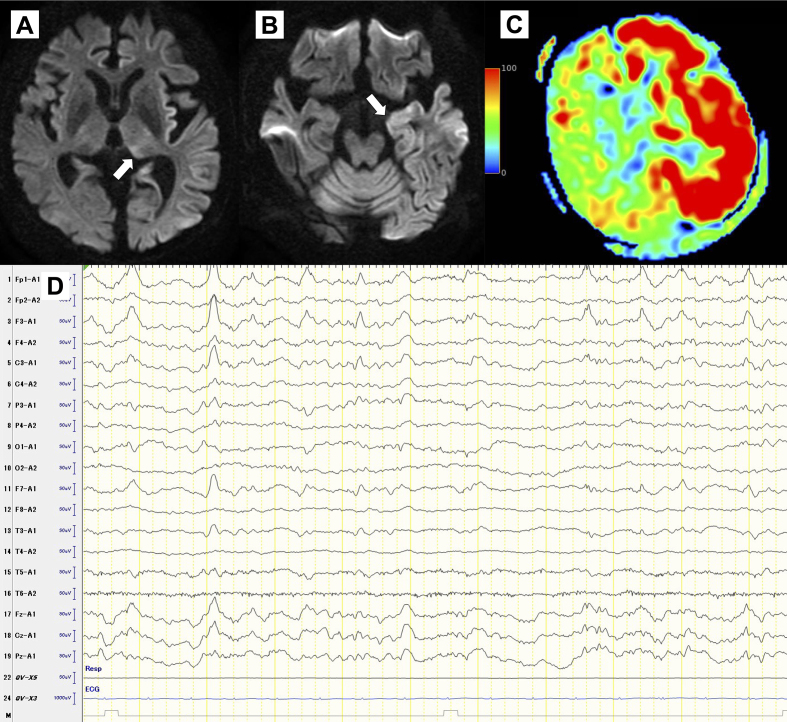 Figure 1
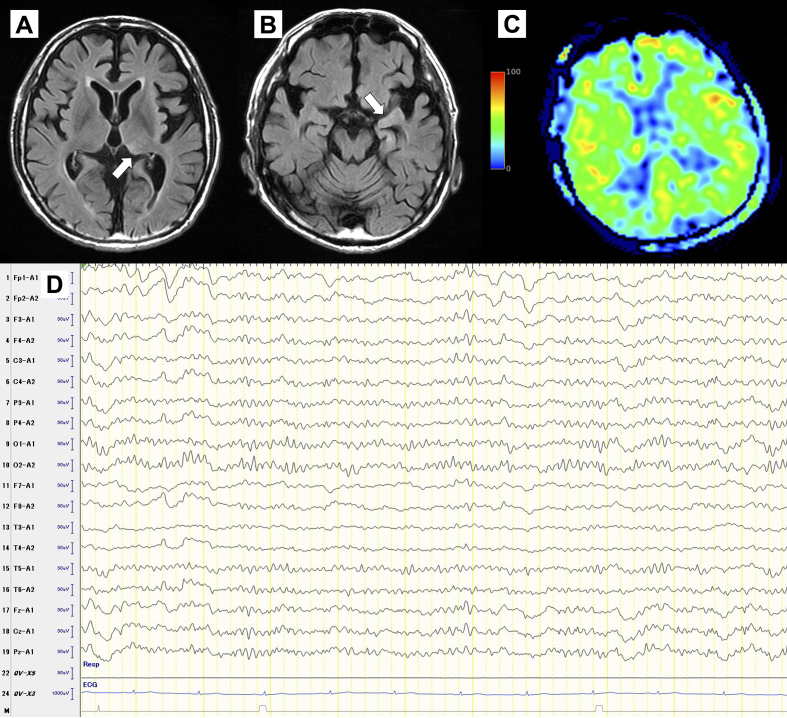 Figure 2
Peer Reviews
No public reviews on file for this paper yet. If you reviewed it on a platform where reviews are public (OpenReview, ICLR, NeurIPS, ICML), you can paste yours below so the community can read it here.
Videos
No videos yet. Explain this paper in a talk, walkthrough, or lecture? Add one.
Taxonomy
TopicsNeurological and metabolic disorders · Alcoholism and Thiamine Deficiency · Infectious Encephalopathies and Encephalitis
A 56-year-old male with alcohol dependence, abstinent for 2 days, was brought to the emergency department with generalized tonic-clonic seizures. He had no history of seizure or withdrawal and had discontinued outpatient treatment. Magnetic resonance imaging (MRI) showed focal hyperintensity (Figure 1A-C). Despite treatment with diazepam and lacosamide, he remained unconscious (E1V1M4). By day 4, his consciousness improved (E4V3M5). Electroencephalography (EEG) revealed lateralized periodic discharges (Figure 1D), confirming a diagnosis of subacute encephalopathy with seizures in alcoholics (SESA) syndrome. By day 24, he regained consciousness but had motor aphasia and visual hallucinations. By day 63, his symptoms remitted and he was transferred to rehabilitation (Figure 2A-D).
SESA syndrome is a rare condition in alcohol-dependent individuals ^(1)^. Unlike typical withdrawal, it often involves prolonged confusion and recurrent seizures, requiring long-term antiepileptic treatment ^(2), (3)^. MRI frequently shows transient cortical-subcortical T2-hyperintense areas with restricted diffusion, and EEG reveals focal abnormalities ^(2), (4)^. The diagnosis of SESA syndrome is crucial due to its distinct course and management.
Article Information
Conflicts of Interest
None
Acknowledgement
The authors thank Yudai Imahayashi MD, Keita Majima MD, Asuka Mori MD, Masayoshi Kawaguchi MD, and Akari Saratani MD for their cooperation in patient care.
Author Contributions
Rikuto Christopher Shinohara contributed to patient care, planning, conduct, and writing up the work. Shun Takayanagi, Yoichi Furutaka, and Shinya Watanabe provided critical revisions to the report. All authors reviewed and approved the final version.
Patient Consent
Consent to publish the details of the present case was obtained from the patient.
The reference list from the paper itself. Each links out to its DOI / PubMed record.
- 1Niedermeyer E, Freund G, Krumholz A. Subacute encephalopathy with seizures in alcoholics: a clinical-electroencephalographic study. Clin Electroencephalogr. 1981;12(3):113-29.7273427 10.1177/155005948101200304 · doi ↗ · pubmed ↗
- 2Fernández-Torre JL, Kaplan PW. Subacute encephalopathy with seizures in alcoholics syndrome: a subtype of nonconvulsive status epilepticus. Epilepsy Curr. 2019;19(2):77-82.30955427 10.1177/1535759719835676 PMC 6610417 · doi ↗ · pubmed ↗
- 3Fernández-Torre JL, Kaplan PW. Subacute encephalopathy with seizures in alcoholics (SESA syndrome) revisited. Seizure. 2014;23(5):393-6.24618220 10.1016/j.seizure.2014.02.002 · doi ↗ · pubmed ↗
- 4Drake-Pérez M, Marco de Lucas E, Lyo J, et al. Neuroimaging features in subacute encephalopathy with seizures in alcoholics (SESA syndrome). Seizure. 2016;40:102-7.27391464 10.1016/j.seizure.2016.06.009PMC 5571733 · doi ↗ · pubmed ↗