Forearm Magnetic Resonance Imaging Findings in Epidemic Myalgia
Remon Sato, Naohiro Uchio, Hirotaka Takagi, Hideyuki Matsumoto

Abstract
Genes, proteins, chemicals, diseases, species, mutations and cell lines named across the full text — each resolved to its canonical identifier and authoritative record.
Click any figure to enlarge with its caption.
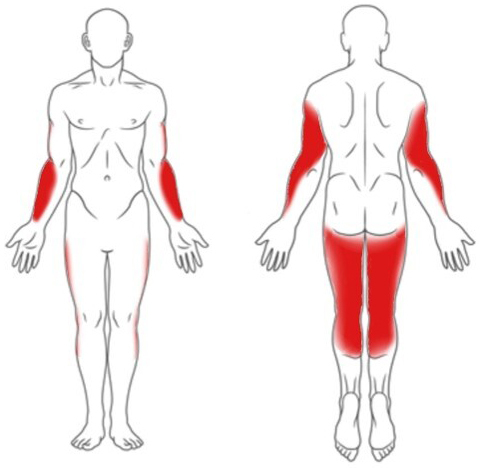 Figure 1
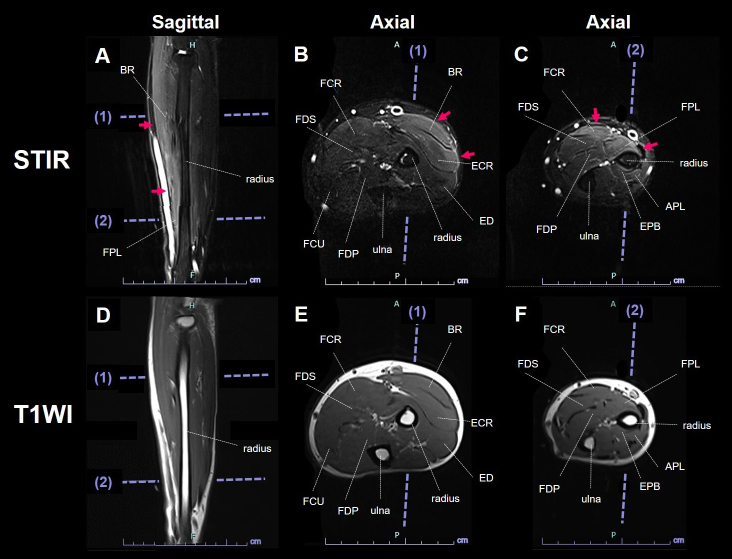 Figure 2
Peer Reviews
No public reviews on file for this paper yet. If you reviewed it on a platform where reviews are public (OpenReview, ICLR, NeurIPS, ICML), you can paste yours below so the community can read it here.
Videos
No videos yet. Explain this paper in a talk, walkthrough, or lecture? Add one.
Taxonomy
TopicsPeripheral Neuropathies and Disorders · Viral Infections and Immunology Research · Orthopedic Surgery and Rehabilitation
A 34-year-old man presented with myalgia after a fever. Neurological examination revealed myalgia in the posterior upper arms, radial forearms, and posterior lower extremities (Figure 1) and muscle weakness in the distal upper extremities, including the wrist flexor, wrist extensor, flexor digitorum superficialis, and flexor digitorum profundus muscles. Laboratory data showed elevated creatine kinase (1927 IU/L). Magnetic resonance imaging (MRI) indicated short-tau inversion recovery (STIR) hyperintensity in the radial forearm muscles and fascia (Figure 2). Epidemic myalgia was diagnosed by detecting parechovirus A3 ribonucleic acid in the patient’s stool. Epidemic myalgia typically shows limb myalgia and decreased grip strength ^(1)^. Although STIR hyperintensity in the muscles and fascia in the posterior upper arm and thigh is documented, forearm MRI findings have not been reported ^(1), (2), (3), (4)^. The radial forearm STIR hyperintensity aligns with myalgia site rather than muscle weakness. Further studies incorporating forearm findings are needed to clarify the relationship between MRI findings and myalgia.
Article Information
Conflicts of Interest
None
Author Contributions
RS, NU, HT, and HM were involved in the acquisition, analysis, or interpretation of data. RS and NU drafted the manuscript. All authors contributed to the revision of the manuscript and approved the final version.
Approval by Institutional Review Board (IRB)
Not applicable.
Informed Consent
The patient signed informed consent forms for academic use of the data.
The reference list from the paper itself. Each links out to its DOI / PubMed record.
- 1Yamakawa T, Mizuta K, Kurokawa K, et al. Clinical characteristics of 17 adult patients with epidemic myalgia associated with human parechovirus type 3 infection. Rinsho Shinkeigaku. 2017;57(9):485-91.28855493 10.5692/clinicalneurol.cn-001035 · doi ↗ · pubmed ↗
- 2Shinomoto M, Kawasaki T, Sugahara T, et al. First report of human parechovirus type 3 infection in a pregnant woman. Int J Infect Dis. 2017;59:22-4.28347852 10.1016/j.ijid.2017.03.018 · doi ↗ · pubmed ↗
- 3Orimo K, Hatano K, Sato N, et al. Clinical characteristics of epidemic myalgia associated with human parechovirus type 3 during the summer of 2019. Intern Med. 2020;59(14):1721-6.32296005 10.2169/internalmedicine.4416-20PMC 7434534 · doi ↗ · pubmed ↗
- 4Masuda S, Koizumi K, Sato M, et al. Severe generalized epidemic myalgia in an adult due to human Parechovirus type 3: a case report. Cureus. 2022;14(10):e 30587.36420236 10.7759/cureus.30587 PMC 9678435 · doi ↗ · pubmed ↗