A Case of the Monocle Sign in Facial Nerve Palsy Caused by External Auditory Canal Cancer on 18F-fluorodeoxyglucose-positron Emission Tomography/Computed Tomography
Reiko Yagi, Ken Yamagiwa, Tomoyuki Fujioka, Junichi Tsuchiya, Tomoaki Asamori, Takeshi Tsutsumi, Ukihide Tateishi

Abstract
Genes, proteins, chemicals, diseases, species, mutations and cell lines named across the full text — each resolved to its canonical identifier and authoritative record.
Click any figure to enlarge with its caption.
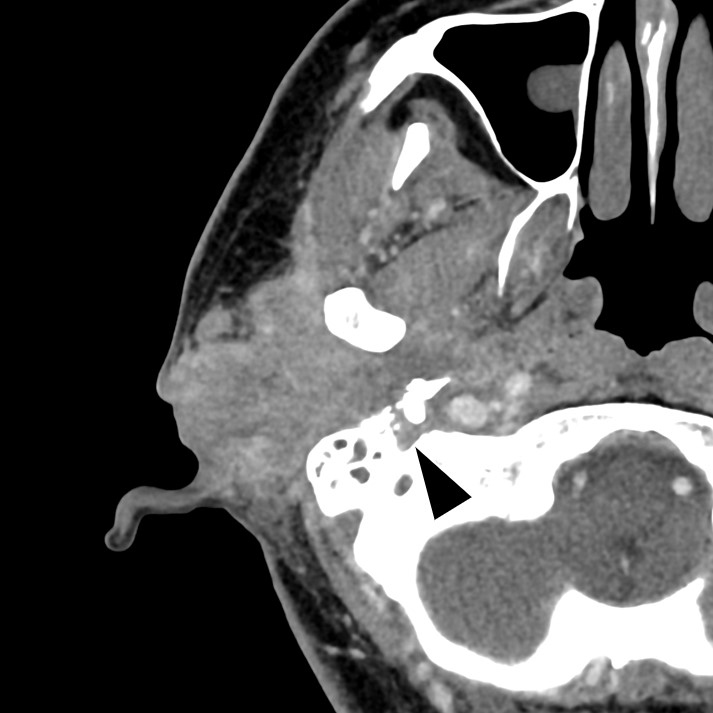 Figure 1
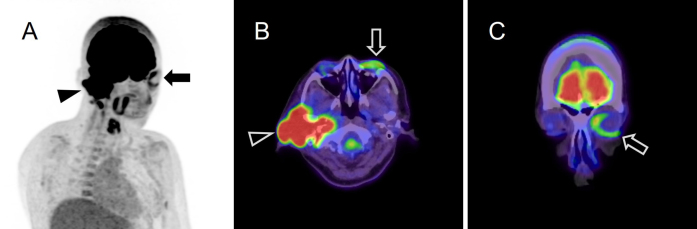 Figure 2
Peer Reviews
No public reviews on file for this paper yet. If you reviewed it on a platform where reviews are public (OpenReview, ICLR, NeurIPS, ICML), you can paste yours below so the community can read it here.
Videos
No videos yet. Explain this paper in a talk, walkthrough, or lecture? Add one.
Taxonomy
TopicsFacial Nerve Paralysis Treatment and Research · Ear and Head Tumors · Salivary Gland Tumors Diagnosis and Treatment
A 47-year-old woman with right external auditory canal cancer presented with an inability to close her left eyelid. Contrast-enhanced computed tomography (CT) identified a tumor extending from the right external auditory canal to the petrous bone, infiltrating the right facial nerve (Figure 1). ^18^F-fluorodeoxyglucose (^18^F-FDG)-positron emission tomography (PET)/CT revealed intense ^18^F-FDG uptake at the site. Notably, the left orbicularis oculi muscle (OOM) showed ^18^F-FDG uptake (maximum standardized uptake value: 3.08), whereas the right OOM showed no abnormal uptake (Figure 2).
Asymmetrical uptake by the OOM, referred to as the “monocle sign,” indicates contralateral peripheral facial nerve palsy (FNP) ^(1)^, which is believed to result from the overactivity of the nonparetic OOM. To the best of our knowledge, this is the first reported case of the monocle sign in a patient with external auditory canal cancer and FNP ^(1), (2)^.
Radiologists should recognize the monocle sign to prevent misdiagnosing unilateral ocular uptake under other conditions.
Article Information
Conflicts of Interest
None
Acknowledgement
We used GPT-4o (https://chatgpt.com/) for Japanese-English translation and English proofreading. The authors read, revised, and proofread the generated text.
Author Contributions
Reiko Yagi wrote the first draft of the manuscript, and Tomoyuki Fujioka, Ken Yamagiwa, Junichi Tsuchiya, Tomoaki Asamori, and Takeshi Tsutsumi revised the manuscript. Tomoaki Asamori and Takeshi Tsutsumi contributed to patient care. Ukihide Tateishi supervised all the procedures.
Informed Consent
We have obtained informed consent for this case report.
Approval by Institutional Review Board (IRB)
Not applicable.
The reference list from the paper itself. Each links out to its DOI / PubMed record.
- 1Orita E, Meerwein CM, Pizzuto DA, et al. The monocle sign in FDG-PET: a sign of contralateral facial nerve palsy. Clin Nucl Med. 2020;45(2):e 94-5.31693602 10.1097/RLU.0000000000002787 · doi ↗ · pubmed ↗
- 2Dana F, Maurer A, Muehlematter UJ, et al. The monocle sign on 18F-FDG PET indicates contralateral peripheral facial nerve palsy. Clin Nucl Med. 2024;49(8):709-14.38651767 10.1097/RLU.0000000000005238 · doi ↗ · pubmed ↗