Detection of Mycobacterium ulcerans with IS2404 loop-mediated isothermal amplification and a fluorescent reporter probe
Jean Y. H. Lee, Jessica L. Porter, Maria Globan, Caroline J. Lavender, Yinhua Zhang, Nathan A. Tanner, Emma C. Hobbs, Andrew H. Buultjens, Timothy P. Stinear

TL;DR
This study introduces a fast and simple molecular test for detecting the bacteria that causes Buruli ulcer, a neglected tropical disease, with performance equal to the current gold standard.
Contribution
A novel fluorescent probe-based LAMP assay for rapid and accessible detection of Mycobacterium ulcerans.
Findings
P-LAMP showed 100% sensitivity and specificity when validated against qPCR in clinical and environmental specimens.
P-LAMP was twice as fast as qPCR, with an average time-to-positive of 19 minutes at the limit-of-detection.
The P-LAMP assay is a versatile and portable alternative to current diagnostic methods for Buruli ulcer.
Abstract
An exquisitely sensitive quantitative PCR (qPCR) assay targeting the high-copy number insertion sequence, IS2404, is the gold standard diagnostic test for Mycobacterium ulcerans, the agent of the neglected tropical skin disease Buruli ulcer. Here, we designed and tested an alternative M. ulcerans diagnostic test, a fluorescent probe-based, loop-mediated isothermal amplification (P-LAMP) assay that also targets IS2404. Benchmarked against IS2404 qPCR, P-LAMP was equally specific and nearly as sensitive (analytical sensitivity of four vs two M. ulcerans genome copies). Clinical and environmental specimen validation against IS2404 qPCR showed P-LAMP had 100% sensitivity and specificity. P-LAMP was twice as fast as qPCR with an average time-to-positive at the limit-of-detection of 19 minutes. P-LAMP targeting IS2404 is a versatile assay that addresses the performance issues of previously…
Genes, proteins, chemicals, diseases, species, mutations and cell lines named across the full text — each resolved to its canonical identifier and authoritative record.
Click any figure to enlarge with its caption.
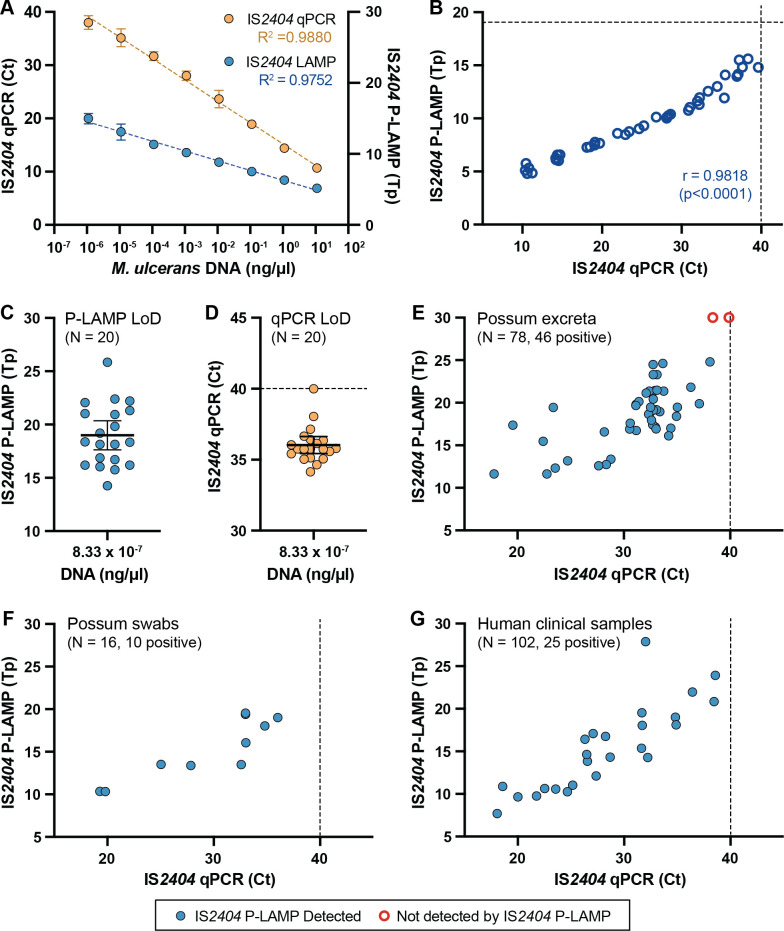 Figure 1
Peer Reviews
No public reviews on file for this paper yet. If you reviewed it on a platform where reviews are public (OpenReview, ICLR, NeurIPS, ICML), you can paste yours below so the community can read it here.
Videos
No videos yet. Explain this paper in a talk, walkthrough, or lecture? Add one.
Taxonomy
TopicsMycobacterium research and diagnosis · Infectious Diseases and Mycology · Fungal Infections and Studies